Darshan 5:00 am to 10:30 pm Shayan Aarti & chaupar · 9:30 pm Mahashivaratri · 6 Mar 2027 Om island parikrama · 7 km Free · Shighra Darshan ₹300
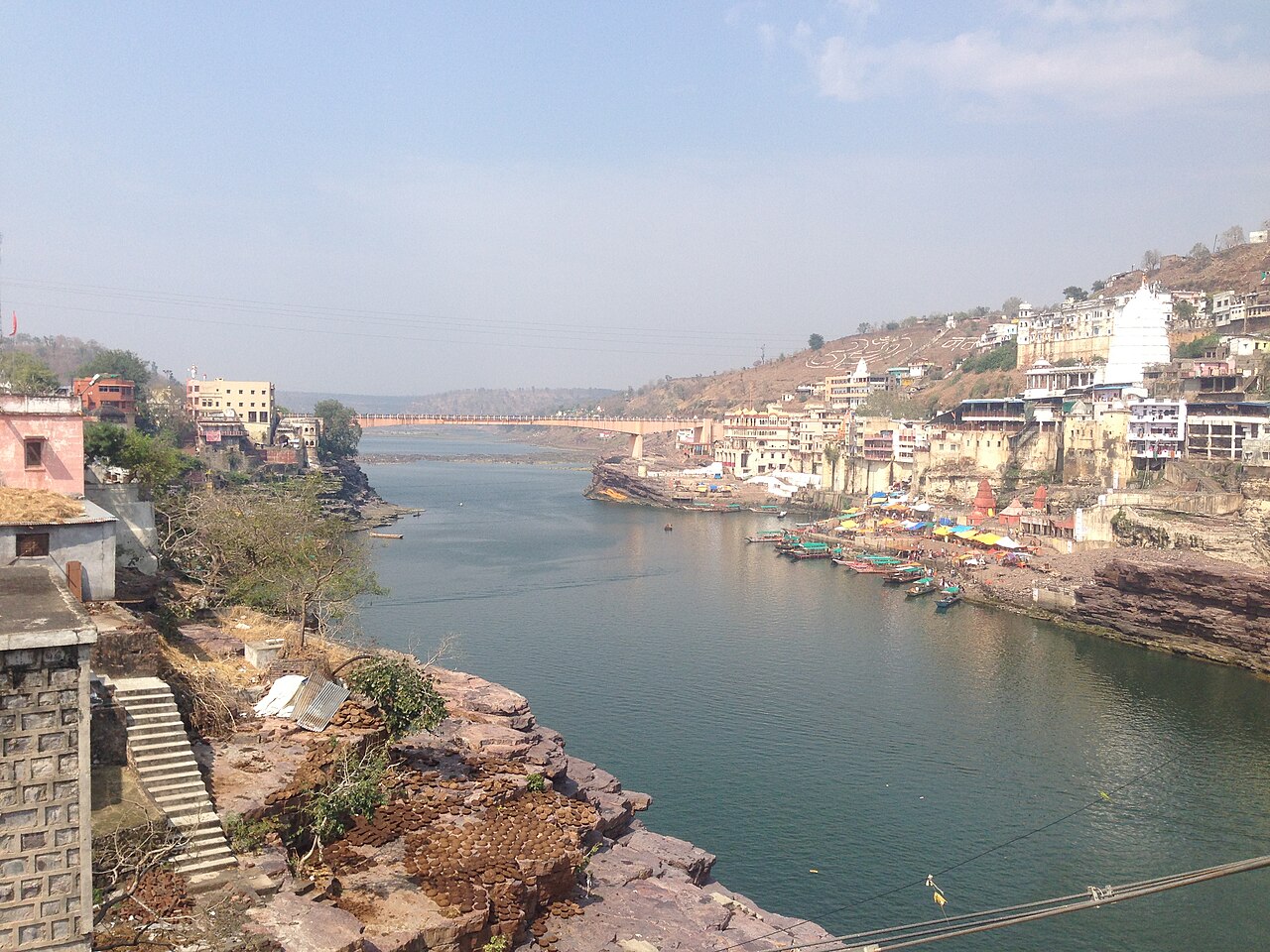
You cross living water to reach this Lord. Under the footbridge the Narmada slides green and quick between shoulders of rock, boatmen call from the ghats, and above them the whitewashed shikhara rises from its hill as the cry goes up: Jai Shri Omkar. The Temple stands on an island, and the island itself is the prayer: its ridges and channels trace the syllable Om upon the river. At every other Jyotirlinga the pilgrim takes darshan and departs. Here, tradition holds, even the Lord does not depart. He Returns each night to rest.
The shrine stands on Mandhata island, also called Shivapuri, a rock in the Narmada whose natural form traces the sacred syllable Om. The river wraps the hill on every side, and pilgrims walk the Omkar parvat parikrama, about 7 km around the syllable itself.
The Jyotirlinga tradition here is a twin: Omkareshwar on the island and Mamleshwar, also called Amareshwar, on the south bank. Tradition holds the one light divided in two, and pilgrims customarily count the darshan whole only after bowing at both.
This is held to be the one Jyotirlinga where Lord Shiva Rests each night. After the Shayan Aarti a chaupar board is laid before the Lingam, for the Lord and Maa Parvati are believed To Play here before He Sleeps.
The mountain, the king, and the syllable
The legend says the mountain Vindhya once came to this rock in the river, ashamed of his own pride, and shaped a Lingam of clay and sand. He worshipped until Lord Shiva Appeared, pleased, and granted him grace, and at the prayer of the sages gathered there the Lord Divided the one light in two: Omkareshwar, Lord of the syllable Om, upon the island, and Amaleshwar upon the southern bank. Another telling remembers the Devas, hard pressed by the Danavas, praying here until the Lord Rose from the rock as light and scattered the darkness.
The island carries a king's name. Mandhata of the Ikshvaku line is said to have worshipped Lord Shiva on this rock until He Manifested as a Jyotirlinga; other tellings give the austerities to the king's sons Ambarish and Muchukunda. Centuries later another seeker came. Tradition holds that in a cave beneath this very hill the boy Shankara found his guru, Govinda Bhagavadpada, and from this island Adi Shankaracharya went out to teach the oneness of all things.
The Temple the pilgrim climbs to today was raised by the Paramara kings of Malwa in the eleventh century. It endured the raids that began with Mahmud of Ghazni and stood on, battered but unbroken, until the Holkar rulers restored it in the eighteenth century, a work the record credits to Gautama Bai and Devi Ahilyabai Holkar.
What you'll actually see
1
The five-storeyed shrine and its sixty pillars
The Temple rises in five storeys above the river, its assembly hall carried on sixty carved stone pillars beneath a stone-layered dome in the North Indian manner. Inside the sanctum the Jyotirlinga is a low, roundish black stone, and beside it a white stone stands for Maa Parvati; water from the Narmada is poured over Him all day.
2
The cave of Govinda Bhagavadpada
Below the Shiva Temple a small cave is kept where tradition holds the young Shankara met his guru; an image of Adi Shankaracharya sits within it. On the hill nearby the Statue of Oneness now rises 108 feet on a 54 foot pedestal, the acharya shown as a boy of twelve, unveiled in September 2023 as the heart of the Ekatma Dham precinct.
3
The ghats and the crossing
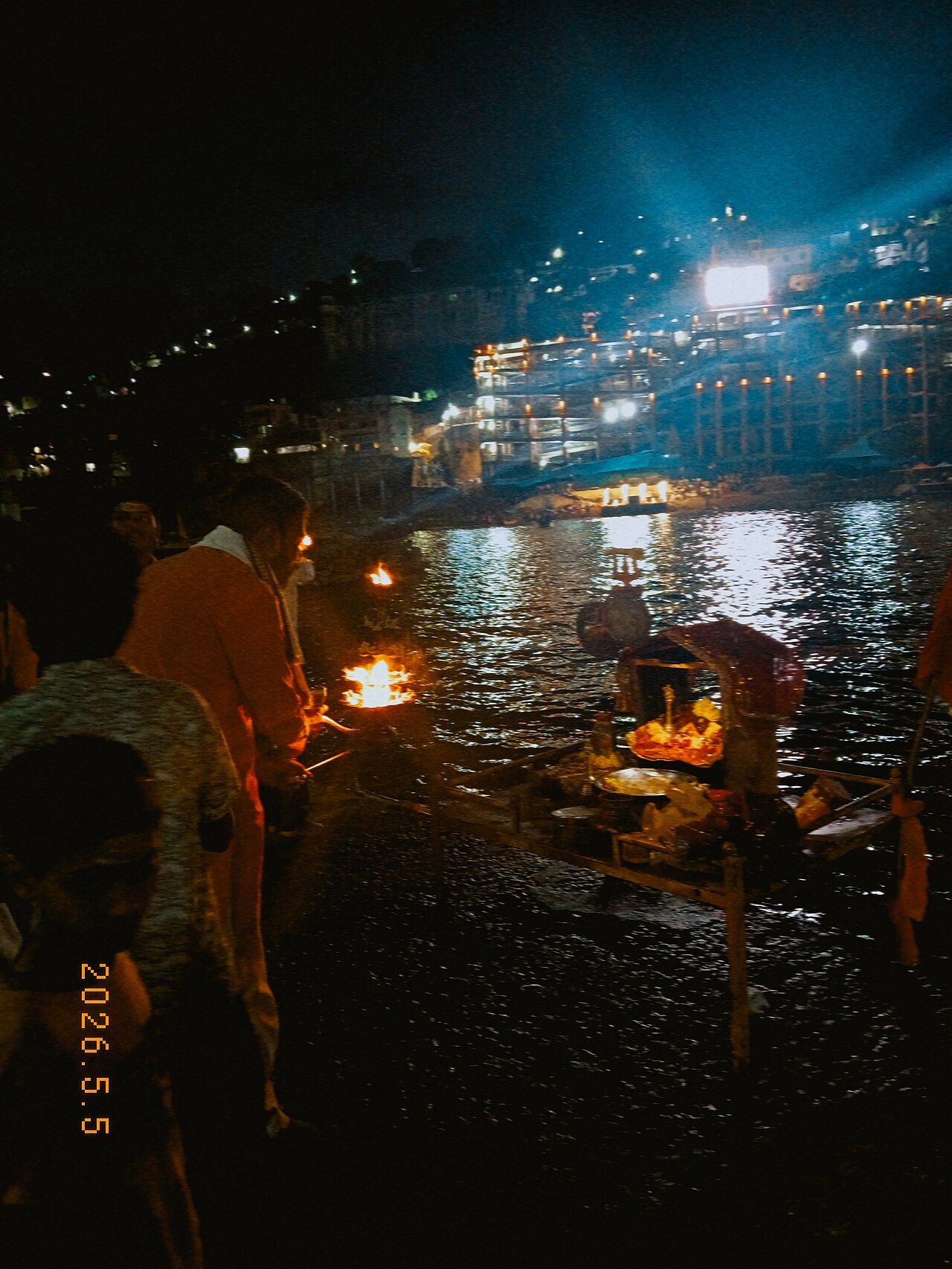
The Narmada ghats below the Temple are the island's living room: boats knocking at the steps, brass pots filling, pilgrims drying saris on the warm rock. The Mamleshwar Setu hanging bridge and the boats carry you across, and at dusk the aarti at the water's edge sends flame out over the river toward the lit shrine.
Evening aarti flames at the Narmada ghats in Omkareshwar, the lit island shrine across the dark waterThe Narmada curving past Mandhata island, the white shikhara of Omkareshwar rising above the ghats with the bridge upstream
Evening aarti on the Narmada, and the Om island from the south bank · photos by Sannjuu (CC BY 4.0) and Sudha Kulkarni (CC BY-SA 4.0), Wikimedia Commons
THE RITE FOUND NOWHERE ELSE
Shayan Aarti and the Lord's game of chaupar
Every night at 9:30 the Temple sings the Shayan Aarti, the lullaby of the Lord. Then the priests lay a chaupar board with dice before the Jyotirlinga and dress the sanctum for the night, for tradition holds that Omkareshwar is where Lord Shiva Comes to Rest after ranging the three worlds, and that He and Maa Parvati Play chaupar here before He Sleeps. The Temple's own priests tell of the board found disturbed at morning, as if the game had truly been played. Shayan Darshan, the sight of the sanctum made ready for the Lord's night, follows from 10:00 to 10:30 pm.
Reach the sanctum before 9:30 pm; darshan pauses during the aarti itself and the Temple closes at 10:30 pm.
Plan your visit
By air
Devi Ahilyabai Holkar Airport, Indore, about 87 km; around 2.5 hours by taxi.
By rail
Omkareshwar Road station at Mortakka is about 12 km, 20 to 25 minutes by auto or bus; Indore and Khandwa junctions, each around 77 km away, carry far more trains.
Timings
The Temple day runs from the 4:30 am Mangal Aarti to the 10:30 pm close; darshan pauses during aarti and shringar periods.
The queue
Darshan is free. Shighra Darshan, ₹300 per person, books a fixed two-hour slot on the trust website, with same-day booking open.
The crossing
Reach the island on foot over the footbridge or by boat from the ghats; steps and Temple lanes climb from the water to the shrine.
Best time
October to March is the gentle season. Shravan, 30 July to 28 August 2026, its Mondays, and Mahashivaratri bring the great crowds.
Parikrama
The Omkar parvat parikrama circles the island, about 7 km past old shrines and long views of the river.
Omkareshwar means the Lord of Omkara, the sound Om; the island is named Mandhata after the Ikshvaku king, and is also called Shivapuri.
Mamleshwar across the river is protected by the Archaeological Survey of India and bears the Halayudha Stotra inscription dated 1063 CE; keep time in your day for both shrines.
The trust notes that offerings such as bilva leaves, flowers, and coconuts may at times not be allowed into the garbhagriha; hand them over when asked.
Book abhishek, Narmada pujan, and Shighra Darshan only through the official trust website; the trust helpline +91 8989998686 answers from 8 am to 8 pm.
Questions pilgrims ask
Are there two Jyotirlingas at Omkareshwar?
Two shrines share the one Jyotirlinga tradition: Omkareshwar on the island and Mamleshwar, also called Amareshwar, on the south bank. The old telling says the light divided in two at the sages' prayer, and pilgrims customarily take darshan at both.
What is the chaupar board laid out at night?
After the 9:30 pm Shayan Aarti the priests set a chaupar board and dice before the Lingam, in the belief that Lord Shiva and Maa Parvati Play here each night before He Rests. It can be seen at Shayan Darshan, 10:00 to 10:30 pm.
How do I reach the island shrine?
On foot over the footbridge across the Narmada, or by boat from the ghats. The nearest railhead is Omkareshwar Road at Mortakka, about 12 km away; Indore, about 77 km by road, has the nearest airport.
Is there a quicker darshan line?
Yes. Shighra Darshan at ₹300 per person gives a fixed two-hour slot booked on the official trust website, including same-day booking. Ordinary darshan is free through the day.
Why is there a giant statue of Adi Shankaracharya here?
Tradition holds that Shankara, still a boy, found his guru Govinda Bhagavadpada in a cave beneath this hill. The 108 foot Statue of Oneness, unveiled in September 2023, shows him as the twelve-year-old acharya, the age at which tradition says he attained knowledge.
Darshan from afar
From the temple's own channels. Nothing loads until you press play.
Dharamshalas and guest houses near this Sthan, shared by devotees. Adisthan takes no bookings and no money; contact each stay directly.
No stays are listed here yet. Know one that serves pilgrims well?
Are you a pujari, trustee, or sevak of Shri Omkareshwar Jyotirlinga? Claim this page to keep timings, aarti bookings, and festival dates true for the pilgrims who cross the Narmada to reach the Lord.