A city carries His name, and its kings call themselves His servants: the Lord Sleeps here, and nothing here sleeps but Him.
Be the first to check in
Entry tended 24 May 2026
East Fort, Thiruvananthapuram Darshan from 3:30 am Mundu only · strict dress code Alpashy Utsavam · 11 to 20 Oct 2026 Seven-tier gopuram · 16th c.
You come to Him past the white walls of East Fort, where the seven-tiered gopuram stands doubled in the still green water of the Padmatheertham, the lotus spring. Bare-chested men in white mundu climb the steps beside women in silk, bells sound from inside the stone, and the long corridor swallows the morning light pillar by pillar. Then you reach the sanctum and learn the first truth of this place: no single doorway can hold the Lord. You will see Him through three doors, and never all at once.
Behind three silver-bound doors Lord Padmanabhaswamy Reclines on the serpent Anantha, an eighteen-foot form built of 12,008 saligrama stones from the Gandaki river, bound in the ayurvedic plaster called katusarkara. One door shows His face and the Shiva linga beneath His hand, one the lotus rising from His navel with Brahma seated upon it, one His feet.
On 17 January 1750 Maharaja Anizham Thirunal Marthanda Varma surrendered the whole Kingdom of Travancore to the Lord in the rite of Thrippadidanam. Every ruler of the house since has borne the title Sree Padmanabha Dasa, servant of Sree Padmanabha, and to this day only the head of the family may prostrate before Him on the Ottakkal Mandapam.
Beneath its floors lie granite vaults. When five of them were opened and inventoried on Supreme Court orders in 2011, the gold, jewels and coins recorded made this the wealthiest documented place of worship on earth. One vault, called Kallara B, has not been opened.
The Lord who asked to be followed
The Temple's own chronicle, the Ananthasayana Mahatmya, tells of the sage Divakara Muni, a Tulu Brahmin absorbed in his worship. A small boy began appearing at his puja, playful and impossible, and one day the child picked up the sage's saligrama and put it in his mouth. The sage scolded him, and the boy vanished with a single instruction: if you wish to see me again, come to Ananthankadu, the forest of Anantha.
The legend says the sage searched until he found the boy again in that forest, where the child merged into a great iluppa tree. The tree fell, and in its place stretched the Lord Himself in Anantha Shayanam, His form reaching further than any eye could travel. The sage begged Him to shrink to a size a devotee could bear, and even then the trees hid the full vision: Divakara Muni saw the Lord in three parts, face, body and feet. The three doors of the sanctum keep that darshan exactly so to this day.
History remembers the Temple nearly as far back. Sangam-era Tamil poetry speaks of the shrine, and by the ninth century the poet-saint Nammalwar was singing of it, which is why it stands among the 108 Divya Desams of the Sri Vaishnava tradition. The foundation of the present gopuram was laid in 1566. From 1731 Marthanda Varma rebuilt the Temple in stone, renewed the deity with saligramas carried from the Gandaki, laid the Ottakkal Mandapam before the sanctum, and in 1750 gave his kingdom away to the Lord he served.
What you'll actually see
1
The gopuram over the lotus spring
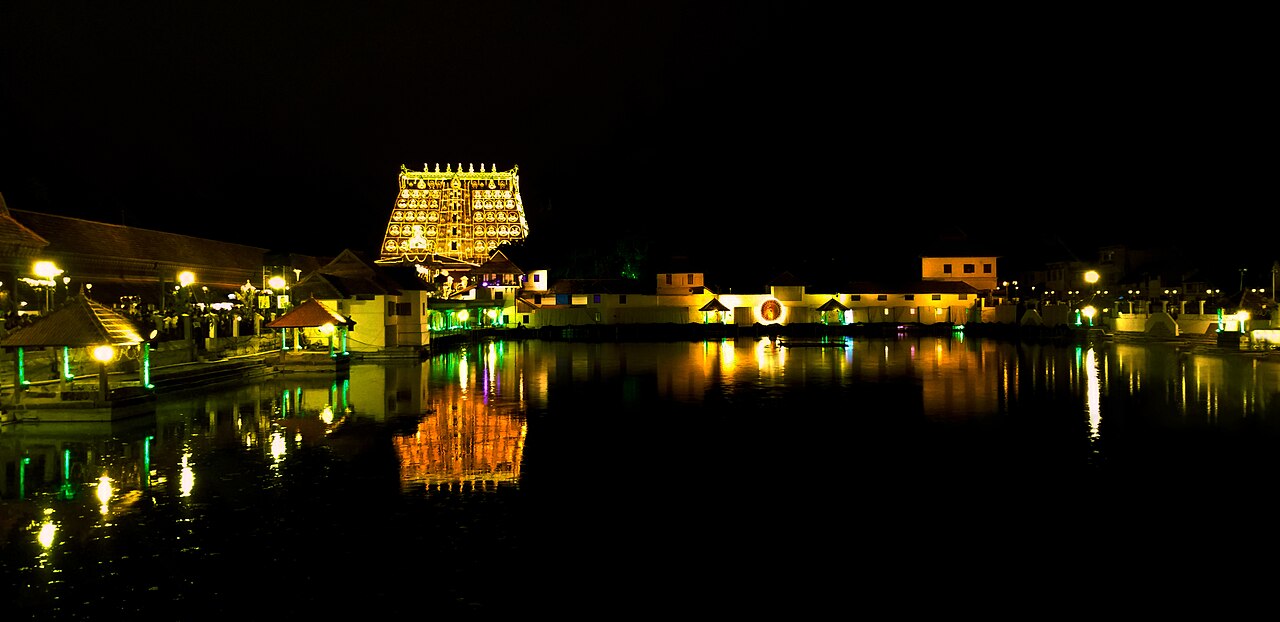
The eastern tower rises seven storeys, about 35 metres of carved stone crowned with seven golden kalasams that tradition reads as the seven worlds. The Ten incarnations of Lord Vishnu are portrayed inside its first storey. At its feet spreads the Padmatheertham, the lotus spring, one of the oldest water bodies in the city, with eight mandapams standing in the tank itself.
2
The corridor of 365 and a quarter pillars
The Sreebalippura, the rectangular stone corridor around the main shrines, is carried on 365 and one quarter monolithic granite pillars, one for each day of the year. Temple records say four thousand stone artisans, six thousand labourers and a hundred elephants worked six months to raise it under the master artisan Ananthapadmanabha Moothassari. An 80-foot gold-plated flagstaff stands before the eastern entrance.
3
The Ottakkal Mandapam and the three doors
Before the sanctum lies a single slab of granite two and a half feet thick and twenty feet square, its pillars sheathed in gold. The abhishekams of the Lord are performed here, and it is here that you look through the three doors in turn: the face, the navel, the feet. Whoever prostrates on this stone is held to have surrendered everything he owns to the Lord, which is why only the king, who already has, may do so.
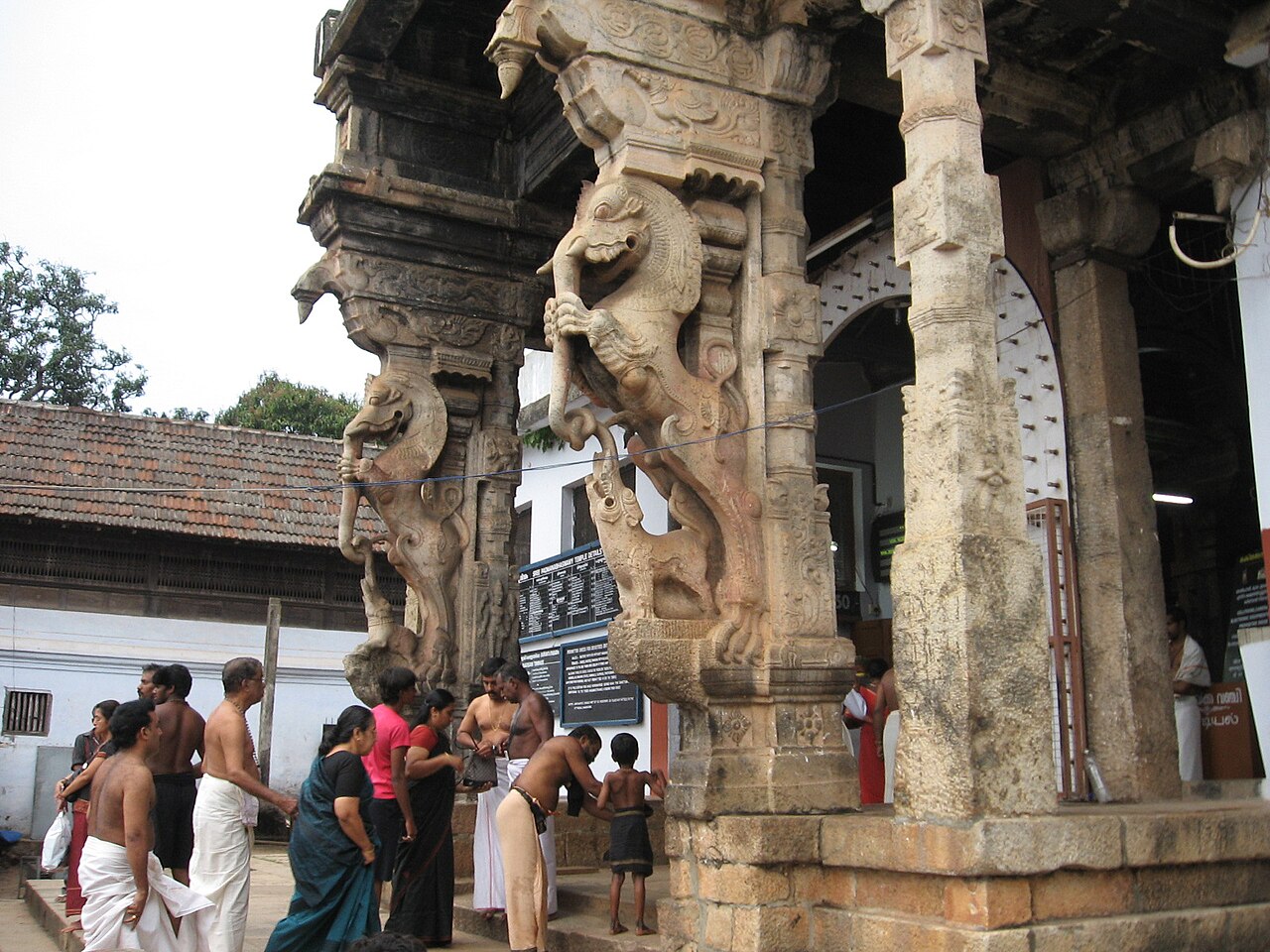
Devotees in mundu and saree passing the carved yali pillars at the entrance of Sree Padmanabhaswamy TempleSree Padmanabhaswamy Temple lit for Lakshadeepam, its gopuram and lamps reflected in the Padmatheertham at night
Stone and lamplight at East Fort · photos by P. K. Niyogi (public domain) and Arun RJ (CC BY-SA 4.0), Wikimedia Commons
THE KING WALKS AS A SERVANT
The Aarattu to Shanghumugham beach
Twice a year the Temple keeps a ten-day utsavam, Alpashy in October and November and Painkuni in March and April, and each ends the same way: the deities leave the sanctum and are carried in procession through the city to Shanghumugham beach for the Aarattu, the ceremonial bath in the sea. The titular Maharaja of Travancore escorts the Lord the whole way on foot, sword in hand, as His servant and guard, with caparisoned elephants and columns of police in escort. The 2026 Alpashy Utsavam runs from 11 to 20 October, with the Aarattu on the final evening; the 2026 Painkuni Aarattu was held on 2 April.
The Aarattu route from the Temple to the beach draws dense crowds on the final evening; regular darshan timings change on festival days.
Plan your visit
By air
Trivandrum International Airport is about 6 km away, roughly 25 minutes by taxi.
By rail
Thiruvananthapuram Central railway station is about 1 km from the Temple; the East Fort entrance is a short walk or auto ride from the station.
Timings
Morning darshan 3:30 to 4:45, 6:30 to 7:00, 9:30 to 11:15 and 12:00 to 1:00; evening darshan 4:30 to 6:15 and 6:45 to 7:20. Timings change on festival days.
Dress
Men wear a plain mundu or dhoti with the chest bare or an angavastram; shirts, trousers and shorts must be left at the locker counter. Women wear a saree, half-saree with blouse or pavada; salwar sets and other modern dress are not permitted. Mundus are available for hire near the entrance, and current practice allows a mundu wrapped over trousers or churidar.
Who may enter
Entry is limited to those who profess the Hindu faith, and the dress code is strictly applied to every visitor.
Best time
The first morning windows are the quietest of the day; October to March brings Thiruvananthapuram's gentler weather, and the two utsavams and Navaratri bring the Temple to its fullest life.
Thiruvananthapuram means the City of Lord Anantha: the capital of Kerala is named for the Serpent on whom the Lord Reclines.
Mobile phones, cameras, laptops and smart watches are on the Temple's own list of items not allowed inside; photography within the Temple is not permitted, so leave electronics at the locker counter.
Sangam-era poets already knew this shrine as the Golden Temple, for the wealth it held even then; the vault inventories of 2011 proved the old name honest.
Once every six years the Temple holds the Murajapam, 56 days of continuous Vedic recitation, closing with the Lakshadeepam when one lakh oil lamps are lit; the last concluded on 14 January 2026.
Questions pilgrims ask
Can anyone visit the Temple?
No. Entry is limited to those who profess the Hindu faith, a rule the Temple states plainly and applies without exception. Every visitor must also keep the dress code: mundu for men with the upper body bare or covered only by an angavastram, saree or pavada for women. Mundus can be hired near the entrance.
Why is the Lord seen through three doors?
The reclining form of Lord Padmanabhaswamy is about eighteen feet long, far wider than any doorway. Through the first door you see His face and the Shiva linga beneath His hand, through the second the golden abhisheka murtis and the lotus rising from His navel with Brahma upon it, through the third His feet. The legend says the sage Divakara Muni was granted the first darshan in exactly these three parts.
Can I see the treasure?
No. The vaults are not open to visitors. Five of them were opened and inventoried under Supreme Court supervision in 2011, and the recorded gold, jewels and coins made this the wealthiest documented place of worship in the world. The vault called Kallara B remains unopened, and any decision on it rests with the Temple's administering committee.
Does the royal family still serve the Temple?
Yes. In July 2020 the Supreme Court of India upheld the Travancore royal family's rights as shebaits of the deity, and day-to-day administration is carried out by a committee chaired by the Thiruvananthapuram District Judge. Every head of the house bears the title Sree Padmanabha Dasa, servant of Sree Padmanabha, a vow kept since 1750.
What happens at Navaratri here?
Each year before Navaratri, the idol of Maa Saraswati travels over 100 km on foot in procession from Padmanabhapuram to Thiruvananthapuram and is installed at the Navaratri Mandapam beside the Temple. For nine nights the mandapam holds concerts of the compositions of Maharaja Swathi Thirunal, a custom opened to musicians from across India in 1933.
Dharamshalas and guest houses near this Sthan, shared by devotees. Adisthan takes no bookings and no money; contact each stay directly.
No stays are listed here yet. Know one that serves pilgrims well?
Are you a priest, officer or sevak of the Sree Padmanabhaswamy Temple? Claim this page to keep darshan windows, utsavam dates and pilgrim guidance exact for devotees worldwide.