Complex open 4 am to 9 pm Bagmati Aarati · 6 pm daily Nepalis & Indians free · others NPR 1,000 Maha Shivaratri · 6 Mar 2027 Pagoda of 1692 · UNESCO 1979
You come to him through a city, yet the lanes go quiet before the gate. Monkeys lope along the walls, sellers of marigold and rudraksha line the path, and then two tiers of gilded roof lift above the courtyard, holding whatever light Kathmandu has to give. Across the river a slow smoke rises from the ghats, and no one hurries it. At the west gate the cry goes up, Har Har Mahadev. Inside stands a linga unlike any other: four faces watching the four directions, and a fifth face no sculptor ever carved.
The heart of the sanctum is the mukhalinga, a dark stone about one metre high bearing four carved faces, Sadyojata, Vamadeva, Tatpurusha and Aghora, with a fifth aspect, Ishana, facing the sky uncarved: Lord Shiva as Pashupati, Lord of All Beings, whole in every direction.
The Temple stands over the Bagmati at Arya Ghat, where Hindus of Nepal, their kings among them, have been given to the fire for centuries; tradition holds that to die and be cremated within Pashupati's gaze opens the way to liberation.
Worship here is recorded from about 400 CE under the Licchavi kings, and the precinct, more than five hundred Temples and monuments spread across both banks, has stood on the UNESCO World Heritage List since 1979.
The deer who would not be Lord
The valley's oldest telling begins with a flight. Tradition holds that Lord Shiva, weary of heaven's duties, slipped away With Maa Parvati to the forest on the Bagmati's east bank, and there the two roamed as deer among the trees. The gods searched every world before they found the shining antlered deer, and when they seized him by the horn to compel him home, the horn broke in their hands. Lord Shiva resumed his true form, and the broken horn was worshipped as a linga, until, in the turning of ages, it was buried and lost.
Centuries later, the story continues, a herdsman marveled at one of his cows, who stole away each day to pour her milk upon a certain mound of earth. He dug where the milk fell, and the linga of Pashupati rose again into the light. Around that rediscovered stone the valley built, and rebuilt, its holiest house, and named the east bank woods Mrigasthali, the place of the deer.
Written history reaches nearly as deep. The Temple's existence is recorded by about 400 CE, and the chronicle called the Gopal Raj Vamshavali names the Licchavi king Prachanda Deva as its builder. Medieval kings repaired and roofed it again and again, and after termites ruined the old structure the present two-tiered pagoda was raised in 1692. It has outlasted every earthquake since, including the great one of 2015, which brought down outer buildings around the complex but left the main Temple and its sanctum untouched.
What you'll actually see
1
The golden roofs and silver doors
The main pagoda carries two tiers of gilt copper roof above richly carved timber, with doors sheathed in silver opening to all four directions. You see the roofs first from everywhere in the precinct, burning softly even under monsoon cloud.
2
The great gilded Nandi
Through the western entrance, the only gate open on ordinary days, an immense golden Nandi kneels facing his Lord, so that every pilgrim enters past the bull who waits forever at the door.
3
The east bank: ghats, terraces and forest
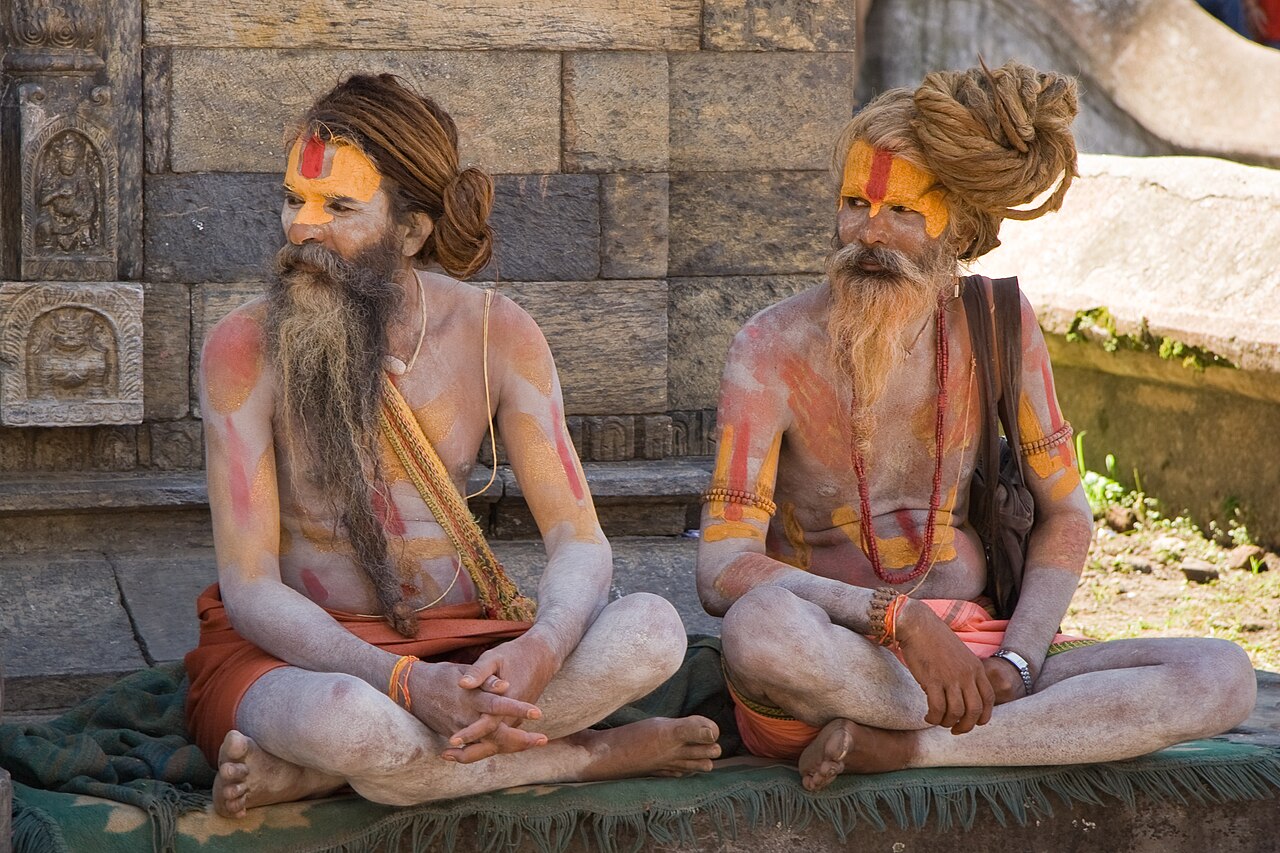
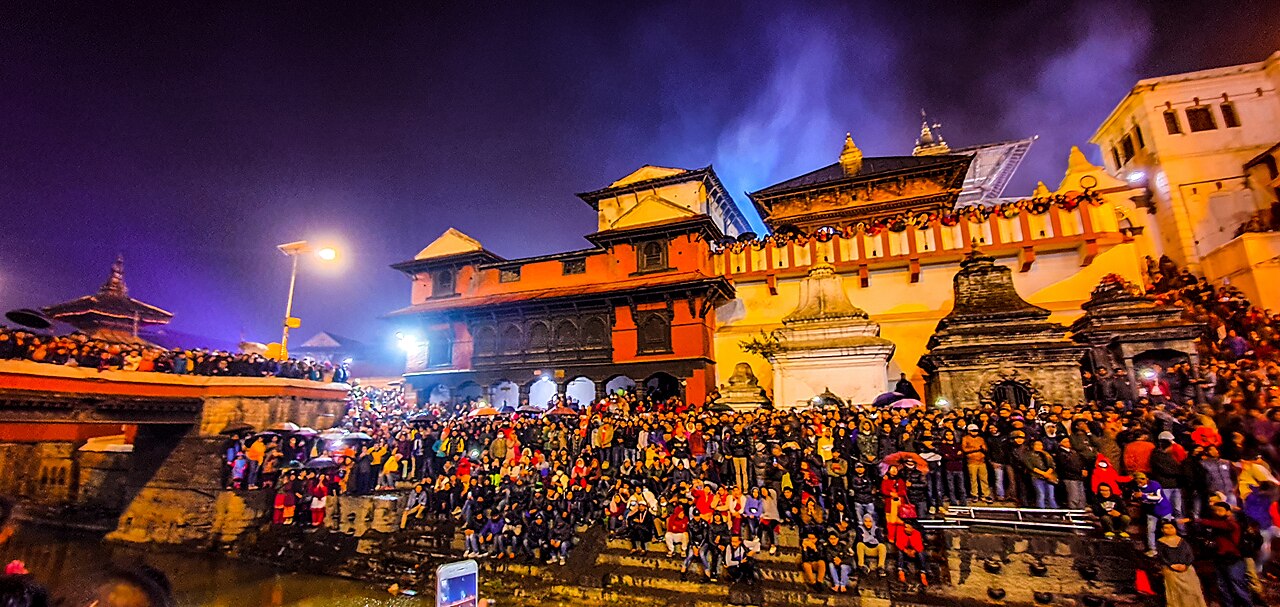
Stone footbridges cross the Bagmati to terraces climbing the wooded hill of Mrigasthali, where deer are kept and sadhus sit by their fires. From these steps the whole Temple faces you across the water, and at dusk the aarati lamps answer the fires of the ghats.
Two sadhus seated against carved stone in the Pashupatinath precinct, KathmanduDevotees fill the east bank terraces of Pashupatinath on an evening of aarati
Sadhus of the precinct, and the east bank at evening aarati · photos by Luca Galuzzi (CC BY-SA 2.5) and Bishal KC (CC BY-SA 4.0), Wikimedia Commons
The night a nation walks to one door
Maha Shivaratri · 6 March 2027
On the fourteenth night of the dark fortnight of Falgun, Nepal keeps vigil for Lord Shiva at his own door. In 2026 more than a million devotees passed through the Pashupati area in a single day and night, while thousands of sadhus, Naga babas among them, walked in from across Nepal and India to sit at their fires in the woods of Mrigasthali. The courtyard's other gates open for the festival, lamps burn on both banks of the Bagmati, and the singing does not stop until dawn. The next Maha Shivaratri falls on 6 March 2027.
Queues form long before first light and stretch for kilometres; come with patience and time, or keep the vigil from the east bank terraces.
Plan your visit
By air
Tribhuvan International Airport is barely 3 to 4 km away, about 10 to 15 minutes by taxi; the Temple is the first sacred place most pilgrims reach in Nepal.
By road
About 5 km northeast of central Kathmandu; taxis and buses stop at Gaushala on the Ring Road, a short walk from the western entrance.
Timings
The complex opens 4 am to 9 pm daily; the inner sanctum gives darshan about 5 am to 12 noon and again 5 to 7 pm.
The aarati
The Bagmati Sandhya Aarati begins at 6 pm every evening: three priests with tiered lamps on the east bank, facing the Temple across the water.
Entry
Free for Nepali and Indian nationals; other visitors pay NPR 1,000 per day at the gate counters.
Best time
Early morning brings the quietest darshan; Mondays, the month of Shravan and festival days bring the heaviest crowds.
Dress
Modest dress with shoulders and knees covered; shoes are left outside the main courtyard.
Who may enter
The main Temple courtyard admits Hindus, and Buddhists of Nepali and Tibetan descent; all other visitors view the Temple from the terraces across the river.
Pashupati is one of Lord Shiva's oldest names: pashu is every living being and pati is its lord, which is why his precinct keeps deer, monkeys, pigeons and pilgrims with equal patience.
Only the four Bhatta priests, Vedic scholars whose line comes from Karnataka, may touch the linga; the Rajbhandari caretakers keep the Temple and its treasury.
The fires across the river at Arya Ghat are funerals, and Nepal's kings were cremated there; lower your camera and your voice whenever you pass the ghats.
The monkeys of Mrigasthali are quick and confident: keep prasad, spectacles and phones held close.
Questions pilgrims ask
I am not Hindu. Can I enter the Temple?
The main courtyard admits Hindus, and Buddhists of Nepali and Tibetan descent; this is stated plainly at the gates and enforced. Everyone else is welcome throughout the wider precinct, and the classic full view of the golden roofs is from the east bank terraces, which is also where the evening aarati is best seen.
What is actually inside the sanctum?
A dark stone mukhalinga about one metre high, its four carved faces looking to the four directions, with the formless fifth aspect, Ishana, facing the sky. Only the four Bhatta priests may touch it; devotees take darshan of the faces from the doorways, and each morning the linga is bathed through the long abhisheka hours.
Is it respectful to watch the cremations at Arya Ghat?
The ghats are a place of grief and of liberation, not a spectacle. Keep your distance from mourners, never photograph a pyre or a family, and keep silence as you cross the bridges. To witness quietly and with prayer is itself an old form of respect here, where death sits in the open beside the Lord who dissolves it.
Where and when is the Bagmati Aarati?
At 6 pm every evening on the east bank of the river, performed by three priests with lamps and conch; it has been offered daily since 2006. Arrive well before six on Mondays and festival evenings, when the terraces fill completely.
Is Maa Guhyeshwari's Temple nearby?
Yes. About a kilometre upstream on the south bank of the Bagmati stands the Temple of Maa Guhyeshwari, the great Shakti Peetha of the valley, where tradition holds a hidden part of Maa Sati's body fell. Pilgrims traditionally take darshan of both in one visit, the Lord and The Mother on one river.
Dharamshalas and guest houses near this Sthan, shared by devotees. Adisthan takes no bookings and no money; contact each stay directly.
No stays are listed here yet. Know one that serves pilgrims well?
Are you an officer of the Pashupati Area Development Trust, or of the Temple's priesthood? Claim this page to keep timings, festival notices and aarati details true for the pilgrims who rely on them.