Ram Janmabhoomi, Ayodhya Dham · Uttar Pradesh, India
Five centuries of longing, one child's smile: Ram Lalla Is home.
Be the first to check in
Coming up: Deepotsav · 7 NovEntry tended 28 Jun 2026
Darshan from 7:00 am Surya Tilak · every Ram Navami Deepotsav · 7 Nov 2026 Nagara style · 392 pillars Free · passes at srjbtkshetra.org
The chant reaches you before the Temple does: Jai Shri Ram, rising and falling along the wide stone stretch of Ram Path. Then the sandstone appears, pale gold in the morning light, tier upon carved tier above a moving sea of pilgrims. You climb thirty-two steps through the Singh Dwar, the lion gate, and the noise of the world drops away. Ahead, in the lamplit dim of the sanctum, a small dark face smiles beneath a golden canopy. Tradition holds you are standing where Prabhu Shri Ram was born.
This Is the Janmabhoomi: the ground the Ramayana and the Skanda Purana tradition name as the birthplace of Prabhu Shri Ram, seventh avatar of Lord Vishnu, born To king Dasharatha and queen Kaushalya of the Ikshvaku line.
The mandir is a three-storey Nagara Temple raised on 392 carved pillars with 44 doors, built of Bansi Paharpur sandstone with no structural iron or steel, its stones locked by copper, designed by the Sompura family of Temple architects and engineered to stand a thousand years.
Once a year, at noon on Ram Navami, the sun itself Performs the abhishek: an arrangement of mirrors and lenses carries sunlight down to the sanctum and rests a glowing tilak on the forehead of Ram Lalla.
The story of the return
The Ramayana tells that in Treta Yuga, in the royal city of Ayodhya on the Sarayu, queen Kaushalya gave birth to Prabhu Shri Ram at noon on the ninth day of the bright half of Chaitra. For unbroken centuries pilgrims have held this rise of ground to be that birth-room, the Ram Janmabhoomi, and no murti here is older than the belief itself: the place Is the shrine.
The ground also carries a heavier history, and the page owes it honestly. From 1528 the Babri Masjid, raised by Mir Baqi, a commander of the Mughal emperor Babur, stood on this site, and generations of Muslims offered prayer here. On 6 December 1992 the mosque was demolished by a crowd, a wound that ran through India for decades of litigation. On 9 November 2019 the Supreme Court of India, in a unanimous verdict, awarded the 2.77 acre site for the Temple and directed that five acres at Dhannipur near Ayodhya be granted for the building of a new mosque.
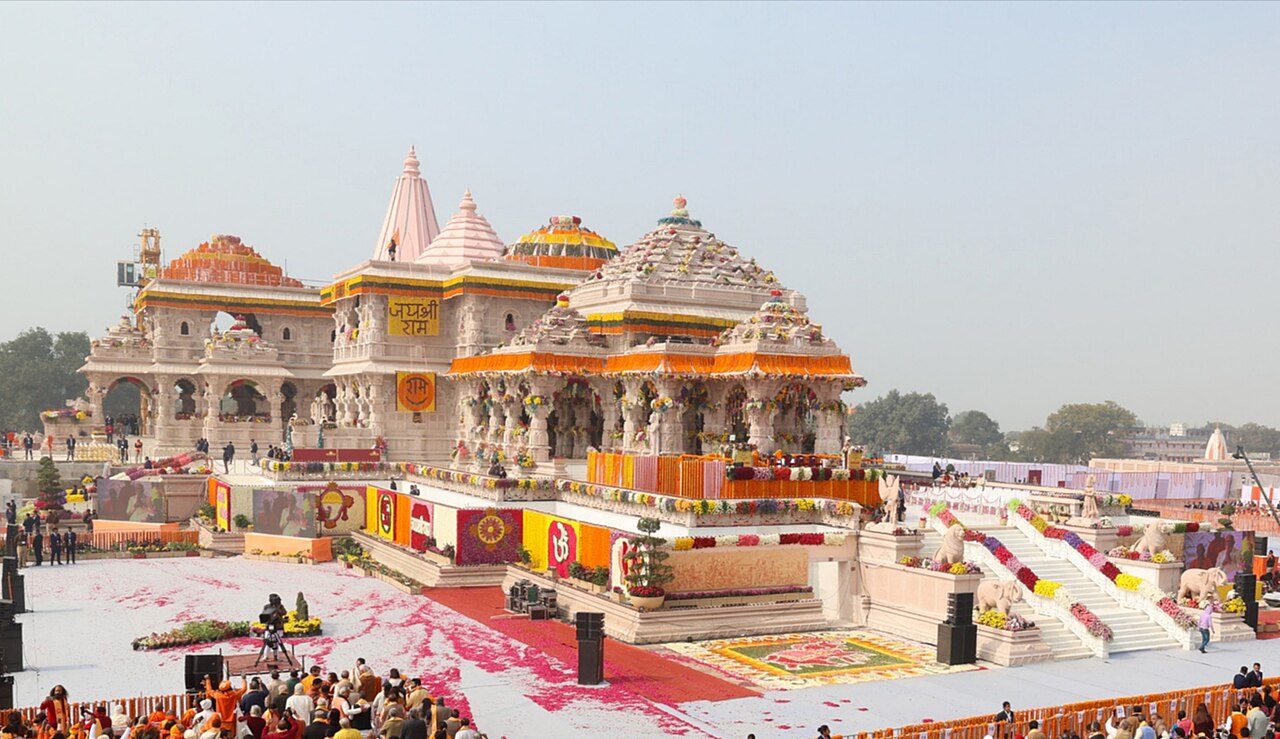
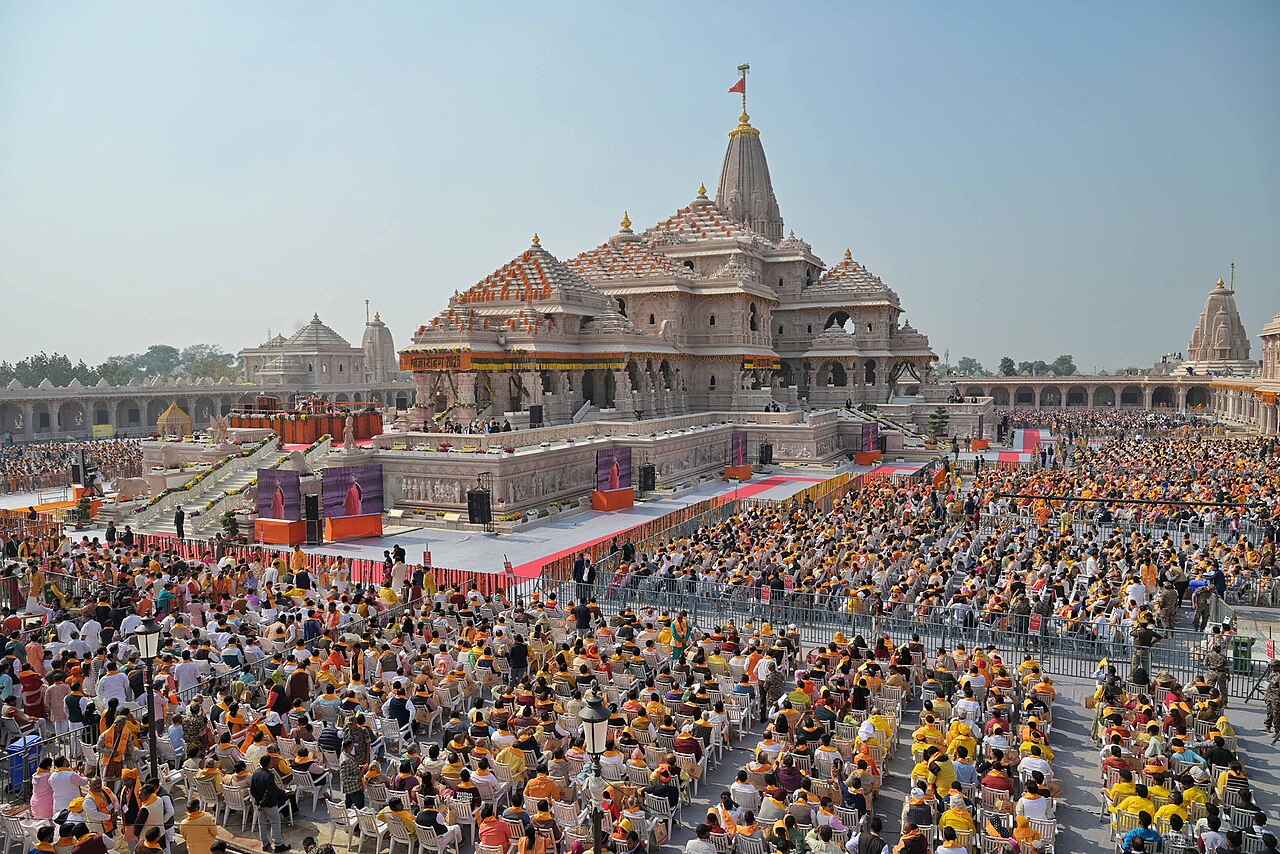
The bhumi pujan followed on 5 August 2020, and on 22 January 2024 the Pran Pratishtha of Ram Lalla, a five-year-old Shri Ram carved by the sculptor Arun Yogiraj, filled the new sanctum with life. The Ram Darbar on the first floor was consecrated on 5 June 2025, and on 25 November 2025 a 22-foot dharmic flag rose over the shikhara at the Dhwajarohan, marking the Temple complex complete.
What you'll actually see
1
The Singh Dwar and the five mandaps
You enter from the east and climb 32 steps through the Singh Dwar, then pass down the Temple's spine through its pillared halls: Nritya, Rang and Sabha mandaps toward the sanctum, with the Prarthana and Kirtan mandaps flanking. Every one of the 392 pillars carries carved devis and devatas; the whole structure rests on a 21-foot granite plinth against the damp of the plain.
2
Ram Lalla in the garbhagriha
The murti Is Shri Ram as a five-year-old child, 51 inches tall, cut from dark krishna shila stone quarried near HD Kote in Mysuru district and carved by Arun Yogiraj of Mysuru's hereditary sculptor lineage. The stone drinks the lamplight, so the face seems lit from within. The deity Is also Known formally as Balak Ram, the child Ram.
3
The Ram Darbar and the parkota shrines
On the first floor Sits the Ram Darbar, the royal court of Shri Ram With Maa Sita, consecrated in June 2025 with regulated daily entry. Around the main Temple the rectangular parkota wall holds shrines of Surya Narayan, Ganesha, Lord Shiva, Maa Durga, Hanuman and Maa Annapurna, beside the restored Shiv Mandir at Kuber Tila and the ancient Sita Koop well.
The mandir dressed in flowers and marigold on the day of the Pran Pratishtha of Ram Lalla, 22 January 2024Tens of thousands of devotees gathered before the completed mandir at the Dhwajarohan Utsav, 25 November 2025
The mandir at its consecration and its completion · photos Prime Minister's Office, GODL-India, via Wikimedia Commons
THE RITE FOUND NOWHERE ELSE
Surya Tilak: the sun anoints Ram Lalla
At solar noon on every Ram Navami, the birthday of Prabhu Shri Ram, an opto-mechanical instrument built by CSIR-CBRI Roorkee with the Indian Institute of Astrophysics gathers sunlight on the Temple's upper floor and bends it through four mirrors and four lenses down a darkened shaft into the sanctum. For three to four minutes a 58 mm disc of living sunlight rests on the forehead of Ram Lalla, a tilak placed by the sun itself. It was performed for the first time on 17 April 2024 and now returns each year; the next Surya Tilak falls on Ram Navami, 15 April 2027.
Ram Navami week is the Temple's heaviest crowd of the year; passes vanish within minutes of release, and the Trust streams the Surya Tilak live on its official YouTube channel.
Plan your visit
By air
Maharishi Valmiki International Airport, Ayodhya Dham, is about 8 to 10 km from the mandir, 20 to 30 minutes by taxi.
By rail
Ayodhya Dham Junction is just over 1 km from the Temple, a short walk or e-rickshaw ride; Ayodhya Cantt is about 8 km.
Timings
Darshan 7:00 to 11:30 am and 2:00 to 7:00 pm, with a midday closure for bhog. Aartis: Mangla 4:00 am, Shringar 6:30 am, Sandhya 7:00 pm, Shayan 9:30 pm; the early and late aartis admit pass holders only.
Passes
Darshan is free. Free Sugam darshan and aarti passes are issued only at online.srjbtkshetra.org, released 15 days ahead; anyone selling a pass is running a scam.
The queue
Roughly 60 to 120 minutes on ordinary days, 30 to 45 with the free Sugam pass. Deposit your phone before you join the line, not after.
The Sarayu
Ram ki Paidi, the great ghat stairway on the Sarayu about 2 km away, holds the evening Sarayu aarti and becomes the lamp-field of Deepotsav.
Best time
A weekday morning outside festival weeks; October to March is the gentle season on the plain.
Mobiles, cameras, smartwatches, earphones and other electronics are strictly barred inside; free lockers exist at the Pilgrim Facility Centre, but locker queues can take 30 to 45 minutes, so leaving devices at your stay is faster.
The Trust repeats it plainly: there is no paid VIP darshan at Shri Ram Janmabhoomi Mandir, and every pass on the official portal is free.
Entry to the first-floor Ram Darbar is regulated separately, with a limited number of devotees admitted each day.
Ayodhya's Deepotsav on the eve of Diwali set two Guinness World Records in 2025, with 26,17,215 diyas lit along the Sarayu; the next Deepotsav falls on 7 November 2026.
Questions pilgrims ask
Is the Temple actually finished?
Yes. The sanctum was consecrated on 22 January 2024, the first-floor Ram Darbar on 5 June 2025, and the Dhwajarohan of 25 November 2025, when the dharmic flag rose over the 161-foot shikhara, marked the Temple complex complete.
Do I have to pay for darshan, or buy a VIP pass?
No. Darshan is free, and the free Sugam and aarti passes come only from online.srjbtkshetra.org. The Trust has stated there is no VIP darshan; any agent or website selling access is defrauding you.
Can I take my phone or camera inside?
No. All electronics must be deposited in the free lockers before the security lines. If you want the darshan preserved, the Trust's official YouTube channel streams aarti and darshan live every day.
What does Ram Lalla look like?
A five-year-old Shri Ram, 51 inches tall, carved from near-black krishna shila stone by Arun Yogiraj of Mysuru, standing beneath a golden canopy with a gentle, unhurried smile. The child form is why the deity Is Called Ram Lalla.
When is the next Surya Tilak?
At noon on Ram Navami, 15 April 2027, when mirrors and lenses will again carry the sun down to rest a tilak of light on Ram Lalla's forehead.
Darshan from afar
From the temple's own channels. Nothing loads until you press play.
Dharamshalas and guest houses near this Sthan, shared by devotees. Adisthan takes no bookings and no money; contact each stay directly.
No stays are listed here yet. Know one that serves pilgrims well?
Are you a trustee, priest or sevak of Shri Ram Janmabhoomi Teerth Kshetra? Claim this page to keep darshan hours, pass rules and festival dates true for pilgrims across the world.