Rameswaram Island · Ramanathapuram, Tamil Nadu, India
Where Lord Rama worshipped Lord Shiva, two names of God become one prayer.
Be the first to check in
Coming up: Masi Maha Shivaratri · 6 MarEntry tended 28 Jun 2026
Open 4 am to 1 pm · 3 to 8 pm 22 theertham bath before darshan Southernmost of the twelve jyotirlingas Maha Shivaratri · 6 Mar 2027 The longest Temple corridor on earth
You enter this Temple wet, and that is the custom. At first light pilgrims stand in the sea at Agni Theertham, then walk dripping through the east gate, where Temple men with brass buckets pour the water of twenty-two wells over them, one well after another, each with its own name and its own taste. Only then, in dry clothes, do you walk the painted corridor toward the sanctum. The worshipper who came here before you was Lord Rama Himself.
Two of Hinduism's greatest circuits meet in this one sanctum: it is the southernmost of the twelve jyotirlingas of Lord Shiva, and one of the four dhams of the Char Dham, with Badrinath, Puri and Dwarka. Shaiva and Vaishnava pilgrims arrive here as one stream.
Twenty-two sacred theerthams lie within the Temple itself, one for each arrow in Lord Rama's quiver, and bathing in them in sequence before darshan is held to be equal to penance.
The outer corridor is described as the longest Temple corridor in the world: about 3850 feet of continuous colonnade with about 1212 pillars, their capitals painted, their ranks converging to a point of light.
The Lord who needed to pray
The war in Lanka was over and Ravana was dead, but Lord Rama carried a weight no victory could lift. Ravana was a brahmin, grandson of the sage Pulastya, and tradition holds that the sin of brahmahatya followed Lord Rama back across the sea. On this island shore the sages counselled Him: worship Lord Shiva here, and be made clean. So the Lord whom millions worship bent His own head to pray.
Sri Hanuman was sent to Mount Kailash to bring back a linga worthy of the rite. When the auspicious hour drew near and he had not returned, tradition holds that Maa Sita Herself Gathered the sea sand and Shaped a linga with Her own hands, and Lord Rama worshipped it. Hanuman returned grieved that his errand had come to nothing, so Lord Rama decreed that the linga from Kailash be enshrined beside the first and be worshipped first, always. Both stand in the sanctum today: the Ramalingam of sand, and the Vishwalingam of Kailash, honoured first at every pooja, exactly as promised.
Around that legend, kings built. The Pandyas expanded the shrine in the 12th century; Jeyaveera Cinkaiariyan, a king of Jaffna across the strait, renovated the sanctum around 1380 to 1410; and the Sethupathi rulers of Ramanathapuram raised the immense corridors, the outermost completed under Muthuramalinga Sethupathi in the 18th century. The Temple as you walk it now is largely the work of the 17th century and after, wrapped around a shrine as old as the story itself.
What you'll actually see
1
Agni Theertham, the sea that comes first
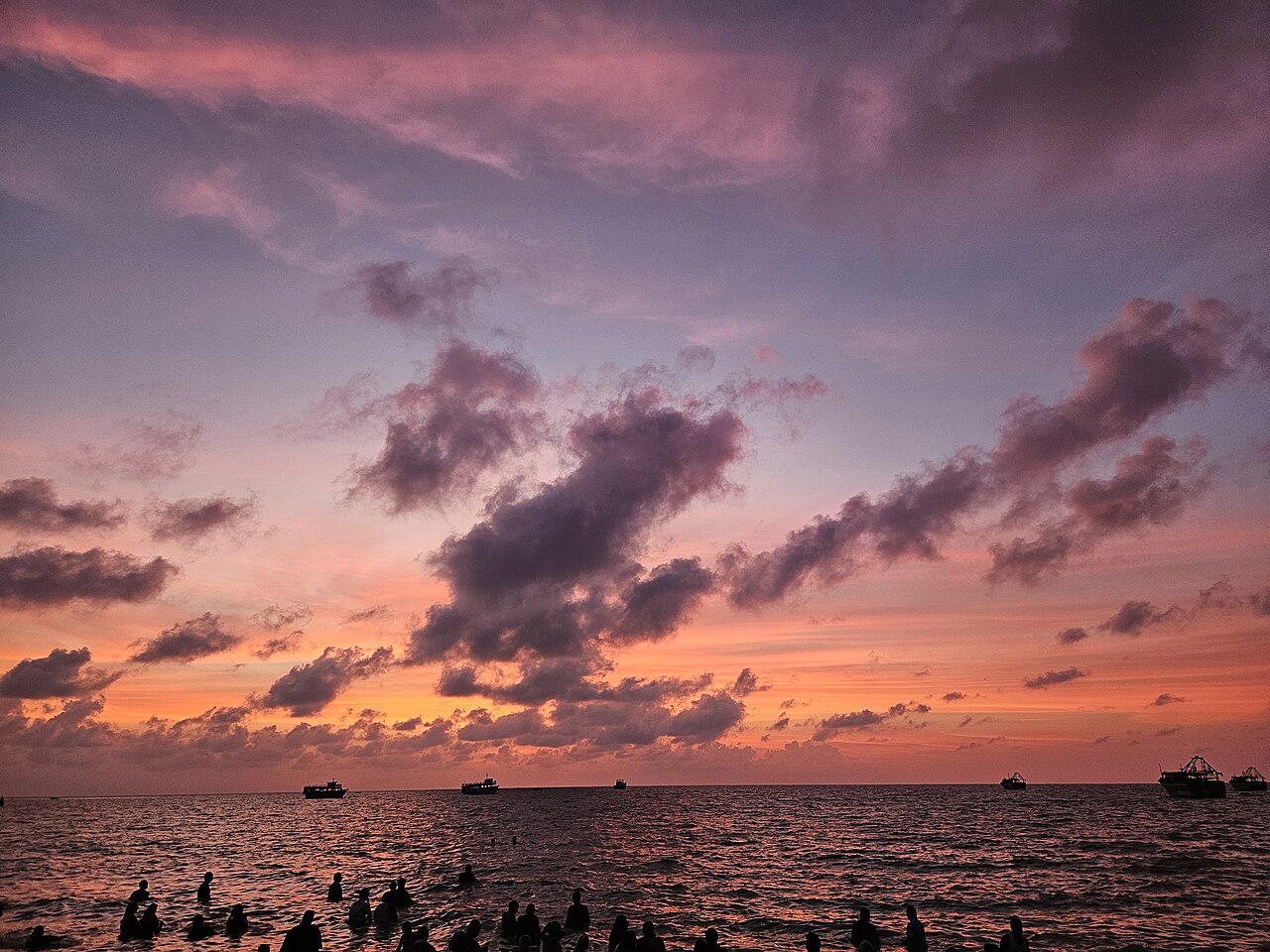
The pilgrimage begins outside the walls, in the Bay of Bengal itself. A few hundred steps east of the Temple, families wade into the shallow surf at dawn, offer handfuls of seawater to their ancestors, and turn back toward the gopuram still dripping. The sea here is the first and greatest of the theerthams.
2
The third corridor
A colonnade so long the far end dissolves into light. Rank upon rank of pillars stand on raised stone platforms, every capital carved with rearing yali lions and painted in ochre, rose and green, under a ceiling of painted lotus medallions. Pilgrims walk it barefoot on cool granite, and the sound of the Temple arrives as echo long before the sanctum does.
3
The two lingas of the sanctum
In the innermost shrine stand two lingas side by side: the Ramalingam, which tradition holds Maa Sita Shaped from sea sand, and the smaller Vishwalingam that Sri Hanuman carried from Kailash. By Lord Rama's own decree the Vishwalingam receives worship first at every pooja, a promise kept daily for as long as anyone has kept count.
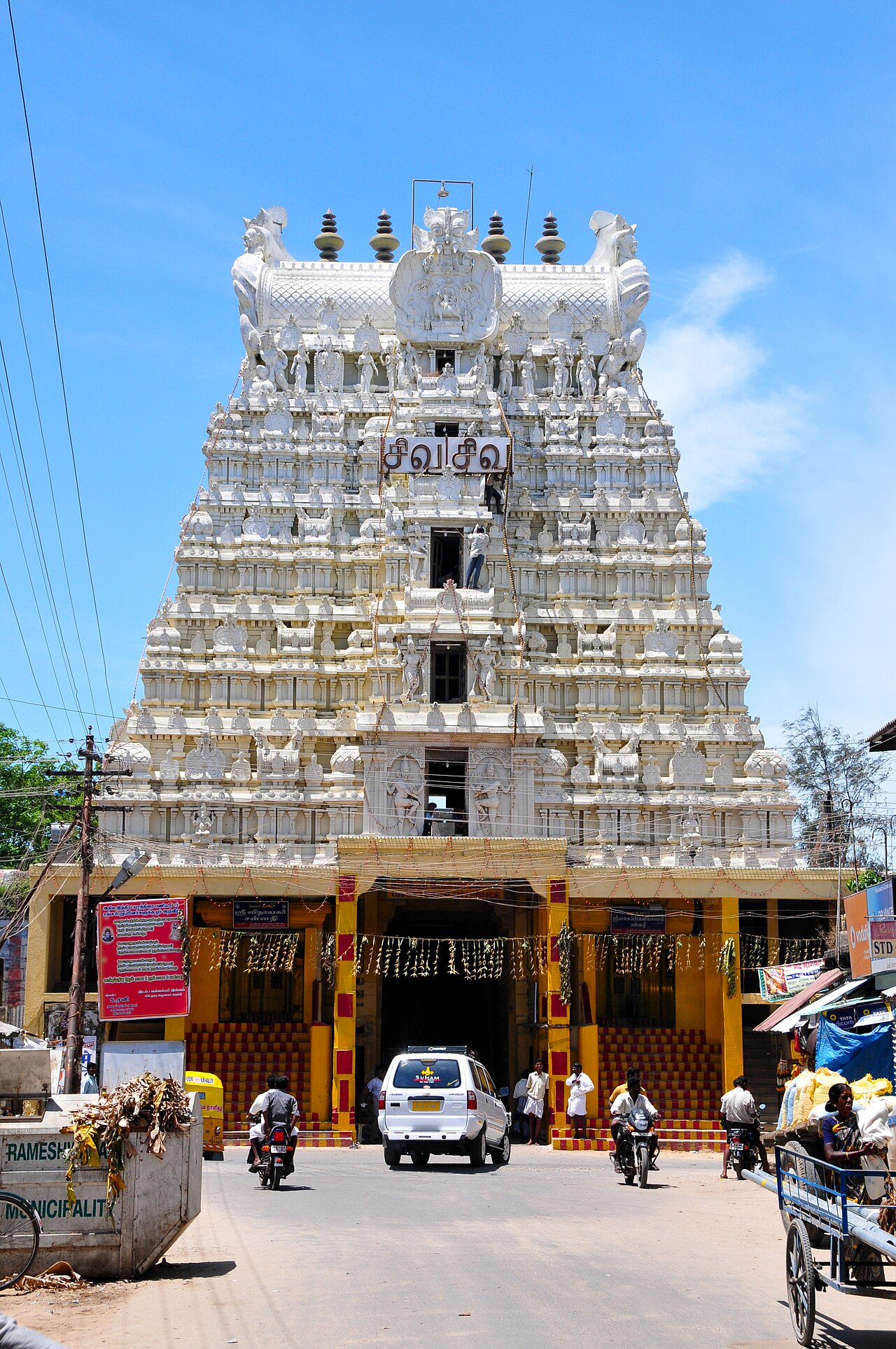
The white gopuram of the Ramanathaswamy Temple rising over the Temple street in RameswaramPilgrims bathing in the sea at Agni Theertham under a dawn sky, Rameswaram
The gopuram above the temple street, and dawn bathers at Agni Theertham · photos CC BY-SA 3.0 (Jyothis) and CC0 (PrishitaBose), Wikimedia Commons
THE RITE FOUND NOWHERE ELSE
The bath of the twenty-two theerthams
Every pilgrim's Rameswaram begins as a soaking. First the sea at Agni Theertham, then the twenty-two wells inside the Temple, taken in order: at each one a Temple attendant hauls up a brass bucket and pours it straight over your head, and each well's water is said to differ in taste and virtue. The number remembers the twenty-two arrows in Lord Rama's quiver. The wells are open 5:30 am to 12:30 pm and 3 to 7 pm, with a small bath ticket (about ₹25) sold at the counter inside the east entrance.
Wear clothes you are willing to drench and carry a dry set: wet clothes are not permitted at darshan, and changing rooms are provided.
Plan your visit
By air
Madurai Airport, about 175 km away; roughly 3.5 to 4 hours by taxi or bus. Thoothukudi Airport is about 195 km.
By rail
Rameswaram station is about 1.3 km from the Temple. Trains cross the new Pamban vertical-lift sea bridge, opened 6 April 2025.
Timings
Temple open 4:00 am to 1:00 pm and 3:00 to 8:00 pm. Theertham bath 5:30 am to 12:30 pm and 3:00 to 7:00 pm.
Best time
Dawn. Take the sea bath at first light, finish the wells by mid-morning, and have darshan before the afternoon closing.
Dress
Traditional dress: dhoti or trousers with a shirt for men, saree or salwar kameez for women. Shorts and jeans are not permitted, and a dry change is needed after the bath.
The bath
The 22-well round costs about ₹25, with attendants pouring the water at each well; guides are optional.
Beyond the Temple
Dhanushkodi, the ghost town swept away by the 1964 cyclone, is 18 km along the spit; Arichal Munai, 4.5 km further, faces the Ram Setu shoals toward Lanka.
Ramanathaswamy means the Lord of Rama: in this Temple's very name, the name of God carries the name of His greatest worshipper.
Mobile phones are not allowed inside the Temple; locker facilities operate near the east gate, so plan to hand yours in before the bath.
By Lord Rama's decree the Vishwalingam brought by Sri Hanuman is worshipped before the Ramalingam at every pooja, to this day.
Tradition holds that from Dhanushkodi, at this island's tip, Lord Rama's vanara army built the causeway to Lanka; the sand spit at Arichal Munai still points along the line of the Ram Setu shoals.
Questions pilgrims ask
Is this a Temple of Lord Rama or of Lord Shiva?
It is a Temple of Lord Shiva, who Is Worshipped here as Ramanathaswamy in the form of a jyotirlinga. Lord Rama is the worshipper, not the deity of the sanctum. That is exactly why the Temple is doubly holy: it is a jyotirlinga shrine for Shaivas and a Char Dham of Lord Rama's own story for Vaishnavas.
Do I have to bathe in all twenty-two theerthams before darshan?
It is the honoured custom rather than a rule. Most pilgrims take the sea bath at Agni Theertham, then buy the bath ticket (about ₹25) and let the attendants pour water from each of the 22 wells in sequence. You must change into dry clothes before entering for darshan.
Which linga is worshipped first, and why?
The Vishwalingam, which Sri Hanuman brought from Kailash. When Maa Sita's sand linga Was consecrated before Hanuman returned, Lord Rama consoled him by decreeing that the Kailash linga would receive every first worship. The priests keep that promise at every pooja.
Can I take my phone or camera inside?
No. Mobile phones and cameras are not permitted inside the Temple. Deposit them at the lockers near the east gate before you begin the theertham round.
How do I reach Rameswaram?
By rail to Rameswaram station, crossing the new Pamban vertical-lift bridge opened in April 2025, or by road over the adjacent road bridge. The nearest airport is Madurai, about 175 km away.
Dharamshalas and guest houses near this Sthan, shared by devotees. Adisthan takes no bookings and no money; contact each stay directly.
No stays are listed here yet. Know one that serves pilgrims well?
Are you a priest, trustee, or officer of the Arulmigu Ramanathaswamy Temple? Claim this page to keep timings, pooja schedules and festival dates true for pilgrims planning the crossing.