They built it to house a god; history kept the mason's name instead.
Be the first to check in
Coming up: Maha Shivaratri · 6 MarEntry tended 28 Jun 2026
Kakatiya Temple · raised from 1213 CE Lord Shiva as Rudreshwara UNESCO World Heritage · inscribed 2021 Open 6 am to 6 pm daily Entry free Maha Shivaratri · 6 Mar 2027
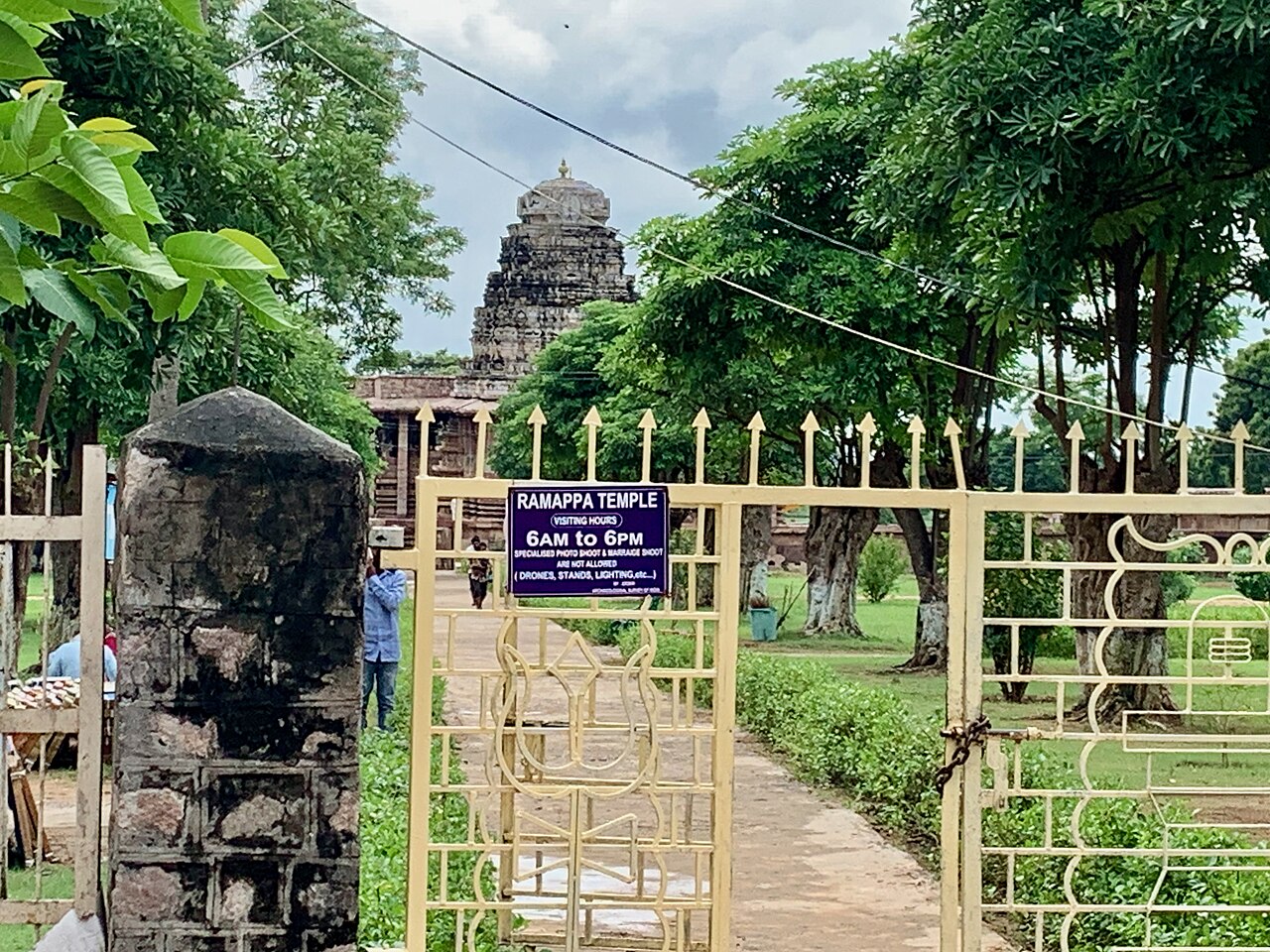
You walk a garden path under trees and the shikhara rises first, a stepped tower of pale sandstone standing over its own reflection in Ramappa Lake. Cross the star-shaped plinth and the walls turn strange: black bracket figures lean out from the pillars, drummers and dancers frozen mid-turn, carved from stone so dark it looks poured rather than cut. A stone Nandi kneels facing the sanctum, where Lord Shiva is worshipped still, under a roof tradition holds was built light enough to float.
Government of India and Archaeological Survey accounts describe this as the only Temple in India known to carry the name of the sculptor who built it rather than the deity enshrined within: Ramappa, credited by tradition with some forty years shaping this stone.
The roof chamber beneath the shikhara was built with a distinctive porous brick, kaolinitic clay bound with tree resin, jute, and rice husk, that a 1947 laboratory test found light enough to float on water, letting the Kakatiya builders raise a tall stone tower without its full weight bearing on the carved walls below.
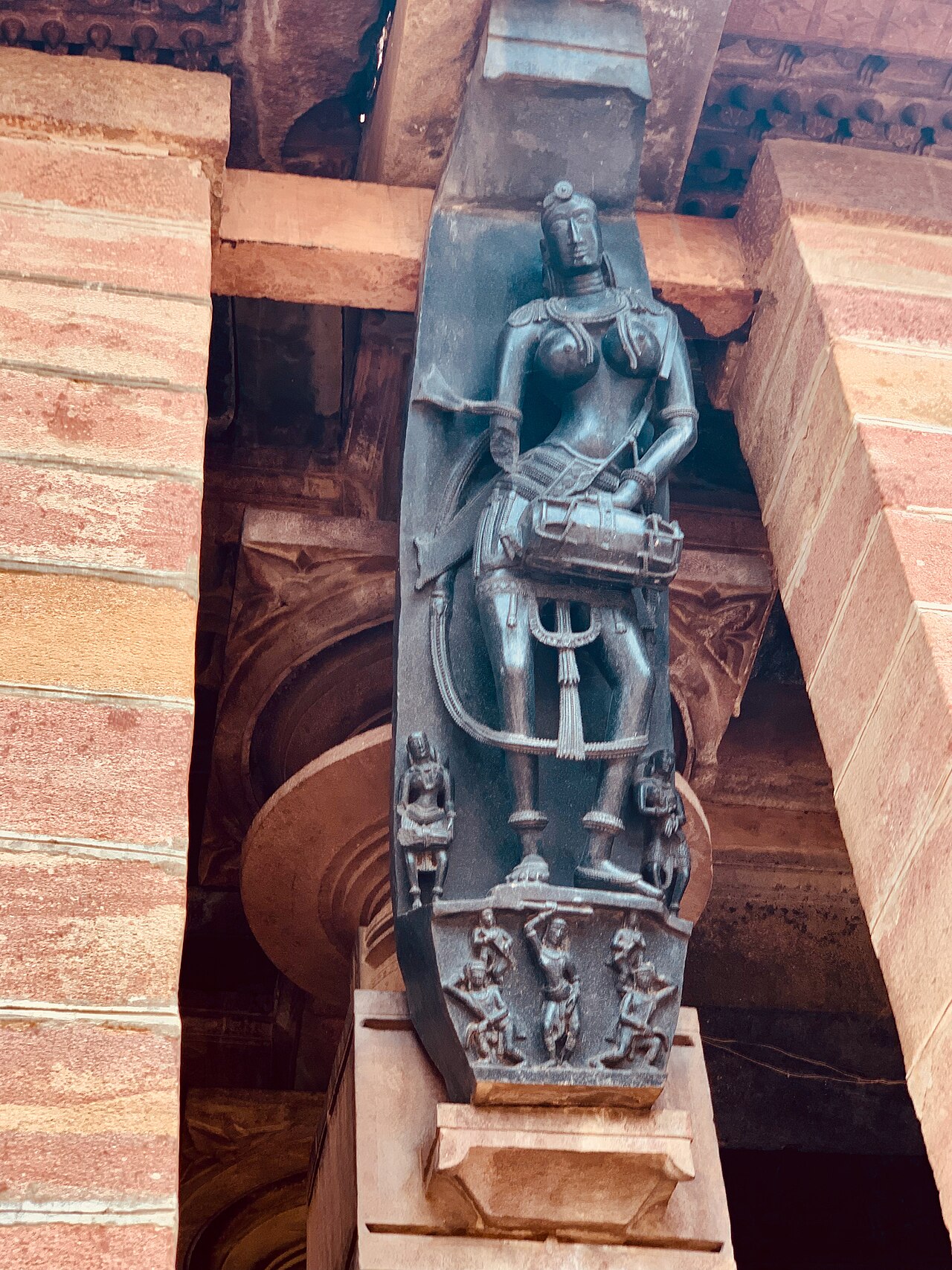
Twelve life-size bracket figures cut from single slabs of black basalt, dancers, a drummer, a huntress, and a nagini among them, stand at the pillar-tops in postures so alive that the twentieth-century dancer Nataraja Ramakrishna revived the lost Perini Sivatandavam by studying them one by one.
The general's Temple, the mason's name
The Kakatiya dynasty ruled the Deccan from Warangal for two centuries, and in the early thirteenth century King Ganapati Deva sent his general Recharla Rudra to raise a Temple beside a new irrigation lake at Palampet. An inscription inside the shrine dates the start of work to 1213 CE. Building went on for decades as three Temples took shape inside one walled courtyard: the great shrine to Lord Shiva at the centre, and two smaller shrines flanking it.
Tradition and Archaeological Survey accounts agree on an unusual detail: the Temple came to be known by the name of the man who carved it. Ramappa, the sculptor entrusted with the work, is said to have given some forty years to the stone, and the finished shrine took his name rather than the god's it was built to hold, Rudreshwara. No other Kakatiya Temple, and by most accounts no other Temple anywhere in India, carries a craftsman's name this way.
A powerful earthquake struck the region centuries later and brought down lesser structures nearby; the main shrine stood, and the Archaeological Survey credits a bed of sand, lime, and jaggery laid beneath the foundation, the 'sandbox' technique, with absorbing the shock. By 1914 the Temple stood in real disrepair, and the Nizam of Hyderabad's newly formed Archaeology Department began its rescue; the archaeologist Ghulam Yazdani traced fallen chajjas and ornament back to their places through the 1920s and 1930s. The Archaeological Survey of India has held the site since, and in July 2021 UNESCO inscribed it as the Kakatiya Rudreshwara (Ramappa) Temple.
What you'll actually see
1
The star-plinth and the outer pillars
The main shrine rises on a six-foot star-shaped plinth of pink sandstone. Around it stand pillars of granite and black basalt, and at their tops project broad brackets carved as mythical beasts, dancers, and musicians, the madanikas that scholars count among the finest sculpture the Kakatiya kingdom produced.
2
The Nandi mandapa
Just east of the sanctum sits a large stone Nandi in his own open pavilion, still facing the linga he was carved to serve. Two smaller Shiva shrines flank the main Temple, one sheltering a second, smaller Nandi, so the courtyard reads as a small family of shrines rather than one building alone.
3
The stepped shikhara
Above the sanctum the tower climbs in tiers to a rounded stone finial, its outline stepped like a mountain against the sky. The chamber inside its base was built with the porous brick that gave the Temple its engineering fame, lightening a roof that would otherwise have pressed hard on the carved walls beneath it.
A black basalt bracket figure of a drummer carved at a pillar-top of the Ramappa Temple, one of its Kakatiya madanikasThe garden approach to Ramappa Temple, its stepped shikhara visible past the entrance gate and ASI visiting-hours sign
A madanika bracket figure, and the garden approach to the shrine · photos by Ms Sarah Welch (CC0), Wikimedia Commons
THE NIGHT DEVOTEES KEEP VIGIL AT RUDRESHWARA'S SHRINE
Maha Shivaratri · 6 March 2027
Once a year the ASI-protected courtyard becomes a Temple in the fuller sense. For three days devotees from Palampet and the villages around Ramappa Lake come for Abhishekam, Archana, and Harathi offered to the Shiva linga in the sanctum, and the crowds that gather after dark are the largest the monument sees all year. It sits alongside the worship the Temple keeps every day, archana and aarti offered to Lord Shiva even as the Archaeological Survey manages the stones around it.
Come by day if you want the carvings to yourself; nightfall on Shivaratri itself draws the year's biggest crowd and the approach road gets busy.
Plan your visit
By air
Rajiv Gandhi International Airport, Hyderabad, is about 209 km away; allow four hours or more by road.
By rail
Warangal railway station, about 66 km away, is the nearest railhead, with regular connections to Hyderabad and Vijayawada; taxis and buses run on to Palampet.
By road
Buses and taxis run from Warangal via Mulugu, about 15 km short of the Temple; the drive from Warangal takes roughly ninety minutes.
Timings
Open daily, 6 am to 6 pm.
Entry
Free, for all visitors.
Best time
October to March, when the weather is cool; Maha Shivaratri in late winter brings the year's largest gathering.
Guides
Government-approved guides wait near the entrance and are worth hiring; the sculpture rewards a slow, guided reading.
The popular name comes from Ramappa, the sculptor credited by the Archaeological Survey and Government of India sources with carving the Temple; the deity honoured inside it is Lord Shiva as Rudreshwara, and both names refer to the same shrine.
The 'floating brick' claim rests on a 1947 laboratory test of the porous, resin-and-husk-bound brick used in the roof chamber, which floated when placed in water; it documents the material, not a demonstration staged on site today.
A sign at the entrance gate asks visitors not to bring drones, lighting stands, or staged wedding and fashion shoots onto the monument grounds; ordinary photography is welcome.
Ramappa Lake, the reservoir the Temple stands beside, was built in the same Kakatiya period and still irrigates the surrounding fields; boats for visitors operate on the lake near the Temple.
Questions pilgrims ask
Is Ramappa Temple really named after the man who built it, and not the god inside it?
Yes, by the account the Archaeological Survey of India and the Government of India both give: the shrine is dedicated to Lord Shiva as Rudreshwara, but it carries the popular name of Ramappa, the sculptor entrusted with carving it. Government sources describe this as the only Temple in India named for its craftsman rather than its deity.
Do the roof bricks actually float on water?
The claim traces to a real 1947 test: samples of the porous brick used in the shikhara's roof chamber, made of kaolinitic clay bound with tree resin, jute, and rice husk, floated when placed in water. That documents the material's unusual lightness rather than a demonstration performed at the Temple today; the bricks you see are mortared into the tower, not floating anywhere.
Is Ramappa still a working Temple, or only a monument?
Both. The Archaeological Survey of India protects and conserves the structure, and daily worship continues alongside that protection: archana and aarti are offered to the Shiva linga each day, and Maha Shivaratri draws large crowds for a three-day festival.
Is this the same place as the Thousand Pillar Temple in Warangal?
No. Ramappa Temple stands at Palampet in Mulugu district, about 66 km from Warangal city. The Thousand Pillar Temple is a separate Kakatiya-era shrine inside Warangal itself, dedicated jointly to Rudreshwara, Vishnu, and Surya. The two share a dynasty and a building style, not a location.
How did the Temple survive a major earthquake centuries after it was built?
The Archaeological Survey credits the foundation: builders laid a deep bed of sand, lime, and jaggery beneath the Temple, a cushioning method now called the sandbox technique, thought to have absorbed the shock that damaged other structures nearby.
The Sthan in photographs
Darshan from afar
From the temple's own channels. Nothing loads until you press play.
Dharamshalas and guest houses near this Sthan, shared by devotees. Adisthan takes no bookings and no money; contact each stay directly.
No stays are listed here yet. Know one that serves pilgrims well?
Do you serve in the conservation, priesthood, or guiding of Rudreshwara's shrine at Palampet? Claim this page to keep its timings, festival days, and visiting details true for every devotee and traveller who comes to read these stones.