
Ramna Kali Temple
Ramna Kalibari · Ramna Kali Mandir
About
The Ramna Kali Temple, long remembered as the Ramna Kalibari, stands in the Ramna area of Dhaka, the capital of Bangladesh. Set on a 2.25-acre site beside the former Dhaka Racecourse, now Suhrawardy Udyan, and across from the Bangla Academy, the shrine is dedicated to the goddess Maa Kali and has been a centre of Hindu devotion since the days of the Mughal Empire.
In Nepalese folklore the Temple is said to have been founded by devotees of Maa Kali who came down from the Himalayas to Bengal. Although it had stood for centuries, the precinct was largely developed in the early twentieth century under the patronage of Rani Bilashmoni Debi, wife of Rajendra Narayan, when its tall shikhara rose as one of the most prominent landmarks of Dhaka. Beside it stood the Ma Anandamoyee Ashram, with a large dighi serving pilgrims and the wider neighbourhood.
On the night of 25 March 1971, the Pakistan Army launched Operation Searchlight against the Bengali nationalist movement in what was then East Pakistan, triggering the Liberation War. Two days later soldiers entered the Ramna Kali Mandir complex and within an hour killed more than a hundred people, including Hindu devotees and Muslims who had sought refuge with them. The original Temple was demolished.
A reconstruction of the complex was announced in 2017, supported by the government of India, and the rebuilt Temple was inaugurated on 17 December 2021 by President Ram Nath Kovind of India, who described the shrine as a symbol of the spiritual and cultural bond between India and Bangladesh.
History
Tradition holds that the Temple was founded in the Mughal era by devotees of Maa Kali who had travelled down from the Himalayas, and it was substantially rebuilt in the early twentieth century under the patronage of Rani Bilashmoni Debi, when its tall shikhara became one of Dhaka's recognised landmarks. On the night of 27 March 1971, two days into the Pakistan Army's Operation Searchlight, soldiers entered the Temple complex and within an hour killed more than a hundred people, Hindu devotees and Muslims who had taken shelter among them alike, and the Temple itself was demolished. The site stood without its Temple for decades until reconstruction, supported by the government of India, was announced in 2017. President Ram Nath Kovind of India inaugurated the rebuilt Temple on 17 December 2021.
Significance
For Dhaka's Hindu community the Temple now carries a double weight, a place of daily devotion before Maa Kali and a memorial to those killed on this ground in 1971. At its reopening, President Kovind called it a symbol of the spiritual and cultural bond between the peoples of India and Bangladesh, and the Temple today stands as both a living shrine and a remembrance.
Architecture
Bengali Hindu Temple architecture with a tall shikhara; rebuilt after 1971 in modern masonry, marble, and glass
Visiting
Hours
Hours not listed.
Contact
No contact details listed yet.
Engage with Ramna Kali Temple
Through the four pathways
Seva सेवा — Service
Offer your time and skills here. The following opportunities are open at Ramna Kali Temple:
No Seva offerings listed yet.
Sādhana साधना — Practice
Learn the worship and practice associated with Ramna Kali Temple:
No Sādhana offerings listed yet.
Sandhāna सन्धान — Wisdom
Unite with the wisdom of this tradition:
No Sandhāna offerings listed yet.
Sādhya साध्य — Giving
Support this sacred place according to your means:
No Sādhya offerings listed yet.
All giving flows directly to Ramna Kali Temple. Adisthan does not take a commission.
Festivals & Events
- Oct
Durga Puja
19 October 2026 · annual
Celebrated at the Temple alongside the worship of Maa Kali each autumn, drawing devotees to its pandal for five days culminating at Maha Ashtami.
- Nov
Kali Puja
8 November 2026 · annual
The Temple's principal night of worship, when Maa Kali is honoured at midnight on the new-moon night of Kartik, the same night as Diwali, with anjali offerings and a hom-joggo fire ritual.
Gallery
Related sacred places
 Hinduism
Airavatesvara Temple, Darasuram
Darasuram (Kumbakonam) · India · temple
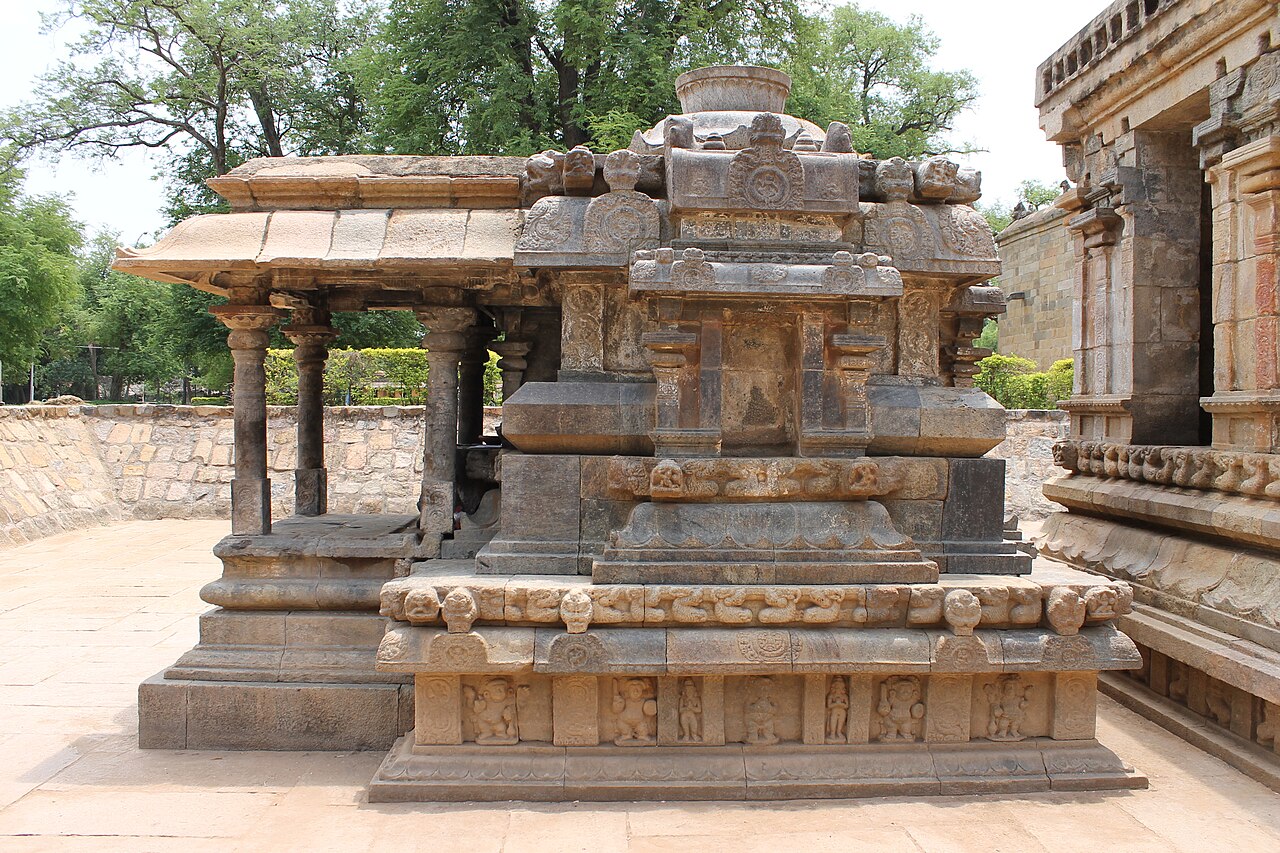
The third of the Great Living Chola Temples, raised by Rajaraja Chola II around 1166 CE at Darasuram near Kumbakonam: a chariot-form shrine of Lord Shiva as Airavatesvara, famed for its carved stone wheels, its singing steps, and worship that has continued for over eight centuries.
Aisanyesvara Siva Temple
Bhubaneswar · India · temple
A living thirteenth-century Shiva shrine in the Old Town of Bhubaneswar, standing close to the western wall of the great Lingaraj Temple, where a Shivalinga set within a circular yonipitha still receives daily worship in the Kalinga architectural tradition.
 Hinduism
Akhadachandi Temple
Bhubaneswar · India · temple
A tenth-century Kalinga-style shrine on the southwestern bank of Bhubaneswar's sacred Bindusagar tank, Akhadachandi Temple honours Maa Mahishasuramardini, the Goddess in her form as slayer of the buffalo demon, within the dense cluster of ancient shrines that fills the city's Old Town.
 Hinduism
Akshardham
New Delhi · India · temple
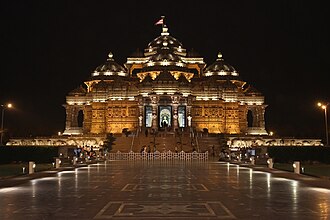
A vast contemporary Hindu mandir campus on the Yamuna's west bank in East Delhi, raised without structural steel by 11,000 artisans and volunteers, and recognised by Guinness World Records in 2007 as the world's largest comprehensive Hindu Temple.
 Hinduism
Amarnath Temple
· India · temple
A high Himalayan cave shrine in Jammu and Kashmir where a naturally forming ice lingam is venerated as Lord Śiva, drawing one of India's great seasonal pilgrimages.
 Hinduism
Ambalappuzha Sri Krishna Temple
Ambalappuzha · India · temple
A Vaishnava shrine on the Kerala backwaters consecrated to Sri Krishna in his Parthasarathy form, counted among the seven great Temples of the former kingdom of Travancore and famed across South India for its Ambalapuzha Paal Payasam offering.