Darshan 6 am to 9 pm Free · Quick Seva ₹250 Vaikunta Ekadasi · 20 Dec 2026 Seven prakaras · 21 gopurams 156-acre island Temple town
You do not arrive at Srirangam so much as enter it. The road passes under one whitewashed gateway, then another, past flower stalls, brass shops and homes with kolam at the door, and you are still not inside the Temple. Ahead, thirteen tiers of painted stucco climb into the sky: the Rajagopuram, among the tallest Temple towers in Asia. Somewhere far within, past seven concentric walls, the Lord of the island lies in repose on His serpent. This is not a Temple inside a town. The town is inside the Temple.
The largest functioning Hindu Temple complex in the world: 156 acres wrapped in seven concentric prakaras with 21 gopurams, where the outer enclosures are living streets of houses, schools and shops.
First and foremost of the 108 Divya Desams, the shrines sung by the Alvar saints. Lord Ranganatha reclines on Adisesha facing south, tradition holds, so His gaze rests forever on Vibhishana's Lanka.
The epicentre of Sri Vaishnavism. Ramanuja taught and administered here in the eleventh and twelfth centuries, and tradition holds his sacred form is preserved to this day in his own shrine within the Temple.
The Lord who chose the island
The old telling begins in Ayodhya. When the war in Lanka was won, Sri Rama gave His family's own worshipped form of the reclining Lord, the Ranga Vimana, to Vibhishana to carry home. Resting on his journey south, Vibhishana set it down on the island between two arms of the Kaveri, and when he rose to leave, it would not move. The Lord had chosen His place. To console the grieving king, He made a promise: He would recline facing south for all time, His gaze resting on Lanka. That is why, alone among great shrines, the Lord of Srirangam looks south.
Around that promise a civilisation gathered. The Alvar poet-saints sang 247 hymns of the Divya Prabandham to this shrine, more than to any other. Nathamuni organised their recitation here, and Ramanuja, the great philosopher of qualified non-dualism, spent his mature years ordering the Temple's worship and administration, making Srirangam the capital of Sri Vaishnavism. Tradition holds that his body, seated in jnana mudra, is preserved in his shrine in the Temple to this day.
In 1311 the armies of Malik Kafur sacked the Temple, and the processional Lord, Namperumal, went into a long exile, hidden and carried from shrine to shrine. Legend remembers the Delhi Sultan's daughter who loved the image and followed it south; she is worshipped still as Thulukka Nachiyar, offered chapatis in the north Indian way. Namperumal returned home in 1371, and Vijayanagara rebuilt what was broken. The Rajagopuram they began around 1500 stood unfinished for four centuries, until it was finally crowned in 1987.
What you'll actually see
1
The Rajagopuram
The southern gateway rises 236 feet in thirteen diminishing tiers of painted deities, a base begun under Vijayanagara around 1500 and completed only in 1987. You pass beneath it with the whole town, pilgrims, cycles and vegetable carts together.
2
The walk through seven walls
Each gateway inward strips away more of the world: shops give way to mandapams, traffic to bare stone underfoot, until the seventh enclosure holds only the dark sanctum beneath the golden Ranga Vimana, its dome shaped, tradition says, like the syllable Om.
3
The thousand-pillared hall and the rearing horses
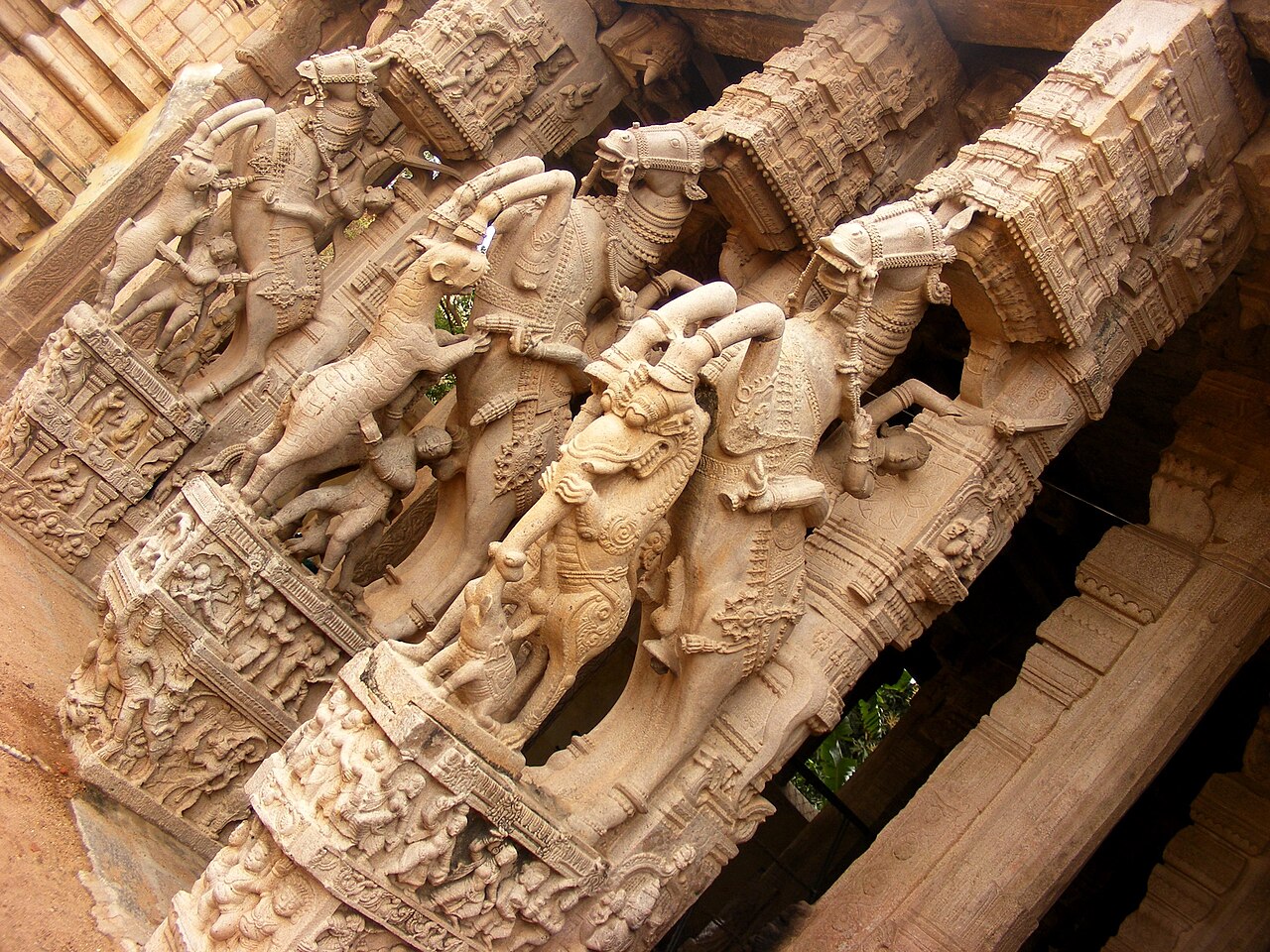
In the fourth enclosure stands the great granite hall raised under Vijayanagara, a forest of carved columns. Beside it, monolithic pillars burst into life-sized horsemen on rearing mounts, riders spearing tigers mid-leap, cut from single stones.
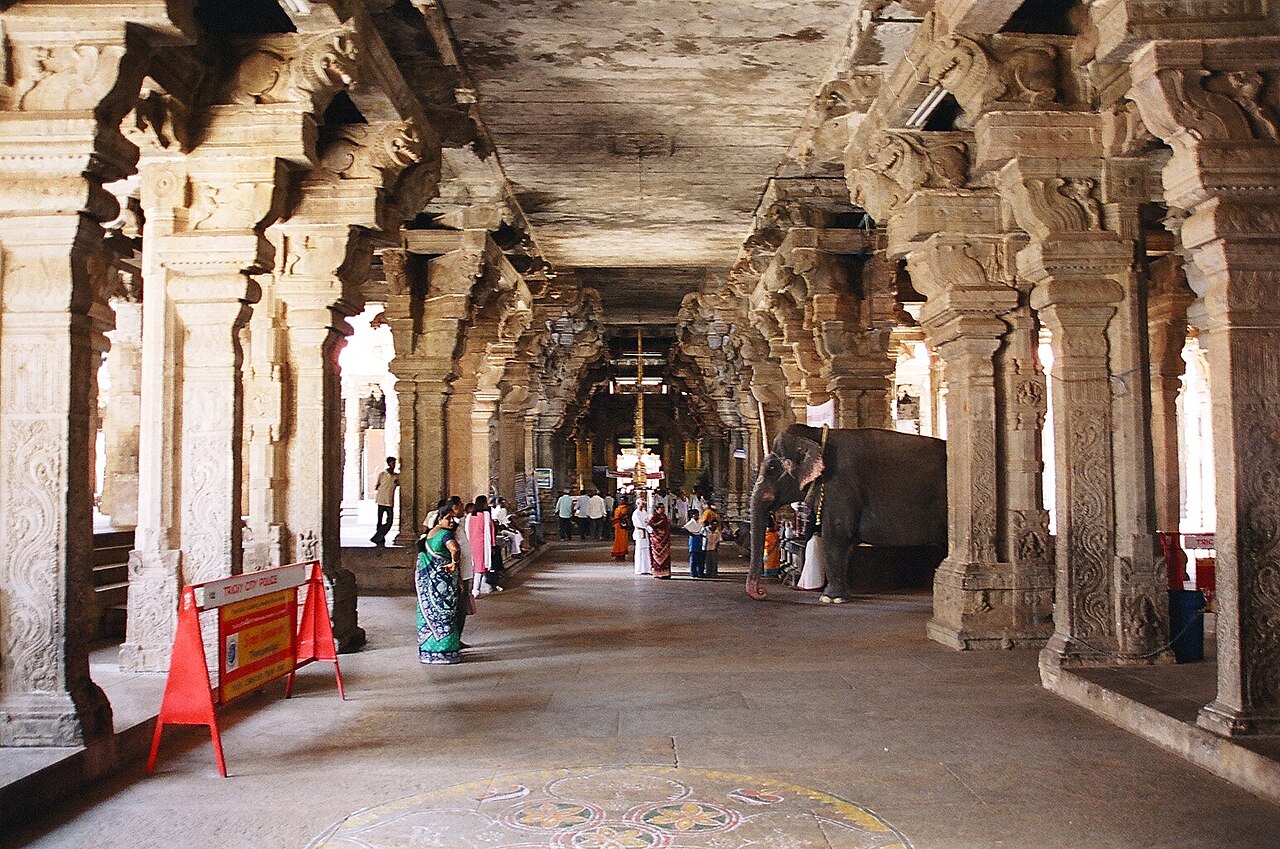
Rearing stone horses and riders carved from single granite pillars at the thousand-pillared hall, SrirangamThe Temple elephant standing among carved corridors inside Sri Ranganathaswamy Temple
The rearing horse pillars, and the temple elephant in the corridors · photos CC BY-SA 4.0 Haneeshkm and CC BY 2.0 Giridhar Appaji Nag Y, Wikimedia Commons
THE TWENTY-ONE DAYS OF RECITATION
Vaikunta Ekadasi · 20 December 2026
Each Margazhi the Temple keeps the Adhyayana Utsavam, the festival that gave Vaikunta Ekadasi to the world: ten days of recitation by day, the Pagal Pathu, then ten nights, the Ra Pathu, as the entire Divya Prabandham is sung before Namperumal and the hereditary Araiyars enact the verses in the ancient Araiyar Sevai. At dawn on Vaikunta Ekadasi, 20 December 2026, the Lord passes through the Paramapada Vasal, the gate of Vaikuntha, opened this one day in the year, and lakhs of devotees stream through behind Him. The full festival draws around a million pilgrims.
The Temple publishes the exact utsavam schedule close to the season; on the day itself, queues form long before dawn, so plan for hours or come on the quieter recitation days.
Plan your visit
By air
Tiruchirappalli International Airport (TRZ), about 15 km, 30 to 40 minutes by taxi.
By rail
Srirangam station is about 1 km from the Temple; most long-distance trains stop at Tiruchirappalli Junction, a short drive away.
Timings
6:00 am to 9:00 pm daily; the sanctum closes for poojas roughly 7:15 to 9:00 am, 12:30 to 2:15 pm and 5:30 to 7:00 pm. Festival days differ.
Viswaroopa Seva
The day's first darshan, 6:00 to 7:15 am, as the Lord is awakened. Ticket ₹100.
Darshan
General darshan is free at all times. A Quick Seva ticket, ₹250 per head, shortens the queue.
Dress
Traditional dress: dhoti or trousers with shirt for men, saree or salwar kameez for women. Shorts, sleeveless tops and short skirts are not permitted.
The queue
Modest on ordinary weekdays; expect several hours during Margazhi and on Vaikunta Ekadasi itself.
Sri Vaishnavas call this simply Periya Kovil, the Big Temple, and the island Thiruvarangam; the shrine is also praised as Bhooloka Vaikuntam, heaven on earth.
Sri Ranganayaki Thayar never leaves Her sannidhi; once a year, on Panguni Uthiram, Lord Ranganatha comes to Her, and the divine couple give the rare Serthi Sevai darshan together.
A small ticket buys access to a rooftop viewpoint on an inner wall, the one place to see the painted gopurams marching inward in a single sweep.
The Temple received the UNESCO Asia-Pacific Award of Merit for conservation in 2017 and stands on India's UNESCO tentative list.
Questions pilgrims ask
Is the whole town really inside the Temple?
Yes. The two outermost of the seven enclosures are ordinary living streets, with homes, schools, markets and traffic, all held within the Temple's walls. Only as you pass the inner gateways does the complex become purely sacred space. Nothing else on this scale survives in active worship anywhere in the world.
What will I see in the sanctum?
In the lamplit inner shrine beneath the golden vimana, Lord Ranganatha reclines on the coils of the five-hooded Adisesha, an image about six metres long, His head to the west and His face turned south. Darshan is brief and the sanctum is dark; let your eyes adjust and take Him in slowly.
Can visitors of other faiths enter?
The outer enclosures, gopurams, halls and the rooftop viewpoint are open to all. Entry to the innermost sanctum area is reserved for Hindus, and signs mark the boundary. The dress code applies to everyone.
Is Ramanuja really enshrined here?
Tradition holds that after the acharya's passing in 1137 his body was preserved, seated in jnana mudra, and it is honoured in his shrine within the Temple, tended with sandal and saffron to this day. For Sri Vaishnavas this sannidhi is among the most sacred places in the complex.
How long should I allow?
A hurried darshan is possible in an hour or two, but the Temple rewards half a day: the walk in through the seven walls, the thousand-pillared hall, the Thayar and Ramanuja sannidhis, and the rooftop view are each worth unhurried time.
The Sthan in photographs
Darshan from afar
From the temple's own channels. Nothing loads until you press play.
Dharamshalas and guest houses near this Sthan, shared by devotees. Adisthan takes no bookings and no money; contact each stay directly.
No stays are listed here yet. Know one that serves pilgrims well?
Are you a priest, trustee or sevak of Sri Ranganathaswamy Temple? Claim this page to keep darshan hours, seva tickets and utsavam schedules exact for the pilgrims who plan their year around Namperumal.