Opens only in its seasons Mandalam · 16 Nov to 27 Dec 2026 Makaravilakku · 14 Jan 2027 About 5 km forest climb from Pamba Black or blue, after a 41-day vratham Darshan free · Virtual Q booking required
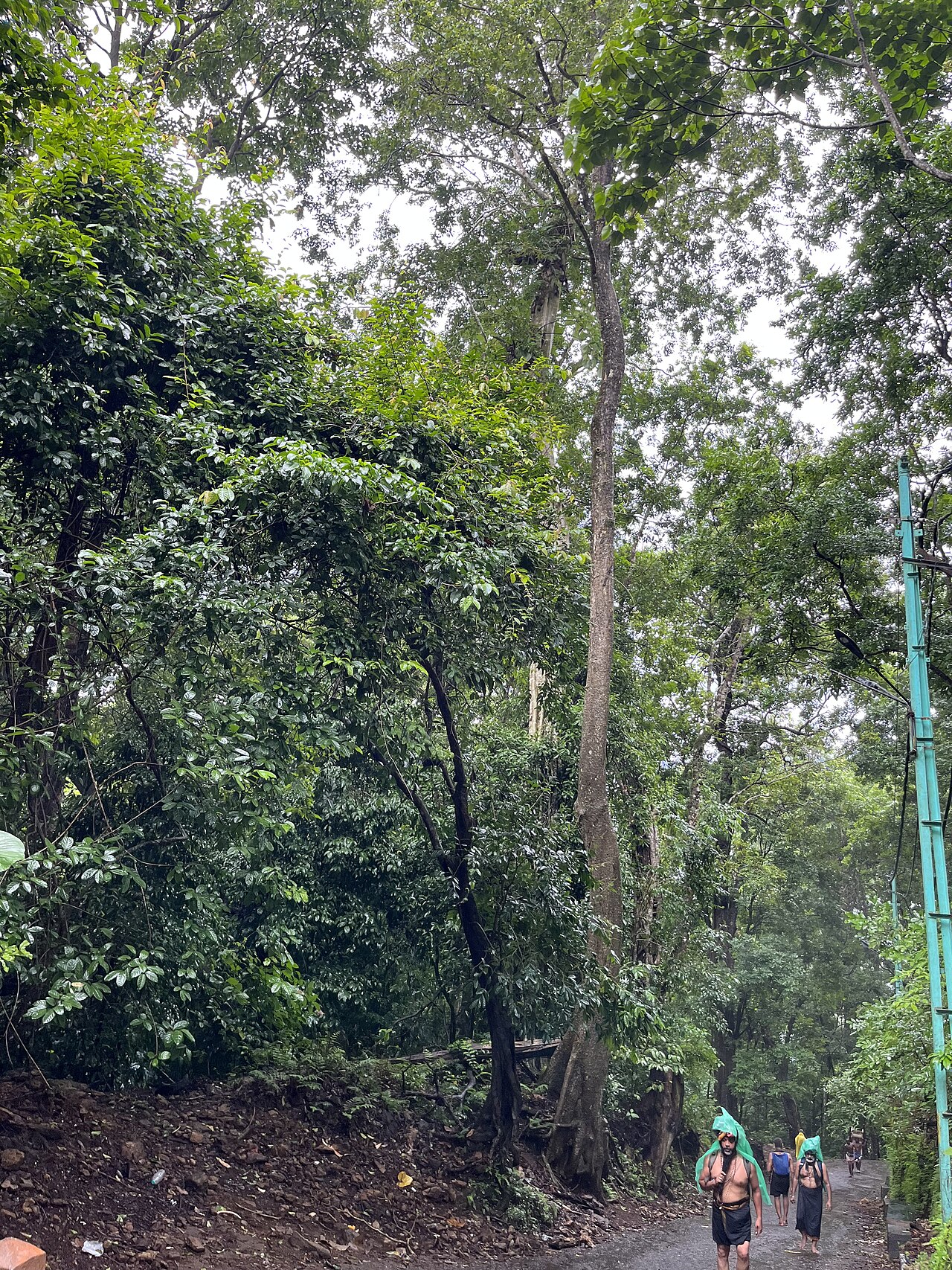
The chant reaches you before the Temple does: Swamiye Saranam Ayyappa, rising and falling along five kilometres of forest path from the Pamba river to the hilltop. Pilgrims in black climb barefoot, each with an irumudi bundle riding on his head, each calling every other man Swami. Then the trees open, and the gold-sheathed sanctum stands on its plateau deep inside the Periyar Tiger Reserve. You cannot simply drop in here. The Temple keeps its own calendar, and its great stairway opens only to those who arrive under a vow.
Lord Ayyappa Is Worshipped here as Hariharasuthan, the Son born of Lord Shiva and of Lord Vishnu in His Mohini form, seated as an eternal brahmachari in yogic stillness, His right hand raised in blessing.
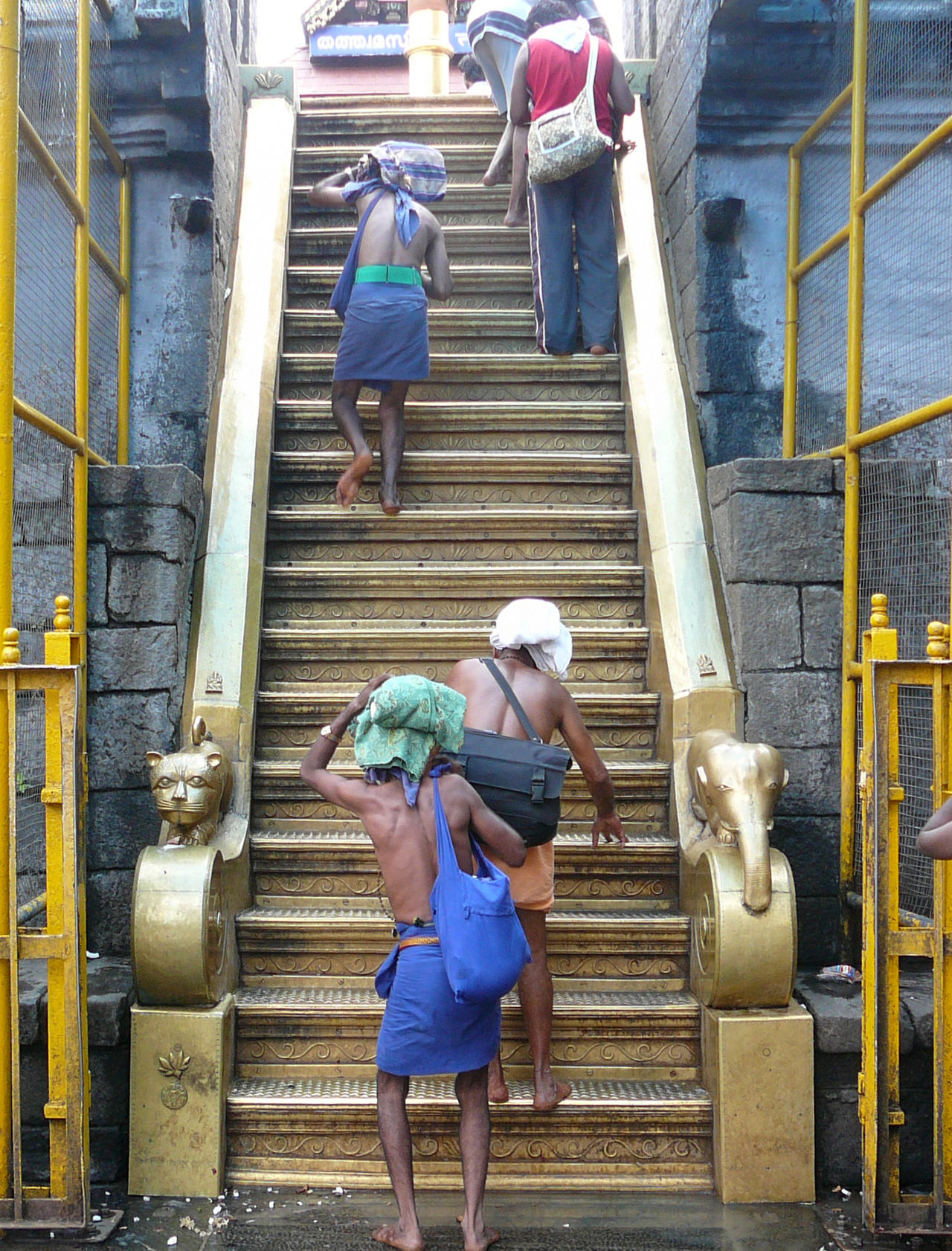
The pathinettam padi, the eighteen gold-clad sacred steps, may be climbed only by a pilgrim who has kept the 41-day vratham and carries the irumudi kettu on his head. No vow, no steps.
The pilgrimage crosses the lines the world draws. Before entering the forest at Erumeli, pilgrims of every caste and creed pay respects at the mosque of Vavar Swami, the Muslim companion of the Lord, and a shrine to Vavar stands at the Sannidhanam itself.
The story the forest tells
Tradition holds that the demoness Mahishi had won a boon that no son of Lord Shiva or of Lord Vishnu alone could destroy her. So the two became one: from Lord Shiva and from Lord Vishnu in the enchanting form of Mohini was born a Divine Child, left on the banks of the Pamba with a golden bell at His throat. The childless Raja of Pandalam found Him there, named him Manikandan, the bell-necked one, and raised Him as a prince.
When palace intrigue sent the boy to the forest to fetch a tigress's milk for an ailing queen, He returned riding the tigress herself. On the way, the legend says, He met Mahishi at Erumeli and ended her; pilgrims still dance the pettathullal there in the joy of that deliverance. There too He bound His friendship with Vavar, a Muslim warrior who fought Him and then loved Him, and whom He asked His devotees to honour first, before ever climbing to His hill.
His work done, the Lord chose the hill named for Sabari, the forest ascetic of the Ramayana who waited a lifetime for Lord Rama, and merged with the Dharma Sastha enshrined there, seated forever in the yogapatta, vowed to celibacy. The Pandalam kings raised His shrine and keep His ornaments to this day. Fire took the Temple in 1902 and again in 1950; the present panchaloha image of Swami Ayyappan, about one and a half feet tall, was consecrated after that second fire, and the Travancore Devaswom Board now tends the hill.
What you'll actually see
1
The Pathinettam Padi
Eighteen steps rise from the courtyard to the sanctum gate, sheathed in gleaming panchaloha alloy since 1985 and flanked by guardian shrines. Pilgrims break a coconut before the first step and climb with the irumudi balanced on the head; tradition reads the steps as the eighteen hills around the shrine, or the eighteen stages the seeker must cross.
2
The golden Sreekovil
At the top of the steps the Sannidhanam opens out: the sanctum with its gold-plated roof and four golden finials, the copper-clad mandapams, the ever-burning aazhi fire pits, and the flagstaff raised in 1969. Nearby stands the shrine of the goddess Maalikappurathamma, honoured by pilgrims almost as deeply as the Lord Himself.
3
The path itself
The last Temple of the journey is the forest. From Pamba the paved path climbs about five kilometres through the Periyar Tiger Reserve canopy, past Neelimala and the Sabari Peedam; the old route from Erumeli runs some 61 kilometres over Karimala, walked barefoot for centuries. Each night at closing the Harivarasanam lullaby is sung as the lamps go out.
Pilgrims with irumudi bundles on their heads climbing the eighteen gold-clad sacred steps at SabarimalaPilgrims trekking the forest path through the Periyar Tiger Reserve toward the Sabarimala Temple
The gold-clad eighteen steps, and the forest path from Pamba · photos CC BY-SA, Wikimedia Commons
The night the hill watches the sky
Makaravilakku · 14 January 2027
On Makara Sankranti evening the two-month season reaches its summit. The Thiruvabharanam, the sacred ornaments of Lord Ayyappa, arrive in procession from the Pandalam palace and adorn the Lord as the evening deeparadhana begins. At that hour every eye turns east toward the ridge of Ponnambalamedu, where a flame appears three times against the dark; the Devaswom Board has acknowledged that the lamp is lit there, and the answering roar of Saranam from lakhs of throats does not dim for it. The Mandala season that precedes it opens on 16 November 2026 and closes with the Mandala Pooja on 27 December 2026; the shrine reopens on 30 December for the Makaravilakku season, through 20 January 2027.
These are the heaviest days on the hill, with around half a million devotees on Makaravilakku itself: book a virtual queue slot the day booking opens, and allow a full day for the climb and darshan.
Plan your visit
By air
Cochin International Airport about 160 km; Thiruvananthapuram International about 170 km.
By rail
Chengannur about 85 km and Kottayam about 96 km; both run special services in season.
By road
Private vehicles park at the Nilakkal base camp; KSRTC shuttle buses cover the last 22 km to Pamba.
The climb
About 5 km on foot from Pamba, steep in stretches; the traditional Erumeli forest route is about 61 km.
When it opens
Mandala season 16 Nov to 27 Dec 2026, Makaravilakku season 30 Dec 2026 to 20 Jan 2027, Vishu in April, and the first five days of each Malayalam month. Closed otherwise.
Timings in season
Nada open 3 am to 1 pm and 3 pm to 11 pm; Neyyabhishekam till 11 am; Harivarasanam at 10:50 pm.
Dress
Black or blue mundu after the 41-day vratham; the irumudi kettu is required for the eighteen steps.
The queue
Darshan is free, but a virtual queue slot on sabarimalaonline.org is mandatory in season; limited spot booking at Pamba, Nilakkal, Vandiperiyar and Chengannur.
The hill is named for Sabari, the ascetic of the Ramayana who waited a lifetime to offer Lord Rama the fruit she had tasted for sweetness.
The 41-day vratham asks celibacy, a vegetarian table, no intoxicants, plain black or blue dress and a tulasi or rudraksha mala; for those days the pilgrim himself is addressed as Ayyappa or Swami.
The prasadam is aravana payasam in sealed tins and soft unniyappam, cooked in the Temple kitchens; in peak season the counters cap how many tins each pilgrim may carry down.
Pilgrims who arrive without an irumudi may have darshan through the northern gate, but the eighteen steps themselves are reserved for the vow-keepers.
Questions pilgrims ask
Can I visit Sabarimala at any time of year?
No, and this is the fact that surprises most first-time pilgrims. The Temple opens only during the Mandala and Makaravilakku seasons from mid-November to mid-January, for Vishu in April, and for the first five days of each Malayalam month. The rest of the year the hill rests in silence.
Can women make this pilgrimage?
Women under ten and over fifty have always climbed the hill in large numbers. By custom, women of ten to fifty do not enter, a practice the tradition ties to the Lord's vow of eternal celibacy. In 2018 the Supreme Court of India ruled 4 to 1 that women of all ages may enter; review petitions were referred to a larger bench, and a nine-judge bench heard the questions and reserved its judgment in May 2026. While the matter awaits final judgment, the customary practice continues to be observed at the shrine.
Do I have to keep the 41-day vratham and carry the irumudi?
The vratham and the irumudi kettu, the two-chambered bundle holding the ghee-filled coconut and offerings, are the heart of the tradition, and only pilgrims carrying the irumudi may climb the eighteen sacred steps. Those without one may still reach the Sannidhanam and have darshan through the northern gate.
What is the Makara Jyothi?
At the evening deeparadhana on Makara Sankranti, devotees watch the sky toward Ponnambalamedu: for the star hailed as Makara Jyothi, and for the Makaravilakku flame that appears three times on the ridge. The Devaswom Board has acknowledged the flame is lit there; for the devotee on the hill, the moment remains the summit of the pilgrimage.
How do I book darshan?
Register on sabarimalaonline.org, the Travancore Devaswom Board portal, and reserve a free virtual queue slot with ID details for each pilgrim; booking for the season opens in advance and slots for peak days go quickly. Limited spot booking is available at Pamba, Nilakkal, Vandiperiyar and Chengannur.
Dharamshalas and guest houses near this Sthan, shared by devotees. Adisthan takes no bookings and no money; contact each stay directly.
No stays are listed here yet. Know one that serves pilgrims well?
Are you a priest, officer, or sevak of the Sabarimala Sree Dharma Sastha Temple or the Travancore Devaswom Board? Claim this page to keep season dates, queue guidance, and timings true for pilgrims worldwide.