Praza do Obradoiro · Santiago de Compostela, Galicia, Spain
Every road ends here, at the tomb where Europe learned to walk.
Be the first to check in
Coming up: Transfer of the Apostle's Remains (Traslacion) · 30 DecEntry tended 11 Jul 2026
Open daily 7 am to 9 pm Cathedral free · Museum from 9€ Feast of St. James · 25 July Botafumeiro on 11 solemnities Romanesque · consecrated 1211
Cross under the arch into the Praza do Obradoiro and you hear it first: boots on granite, walking staffs going still, someone laughing and crying at once. Pilgrims lie flat on the flagstones, packs under their heads, gazing up at a Baroque facade the colour of wet stone and old gold. They have walked a week, a month, sometimes half a year. Inside, past the incense and the organ, a small stair climbs behind the high altar. You do not come here only to see the Apostle. You come to put your arms around him.
Beneath the high altar, in a silver urn in the crypt, rest the relics venerated as those of St. James the Apostle, one of the Twelve. For some twelve centuries this tomb has stood with Jerusalem and Rome among the great pilgrimage goals of Christendom.
This is the end of the Camino de Santiago. The Camino Francés, the Portugués, the del Norte, the Primitivo, the Inglés and the Vía de la Plata all finish at these doors, and pilgrims who complete at least the last 100 km on foot receive the Compostela.
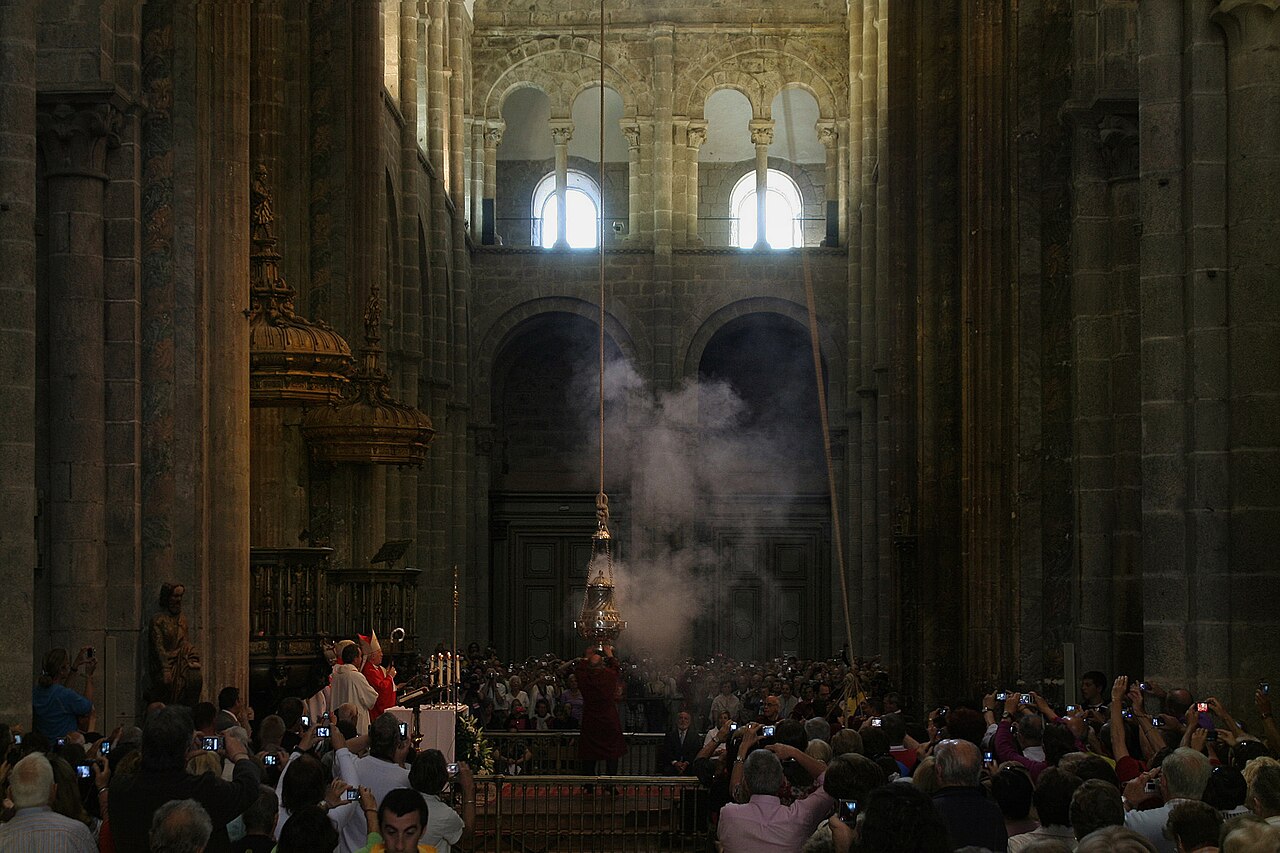
The Botafumeiro, a silver-plated thurible of about 80 kg, flies through the transept on a 65 metre arc, hauled on its rope by eight tiraboleiros, trailing incense at close to 68 km/h. No other church on earth keeps such a rite.
The hermit, the field of the star, and the road that built Europe
Tradition holds that James, son of Zebedee, fisherman of Galilee and one of the Twelve, carried the faith to Hispania, the far western edge of the known world. After he was put to the sword in Jerusalem, the first of the apostles to be martyred, the legend says his disciples bore his body to the sea, and a boat carried it to the coast of Galicia, where it was laid in a Roman burial ground and forgotten for nearly eight hundred years.
Early in the ninth century a hermit named Pelayo watched lights hang over a wooded hill night after night. Bishop Theodomir of Iria came, dug, and found a mausoleum of the Roman age, and proclaimed it the tomb of the Apostle. King Alfonso II walked from Oviedo to venerate the relics, remembered as the first pilgrim on a road that has never since been empty. An old telling hears in the city's name campus stellae, the field of the star. A church rose over the tomb, was burned to ashes by Al-Mansur in 997, the tomb itself left untouched, and rose again.
The cathedral you enter today was begun in 1075 under King Alfonso VI and Bishop Diego Peláez, and consecrated in 1211 in the presence of King Alfonso IX. In 1188 Master Mateo set his Pórtico de la Gloria over the west door, some two hundred carved figures of prophets, apostles and musician elders. Five centuries later Fernando de Casas Novoa wrapped the Romanesque church in the granite Baroque of the Obradoiro facade, the face every arriving pilgrim now sees first.
What you'll actually see
1
The Obradoiro facade and its staircase
Completed in 1740, a cliff of carved Galician granite between twin towers rising 75 metres, with St. James dressed as a pilgrim at its crown. After rain the stone darkens and the gold lichen glows. The double staircase beneath it has received arriving pilgrims for nearly three centuries.
2
The Pórtico de la Gloria
Master Mateo's Romanesque masterpiece of 1188: three deep arches crowded with prophets, apostles and the elders of the Apocalypse tuning their instruments around Christ in glory. Its restored medieval colour is seen on a timed 25 minute visit, in small groups, with no photography.
3
The crypt and the embrace
The queue in the ambulatory leads down worn steps to the crypt, built on the site of the Roman mausoleum, where a silver urn holds the relics of the Apostle and his disciples Athanasius and Theodorus. Then a narrow stair climbs behind the high altar to the 13th century statue of St. James, where pilgrims rest their arms on his jewelled cape in the traditional embrace.
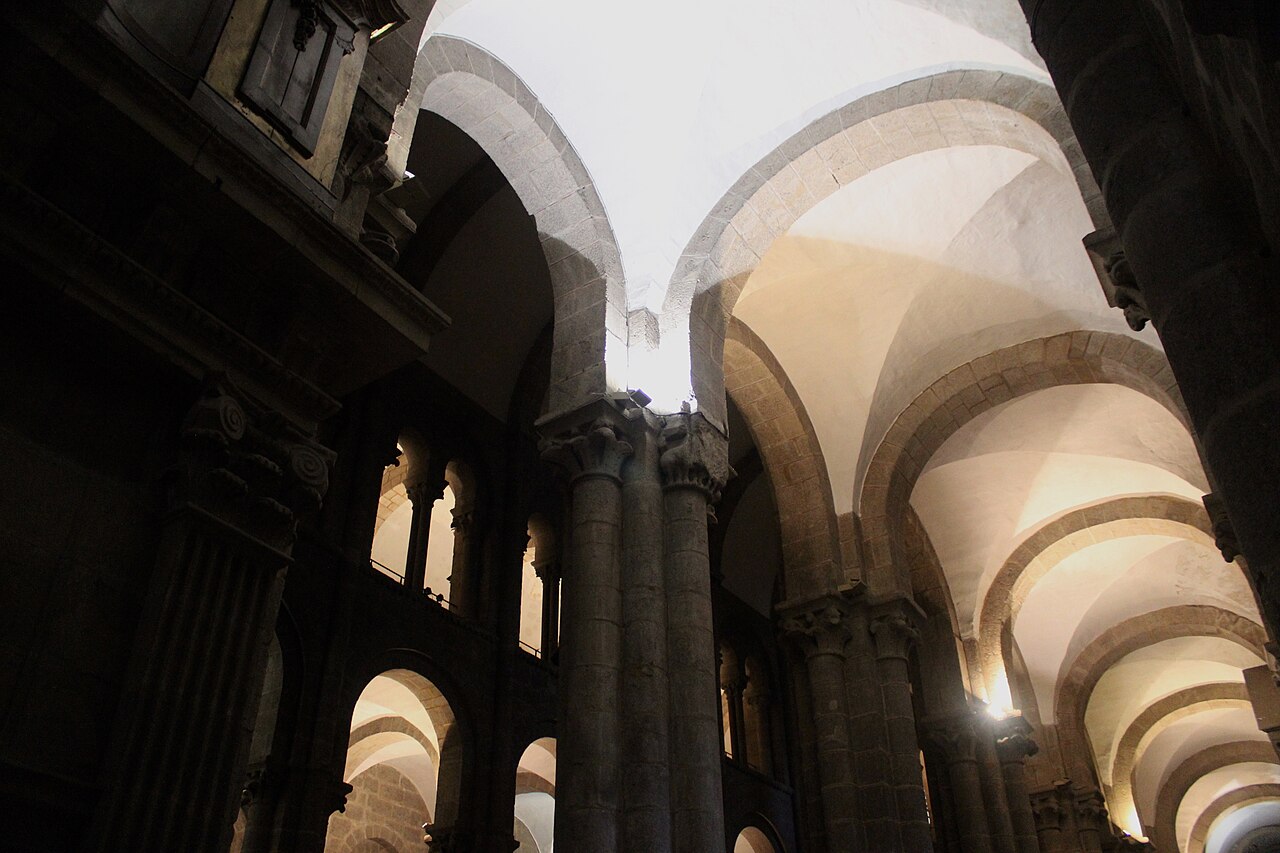
The Botafumeiro in mid flight above the crossing of Santiago CathedralThe Romanesque nave of Santiago Cathedral looking toward the high altar
The Botafumeiro in flight, and the Romanesque nave · photos CC BY 2.0 wolfgang.mller54 and CC BY-SA 4.0 Miguel Hermoso Cuesta, Wikimedia Commons
THE RITE FOUND NOWHERE ELSE
The Botafumeiro flies · Feast of St. James, 25 July 2026
At midnight on 24 July the Praza do Obradoiro fills for the Fogos do Apóstolo, fireworks and light projected across the cathedral facade. On 25 July, the day Galicia keeps as its national day, the solemn Mass of the Martyrdom of St. James is sung, and the Botafumeiro takes flight: eight tiraboleiros haul the rope until the great censer sweeps its 65 metre arc through the transept, swinging to a height of about 21 metres and filling the church with incense smoke. It also flies on ten other fixed solemnities each year, among them Epiphany, Easter Sunday, Pentecost, the Assumption and Christmas, and when pilgrim groups arrange it in advance by writing to botafumeiro@catedraldesantiago.es.
Come hours early on 25 July; if your dates miss a solemnity, an evening Pilgrim's Mass with a pre-arranged group request is your likeliest chance to see it fly.
Plan your visit
By air
Santiago Rosalía de Castro Airport (SCQ), 12 km east at Lavacolla; taxi about 21€ in 15 to 20 min, or bus 6A to the centre every 30 min.
By rail
Santiago de Compostela station has direct trains from Madrid and along the Galician coast; the old town and the cathedral are a short walk uphill.
On foot
The Compostela requires at least the final 100 continuous km on foot or horseback, or 200 km by bicycle, with a pilgrim credential stamped along the way.
Timings
Cathedral open daily 7 am to 9 pm through the Porta de Praterías; museum daily 10 am to 8 pm.
Entry
The cathedral, the tomb and the embrace are free. Museum permanent collection 9€ (reduced 7€); Pórtico de la Gloria 15€ (reduced 12€), timed and booked ahead.
Best time
The 7 am opening is the quietest hour in the nave; the midday Pilgrim's Mass is the fullest of the day, especially in summer.
The Compostela
Issued free at the Pilgrim's Reception Office, open 9 am to 7 pm daily; bring your stamped credential.
Backpacks are not allowed inside the cathedral for security reasons, so leave your pack at your lodging or a storage service before you queue.
A Holy Year, the Ano Santo Xacobeo, comes whenever 25 July falls on a Sunday; the next is 2027, and the Holy Door facing Praza da Quintana is opened on 31 December 2026 and stays open through the year.
Pilgrim's Masses are sung at the high altar at 7:30 am, 9:30 am, 12:00 noon and 7:30 pm daily; Mass in English is at 10:30 am (except Wednesdays) in the Pilgrim's Office chapel, and confession is heard in several languages in the ambulatory chapels.
Photography is prohibited inside the museum and on the Pórtico de la Gloria visit, and bags, umbrellas and walking sticks may not be taken in.
Questions pilgrims ask
Does the Botafumeiro swing at every Pilgrim's Mass?
No, and this is the most common disappointment. It flies on eleven fixed solemnities each year, including 6 January, Easter Sunday, Pentecost, 25 July, 15 August, 8 December, Christmas and 30 December, and additionally when a pilgrimage group has arranged and funded it in advance by email. On an ordinary day it does not appear.
Do I have to walk the Camino to enter the cathedral?
No. The cathedral is open free to everyone, pilgrim or not, every day from 7 am to 9 pm through the Porta de Praterías. Only the museum spaces, the rooftop and the Pórtico de la Gloria visits are ticketed.
How do I receive the Compostela?
Complete at least the final 100 continuous km to Santiago on foot or horseback, or 200 km by bicycle, on a recognised route, for religious or spiritual motives, with a pilgrim credential stamped along the way including your final stage into the city. The certificate is issued free at the Pilgrim's Reception Office.
Can I really visit the tomb of St. James?
Yes, freely. Join the queue in the ambulatory: it leads down to the crypt where the silver urn holding the relics is venerated, then up the stair behind the high altar to embrace the 13th century statue of the Apostle, the pilgrim's traditional final gesture.
What makes 2027 special?
It is a Holy Year, the Ano Santo Xacobeo, declared whenever the Feast of St. James falls on a Sunday. The Holy Door on Praza da Quintana is opened on 31 December 2026, and pilgrims who enter through it, pray, attend Mass and receive the sacraments may gain the jubilee plenary indulgence. Expect the busiest year on the Camino in a generation.
The Sthan in photographs
Darshan from afar
From the temple's own channels. Nothing loads until you press play.
Dharamshalas and guest houses near this Sthan, shared by devotees. Adisthan takes no bookings and no money; contact each stay directly.
No stays are listed here yet. Know one that serves pilgrims well?
Are you of the cathedral chapter, the Archdiocese of Santiago, or the Pilgrim's Reception Office? Claim this page to keep Mass times, Botafumeiro dates and Holy Year notices true for the pilgrims still on the road.