Open 4 am to 10:30 pm Til oil abhishek, daily Shani Amavasya · Sat 10 Oct 2026 5.5 ft slab · open to the sky Darshan free
You walk through gateways and pillared corridors expecting, at the end of them, a Temple. There is none. On a raised platform under the bare Maharashtra sky stands a black slab, five and a half feet of dark stone glistening with oil, garlanded in marigold, a brass vessel dripping above it. No roof shelters Lord Shanidev, no walls enclose him, no door closes on him at night. Then you notice the village around you: the houses have no doors either.
The deity is a swayambhu, a self-emerged black slab about five and a half feet tall, worshipped in the open on a platform called the chauthara: no roof above, no walls around, by Lord Shanidev's own instruction, tradition holds, that the whole sky is his roof.
Shingnapur is the famed village without doors. Houses have door frames but traditionally no doors and no locks, for the village holds itself under Lord Shanidev's direct protection; in 2011 even a bank opened a lockless branch here.
The worship is oil. Devotees pour til (sesame) oil over the slab in an unbroken daily abhishek, swelling every Saturday, Lord Shanidev's own day, and cresting on Shani Amavasya, when around three lakh people arrive in a single day.
The stone that bled, and the village that gave up its doors
The legend says the stone came with the flood. Centuries ago, after a heavy downpour, villagers found a massive black slab washed up in the Panasnala stream. A shepherd prodded it with a pointed stick, and the stone began to bleed. That night Lord Shanidev appeared in the dream of the most devoted of the shepherds and revealed that the slab was his own swayambhu form. He asked to stay in the village, but on his own terms: no Temple was to be built over him and no roof raised, for the whole sky is his roof. He asked only for daily worship, and tel abhishek, the pouring of oil, every Saturday.
The villagers obeyed, and then went further. If Lord Shanidev himself stood unguarded under the open sky, watching the village, what did anyone need doors for? To this day houses in Shingnapur have door frames but, by tradition, no doors and no locks. In January 2011 UCO Bank opened a branch here with no locks on its doors, described as the first lockless bank branch in India. Thefts have been reported in the village, including cases in 2010 and 2011, yet the tradition holds, and the doorless lanes remain the village's living act of faith.
The shrine wrote a new chapter in 2016. For generations the custom had allowed only men, bathed and in wet clothes, onto the chauthara. On 26 January 2016 activist Trupti Desai and hundreds of women marched to the Temple asking to worship there. In late March and early April 2016 the Bombay High Court ruled that women cannot be denied entry to places of worship, citing the Maharashtra Hindu Place of Worship (Entry Authorisation) Act, 1956. On 8 April 2016 the Temple trust opened the chauthara to all devotees, women and men alike.
What you'll actually see
1
The chauthara and the slab
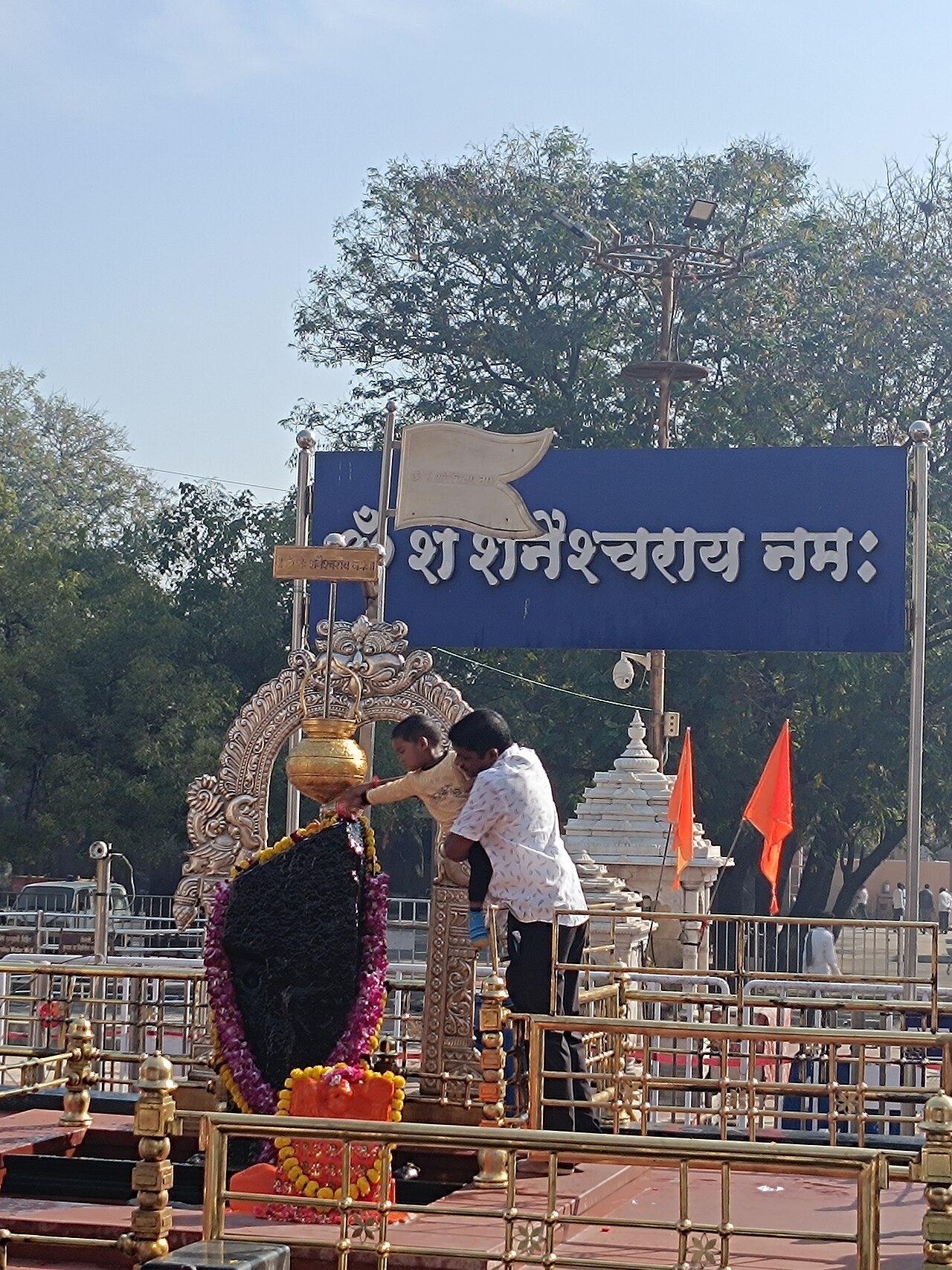
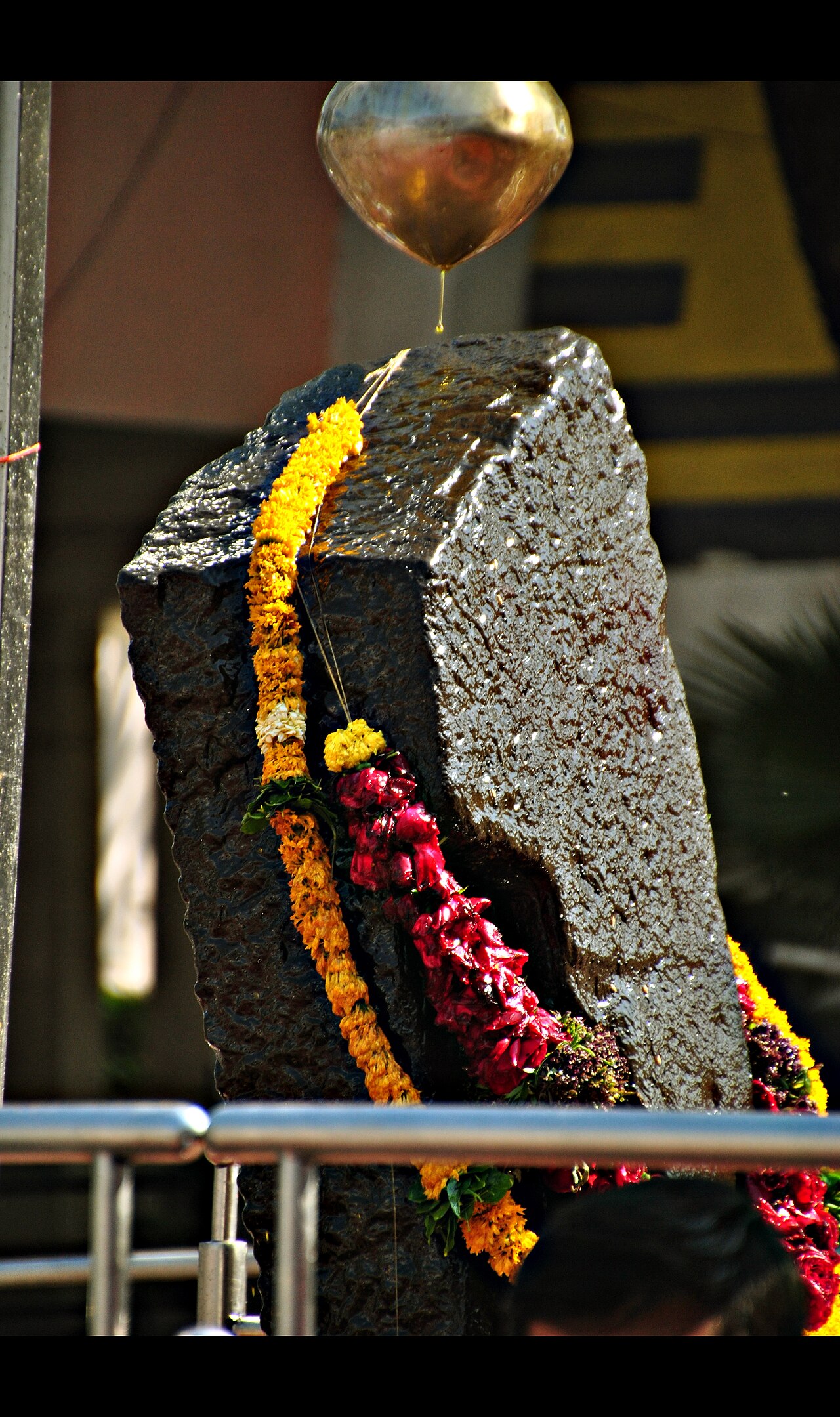
The heart of the shrine is a raised open platform ringed by brass railings. On it stands the black slab of Lord Shanidev, kept wet and gleaming under a suspended vessel from which oil falls on him, with a trident rising beside it and figures of Nandi and Lord Hanuman keeping company. Behind it, a blue signboard carries his mantra: Om Shri Shanaishcharaya Namah.
2
The doorless lanes of Shingnapur
Step off the Temple path into the village and look at the houses: door frames stand open onto living rooms, with at most a curtain drawn across. Shops, homes and even the local UCO Bank branch keep the custom. It is the rarest kind of Temple architecture: a whole village built as an act of trust.
3
The Temple complex and Prasadalay
Around the open shrine the trust has raised gateways, long pillared corridors for the queue, and a tall carved tower that marks the complex from far across the plain. The Prasadalay building serves prasad of Lord Shanidev daily, 10 am to 3 pm and 6 pm to 9 pm, for a nominal amount.
A devotee lifts a child to touch the black slab of Lord Shanidev on the open chauthara at Shani Shingnapur, beneath the golden oil vesselThe garlanded swayambhu slab of Lord Shanidev glistening with sesame oil as a drop falls from the vessel suspended above
Oil offered on the open chauthara, and the swayambhu slab of Lord Shanidev · photos CC0 and CC BY-SA 4.0, Wikimedia Commons
THE DAY THE VILLAGE OVERFLOWS
Shani Amavasya · Saturday, 10 October 2026
When the new moon falls on a Saturday, Lord Shanidev's own day and his own tithi meet, and Shingnapur receives its greatest tide. On ordinary days the shrine sees tens of thousands of devotees; on amavasya around three lakh arrive, queuing through the corridors with bottles of til oil to pour over the slab, seeking relief from sade sati and the weight of Saturn. The next Shani Amavasya falls on Saturday, 10 October 2026. The other summit of the year is Shani Jayanti, Lord Shanidev's birth anniversary on the Jyeshtha Amavasya, next observed on 4 June 2027, when the trust also holds days of continuous chanting and a reading of the Dnyaneshwari each Chaitra.
On Shani Amavasya arrive before dawn and expect hours in the queue; for a quiet darshan choose any plain weekday morning instead.
Plan your visit
By air
Aurangabad (Chhatrapati Sambhajinagar) airport, about 90 km; taxis and buses run to the Temple.
By rail
Rahuri 32 km is closest; Ahmednagar 35 km and Shrirampur 54 km have more connections.
By road
Shirdi 70 km, Ahmednagar 35 km, Pune 160 km, Mumbai 300 km; MSRTC buses and taxis run through the day.
Timings
Temple open 4 am to 10:30 pm; aarti at 4:30 am, 12 noon and sunset.
Fee
Darshan is free.
Best time
A plain weekday morning for quiet darshan; Saturdays and Shani Amavasya for the full tide, with the longest queues.
The custom
Devotees mounting the chauthara traditionally do so bathed, in wet clothes and bareheaded; since 8 April 2016 the platform is open to women and men alike.
The worship here is oil: devotees pour til (sesame) oil over the slab, and the trust warns that no online puja app is authorised, so puja and oil abhishek happen only on the premises.
The village keeps its doorless custom honestly rather than perfectly: thefts were reported in 2010 and 2011, and yet the door frames of Shingnapur still stand open.
Prasad of Lord Shanidev is served daily in the Prasadalay building, 10 am to 3 pm and 6 pm to 9 pm, for a nominal amount per person.
Most pilgrims pair Shingnapur with Shirdi, 70 km away, taking darshan of Sai Baba and Lord Shanidev in a single journey.
Questions pilgrims ask
Is there a Temple building with an idol inside?
No. Lord Shanidev is a self-emerged black slab about five and a half feet tall, standing on an open platform with no roof and no walls around him, by his own instruction in the shepherd's dream, tradition holds. The sky itself is the sanctum.
Can women go onto the chauthara?
Yes. After the Bombay High Court ruled in 2016 that women cannot be denied entry to places of worship, the Temple trust on 8 April 2016 opened the chauthara to all devotees, women and men alike.
Do the houses really have no doors?
Traditionally yes: houses in Shingnapur have door frames but no doors and no locks, held to be under Lord Shanidev's protection, and in 2011 UCO Bank opened a lockless branch here. A few thefts have been reported over the years, yet the custom continues.
Is darshan free, and when is the Temple open?
Darshan is free. The trust keeps the Temple open 4 am to 10:30 pm daily, with aarti at 4:30 am, 12 noon and sunset. Saturdays and amavasya days draw the largest crowds.
What should I offer?
Til (sesame) oil is the offering of this shrine, poured over the slab as abhishek. Oil is easily bought in the village; those mounting the platform follow the custom of a bath, wet clothes and a bare head.
Dharamshalas and guest houses near this Sthan, shared by devotees. Adisthan takes no bookings and no money; contact each stay directly.
No stays are listed here yet. Know one that serves pilgrims well?
Are you a trustee or sevak of Shri Shaneshwar Devasthan, Shanishingnapur? Claim this page to keep darshan timings, abhishek guidance and festival days true for the lakhs who travel to Lord Shanidev's open sky.