Open 6 am to 6 pm daily ₹40 Indian · ₹600 foreign · under 15 free Early 8th-c. Pallava structural granite Lord Shiva twice · Lord Vishnu between Indian Dance Festival · late Dec to mid Jan
You hear the surf before you see the stone. Across a lawn bent by sea wind, past a screen of casuarina trees, two weathered pyramids of granite rise straight out of the sand, so close to the Bay of Bengal that spray still reaches their carvings. Salt has softened every face into something between sculpture and sea rock. Walk the ring wall where ranks of stone bulls keep watch, and the strangeness settles in: on a coast famous for Temples carved out of rock, this one was built, block upon block, at the very edge of the water.
One of the oldest structural stone Temples of South India: raised from dressed granite blocks around 700 to 728 CE, it marks the moment Pallava builders stepped beyond caves and monoliths, opening the road that leads to the great Dravidian Temples of the Cholas.
A single platform holds three sanctums: an east-facing shrine of Lord Shiva that catches the sunrise over the sea, a west-facing shrine of Lord Shiva behind it, and between them Lord Vishnu Reclining as Anantashayana, His image carved on the living bedrock.
The last of the mariners' Seven Pagodas: European seafarers from Marco Polo onward named this coast for seven towers, six of them lost to the sea in the telling, and the 2004 tsunami briefly drew back the water to reveal submerged stonework offshore.
The seventh pagoda
Thirteen centuries ago this beach was a harbour. Mamallapuram was the great port of the Pallava kings, its ships trading as far as Southeast Asia, and for two generations its rock faces had been carved into caves, rathas, and the vast relief of the Descent of the Ganges. Then, around the turn of the eighth century, King Narasimhavarman II, remembered as Rajasimha, who reigned from about 700 to 728 CE, did something new on this coast: instead of cutting a shrine out of the hill, his builders raised one out of quarried granite, block set upon block, at the line where the sand meets the sea.
The Temple they left is really three. The tall eastern vimana of Lord Shiva, called Kshatriyasimhesvara in the inscriptions, opens toward the water so that the first sun over the Bay of Bengal falls into the sanctum, where a sixteen-faceted pillar of polished black basalt, the Dharalinga, still stands. Behind it a smaller shrine of Lord Shiva, Rajasimha Pallavesvara, faces west toward the town. And between the two, in a low chamber, Lord Vishnu Sleeps upon the serpent Ananta, His form carved not from a quarried block but from the bedrock of the shore itself, a shrine that may be older than everything around it.
The sailors of later centuries knew none of these names. To them the tower was a seamark, and the tale that travelled with Marco Polo's generation spoke of seven pagodas on this coast, six of which the sea had taken. Legend or memory, the ocean has kept its counsel: when the tsunami of December 2004 drew the water far back from this beach, watchers saw rows of submerged stones offshore, and a collapsed granite structure was exposed nearby. Today the Temple is a protected monument in the care of the Archaeological Survey of India, no longer a shrine of daily worship, inscribed by UNESCO in 1984 among the Group of Monuments at Mahabalipuram: a prayer in granite that the sea has answered, wave by wave, for thirteen hundred years.
What you'll actually see
1
The twin vimanas
Two stepped pyramids of grey granite, the taller rising about 18 metres above its platform, their tiers crowded with wave-worn lions, nymphs, and miniature shrines. Inside the main east sanctum stands the Dharalinga, a sixteen-faceted linga of black basalt, and on the inner walls of both Shiva shrines are carved Somaskanda panels: Lord Shiva Enthroned with Maa Parvati and the child Skanda between them.
2
The wall of Nandis
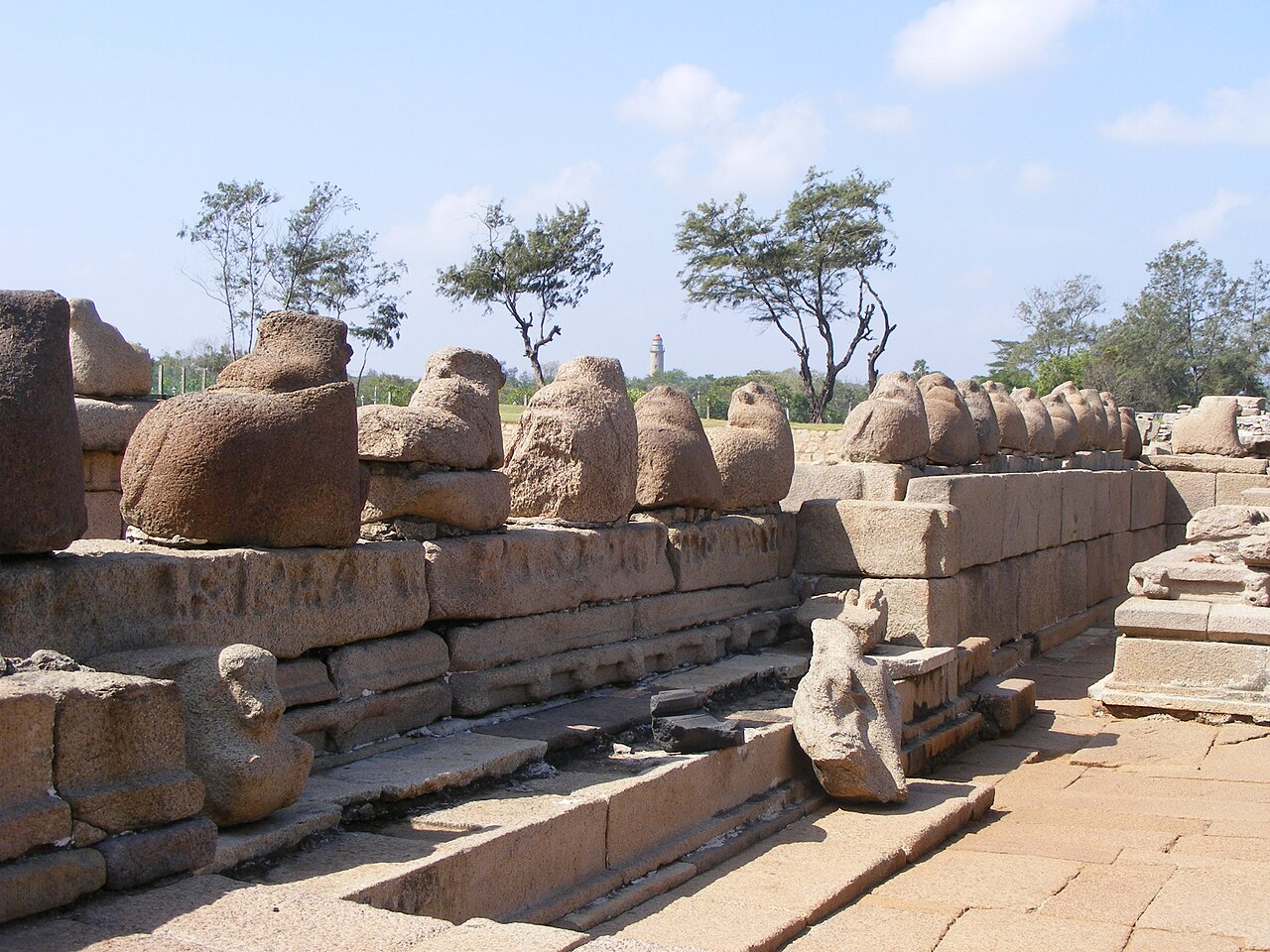
The boundary wall of the compound is crowned with row upon row of seated Nandi bulls, dozens of them, each carved whole and now rounded soft by centuries of salt wind. No other early Temple wears its herd like this; walk the perimeter and you pass beneath their patient watch the entire way.
3
The sleeping Lord and the lion of Maa Durga
In the low central chamber Lord Vishnu Rests full length upon the bedrock as Anantashayana. Nearby stands a monolithic lion, the mount of Maa Durga, with an image of The Goddess on its body and a carved cavity in its chest, and beside the compound a miniature shrine with a Varaha image, uncovered only in 1990, recalls the site's earliest builders.
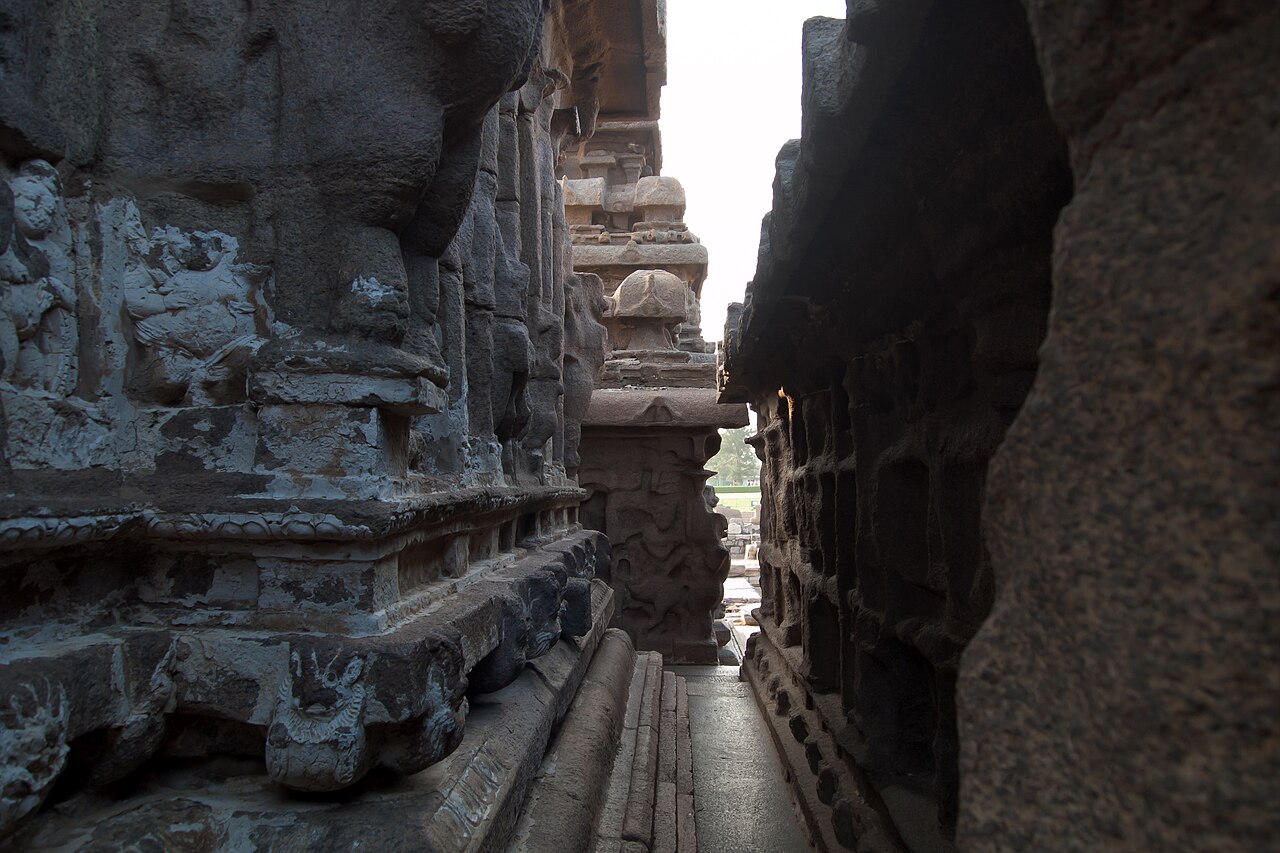
Rows of weathered Nandi bulls seated along the boundary wall of the Shore Temple, with the Mahabalipuram lighthouse in the distanceThe narrow carved passage between the shrines of the Shore Temple, its granite reliefs softened by centuries of sea air
The Nandi ranks on the boundary wall, and the carved passage between the shrines · photos by Amritamitraghosh (CC BY-SA 3.0) and Argenberg (CC BY 4.0), Wikimedia Commons
A MONTH OF DANCE BENEATH THE TOWERS
The Indian Dance Festival at Mamallapuram
Each winter the Department of Tourism of Tamil Nadu turns the monuments into an open-air stage. For about a month, from the third week of December to the middle of January, evening after evening of Bharatanatyam, Kuchipudi, Kathak, Odissi, Mohiniyattam, Kathakali, and Tamil folk forms is danced against the floodlit stones; the 2025-26 edition ran from 21 December 2025 to 19 January 2026, with performances from 5:30 to 8:30 pm. The dance carved on these rocks thirteen centuries ago steps off the wall and breathes.
Dates for the 2026-27 edition are announced by Tamil Nadu Tourism late in the year; December evenings by the sea are cool, so carry a light layer.
Plan your visit
By air
Chennai International Airport (MAA), about 52 km away; taxis and buses run down the East Coast Road.
By rail
Chengalpattu Junction (CGL) is the nearest railhead, about 29 km by road, with buses and taxis onward; Chennai's stations are about 60 km away.
By road
About 60 km south of Chennai along the scenic East Coast Road (ECR); public and private buses serve Mamallapuram through the day.
Timings
6 am to 6 pm, every day of the week.
Entry
₹40 for Indian and SAARC/BIMSTEC visitors, ₹600 for other foreign visitors, children under 15 free. One ticket covers the whole Mahabalipuram monument group, including the Five Rathas.
Best time
Sunrise, when the east shrine of Lord Shiva catches the first light over the Bay of Bengal; the cooler months from November to February are kindest.
The other monuments
The Descent of the Ganges relief, the cave mandapas, and the Five Rathas all lie within the small town, an easy walk or a short ride apart.
This is a protected monument of the Archaeological Survey of India, not a shrine of daily worship; the living worship of the town continues at the Sthalasayana Perumal Temple (Thirukadalmallai), whose deities are carried in procession to this shore for a sea bath each Masi Magam, falling on 20 February in 2027.
The town's name honours Narasimhavarman I, called Mamalla, the great wrestler, under whom most of the rock-cut monuments were carved a generation before the Shore Temple was built.
The Archaeological Survey of India has raised a groyne wall against the surf and planted casuarina belts to slow the salt wind; the seaward carvings are wave-softened, and the sharpest details survive on the landward faces.
The compound is open lawn and sand with little shade, and the sea wind is constant; go early, carry water, and hold onto your hat.
Questions pilgrims ask
Is worship still offered at the Shore Temple?
No. The Temple is a protected monument in the care of the Archaeological Survey of India, without daily puja or resident priests. It is honoured as a monument of devotion, and pilgrims seeking living darshan go to the town's active Temples, including the Sthalasayana Perumal Temple a short walk inland.
Were there really seven pagodas, with six under the sea?
That is the mariners' tradition, and the page tells it as tradition. European seafarers from Marco Polo's era onward called this coast the Seven Pagodas. What is fact: the 2004 tsunami briefly exposed submerged stone structures offshore and a collapsed granite Temple nearby, and explorations have mapped man-made stonework under the water. How many Temples the sea holds, archaeology has not settled.
Which deities does the Temple hold?
Three sanctums stand on one platform: the main east-facing shrine of Lord Shiva (Kshatriyasimhesvara), holding the sixteen-faceted basalt Dharalinga; a smaller west-facing shrine of Lord Shiva (Rajasimha Pallavesvara); and between them Lord Vishnu Reclining as Anantashayana, carved on the bedrock itself.
Does one ticket cover the other monuments?
Yes. A single Archaeological Survey ticket, ₹40 for Indians and ₹600 for foreign visitors, admits you to the whole Group of Monuments at Mahabalipuram, including the Five Rathas and the cave Temples, on the same day.
When is the dance festival held?
Annually from the third week of December to the middle of January, organised by Tamil Nadu Tourism, with evening performances against the floodlit monuments. The 2025-26 edition ran from 21 December 2025 to 19 January 2026; watch Tamil Nadu Tourism's announcements for the 2026-27 dates.
Dharamshalas and guest houses near this Sthan, shared by devotees. Adisthan takes no bookings and no money; contact each stay directly.
No stays are listed here yet. Know one that serves pilgrims well?
Do you serve in the stewardship, conservation, or study of the Mahabalipuram monuments? Claim this page to keep its timings, fees, and festival dates true for every seeker who comes to stand where the Pallavas met the sea.