Srikalahasti · Tirupati district, Andhra Pradesh, India
No window, no wind, and still the flame trembles: the Lord Is breathing.
Be the first to check in
Coming up: Maha Shivaratri Brahmotsavam · 6 MarEntry tended 29 Jun 2026
Rahu-Ketu pujas 6 am to 5 pm daily Free darshan · special entry from ₹50 Maha Shivaratri · 6 Mar 2027 36.5 m Rajagopuram · 1516, rebuilt 2017 The lamp that never stands still
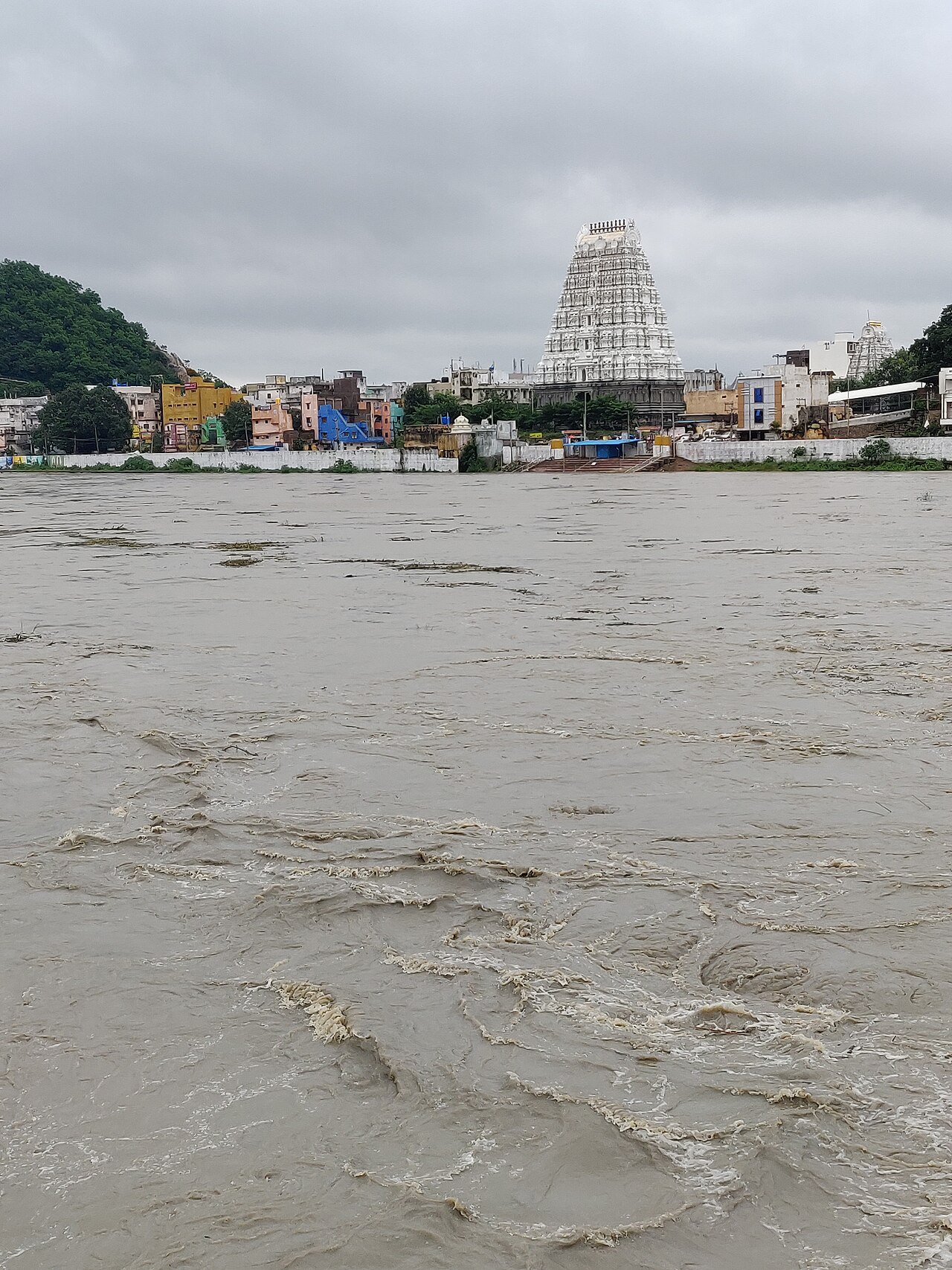
The Swarnamukhi slides past the bathing ghat, and above the steps the pale Rajagopuram climbs out of the town. Behind the shrine a bare hill leans in so close that the living rock becomes the Temple's eastern wall. Inside, past the hundred-pillared hall, the corridors narrow and darken toward a sanctum that has no window. Watch the lamps. One flame will not stay still. And the Lord within has never once been touched by a human hand, not even the priest's.
One of the five Pancha Bhoota Sthalams, where Lord Shiva Is Worshipped as a single element of creation. This is the shrine of air: the Vayu lingam, whose presence is read in a lamp that wavers day and night inside a windowless sanctum no wind can enter.
The white swayambhu lingam is never touched by any human hand, the priests included. The bathing mixture, the sandal, the flowers and the sacred thread are all offered to the utsava murti; the Lord's own form stays forever untouched.
This is India's best-known seat of the Rahu-Ketu Sarpa Dosha Nivarana puja, performed through the day, every day, and the shrine famously stays open even through solar and lunar eclipses, when Temples across the land close their doors.
The spider, the serpent and the elephant
The Temple carries its worshippers in its own name. In the Krita Yuga, the legend says, a spider (Sri) wove a web over the Lord in the shape of a Temple, and when a lamp flame threatened its work it leapt to swallow the fire and was taken into Him. In the next age a serpent (Kala) laid gems from the underworld on the linga each day; then an elephant (Hasti) bathed the Lord with river water carried in its trunk and crowned Him with bilva leaves, sweeping the gems aside. Each finding their worship undone, the two fought until both fell, and Lord Shiva granted that their three names merge with His: Srikalahasteeswara. Devotees still read their marks on the white lingam: the snake's hoods, the tusks, the spider.
Here too worshipped Thinnan, the hunter the world remembers as Bhakta Kannappa. The Periya Puranam tells how he saw the Lord's eye bleeding and plucked out his own to stanch it, and when the second eye welled up, set his foot on the linga to mark the place and raised the arrow to his remaining eye. The Lord stopped his hand, restored his sight, and granted him liberation. Kannappa stands among the sixty-three Nayanmars, and his shrine crowns the hill above the Temple.
Appar, Sambandar, Sundarar and Manikkavasagar all sang the Lord of Kalahasti in the Tamil canon, and for two thousand years the town has been honoured as Dakshina Kailasam, the Kailash of the south, its Swarnamukhi river as a southern Ganga. A Pallava core of the fifth century was renewed by Rajendra Chola I, given gopurams under Kulottunga Chola I, and crowned in 1516 when Krishnadevaraya of Vijayanagara raised the great gopuram and the hundred-pillared hall.
What you'll actually see
1
The Rajagopuram by the river
Krishnadevaraya's gateway of 1516 rises 36.5 metres (120 feet) near the Swarnamukhi ghat. The old tower collapsed on 26 May 2010; it was rebuilt in its original form on the same spot at a cost of about ₹45 crore and consecrated on 18 January 2017, so the skyline the Vijayanagara emperor gave the town stands whole again.
2
The hundred-pillared hall and the buried Ganapati
Inside, the hundred-pillared hall of 1516 carries its carvings toward the inner courts, where Maa Gnanaprasunambika, the Mother Who Bestows the flower of knowledge, Receives Her own worship beside the Lord. In the outer prakaram, steps lead about nine feet down into the rock to Patala Ganapati, a sunken shrine of Lord Ganesha carved into the earth itself.
3
Kannappa's hill
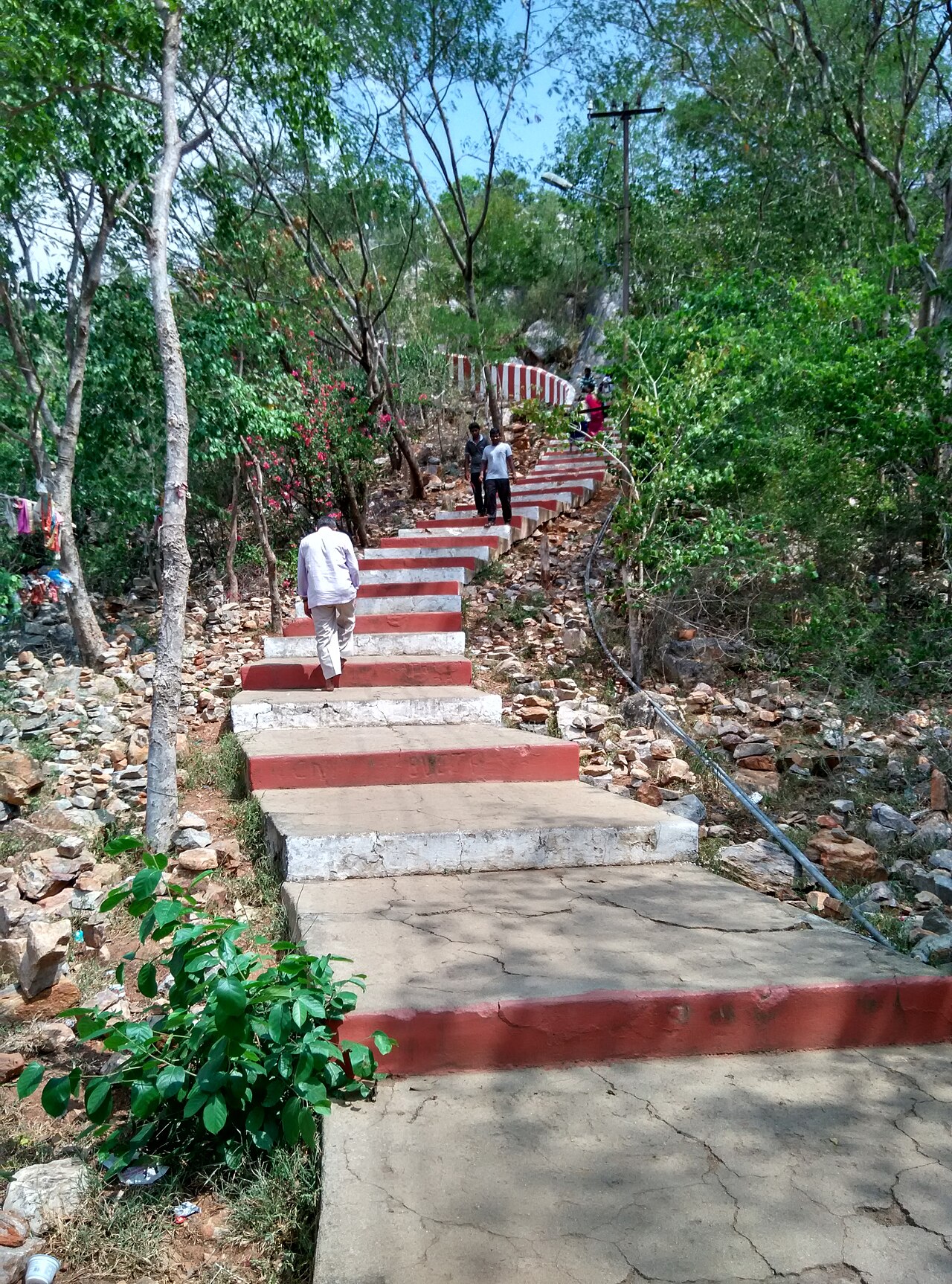
South of the main Temple, past the Dakshina gopuram, a stair of some three hundred steps climbs the hillock to the small shrine of Bhakta Kannappa, the hunter-saint. From the top the whole Temple lies below you: the gopurams, the river, and the roofs of the town he once hunted above.
The Swarnamukhi river below the tall gopuram at SrikalahastiStone steps climbing the hill to the Bhakta Kannappa shrine above Srikalahasti Temple
The Swarnamukhi below the gopuram, and the steps up Kannappa's hill · photos CC BY-SA 3.0/4.0 రవిచంద్ర (Ravichandra), Wikimedia Commons
THE RITE FOUND NOWHERE ELSE
Rahu-Ketu Sarpa Dosha Nivarana · every day, 6 am to 5 pm
Devotees come from every corner of India for the puja this Temple is famous for: the rite that quiets Rahu and Ketu, the shadow planets, and the afflictions of sarpa dosha traced to them in a birth chart. The devasthanam performs it daily from 6 am to 5 pm, at ticket tiers of ₹500, ₹750, ₹1,500, ₹2,500 and ₹5,000, and the Temple streams the paroksha seva live each day. The press of devotees peaks on new-moon days, Sundays and eclipse days, for this shrine keeps its doors open even while an eclipse darkens the sky.
Tickets are sold at the Temple counters and online through the AP endowments portal (aptemples.ap.gov.in); wear traditional dress for sevas and carry a government photo ID.
Plan your visit
By air
Tirupati Airport (TIR) is about 29 km away; Chennai International (MAA) about 96 km.
By rail
Srikalahasti has its own station on the Tirupati to Vijayawada broad-gauge line, where express trains stop; Renigunta Junction is 25 km away.
By road
About 36 km from Tirupati; APSRTC buses leave Tirupati for Srikalahasti every few minutes, so most pilgrims pair the Temple with Tirumala.
Timings
Rahu-Ketu pujas run 6 am to 5 pm at the devasthanam's official rate card; the Temple itself keeps long, effectively continuous hours from before dawn to about 9 pm.
Darshan
General darshan is free; Special Entrance ₹50, Seeghra Darsanam ₹200, and inner-sanctum darshan ₹500, the last open only to devotees in traditional dress.
Dress
Hindu traditional wear is required for all sevas (no sleeveless or modern clothes); carry a government ID, and children above ten need their own ticket.
Best time
A weekday morning away from new-moon days for quiet darshan; the Maha Shivaratri Brahmotsavam, about two weeks of vahana processions, Rathotsavam and Teppotsavam around Shivaratri (6 March 2027), if you have come for the festival.
The climb
Keep half an hour for the stepped path up Kannappa's hill south of the Temple; the view takes in the gopurams and the river.
The name is three devotees fused into one Lord: Sri the spider, Kala the serpent, Hasti the elephant, whose names Lord Shiva took as His own.
The white lingam is held to be swayambhu, self-manifested, and tradition sees it as solidified camphor; no abhishekam ever falls on it directly, only on the utsava murti.
The shrine stays open through solar and lunar eclipses, when most Hindu Temples close, and eclipse days are among its busiest.
Booked seva tickets cannot be cancelled, redated or transferred, so fix your dates before paying.
Questions pilgrims ask
Is abhishekam poured over the Vayu lingam?
No. The main lingam is never touched, not even by the priests. The mixture of water, milk, camphor and the rest is offered to the utsava murti, and sandal paste, flowers and the sacred thread go to that processional form as well. The Lord of air keeps His own form untouched.
What is the Rahu-Ketu puja, and do I need to book ahead?
It is the Temple's signature rite for sarpa dosha and the afflictions of Rahu and Ketu, performed daily from 6 am to 5 pm at tiers from ₹500 to ₹5,000. Tickets are sold same-day at the Temple counters and online through the AP endowments portal; on new-moon days, Sundays and eclipse days come early, for the queues stretch longest then.
Does the sanctum lamp really flicker without wind?
The sanctum has no window, yet a lamp inside wavers day and night with no draught to move it. Devotion reads that restless flame as the breath of the Lord, Who dwells here as Vayu, the air itself. It is the sight pilgrims wait longest to see.
Can I climb to Kannappa's shrine?
Yes. A stepped path starts south of the main Temple past the Dakshina gopuram and climbs some three hundred steps to the hilltop shrine of the hunter-saint who offered the Lord his own eyes. Go in the cool of morning and carry water.
Is this Temple part of Tirupati?
No, it is its own devasthanam under the Andhra Pradesh endowments department, about 36 km from Tirupati. Most pilgrims visit both in one journey: Lord Venkateswara on the hill at Tirumala, and Lord Shiva as air at Srikalahasti on the plain below.
The Sthan in photographs
Darshan from afar
From the temple's own channels. Nothing loads until you press play.
Dharamshalas and guest houses near this Sthan, shared by devotees. Adisthan takes no bookings and no money; contact each stay directly.
No stays are listed here yet. Know one that serves pilgrims well?
Are you a priest, trustee or sevak of Sri Kalahastheeswara Swamy Vari Devasthanam? Claim this page to keep darshan hours, Rahu-Ketu puja details and the Brahmotsavam programme exact for the pilgrims who travel across India to breathe with the Lord of air.