Beraban, Kediri · Tabanan Regency, Bali, Indonesia
Twice a day the sea takes the path away, and the prayer remains.
Be the first to check in
Coming up: Pujawali of Pura Pakendungan with the Ki Baru Gajah procession · 23 JanEntry tended 25 May 2026
Open daily 7 am to 7 pm Cross on foot at low tide only Pujawali · 27 Jan 2027 16th c. · Dang Hyang Nirartha Foreign adult IDR 75,000
The path drops through a market's chatter, and then the sound changes: surf breaking on black rock, wind off the open Indian Ocean, a bell somewhere above the water. Ahead, a wave-carved rock stands offshore with a pura on its crown, green scrub clinging to its shoulders, incense lifting from shrines you cannot quite reach. Twice a day the sea closes the way across; twice a day it relents. Tanah Lot means the land in the sea, and here the name is not a metaphor.
A pura segara, one of the seven principal sea Temples strung along Bali's southwestern coast, and honored as a Dang Kahyangan, the rank Bali gives to Temples raised in memory of its great holy teachers.
The pura honors Bhatara Baruna, also called Bhatara Segara, the sea god, and venerates alongside him the sage Dang Hyang Nirartha, who tradition holds consecrated this rock on his journey down Bali's southern shore.
The tide keeps the Temple's own discipline: the rock can be reached on foot only when the water withdraws, the inner courts open to worshippers alone, and beneath the rock a freshwater beji rises sweet within reach of the salt.
The sage, the headman, and the rock that moved
The lontar called Dwijendra Tattwa carries the telling. Dang Hyang Nirartha, the high priest who had come across the water from Majapahit Java, was walking Bali's southern coast on his dharma journey when, resting at Rambut Siwi, he saw a holy light rising in the southeast. He followed it and found a spring, and near the spring a rock offshore shaped like a bird, which the people called Gili Beo. There the sage sat, and gave his devotion to the god of the sea.
The headman of Beraban, Bendesa Sakti Beraban, watched his own followers turn to the newcomer's teaching and ordered the priest driven out. The legend says Nirartha answered without anger: he moved the very rock he sat upon out into the waves, set it beyond the headman's reach, and named it Tanah Lot, the land in the sea. To guard it he loosed his sash upon the ground, and the sash became the sea snakes that hold the base of the rock to this day. The headman, seeing all this, bowed and became his follower.
Before leaving Beraban, the sage gave the headman a kris, Ki Baru Gajah, still kept at the palace in Kediri and carried in procession to Pura Pakendungan at every 210-day festival. And he asked the people to build a shrine on the rock honoring sea and mountain together, nyegara gunung, the meeting of the two powers by which life continues. The families of Beraban keep that charge still.
What you'll actually see
1
The rock from the terraces
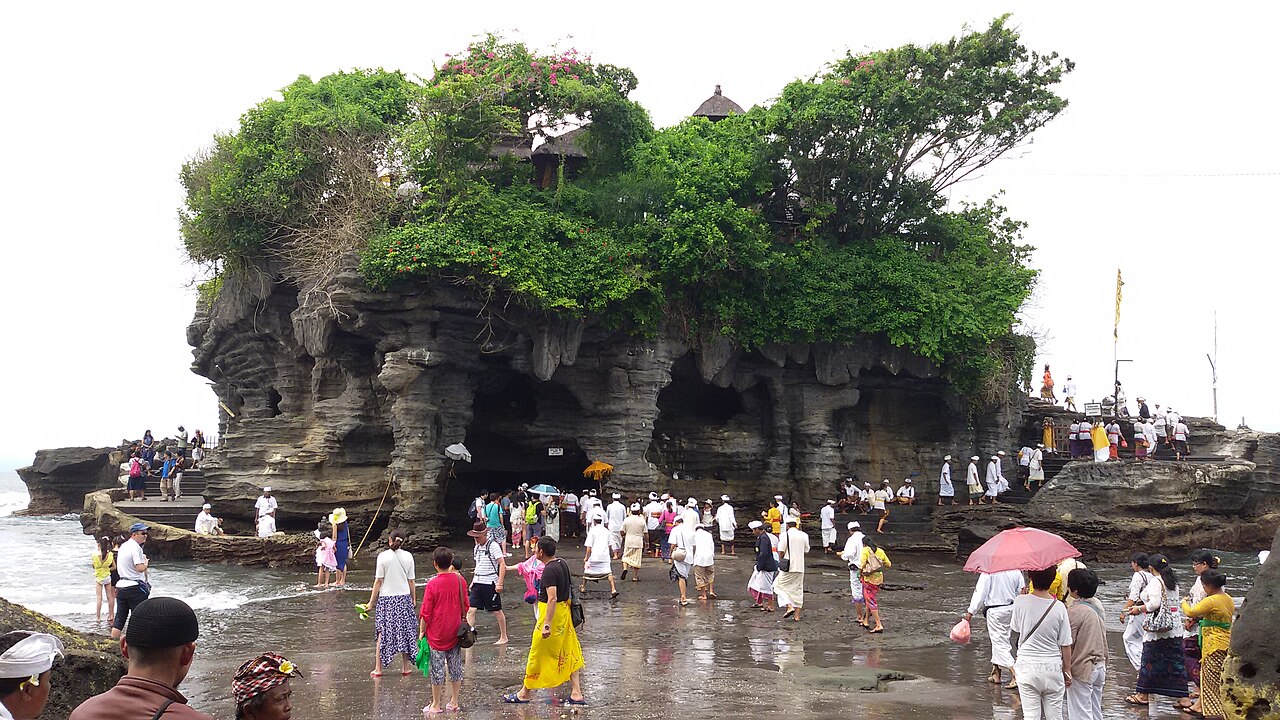
From the clifftop paths the whole drama is in front of you: a stack of wave-cut stone standing in the surf, its base undercut and hollowed by the sea, thatched shrines on its crown, spray climbing the dark flanks with every set of waves. At low water a causeway of reef and sand appears, and the offshore island becomes, for a few hours, a place you can walk to.
2
The beji beneath the rock
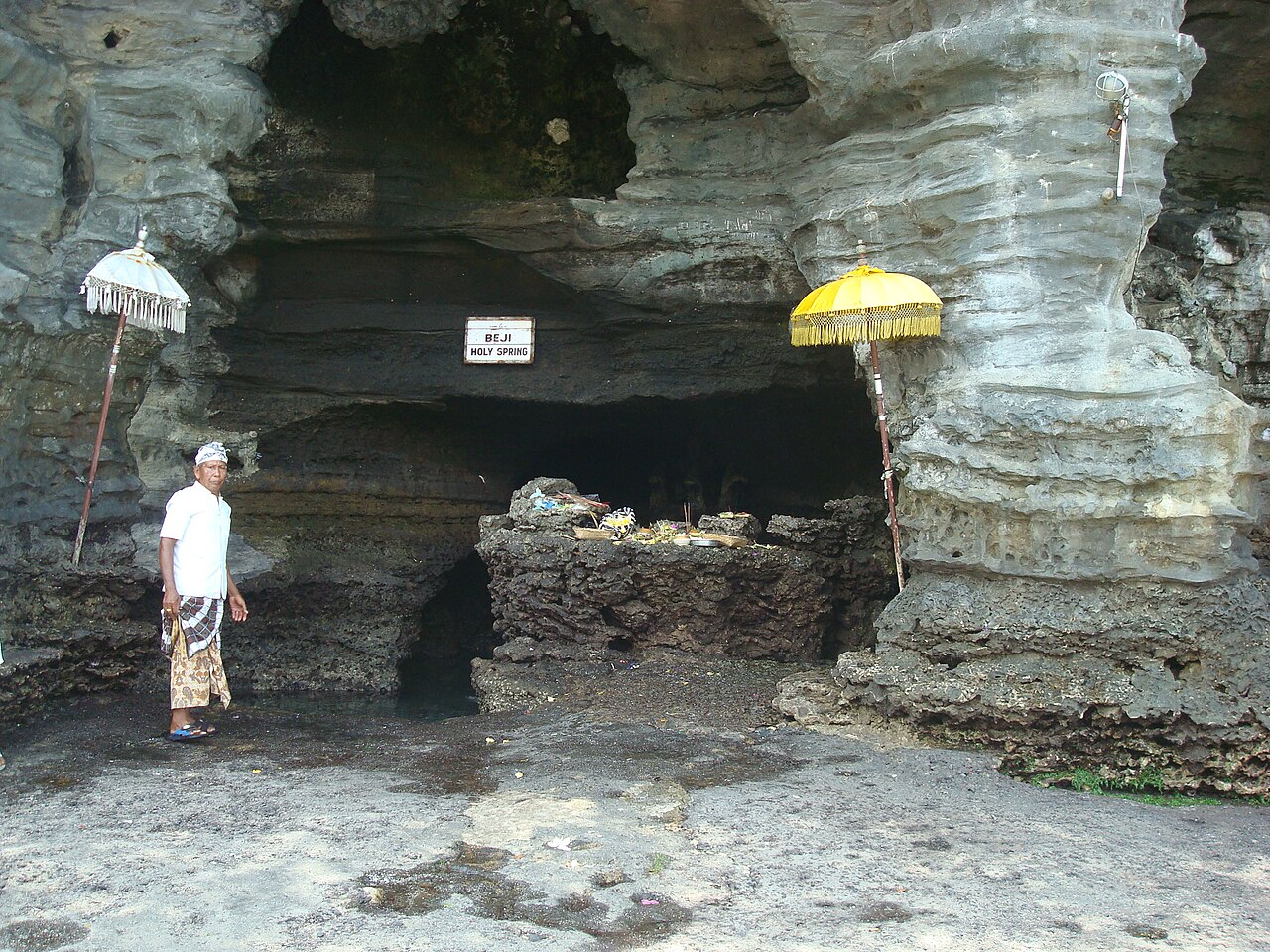
In a low cave at the foot of the rock, under ceremonial umbrellas, a freshwater spring rises within metres of the salt sea. Tradition holds the water came with the sage's blessing. Attendants keep the spring, and those who cross at low tide may wash their hands and face or drink, asking health, children, and a clean heart.
3
The snake cave
Opposite the Temple, in a cave by the beach, live the black and white banded sea snakes the tradition calls the Temple's guardians, born of Nirartha's sash. Keepers sit with them, and pilgrims stop to see the small, quiet creatures charged with so large a duty.
Pemedek in Temple dress cross the wet causeway at low tide during the odalan at Pura Tanah LotThe beji spring in the cave beneath the Tanah Lot rock, sheltered by ceremonial umbrellas
Pemedek crossing at low tide for the odalan, and the beji spring beneath the rock · photos CC BY-SA 4.0 Okkisafire and Arabsalam, Wikimedia Commons
The Temple's own day
Pujawali on Buda Cemeng Langkir
Every 210 days of the pawukon calendar, on Buda Cemeng Langkir, the Wednesday of Wage in the wuku Langkir, four days after Kuningan, Pura Luhur Tanah Lot keeps its pujawali. The day before, the Ngebejian rite bathes the Temple's sacred objects, the pratima, in holy water drawn from the beji. Then for three days the ceremony stays nyejer on the rock, and pemedek from Beraban and across Tabanan cross with the tide, many praying between seven and ten at night when the water stands lowest. When the sea will not open, worship moves to Pura Penataran Madya on the shore. The pujawali begins next on Wednesday 27 January 2027.
The same day is kept at Pura Batu Bolong and Pura Penataran within the grounds; visitors may watch the processions from the terraces, but the crossing then belongs to the worshippers.
Plan your visit
By air
Ngurah Rai International Airport (DPS), Denpasar, is about 30 km away; allow roughly an hour or more by road.
By road
In Beraban village, Kediri district, Tabanan Regency: about 13 km south of Tabanan town and 20 km northwest of Denpasar, with the turn signposted at Kediri.
Timings
The grounds are open daily, 7:00 am to 7:00 pm (WITA).
Fees
Foreign visitors IDR 75,000 adult, IDR 40,000 child; domestic IDR 30,000 adult, IDR 20,000 child (5 to 10 years). Parking IDR 5,000 for cars, IDR 3,000 for motorbikes.
The crossing
On foot only at low tide. At high water the rock is an island again, so check the tide before planning to reach the base.
Best time
Early morning for quiet and an empty shoreline; the sunset hour draws the day's largest crowds to the terraces.
Dress
Modest dress as at any pura: shoulders and knees covered. The inner Temple is not open to visitors, so no sarong hire is required for the terraces.
Tanah Lot is read as the land in the sea; the Temple's own histories also trace it to older words for thick soil, and remember the rock's first name, Gili Beo, the bird rock.
Over one-third of the rock you see today is artificial: after the cliff face began crumbling in the 1980s, a Japanese-funded stabilization program rebuilt and reinforced it to save the Temple.
The inner courtyards on the rock are reserved for Balinese Hindu worshippers; everyone else visits the base at low tide for the blessing at the spring and views the pura from the shore.
A Kecak dance, the 1930s Ramayana performance rather than a Temple rite, is staged at sunset at De Jukung within the grounds.
Questions pilgrims ask
Can I go inside the Temple?
No. The courtyards on the rock are open to Balinese Hindu worshippers only. At low tide anyone may walk across to the base of the rock, wash or drink at the holy spring, and receive its blessing; the pura itself is viewed from the shore and the clifftop terraces.
Is the rock natural?
Mostly, and honestly, not entirely. The sea had eaten so far into the rock by the 1980s that the Temple was in danger, and a Japanese-aided conservation program reinforced it; more than a third of the present rock is artificial. The shrine it carries is the same living pura it has always been.
When can I walk across to the rock?
Only at low tide, when a causeway of reef and sand emerges. At high water the crossing disappears completely. Tide times shift daily, so check them for the day you come; during festivals the Temple committee posts tide guidance for worshippers.
Are the holy snakes real?
Yes. Black and white banded sea snakes live in the caves and crevices at the base of the headland, and keepers watch over a cave where visitors may see them. Tradition holds they were born of Dang Hyang Nirartha's sash and guard the pura from harm.
Which god is worshipped at Tanah Lot?
The pura honors Bhatara Baruna, also called Bhatara Segara, the god of the sea, together with the divine in its mountain aspect, nyegara gunung. Dang Hyang Nirartha, the sage who consecrated the rock, is venerated here as well.
Dharamshalas and guest houses near this Sthan, shared by devotees. Adisthan takes no bookings and no money; contact each stay directly.
No stays are listed here yet. Know one that serves pilgrims well?
Are you with the pengempon of Pura Luhur Tanah Lot, Desa Adat Beraban, or the DTW Tanah Lot management? Claim this page to keep its tides, fees, and festival days true for every pilgrim.