Darshan nearly round the clock Free · ₹300 Special Entry Brahmotsavam · 15 to 23 Sep Seventh of the Seven Hills The Srivari Laddu, GI-protected
The bus climbs fifty-seven hairpin bends through green Seshachalam forest, and somewhere on the climb the chant begins: Govinda, Govinda. By the time the golden crown of the Ananda Nilayam rises over the mada streets, the whole hilltop is one voice. More pilgrims stand in this queue on an ordinary Tuesday than most shrines receive in a year, and every one of them is here for a single glimpse lasting a few seconds. Ask any of them: it is enough.
Lord Venkateswara Is Kaliyuga Vaikuntham, Vishnu present on earth through this dark age; tradition holds the murti is swayambhu, self-manifested, no sculptor ever claimed it.
The hundi overflows daily because of a debt: the Lord borrowed from Kubera for His wedding to Devi Padmavati, and every offering helps repay it. Devotees have kept the account open for centuries.
Tens of thousands climb to Him on foot, up 3,550 stone steps from Alipiri, some lighting camphor on each step, some carrying their weight in jaggery, most simply carrying a promise.
The story the seven hills tell
The old telling says that when the sage Bhrigu struck Lord Vishnu's chest to test the gods' patience, Goddess Lakshmi left Vaikuntha in sorrow. The Lord followed Her to earth, and as Srinivasa he made the Seshachalam hills His home, the Seven peaks said to be the hoods of Adisesha himself. Here he loved and wed Padmavati, daughter of the Chola king Akasha Raja, borrowing the bride-price from Kubera, treasurer of the gods. That loan is the Temple's living legend: the interest is still being paid, and every coin in the hundi is a devotee's share in the Lord's own debt.
History arrives later and keeps the same devotion. Inscriptions on these walls run from the Pallavas of the ninth century through the Cholas and the emperors of Vijayanagara; Krishnadevaraya came on pilgrimage again and again and plated the sanctum's vimana in gold. In 1933 the Tirumala Tirupati Devasthanams was formed to steward the Temple, and under its care the hill grew into what it is now: a city that exists for darshan, feeding, housing, and moving an ocean of pilgrims every single day.
What you'll actually see
1
The Ananda Nilayam vimana
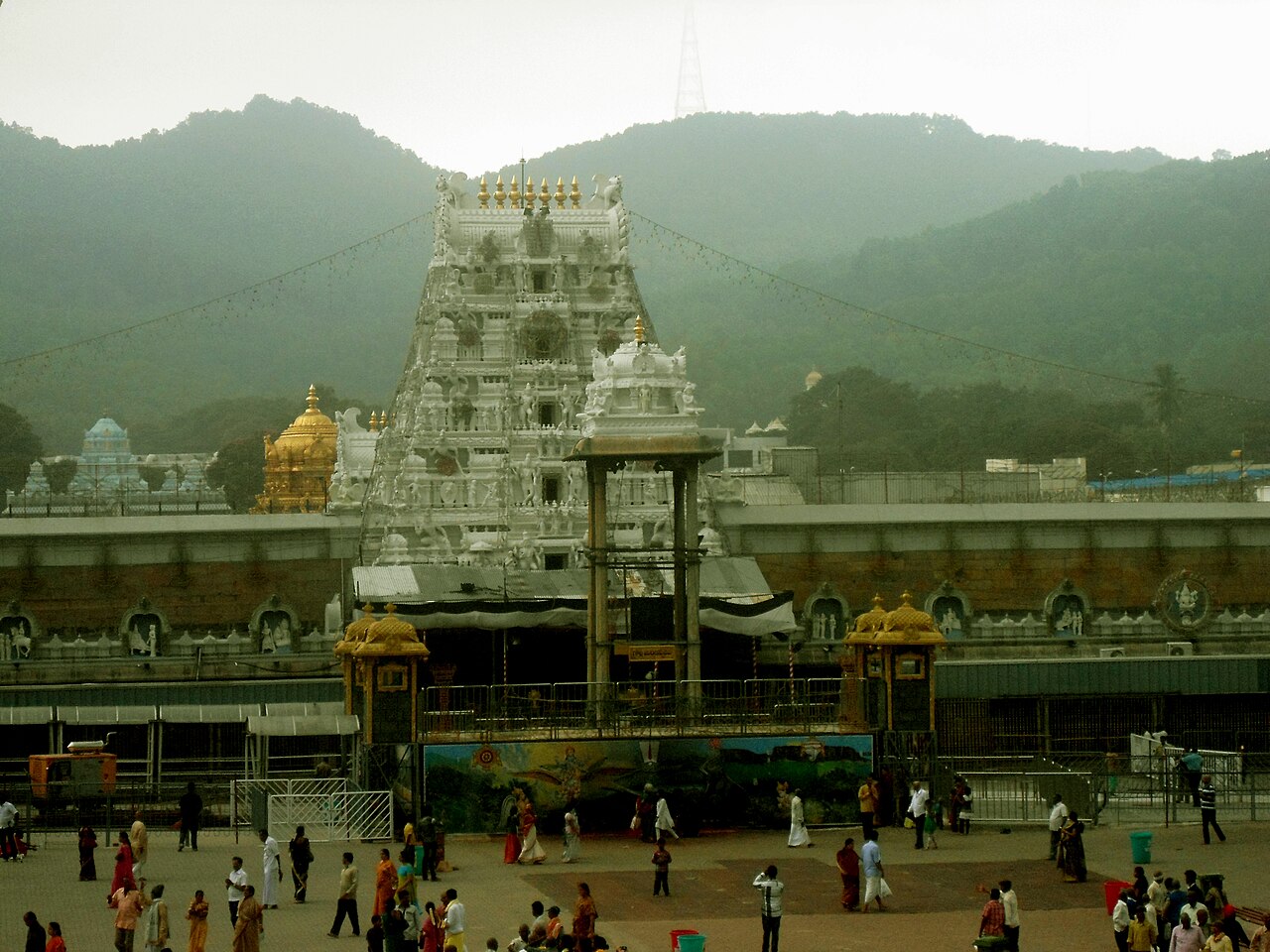
The golden tower over the sanctum, gilded under Vijayanagara patronage, is the image every devotee carries home. It is visible from across the mada streets, and pilgrims stop mid-stride to raise folded hands to it.
2
The few seconds before the Lord
Inside the sanctum stands the black stone murti of Lord Venkateswara, eyes covered almost entirely by a namam of white camphor, chest bearing Goddess Lakshmi. The line moves fast; the moment does not leave you.
3
Kalyanakatta and the offered hair
Thousands of devotees a day offer their hair at the great tonsure halls, an act of surrendering vanity that makes the hilltop unmistakable: newly shaven heads shining with sandal paste in every direction.
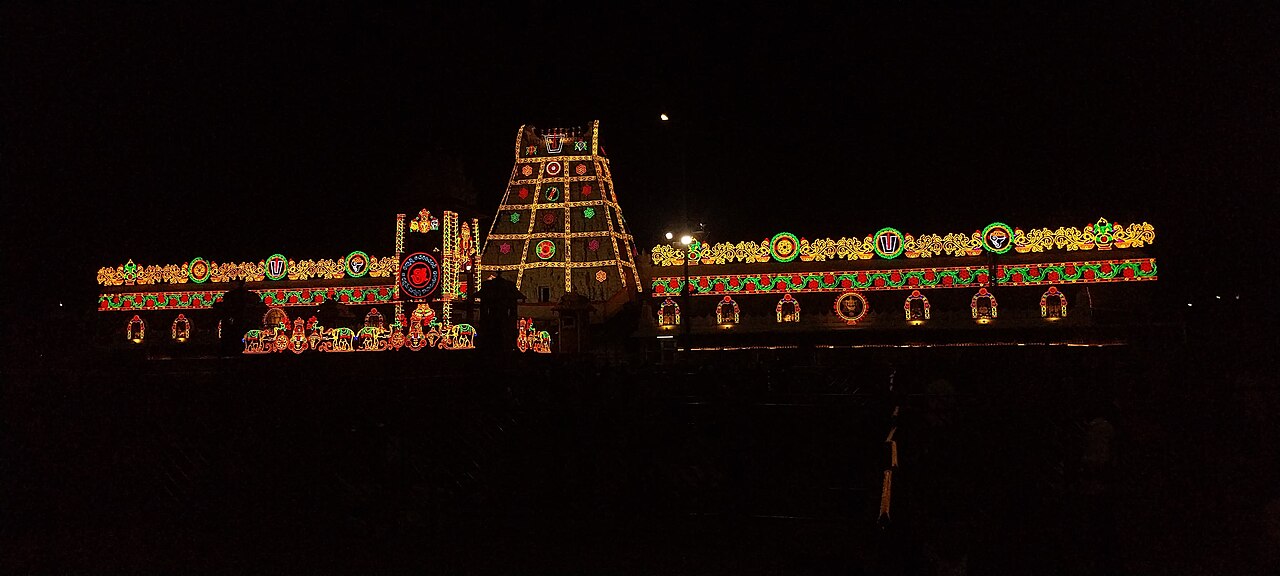
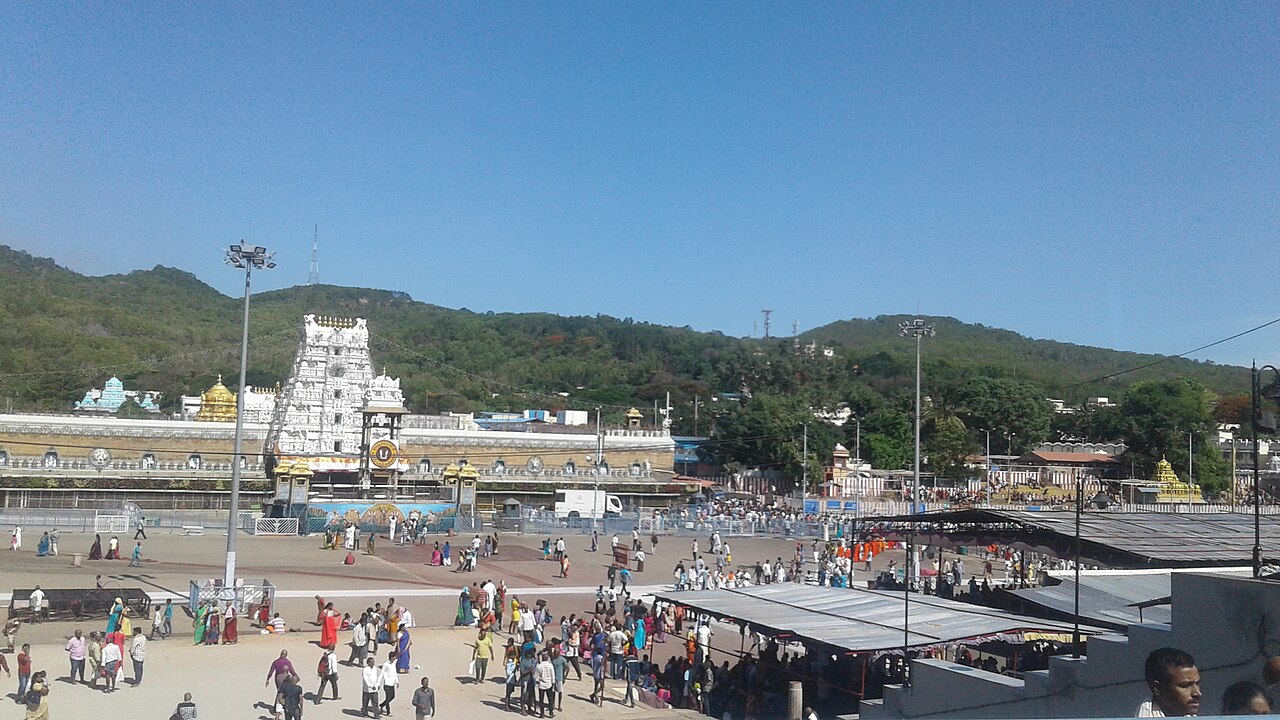
The Temple complex of Lord Venkateswara amid the Tirumala hillsTirumala Temple illuminated at night
The temple among the hills, and the gopuram lit for the night · photos CC BY-SA / CC BY, Wikimedia Commons
A YEAR FOUND NOWHERE ELSE
Two Brahmotsavams · 15 to 23 September and 12 to 20 October 2026
Because an extra lunar month falls in 2026, Tirumala keeps its nine-day Brahmotsavam TWICE: the annual Salakatla utsavam from 15 to 23 September and the Navaratri Brahmotsavam from 12 to 20 October. Each evening the utsava murti of Sri Malayappa Swami rides a different vahana through the mada streets; the Garuda Seva nights (19 September and 16 October) draw the largest crowds of the year.
Garuda Seva evenings are the peak of the peak. Come days early or watch the streets instead of the queue; rooms on the hill vanish months ahead.
Plan your visit
By air
Tirupati Airport (TIR), about 15 km to Tirupati town; the hill is a further 22 km by ghat road.
By rail
Tirupati station, then frequent TTD buses climb the 57-bend ghat road in under an hour.
On foot
Alipiri Mettu: 3,550 steps, about 9 km, 3 to 4 hours, open through the day. Srivari Mettu: 2,388 steps, about 2 km, shorter and quieter.
Timings
The Temple functions nearly round the clock; Sarva Darshan tokens issue from about 2:30 am.
Darshan
Sarva Darshan is free. ₹300 Special Entry slots are online only at ttdevasthanams.ap.gov.in and sell out within minutes of each monthly release.
Best time
Weekday pre-dawn outside festival and holiday weeks; the hill is coolest and the line shortest.
Dress
Traditional wear: dhoti or kurta-pyjama for men, saree or salwar-kameez for women. Mandatory for Special Entry darshan.
The queue
A few hours on quiet days; Sarva Darshan can run far longer on weekends and festivals. Phones and cameras are not allowed inside.
The Srivari Laddu carries a Geographical Indication tag, the first sacred food in India protected this way; collect yours at the counter after darshan.
Say it once and you will hear it a thousand times: the hill greets, thanks, and consoles itself with one word, Govinda.
Free meals run all day at the Annaprasadam complex, and TTD guesthouses take online booking in the same portal as darshan.
Leave footwear and phones in the free cloakrooms before the queue; only your ticket, and patience, go in with you.
Questions pilgrims ask
How long will darshan actually take?
On an ordinary weekday with a ₹300 Special Entry slot, two to four hours door to door. Free Sarva Darshan varies with the crowd, from a few hours to most of a day at festival peaks. The compartments have seating, water, and food service.
What will I actually see?
The line delivers you to the Bangaru Vakili, the golden doorway, and past it the Lord stands in the half-dark, tall, black, crowned, His eyes nearly covered By the white namam. You get a handful of seconds. Devotees plan for years around them.
Can I book darshan without the crowds selling tickets outside?
Yes, and only that way: ttdevasthanams.ap.gov.in is the single official portal for darshan, sevas, and rooms. Anyone offering guaranteed tickets on the street or another website is not official.
Why do people shave their heads here?
Hair is offered as the surrender of vanity and beauty back to the Lord who gave them. Kalyanakatta halls perform the tonsure free, for men, women, and children alike; the offered hair is auctioned and the proceeds serve the Temple.
The Sthan in photographs
Darshan from afar
From the temple's own channels. Nothing loads until you press play.
Dharamshalas and guest houses near this Sthan, shared by devotees. Adisthan takes no bookings and no money; contact each stay directly.
No stays are listed here yet. Know one that serves pilgrims well?
Are you connected with the Tirumala Tirupati Devasthanams? Claim this page to keep timings, quotas, and utsavam dates exact for the pilgrims who plan years around them.