Darshan 5:30 am to 9 pm Three-faced Jyotirlinga · the Trimurti Kushavarta · birth of the Godavari Simhastha Kumbh · from 31 Oct 2026 Free · donation pass ₹200 Black basalt · consecrated 1756
You climb out of Nashik through vineyards and monsoon paddy until the green wall of Brahmagiri fills the sky, cloud pouring down its cliffs. Beneath it the Temple stands black as iron, carved basalt rising against the rain. Pilgrims bathe first at Kushavarta, then walk the wet lane to the gate with Har Har Mahadev moving through the crowd. In the sanctum there is no tall pillar of light. There is a hollow in the stone, and within it three small lingas. No other Jyotirlinga wears three faces.
Among the Twelve Jyotirlingas this one alone holds three faces in a single hollow: Lord Brahma, Lord Vishnu, and Lord Shiva together as the Trimurti. Every other Jyotirlinga enshrines Lord Shiva alone; here the whole Trinity receives the pilgrim.
The Godavari, the longest river of peninsular India, is born on Brahmagiri hill above the Temple and gathers at Kushavarta, the tank honoured as Tirtharaj, king of tirthas, where the sacred bath of the Simhastha Kumbh Mela is taken.
The rites of the ancestors, Narayan Nagbali, Kalsarpa puja, and Tripindi shraddha, are performed by hereditary tamrapatradhari purohits whose copper-plate rights descend from the Peshwa; tradition holds that Narayan Nagbali may be performed only at Trimbakeshwar.
The sage, the river, and the three faces
The legend says sage Gautama lived with his wife Ahalya in a hermitage on Brahmagiri, and his penance was so pure that when famine burned the land, grain still grew for his household and every guest was fed. Rishis jealous of that grace set a trap: a cow was made to fall dead by his hand, and the greatest of sins clung to him. To be washed of it, Gautama climbed the mountain and prayed to Lord Shiva for the one water that cleanses everything, Ganga herself.
Lord Shiva granted her, but the river came down wild and would not be held. Tradition tells that Gautama ringed her with sacred kusha grass, and where she settled into stillness the pool was named Kushavarta. From that whirl of grass and water the Godavari began her long journey to the eastern sea, and she is called Gautami still. At the sage's plea the Lord remained beside the river He had given, manifest as a Jyotirlinga bearing three faces, Lord Brahma, Lord Vishnu, and Lord Shiva in one stone.
The Temple that guards the hollow today was raised by Peshwa Balaji Bajirao, called Nanasaheb, in carved black basalt on the site of an older shrine; the trust's record sets its grand opening on Mahashivaratri, the 16th of February 1756, amid shehnai and drums. Its deity once wore the famous Nassak diamond, looted by the British in the Third Anglo-Maratha War and never returned. The three daily pujas the Peshwa endowed continue unbroken: to Lord Brahma in the morning, to Mahadev at midday, to Lord Vishnu in the evening.
What you'll actually see
1
The black basalt Temple of the Peshwa
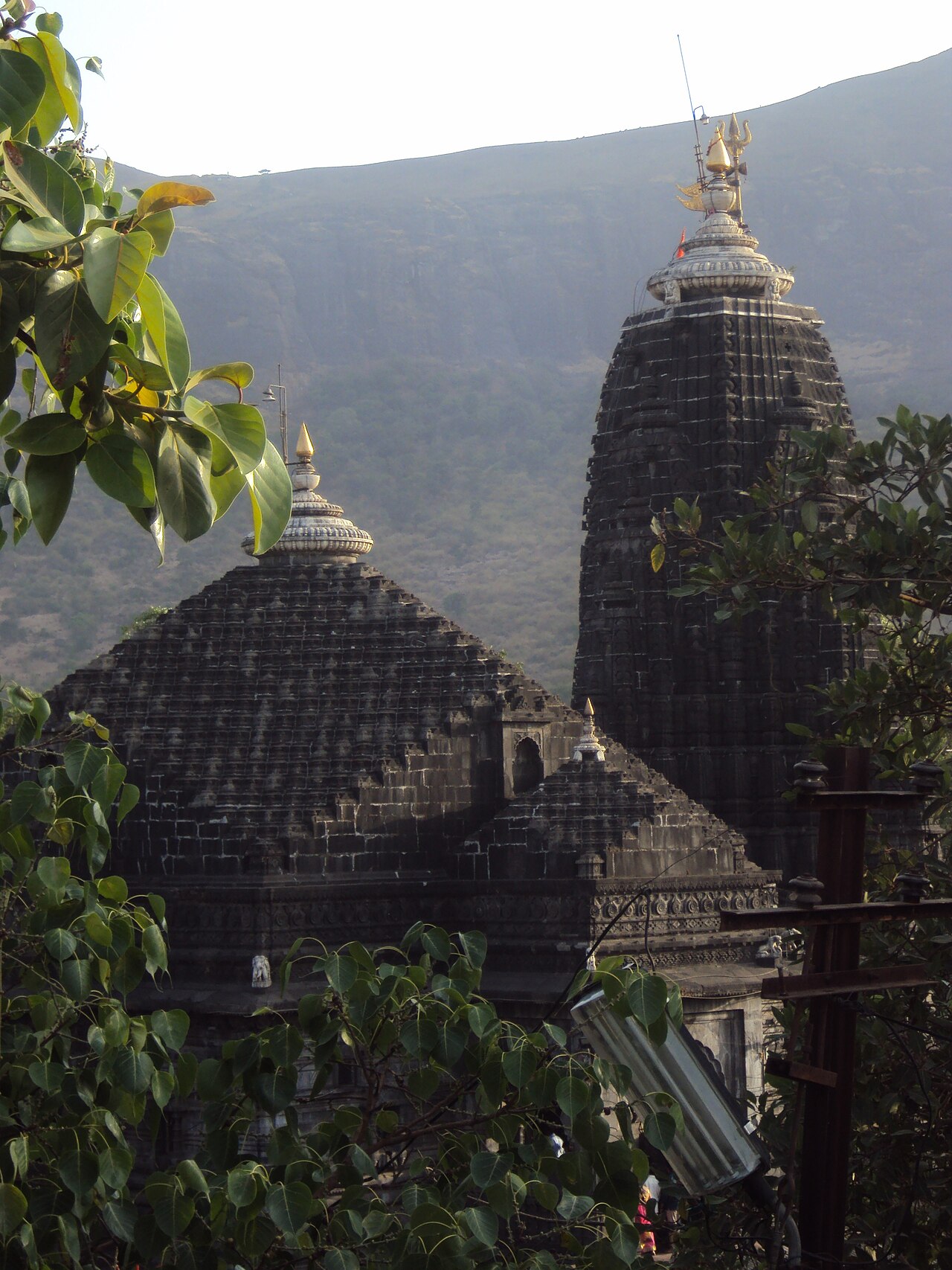
The Temple is built wholly of the dark local basalt in the Hemadpanthi manner, its curved tower rising in carved tiers to a gilded kalash and trident against the Brahmagiri cliffs. Sculpted deities and figures cover the tower, and a massive stone enclosure rings the courtyard.
2
Kushavarta, the king of tirthas
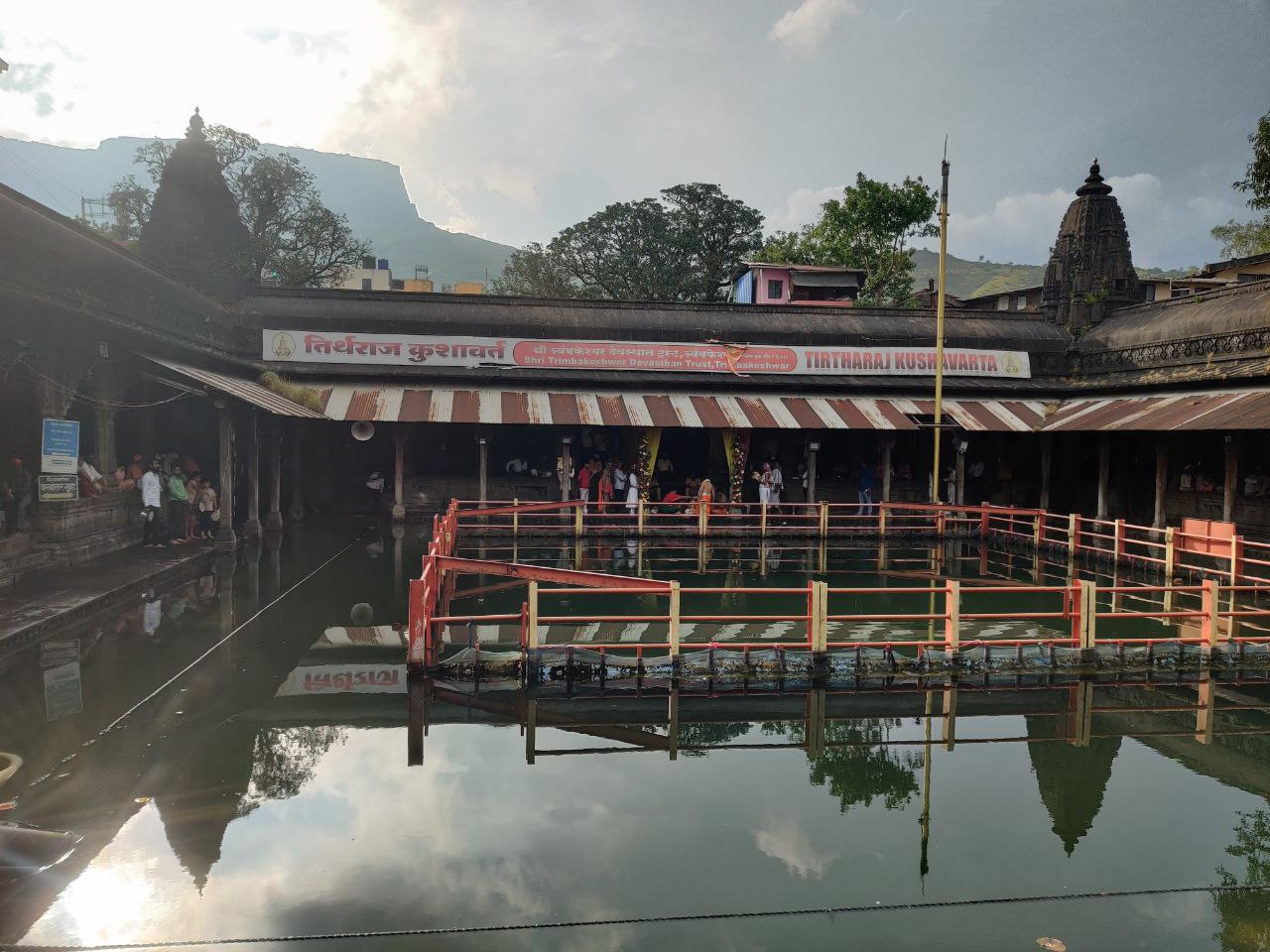
A short walk from the Temple through the bazaar lane, the Godavari gathers in a square stone tank ringed by a pillared colonnade, given its present stone form by Shrimant Sardar Raosaheb Parnerkar, Fadnavis of Indore, whose bust watches from the edge. Pilgrims descend its steps to bathe before darshan, and the Simhastha's holiest bath happens in this water.
3
The hollow of the Trimurti and its crown
In the sanctum the Jyotirlinga sits at floor level: a hollow in which three thumb-sized lingas rise, veiled for worship beneath a gold mask of the Trideva. Over the mask on Mondays is set a jeweled crown, said to come from the age of the Pandavas, thick with diamonds and emeralds, shown to devotees from 4 to 5 pm before the palanquin of Trimbakraja goes out to Kushavarta.
Pilgrims under the colonnade of Kushavarta Tirth, the tank where the Godavari first gathers at TrimbakThe black basalt shikharas of Shri Trimbakeshwar Temple beneath the cliffs of Brahmagiri
Kushavarta Tirth and the basalt shikharas · photos by Studio Gestalt and Mr. Debapriya Hore, CC BY-SA 4.0, Wikimedia Commons
ONCE IN TWELVE YEARS
Simhastha Kumbh Mela · 2026 to 2028
When Jupiter enters the sign of Simha, the Kumbh comes to the Godavari, the only Kumbh Mela held on this river, shared between Trimbakeshwar and Nashik. The coming Simhastha opens with the hoisting of the flag at Trimbakeshwar, Ramkund and Panchavati on 31 October 2026 and closes on 24 July 2028. Its heart is the amrit snan: 2 August 2027, 31 August 2027, and the concluding bath at Trimbakeshwar on 12 September 2027, when the Shaiva akhadas, whose camps stand in Trimbak itself, go down into Kushavarta while lakhs wait their turn in the small town's lanes.
For quiet darshan avoid the amrit snan days entirely; for the rarest sight of living tradition, come on exactly those days and expect hours of walking and waiting.
Plan your visit
By air
Nashik Airport at Ozar, about 55 km, roughly 1.5 hours by taxi; Mumbai's Chhatrapati Shivaji Maharaj International Airport is about 180 km, 4 to 5 hours by road.
By rail
Nashik Road station, about 39 km; taxis and frequent state buses run via Nashik city.
By road
Trimbak is 28 km west of Nashik; state transport buses leave Nashik regularly, and the drive takes under an hour.
Timings
The Temple day runs from Kakad Aarti at 5:30 am to the Shejarati at 9 pm, when the doors close; hours can shift on festival days.
The queue
Darshan is free. A donation darshan pass of ₹200 per person, booked on the trust website, uses a faster line; it is valid only for the chosen date, with last entry at 9 pm. Children under 10 and Divyangjan are exempt.
Dress
Modest dress for ordinary darshan from the hall. Entry into the garbhagriha itself is limited to about one early-morning hour, and requires traditional dress, a silk or cotton *sovala* dhoti for men and traditional silk or cotton wear for women, under rules the trust has applied equally to both since 2016.
Best time
October to March is the gentlest season; the monsoon turns Brahmagiri green and full of waterfalls. Mondays bring the crown darshan and palkhi; Shravan Mondays and Mahashivaratri bring the year's largest crowds.
Brahmagiri climb
The stepped path up Brahmagiri, source of the Godavari, passes the Gangadwar cave shrine where the river first shows herself; allow a half day and start early.
Trimbakeshwar means the Lord who is Tryambaka, the Three-Eyed; that is the name invoked in the Mahamrityunjaya mantra, and its jaap is among the rites pilgrims commission here.
The Nassak diamond that once adorned the deity was taken by the British in the Third Anglo-Maratha War and today sits in a private collection abroad; the crown shown on Mondays still carries diamonds and emeralds said to be far older.
Book pujas only through the hereditary tamrapatradhari purohits, whose copper-plate rights come down from Nanasaheb Peshwa; their Purohit Sangh registers about 300 verified pandits, and the trust itself books Rudrabhishek and Laghurudra online.
Bathe or sprinkle Kushavarta water before darshan in the old order of the tirtha; on every Monday the palanquin of Trimbakraja is carried from the Temple to Kushavarta and worship is offered at the water.
Questions pilgrims ask
Is there a tall Shivalinga to see, like at other Jyotirlingas?
No. The Jyotirlinga here is a hollow at floor level in which three thumb-sized lingas rise, worshipped as Lord Brahma, Lord Vishnu, and Lord Shiva. Pilgrim tradition describes water seeping ceaselessly around them, the Godavari's own first offering. For most of the day the faces are veiled beneath a gold mask of the Trideva.
Can I enter the garbhagriha?
Entry into the inner sanctum is limited to about one hour in the early morning and requires traditional dress: a silk or cotton sovala dhoti for men, traditional silk or cotton wear for women, rules the trust applies to both alike. At all other times darshan is from the hall, a few metres from the sanctum.
What are Narayan Nagbali, Kalsarpa puja, and Tripindi shraddha?
They are rites of release: Narayan Nagbali frees restless ancestors and expiates the killing of a serpent, Kalsarpa puja answers the dosha of Rahu and Ketu, and Tripindi shraddha is an offering to forgotten ancestors. Tradition holds Narayan Nagbali is performed only at Trimbakeshwar; it takes three days, with bathing at Kushavarta, so arrive a day early and book a tamrapatradhari purohit.
When is the next Kumbh Mela at Trimbakeshwar?
The Simhastha Kumbh Mela begins with the flag hoisting on 31 October 2026 and runs to 24 July 2028. The amrit snan days are 2 August 2027, 31 August 2027, and, for Trimbakeshwar's Kushavarta, 12 September 2027.
Where exactly does the Godavari begin?
On Brahmagiri, the mountain above the Temple. The river appears first at the Gangadwar cave shrine on the hill's flank, then gathers in Kushavarta in the town below, which tradition honours as her formal source and as Tirtharaj, the king of bathing places.
Darshan from afar
From the temple's own channels. Nothing loads until you press play.
Dharamshalas and guest houses near this Sthan, shared by devotees. Adisthan takes no bookings and no money; contact each stay directly.
No stays are listed here yet. Know one that serves pilgrims well?
Are you a trustee, pujari, or sevak of Shri Trimbakeshwar Devsthan Trust? Claim this page to keep darshan hours, puja bookings, and Simhastha guidance true for the pilgrims who come to Trimbakraja.