Swaraj Round, Thekkinkadu Maidan, Thrissur · Kerala, India
The god who cannot be seen still draws a whole city to his gate every spring.
Be the first to check in
Coming up: Maha Shivaratri · 6 MarEntry tended 28 Jun 2026
Darshan 4 to 11 am, 5 to 8:30 pm The lingam lies beneath a mound of ghee One of Kerala's oldest Koothambalams Thrissur Pooram · 17 Apr 2027 Darshan free · Hindus only inside Men bare-chested in mundu
Climb the low hillock at the exact centre of Thrissur and the city's traffic falls away behind a laterite wall nine acres round. Ancient trees lean over white gopurams; camphor and wet granite hang in the air of the broad circular passage that rings the inner shrines. Inside the round north sanctum, devotees press forward for a glimpse of Lord Shiva, and find none. There is no lingam to see. Only a dark, gleaming mound taller than a man, built from a thousand years of poured ghee, capped in gold and never once melting.
The presiding lingam, roughly sixteen feet tall, has not been seen by a living devotee. Centuries of daily ghee abhishekam have raised a solid mound entirely over the stone, crowned with thirteen cascading gold crescents and three serpent hoods, which tradition likens to snow-capped Kailasa itself. This is held to be the only Shiva Temple in Kerala where the linga stays forever hidden.
The Temple's Koothambalam, a wood-carved theatre reserved for Koodiyattam, Koothu and Nangyar Koothu, ranks among Kerala's oldest surviving performance halls, its craft credited by Temple tradition to the legendary architect Perumthachan. Both it and the sanctum's murals stand protected as a national monument.
Vadakkunnathan does not stage Thrissur Pooram. It is the still, silent centre the festival circles: the Paramekkavu and Thiruvambadi Devaswoms bring their own deities and elephants to the Thekkinkadu Maidan outside these walls to pay obeisance to Lord Shiva, while the Temple itself keeps its ordinary hours.
The lingam that would not be moved, and the tree that gave way instead
Tradition, echoed in the Brahmanda Purana, holds that Parashurama, the axe-wielding avatar of Vishnu, first asked Varuna, lord of the waters, to raise the land of Kerala from the sea. He then travelled to Kailasa and begged Lord Shiva to bless this new country with His presence. Lord Shiva came south with Maa Parvati, Ganesha and Subrahmanya, and paused where Thrissur now stands. When the divine company vanished, Parashurama found a blazing lingam at the foot of a great banyan tree, a spot still called the Sri Moola Sthana.
The lingam could not simply be left there. When the ruler of Cochin resolved to build a proper Temple around it, cutting the banyan threatened to drop branches on the stone itself. A Yogatirippadu, the legend says, lay his own body over the lingam so the tree could be felled without harm, and not a single branch fell near the deity. The lingam was installed in its present sanctum according to the Shastras, and a Temple rose around it.
History layered onto legend. Tipu Sultan's army camped near Thrissur in December 1789 without touching the shrine, and is remembered as having borrowed its kitchen vessels and returned them along with a bronze lamp. Sakthan Thampuran, moving Cochin's capital to Thrissur soon after, cleared the surrounding forest and founded Thrissur Pooram at the Temple's gates. Tradition also ties the birth of Adi Shankara to forty-one days his parents, Shivaguru and Aryamba, spent in prayer at this shrine.
What you'll actually see
1
The hidden lingam and the circular sanctum
In the round northern srikovil, Lord Shiva faces west as the ghee-veiled lingam, with Maa Parvati's shrine behind Him facing east, the pair read together as Ardhanarishvara. A large white Nandikeswara keeps watch from the surrounding Nalambalam, and two further shrines, Shankaranarayana and Lord Rama, complete the innermost cluster.
2
The Koothambalam
Dense wood carving covers every beam and pillar of the Temple's dedicated theatre, still used for Koodiyattam, Koothu and Nangyar Koothu, ritual performing arts of central Kerala kept alive here across generations. Temple tradition places its craftsmanship in the hands of Perumthachan, which would make it well over a thousand years old.
3
The murals and the nine-acre enclosure
Two murals over 350 years old, the reclining Vasukisayana and the twenty-armed Nrithanatha, are venerated daily on the sanctum walls. Around them, four gopurams mark the compass points of a stone-walled compound nearly nine acres wide, though only the eastern and western towers admit the public into the granite Chuttambalam passage that rings the shrines.
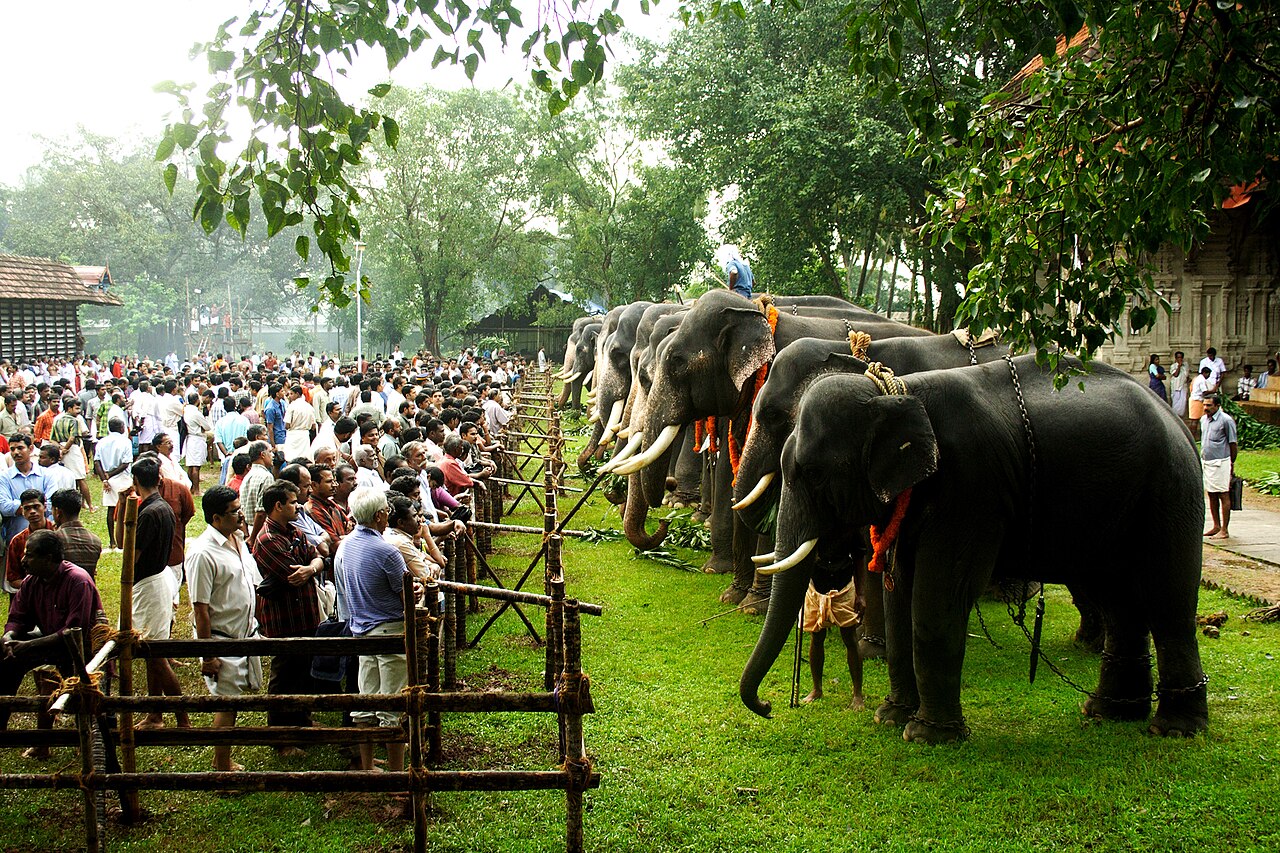
A lily-covered stepped Temple tank in the grounds of Vadakkunnathan Temple, ThrissurElephants lined up to be fed by devotees and priests at the Aanayoottu ceremony, Vadakkunnathan Temple
The temple tank, and elephants fed at Aanayoottu · photos CC BY-SA 3.0 (Challiyan) and CC BY-SA 2.5 IN (Joseph Lazer), Wikimedia Commons
The still centre of the greatest Pooram
Thrissur Pooram · 17 April 2027
On Pooram day in the Malayalam month of Medam, the Thekkinkadu Maidan ringing these walls becomes the stage for the grandest festival in Kerala. The Paramekkavu and Thiruvambadi Devaswoms, each leading a group of Temples, bring rows of caparisoned elephants and thunderous panchavadyam and melam percussion to face one another before Vadakkunnathan, exchanging silk parasols in the Kudamattam and closing with fireworks before dawn. Vadakkunnathan Temple organizes none of it. It keeps its own doors and its own hours, the deity every procession has come to honour. The next Pooram falls on Saturday, 17 April 2027.
Over a million visitors converge on central Thrissur for Pooram; book accommodation months ahead and expect the Temple's own darshan hours, not the festival grounds outside, to stay calm.
Plan your visit
By air
Cochin International Airport (COK) is about 52 km away, close to an hour and a half by taxi.
By rail
Thrissur railway station is barely a kilometre from the Temple, on the Chennai to Ernakulam main line.
By road
The Temple sits inside Swaraj Round at the exact centre of Thrissur city; buses and autos from anywhere in town reach it within minutes.
Timings
4:00 am to 11:00 am, then 5:00 to 8:30 pm daily; the Temple is closed through the middle of the day.
Best time
A weekday dawn for quiet darshan on the cool granite floors; avoid the midday closure, and expect the surrounding maidan, not the Temple itself, to be overwhelmed during Pooram.
Dress
Men remove their shirt and wear a mundu; women wear saree, set-mundu or salwar; trousers, jeans and shorts are not permitted for either.
Entry
Darshan is free. Entry inside the walls is for Hindu devotees only, as at most Kerala Devaswom Temples; the restriction is set aside during Thrissur Pooram, when people of every faith fill the grounds.
The name reads vadakku (north) and nathan (lord): Vadakkunnathan, the Lord of the North, an epithet here for Lord Shiva.
The ghee mound is said never to turn foul and never to melt even in Kerala's heat, though it periodically cracks, and the position of each crack is read by tradition as fortunate or otherwise.
Cameras and mobile-phone photography are not permitted inside the Temple walls.
The Cochin Devaswom Board administers the Temple; a 2005 to 2015 restoration backed by the Chennai-based Venugopalaswamy Kainkaryam Trust and over three hundred craftsmen won the UNESCO Asia-Pacific Award of Excellence for Cultural Heritage Conservation in 2015, a conservation prize, not a World Heritage listing, though the ASI has separately proposed the site for that list.
Questions pilgrims ask
Is there really nothing of Lord Shiva to see in the sanctum?
Correct. The sixteen-foot lingam is entirely buried beneath a mound built up by centuries of daily ghee abhishekam, crowned with gold crescents and serpent hoods and likened by tradition to snow-covered Kailasa. Vadakkunnathan is held to be the only Shiva Temple in Kerala where the linga itself is never seen, only the form devotion has grown over it.
Does Vadakkunnathan Temple organize Thrissur Pooram?
No. The Paramekkavu and Thiruvambadi Devaswoms conduct the festival, bringing their processions to the Thekkinkadu Maidan that surrounds these walls to honour Lord Shiva. Vadakkunnathan Temple itself takes no part in the competition or the fireworks; it simply keeps its ordinary hours as the festival's silent centre.
Can non-Hindu visitors enter?
Entry inside the Temple walls is for Hindu devotees only, in keeping with most Kerala Devaswom Temples. Visitors of other faiths can admire the gopurams and the Koothambalam's carving from the surrounding Thekkinkadu Maidan, and by several accounts the restriction is set aside during Thrissur Pooram itself.
What is the Koothambalam, and can I watch a performance there?
It is the Temple's dedicated theatre for Koodiyattam, Koothu and Nangyar Koothu, ritual Sanskrit and Malayalam performing arts kept alive in central Kerala largely through Temples like this one. Performance schedules are set by the Temple and its resident artists rather than published for tourists; check with the Temple office on arrival.
When should I plan a visit?
An ordinary weekday dawn gives the quietest darshan. The Aanayoottu elephant feast, held on the first day of Karkidakam, next falls on 17 July 2026. For the sight of the festival, come for Thrissur Pooram on 17 April 2027, but expect the crowds to gather on the maidan outside rather than inside the Temple's own darshan hours.
Dharamshalas and guest houses near this Sthan, shared by devotees. Adisthan takes no bookings and no money; contact each stay directly.
No stays are listed here yet. Know one that serves pilgrims well?
Are you an officer of the Cochin Devaswom Board or a priest of Sree Vadakkunnathan Temple? Claim this page to keep darshan hours, festival dates and the Temple's own voice exact for the devotees who climb this hillock at the heart of Thrissur.