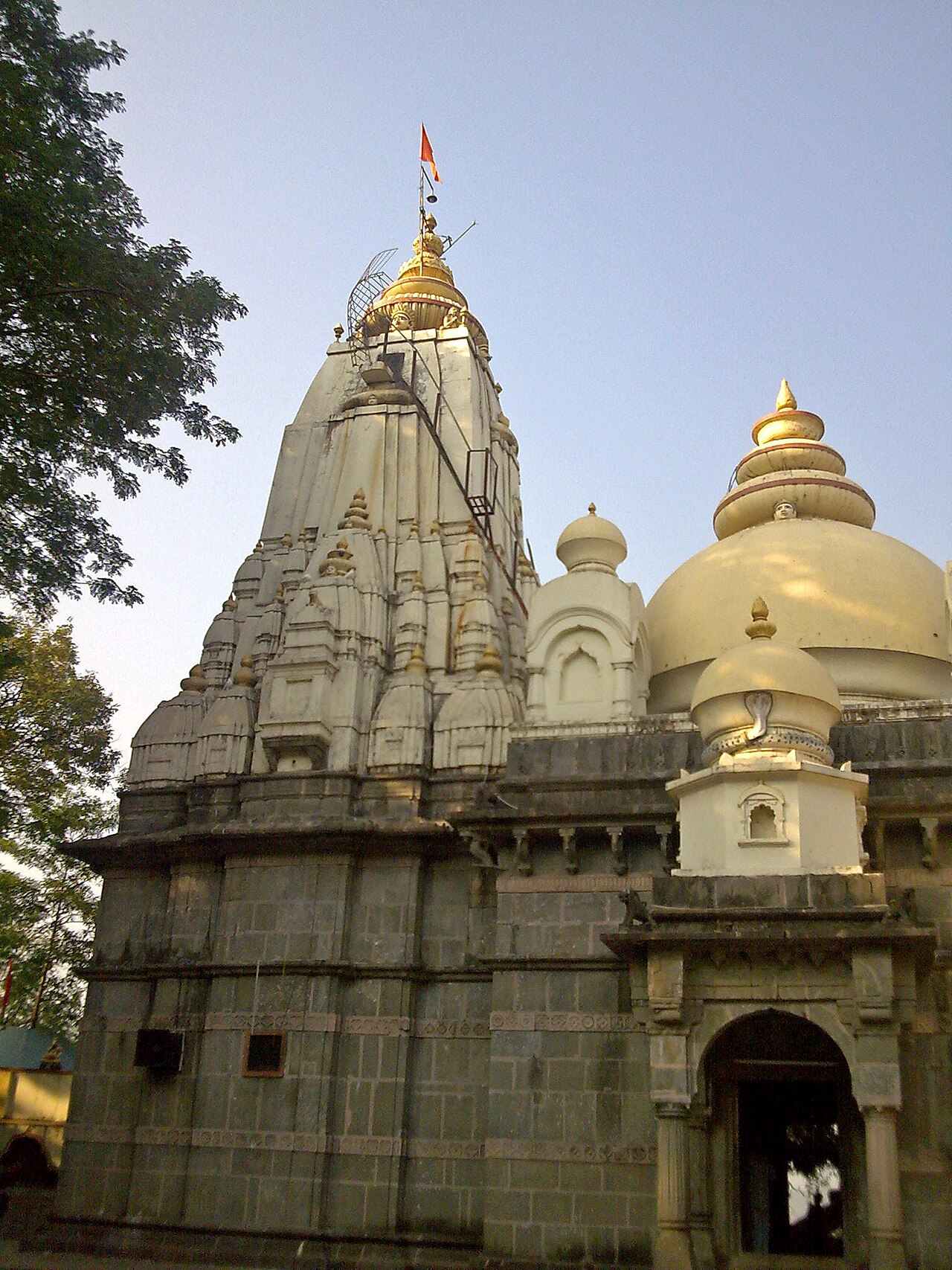
Maa Vajreshwari Temple
Vajreshwari Temple · Shree Vajreshwari Yogini Devi Mandir · Vajrabai Temple
About
Seated upon Mandagiri, a hillock of volcanic origin ringed by forested hills, the mandir consecrated to Maa Vajreshwari commands the landscape above the river Tansa in Thane district. The presiding Goddess, reverently called Vajrábái and Vajrayogini as well, is understood by devotees to be an earthly form of Goddess Pārvatī, or of Ādi-Māyā herself. Her name translates as 'She who is sovereign over the Vajra,' the thunderbolt, and such is her authority over this land that the settlement formerly known as Vadvali was renamed entirely in her honour.
A stone enclosure resembling a fort surrounds the Temple complex. Devotees ascend fifty-two stone steps to reach the main shrine; on one of those steps, a carved golden tortoise is venerated as Kūrma, Vishnu's tortoise incarnation. The principal shrine divides into three connected spaces: the innermost sanctum (garbha gṛha), an intermediate hall, and a pillared assembly hall (maṇḍapa). Enshrined at the centre of the garbha gṛha, the saffron mūrti of Maa Vajreshwari carries a sword in her right hand, a gadā (mace) in her left, and a triśūla stands at her side. To her left are mūrtis of Renuka (mother of Paraśurāma), Saptashrungi Mahālakṣmī with her tiger, and a depiction of the Goddess upon her mount. On her right stand Kālikā and Paraśurāma. Every divine form rests upon silver lotuses, wears silver jewellery and a silver crown, and is sheltered by a silver umbrella.
Smaller shrines on the hillock honour Kapileshwar Mahādeva (Shiva), Datta, Hanuman, and figures venerated by the Giri Gosavi sect. A pīpal tree growing before the Hanuman shrine has taken on a shape that devotees recognise as Gaṇeśa and worship accordingly. Beyond the Temple walls, roughly twenty-one hot-water springs (kuṇḍas) are scattered within a five-kilometre radius. Sacred tradition teaches that their heat is the blood of demons whom the Goddess destroyed; geologists link their warmth to the volcanic geology of the area. Pilgrims bathing in these springs, many of which carry the names of deities such as Sūrya, Chandra, Agni, Vāyu, Rāma, and Sītā, regard the experience as a continuation of the darśan received at the main shrine.
History
Puranic memory places Lord Rama and Parashurama at this site, and tradition holds that the volcanic ash hills nearby are the residue of a yajna Parashurama once performed here. The Goddess is said to have appeared when Indra hurled his Vajra, his thunderbolt, at a demon named Kalikala who was tormenting the sages, and after she swallowed the bolt and destroyed the demon, Rama asked her to remain at this place forever as Vajreshwari. The earliest shrine stood some kilometres north at Gunj until Portuguese forces destroyed it, and the Temple was rebuilt at its present site on the orders of Chimaji Appa, brother of Peshwa Baji Rao I, who had vowed to honour the Goddess if his 1739 campaign against the Portuguese fort at Vasai succeeded. Tradition holds that Maa Vajreshwari came to him in a dream and showed him how the fort could be taken, and when it fell that May he had the Temple built in fulfilment of his vow, a trust of the Giri Gosavi sect maintaining her worship ever since.
Significance
Fifty-two stone steps carry the pilgrim up to a shrine where Maa Vajreshwari stands at the centre of the garbhagriha flanked by Renuka and Maa Kalika, exactly as the Temple's own sanctum inscription still names the three today. Around the hill, some twenty-one hot water springs are said to hold the blood of the demons the Goddess destroyed, and pilgrims bathe in them as an extension of her darshan. Twice yearly Navaratri and a great Amavasya fair in Chaitra draw pilgrims from across the Konkan coast, and the samadhi of the seventeenth century Giri Gosavi saint Godhadebuwa on the adjoining hill marks this ground as Nath Bhumi, sacred to the Natha lineage as well as to the Goddess.
Architecture
Maratha-era Konkan Temple architecture within a fort-like stone enclosure
Visiting
Hours
Hours not listed.
Contact
No contact details listed yet.
Engage with Maa Vajreshwari Temple
Through the four pathways
Seva सेवा — Service
Offer your time and skills here. The following opportunities are open at Maa Vajreshwari Temple:
No Seva offerings listed yet.
Sādhana साधना — Practice
Learn the worship and practice associated with Maa Vajreshwari Temple:
No Sādhana offerings listed yet.
Sandhāna सन्धान — Wisdom
Unite with the wisdom of this tradition:
No Sandhāna offerings listed yet.
Sādhya साध्य — Giving
Support this sacred place according to your means:
No Sādhya offerings listed yet.
All giving flows directly to Maa Vajreshwari Temple. Adisthan does not take a commission.
Festivals & Events
- Oct
Sharad Navratri
11 October 2026 · annual
Nine nights of worship to Maa Vajreshwari beginning with Ghatasthapana and closing at Vijayadashami, one of the two annual Navaratri observances kept at this Temple.
- Apr
Chaitra Amavasya Fair
6 April 2027 · annual
A large fair gathers at the Temple on the new moon of Chaitra, with lamps worshipped through the night and a Palkhi procession carrying the Goddess's image the following morning.
Gallery
Related sacred places
 Hinduism
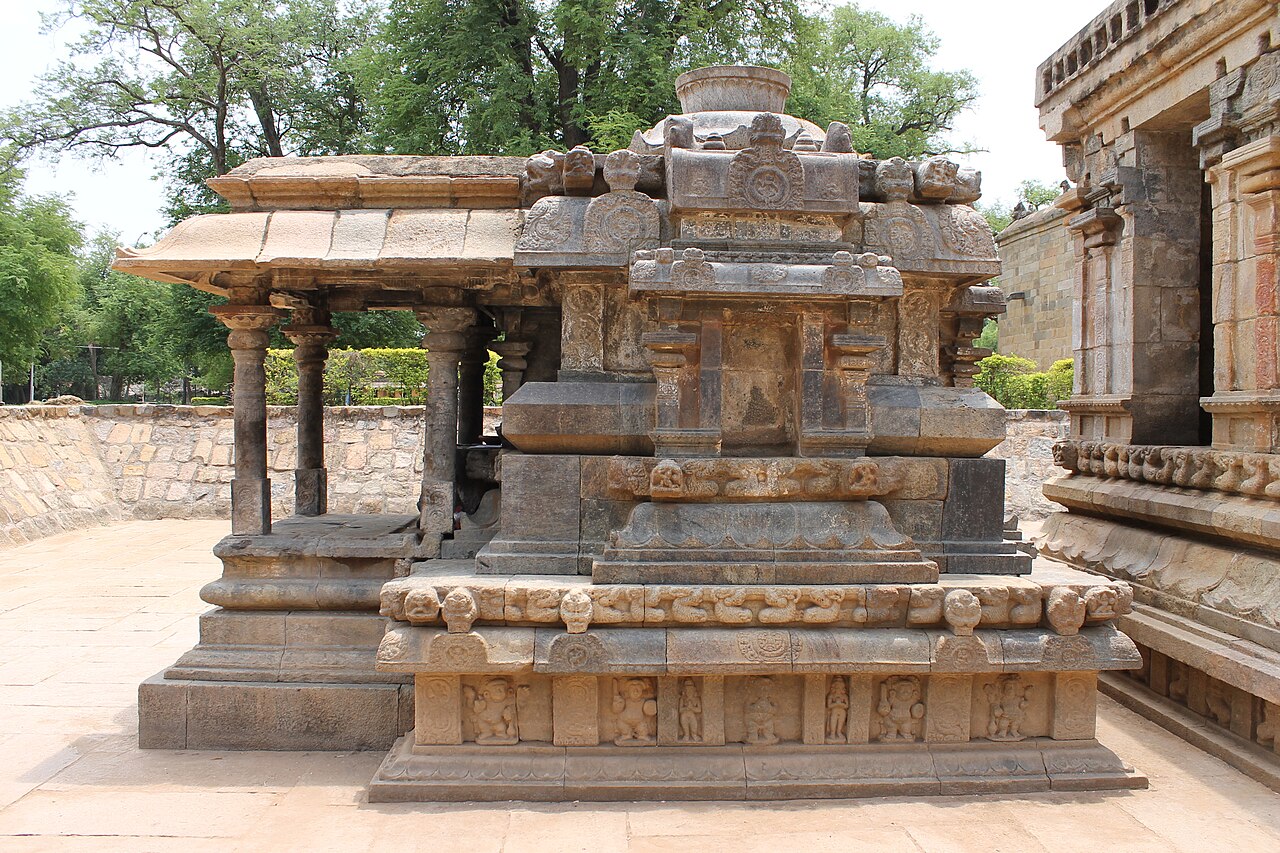
Airavatesvara Temple, Darasuram
Darasuram (Kumbakonam) · India · temple
The third of the Great Living Chola Temples, raised by Rajaraja Chola II around 1166 CE at Darasuram near Kumbakonam: a chariot-form shrine of Lord Shiva as Airavatesvara, famed for its carved stone wheels, its singing steps, and worship that has continued for over eight centuries.
Aisanyesvara Siva Temple
Bhubaneswar · India · temple
A living thirteenth-century Shiva shrine in the Old Town of Bhubaneswar, standing close to the western wall of the great Lingaraj Temple, where a Shivalinga set within a circular yonipitha still receives daily worship in the Kalinga architectural tradition.
 Hinduism
Akhadachandi Temple
Bhubaneswar · India · temple
A tenth-century Kalinga-style shrine on the southwestern bank of Bhubaneswar's sacred Bindusagar tank, Akhadachandi Temple honours Maa Mahishasuramardini, the Goddess in her form as slayer of the buffalo demon, within the dense cluster of ancient shrines that fills the city's Old Town.
 Hinduism
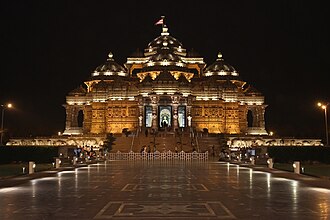
Akshardham
New Delhi · India · temple
A vast contemporary Hindu mandir campus on the Yamuna's west bank in East Delhi, raised without structural steel by 11,000 artisans and volunteers, and recognised by Guinness World Records in 2007 as the world's largest comprehensive Hindu Temple.
 Hinduism
Amarnath Temple
· India · temple
A high Himalayan cave shrine in Jammu and Kashmir where a naturally forming ice lingam is venerated as Lord Śiva, drawing one of India's great seasonal pilgrimages.
 Hinduism
Ambalappuzha Sri Krishna Temple
Ambalappuzha · India · temple
A Vaishnava shrine on the Kerala backwaters consecrated to Sri Krishna in his Parthasarathy form, counted among the seven great Temples of the former kingdom of Travancore and famed across South India for its Ambalapuzha Paal Payasam offering.