Darshan 7:30 am to 8 pm Entry free Garuda Sevai · Vaikasi Visakam Chola & Vijayanagara · 23 acres Athi Varadar rises next in 2059
East of the silk-weavers' lanes, in the quarter Kanchipuram calls Vishnu Kanchi, a whitewashed gopuram rises over the Temple tank like a mountain over a mirror. Inside, the path leads not to a door but to a stairway: the sanctum stands on top of a rock, Hastigiri, the elephant hill, and you climb to the Lord as pilgrims have for a thousand years. And below, in the green stillness of the tank, the Temple keeps a secret. The original Lord is down there, sealed in silver, and He rises once in forty years.
One of the 108 Divya Desams sung by the Alvar saints, and the great Vishnu Temple of Kanchi, one of the seven cities of liberation. Tradition holds the Lord rose here from the fire of Brahma's own ashvamedha sacrifice, radiant and granting boons: Varadharaja, the King who grants.
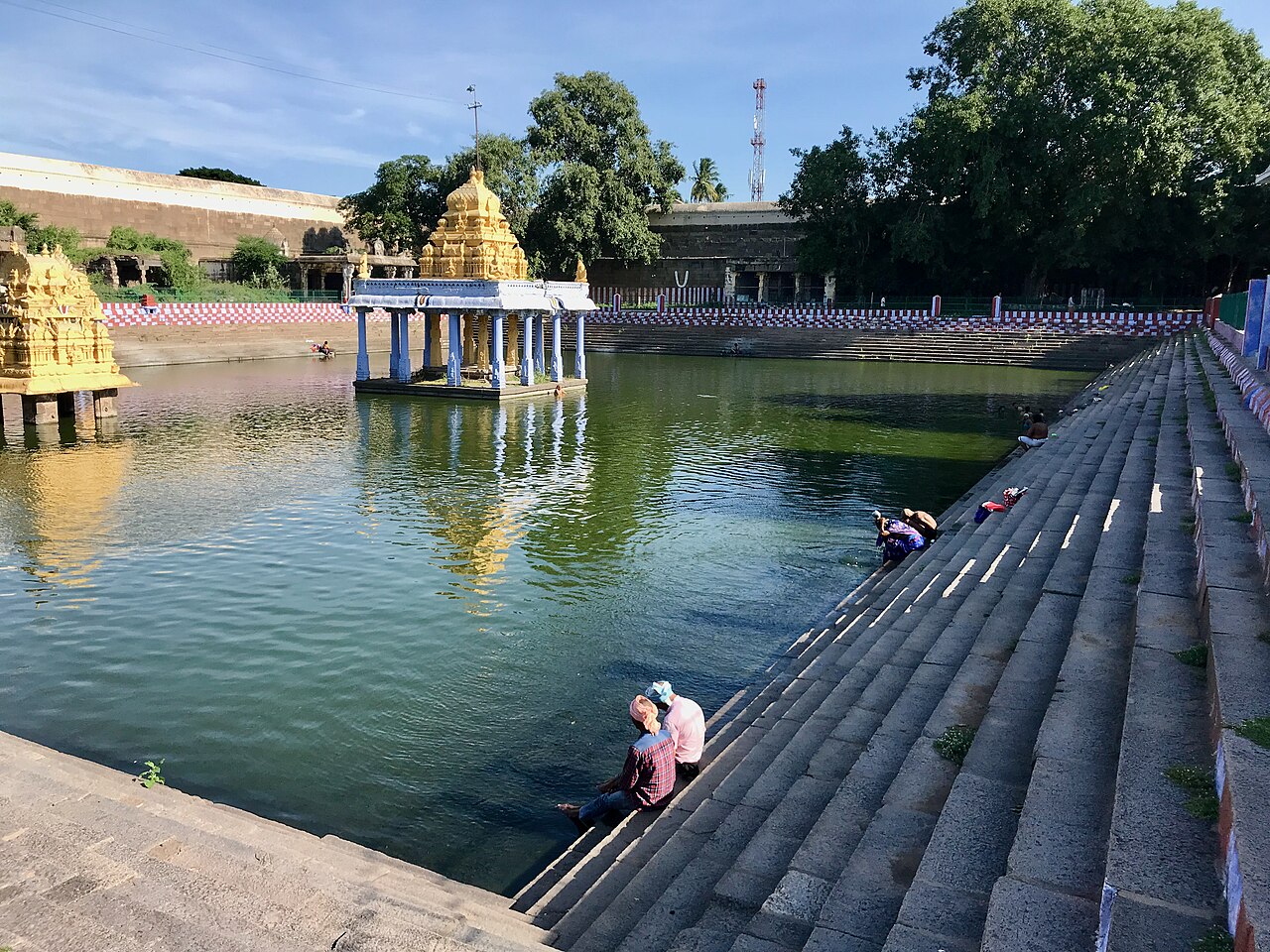
The original fig-wood form of the Lord, Athi Varadar, rests in a silver casket beneath the Ananta Saras tank and is raised for darshan once every forty years, for 48 days. The 2019 rising drew around a crore of devotees. The next is due in 2059.
Here Lord Varadharaja spoke. Through His devotee Thirukachi Nambi, who fanned Him nightly, the Lord sent six words to the young Ramanuja, words Sri Vaishnavas treasure as the seed of their path.
The Lord who rose from the fire
The old telling begins with Brahma himself. Seeking the sight of Lord Vishnu, the creator performed an ashvamedha sacrifice on this spot, and the river Vegavathi rose in flood to sweep the rite away. The Lord laid Himself across the waters so the sacrifice could be completed, and from its fire He emerged with the brilliance of a thousand suns, granting the boon Brahma sought. So He is Varadharaja, the King who grants boons, and Sri Vaishnavas call Him Perarulalan, the Lord of abounding grace. The rock He stands upon is Hastigiri, the elephant hill: tradition holds it is Airavata, the celestial elephant, bearing the Lord on his back forever.
Here the Lord did what deities in stone are not supposed to do: He conversed. Thirukachi Nambi, a humble devotee, held the honour of fanning Him each night, and the Lord would break His silence to talk with him. When the young Ramanuja sought certainty, the Lord gave Nambi six words to carry: that He alone is the supreme cause, that the soul is distinct from Him, that surrender is the way, that the departing soul need not manage its final thought, that liberation comes when the body falls, and that Ramanuja should take Periya Nambi as his master. On those six sentences a philosophy was built.
The Temple's strangest chapter began in the sixteenth century, when invasion threatened and the original Lord, carved of athi (fig) wood, was hidden in the Temple tank. Generations passed and the hiding place was forgotten, until 1709, when the tank was emptied and the Lord was found sleeping in the water. Since then the covenant has held: Athi Varadar rests in His silver casket beneath the Ananta Saras, and once every forty years He rises to see His people.
What you'll actually see
1
The climb up Hastigiri
Past the eastern gopuram, 55 metres of painted tiers, the way to the main sanctum goes up: a flight of steps climbing the bare rock of the elephant hill to Lord Varadharaja's shrine on its summit, with the courtyards and lesser towers spread below.
2
The hundred-pillared hall
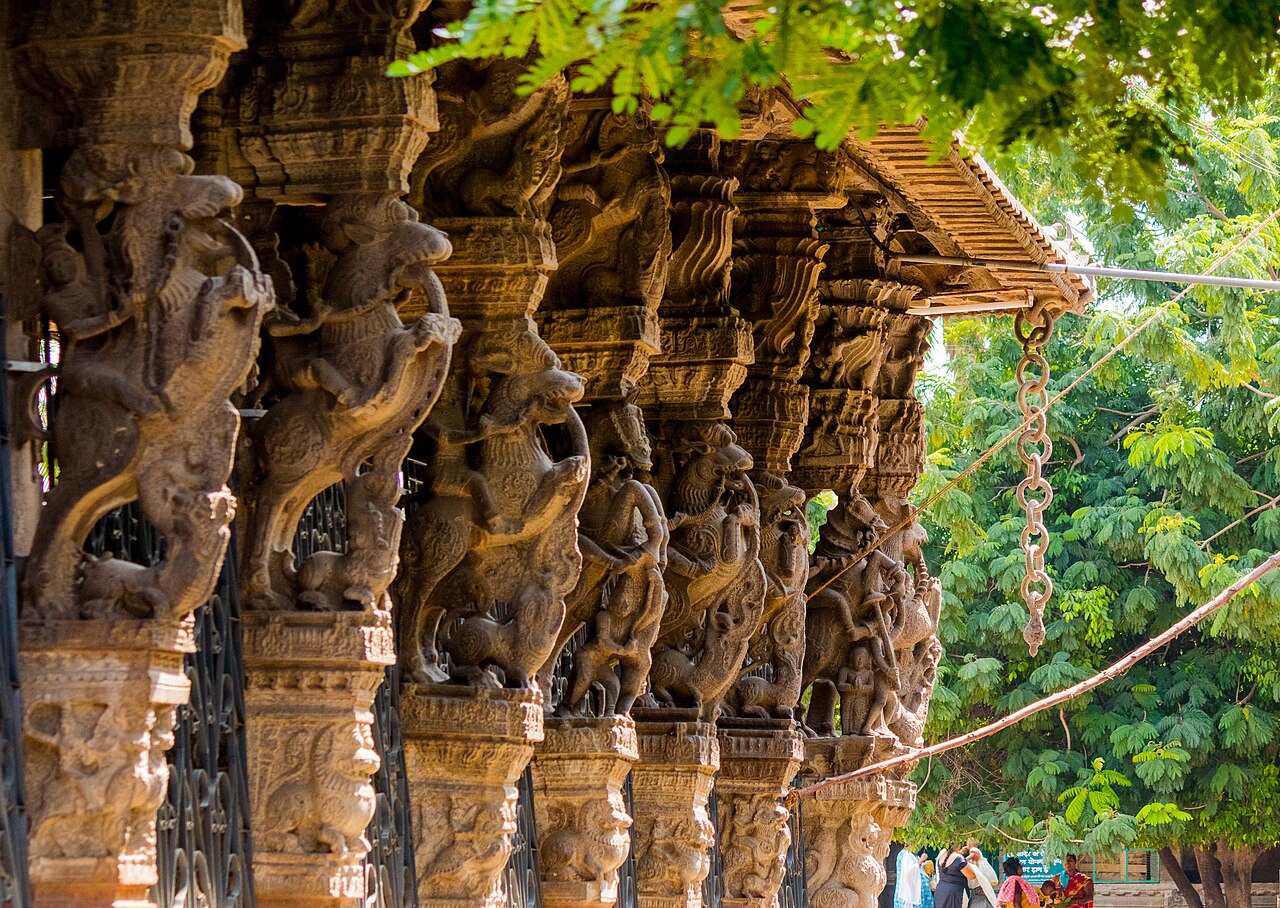
In the outer court stands the Vijayanagara marriage hall, a forest of granite carved into rearing horses, warriors and yali beasts, with scenes of the Ramayana and Mahabharata running along the stone. From its corners hang chains carved link by link from single blocks of granite, no joint anywhere.
3
The gilded lizards on the ceiling
On a ceiling panel near the sanctum crawl two lizards plated in gold and silver. Legend ties them to a curse witnessed and lifted in Indra's time, and pilgrims queue to reach up and touch them, believing the touch dissolves the doshas associated with lizards.
Monolithic stone chain carved from a single block, hanging in the hundred-pillared hall of Varadharaja Perumal TempleThe Ananta Saras Temple tank at Varadharaja Perumal Temple, beneath which Athi Varadar rests
The single-stone chain of the hundred-pillared hall, and the Ananta Saras tank · photos CC BY-SA 4.0 Jmadhu and Ms Sarah Welch, Wikimedia Commons
THE DARSHAN THAT COMES ONCE IN FORTY YEARS
Athi Varadar Vaibhavam · next rising 2059
In the summer of 2019 the Ananta Saras was drained, the silver casket was opened, and the fig-wood Lord rose from the water for the first time in forty years. For 48 days, from 1 July to 17 August, He received His people in the Vasantha Mandapam, first in repose and then standing, while around a crore of devotees poured into Kanchipuram from every direction. Then the casket closed, the water returned, and the Lord went back to His rest. Those who stood in that darshan speak of it as the sight of a lifetime, because it is: the next rising is due in 2059.
In an ordinary year, the great days are the Vaikasi Brahmotsavam in late May and early June, when Garuda Sevai draws lakhs; the Temple publishes each season's schedule.
Plan your visit
By air
Chennai International Airport (MAA), about 61 km; roughly an hour and a half by taxi.
By rail
Kanchipuram station (CJ), a short auto ride from the Temple, with trains toward Chennai and Chengalpattu.
By road
Kanchipuram is about 72 km from Chennai, and buses run through the day; the Temple stands in Little Kanchipuram, the town's eastern Vishnu quarter.
Timings
7:30 am to 12:30 pm and 3:30 to 8:00 pm daily; closing rituals until 8:30 pm. Festival days differ.
Darshan
Free for all. A paid-seva queue operates from 3:30 to 5:00 pm; the fee is posted at the counter.
Best time
The opening hour on a weekday, for a quiet climb up the hill; late May and early June bring the Brahmotsavam crowds.
The climb
The main sanctum sits atop the Hastigiri rock, reached by a flight of steps; take them slowly and unhurried.
The Temple has many names: Devarajaswamy on the official rolls, Attiyur in the Alvars' hymns, Perarulalan to Sri Vaishnavas, and its vimana is the Punyakoti, above one of the seven cities where liberation is given.
It is customary to offer worship at the shrine of Maa Perundevi Thayar first, and only then climb to Lord Varadharaja.
Robert Clive attended the Garuda Sevai in the eighteenth century and presented a jewelled necklace, still called the Clive Maharkandi, which adorns the Lord on a special day each year.
Near the sanctum is the Kannadi Arai, a mirror chamber whose angled glass multiplies the image of the Lord around you.
Questions pilgrims ask
Can I see Athi Varadar if I visit now?
No. The original fig-wood Lord rests in a silver casket beneath the Ananta Saras tank and is raised only once every forty years, next in 2059. Daily darshan is of Lord Varadharaja enshrined atop Hastigiri, and the Temple is fully alive around Him every day.
Is this the main Temple of Kanchipuram?
It is the greatest of Kanchi's Vishnu Temples and among the largest Temples in the city, spread over about 23 acres. Kanchipuram is really two sacred towns in one: Shiva Kanchi around the Ekambareswarar Temple, and Vishnu Kanchi, Little Kanchipuram, gathered around Lord Varadharaja.
What are the six words spoken here?
Tradition holds that Lord Varadharaja, speaking through His fan-bearer Thirukachi Nambi, sent six teachings to the young Ramanuja: He alone is the supreme cause, the soul is distinct from Him, surrender is the means, the final thought need not be feared, liberation comes when the body falls, and Periya Nambi is to be taken as master. Sri Vaishnavas revere them as the charter of their path.
When is the biggest day of the year?
Garuda Sevai, when the Lord rides His golden Garuda through lakhs of devotees during the Vaikasi Brahmotsavam. It falls on Vaikasi Visakam, 20 May in 2027; the full ten-day festival runs in late May and early June.
Why is everyone reaching up to a ceiling panel?
They are touching the gold and silver lizards. Pilgrims believe that touching them removes the doshas connected with lizards, and the small queue below the panel moves all day.
Dharamshalas and guest houses near this Sthan, shared by devotees. Adisthan takes no bookings and no money; contact each stay directly.
No stays are listed here yet. Know one that serves pilgrims well?
Are you a priest, trustee or sevak of Sri Varadharaja Perumal Temple? Claim this page to keep darshan hours, seva details and utsavam schedules exact for the pilgrims who plan their lives, and their forty-year vows, around Perarulalan.