Hampi Bazaar · Hampi, Vijayanagara district, Karnataka, India
The empire fell around Her Lord. The lamps never went out.
Be the first to check in
Coming up: Mahashivaratri · 6 MarEntry tended 29 Jun 2026
Open about 6 am to 9 pm Free entry Mahashivaratri · 6 Mar 2027 9-tier gopuram · 50 m Worship unbroken since about the 7th c.
You walk up the long, colonnaded bazaar street between granite boulders the colour of honey, past ruined pavilions where an empire once traded diamonds, and the pastel nine-storeyed tower keeps rising ahead of you until it fills the sky. Then a bell sounds inside. A priest calls. A file of pilgrims moves through the gate with coconuts and jasmine. Every monument around you is a ruin. This one never became one.
Amid the vast ruins of Vijayanagara, this is the one great Temple still alive: worship of Lord Virupaksha has continued from about the 7th century to this morning, through the very fall of the city in 1565.
The Lord here is Pampapati, the Lord Of Maa Pampa, the river goddess of the Tungabhadra. She won Him By Her penance, this land is Pampa kshetra, and Hampi itself is Her name worn soft by time.
The 50 metre, nine-tiered eastern gopuram and the great pillared hall of 1510, raised by emperor Krishnadevaraya to mark his accession, crown a complex inscribed in UNESCO's Group of Monuments at Hampi.
The penance beside the river
The old telling begins with a young goddess and a silent ascetic. Maa Pampa, Daughter of the waters, the local form of Maa Parvati, resolved to win Lord Shiva as Her husband while He sat lost in tapas on the hill beside the Tungabhadra. She served Him, then matched Him: She Herself took up penance on Hemakuta hill, season after season, until the Lord opened His eyes and consented to wed Her. Tradition holds that at Their marriage the gods showered gold upon the hill, and Hemakuta, the peak of gold, still carries the memory. The Lord became Pampapati, Her Lord; the land became Pampa kshetra; and over centuries the name Pampa softened into Hampi.
A shrine of Lord Shiva stood here from about the 7th century, and stone inscriptions naming Him run back to the 9th and 10th centuries. When the Vijayanagara empire rose in the 14th century it built its capital around this sanctuary, and the modest shrine grew into a state Temple of towered gateways, courtyards and hundred-pillared halls. In 1510 the greatest of its emperors, Krishnadevaraya, marked his accession by raising the ornate central pillared hall and gateway works that still define the complex.
In 1565 the city was sacked and abandoned, its Temples broken, its bazaars left to the boulders. The worship of Virupaksha and Maa Pampa did not stop. Priests kept the rites through the centuries of silence, the towers were renovated early in the 19th century, and the Temple stands today as the living heart of a ruined capital.
What you'll actually see
1
The eastern gopuram over the bazaar
The nine-tiered, 50 metre gateway tower rises straight out of the old Hampi Bazaar street, brick and plaster over granite, crowned with a pair of horn-like projections. It is the landmark of all Hampi: you see it from the hills, from the river, from a kilometre down the colonnade.
2
The ranga mandapa of 1510
Krishnadevaraya's accession gift: an open hall of 38 carved pillars in five aisles, where Temple rituals and the deities' marriage ceremonies are still conducted. Overhead, the ceiling carries rare Vijayanagara-era paintings of gods, sages and processions.
3
The chamber of the inverted tower
In a dark room at the rear of the complex, a narrow slit in the stone casts the shadow of the great eastern gopuram onto the wall, upside down: a pinhole-camera effect built in masonry. Pilgrims queue to watch a 50 metre tower stand on its head.
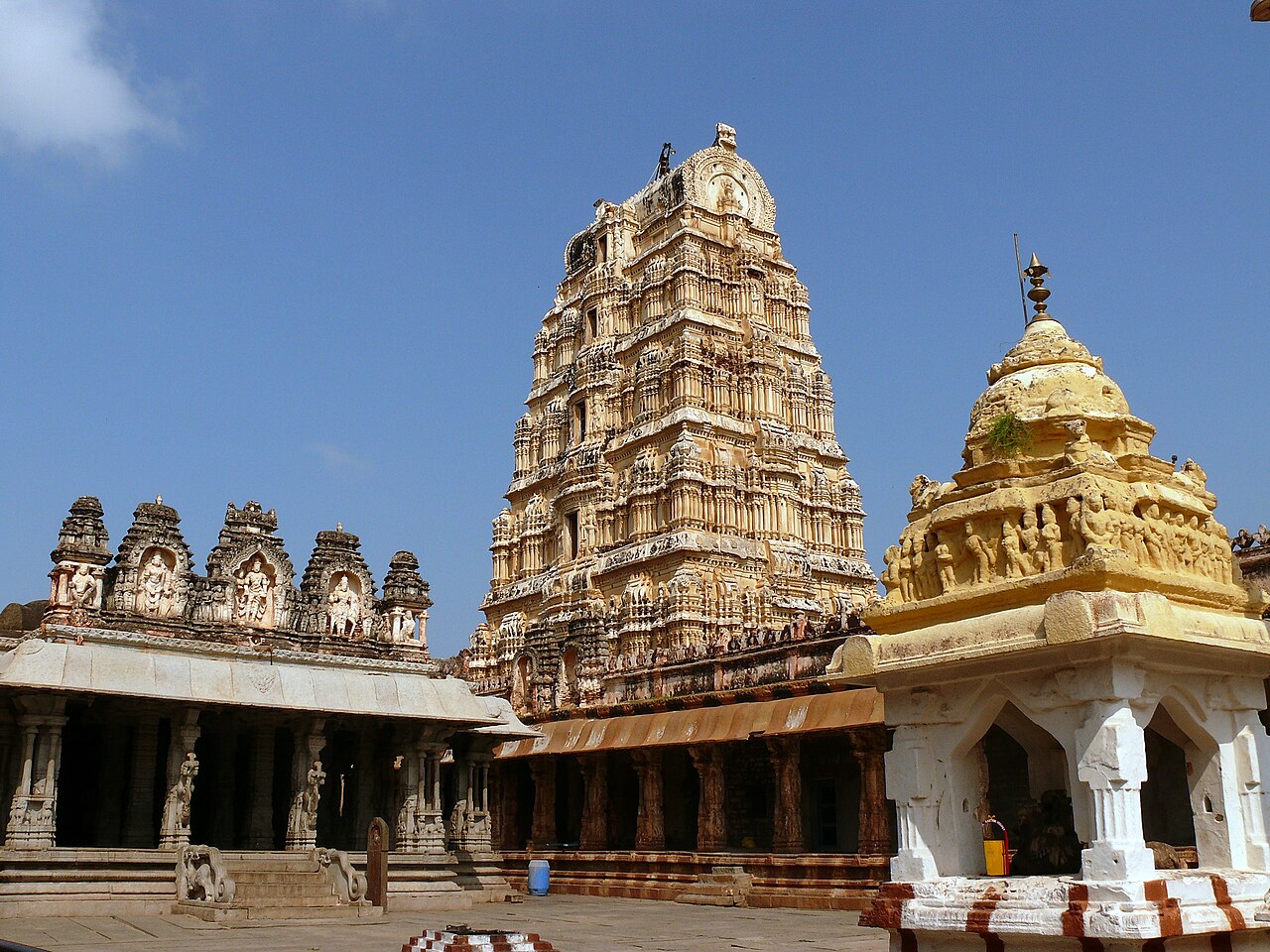
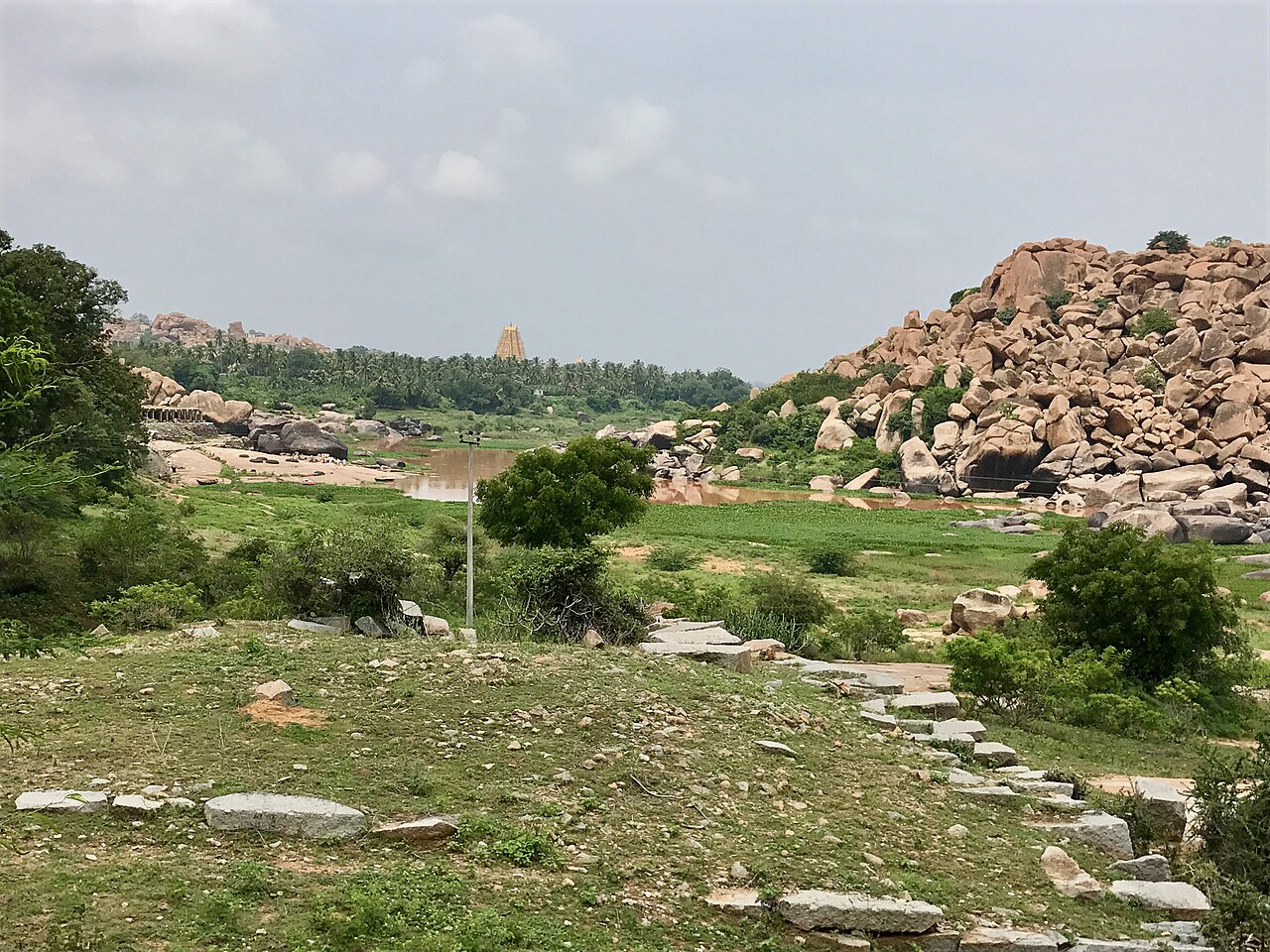
The inner courtyard of Virupaksha Temple, Hampi, with its pillared cloisters and inner gopuramThe old bathing ghat on the Tungabhadra river below the Virupaksha Temple, Hampi
The inner courtyard, and the bathing ghat on the Tungabhadra · photos CC BY 4.0 Amitabha Gupta and CC BY-SA 4.0 Ms Sarah Welch, Wikimedia Commons
THE MARRIAGE AN EMPIRE WAS BUILT AROUND
The Virupaksha Car Festival · each spring
Every year the Temple re-enacts the union that made this land holy. In December comes the Phalapuja, the ceremonial betrothal of Lord Virupaksha and Maa Pampa, and then in spring, in March or April by the lunar calendar, the great car festival celebrates Their ritual marriage. The deities ride a towering wooden chariot pulled by thousands of hands down the same colonnaded bazaar street the Vijayanagara emperors processed along five centuries ago. It is the largest religious gathering in Hampi, and the one day the ruined capital again looks like a capital.
The chariot dates follow the lunar calendar and are announced by the Temple; confirm locally before travelling, and come a day early for the smaller rites.
Plan your visit
By air
Jindal Vijaynagar Airport (VDY), about 35 km, has limited flights; Hubballi (HBX) is about 166 km; Bengaluru (BLR) about 340 km with the widest connections.
By rail
Hosapete Junction (Hospet, HPT), about 13 km; buses and autos run to Hampi Bazaar.
Timings
Open daily, about 6:00 am to 12:00 pm and 4:30 pm to 9:00 pm; the sanctum generally rests at midday.
Best time
Early morning, when the light is gold on the gopuram and the Temple elephant is taken down to the river; November to February for gentle weather.
Entry
Darshan is free and the Temple is open to visitors of all backgrounds; a small camera fee is collected inside.
Dress
Modest dress with shoulders and knees covered; footwear is left at the gate.
The queue
Easy on ordinary days; expect dense crowds for Mahashivaratri and the spring car festival.
Hampi is Maa Pampa's own name: Pampa became Pampe, became Hampi, so the town itself answers to the Goddess.
The Temple elephant, Lakshmi, blesses pilgrims in the courtyard and is bathed each morning at the river ghat behind the Temple.
A narrow channel of the Tungabhadra runs through the Temple, along the terrace and down through the old kitchen court.
Hemakuta hill rises directly behind the south gate, strewn with pre-Vijayanagara shrines; the walk up at sunset takes ten minutes.
Questions pilgrims ask
Is Virupaksha Temple a ruin like the rest of Hampi?
No, and that is the wonder of it. Every other great Temple of Vijayanagara was emptied or broken after the city fell in 1565. This one kept its priests, its rites and its deity. It is a fully living Temple with daily worship, standing inside a World Heritage field of ruins.
Who is Maa Pampa?
The river goddess of the Tungabhadra, honoured here as the local form of Maa Parvati. Tradition holds She won Lord Shiva By Her penance beside the river, so the Lord here is Virupaksha as Pampapati, Her Lord, and the whole sacred zone is Pampa kshetra. Her shrine stands within the complex, and Hampi carries Her name.
Can I see the inverted shadow of the tower?
Yes. Walk to the dark chamber at the rear of the complex, behind the sanctum, and let your eyes adjust: a slit in the wall throws an upside-down image of the eastern gopuram onto the stone, a pinhole camera built centuries before the camera.
How much time does the Temple need, and what about the rest of Hampi?
Give the Temple itself an hour or two: the gopurams, the 1510 pillared hall, the ceiling paintings, the shadow chamber, the river channel. Hampi's wider sacred landscape, Hemakuta hill, the riverside shrines and the Vitthala Temple, asks for at least a full day more.
Dharamshalas and guest houses near this Sthan, shared by devotees. Adisthan takes no bookings and no money; contact each stay directly.
No stays are listed here yet. Know one that serves pilgrims well?
Are you a priest, archaka or trustee of Shri Virupaksha Temple? Claim this page to keep darshan hours, festival dates and the car festival calendar exact for the pilgrims of Maa Pampa's Lord.