Jinlong Gorge, Mount Heng · Hunyuan County, Shanxi, China
Halfway up the cliff, above the road and below the summit, Buddha, Laozi and Confucius have kept one another's company for fifteen hundred years.
Be the first to check in
Entry tended 25 May 2026
8:00 to 18:00 Jun to Oct · 8:30 to 17:30 Nov to May Entrance CNY 15 · Ascent CNY 100 Buddha, Laozi and Confucius in one hall Founded 491 CE · Ming and Qing timber West cliff of Jinlong Gorge, Mount Heng
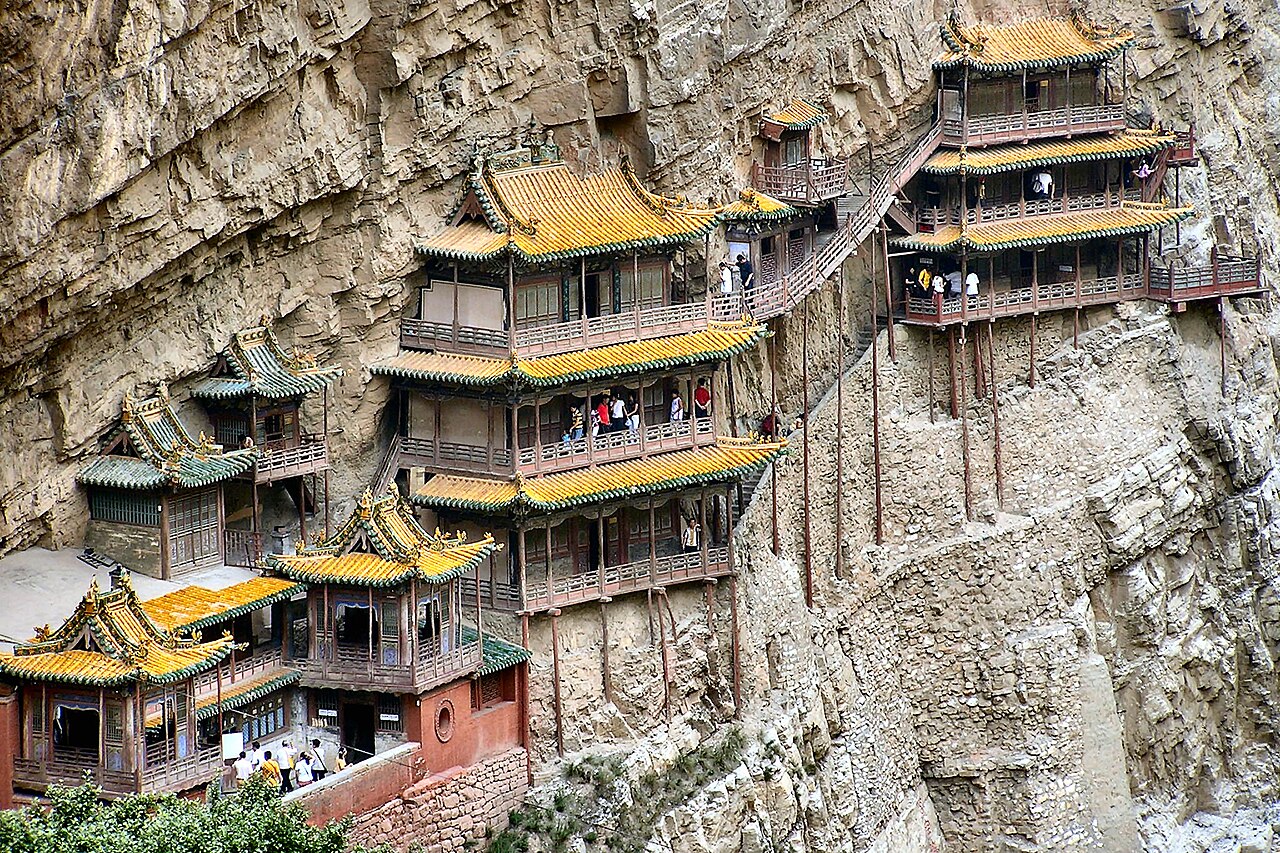
The gorge narrows, the wind funnels through, and then you see it: a lattice of vermilion galleries and grey-tiled roofs pinned to a sheer rock wall, some sixty metres above the floor of Jinlong Gorge. From the path below, the whole Temple looks as thin as a shelf of carved wood. Stone steps climb to a brick-faced terrace, and above it the plank walkways creak on their slender stilts. Look closely at those poles. Some of them sway free of the ground. They are not what holds the Temple up.
This is the only surviving Temple in China where the Three Teachings keep a common shrine. In the San Jiao Hall at the top of the north tower, Sakyamuni Buddha sits at the centre with Laozi and Confucius seated at his sides, three founders sharing one small room above the gorge.
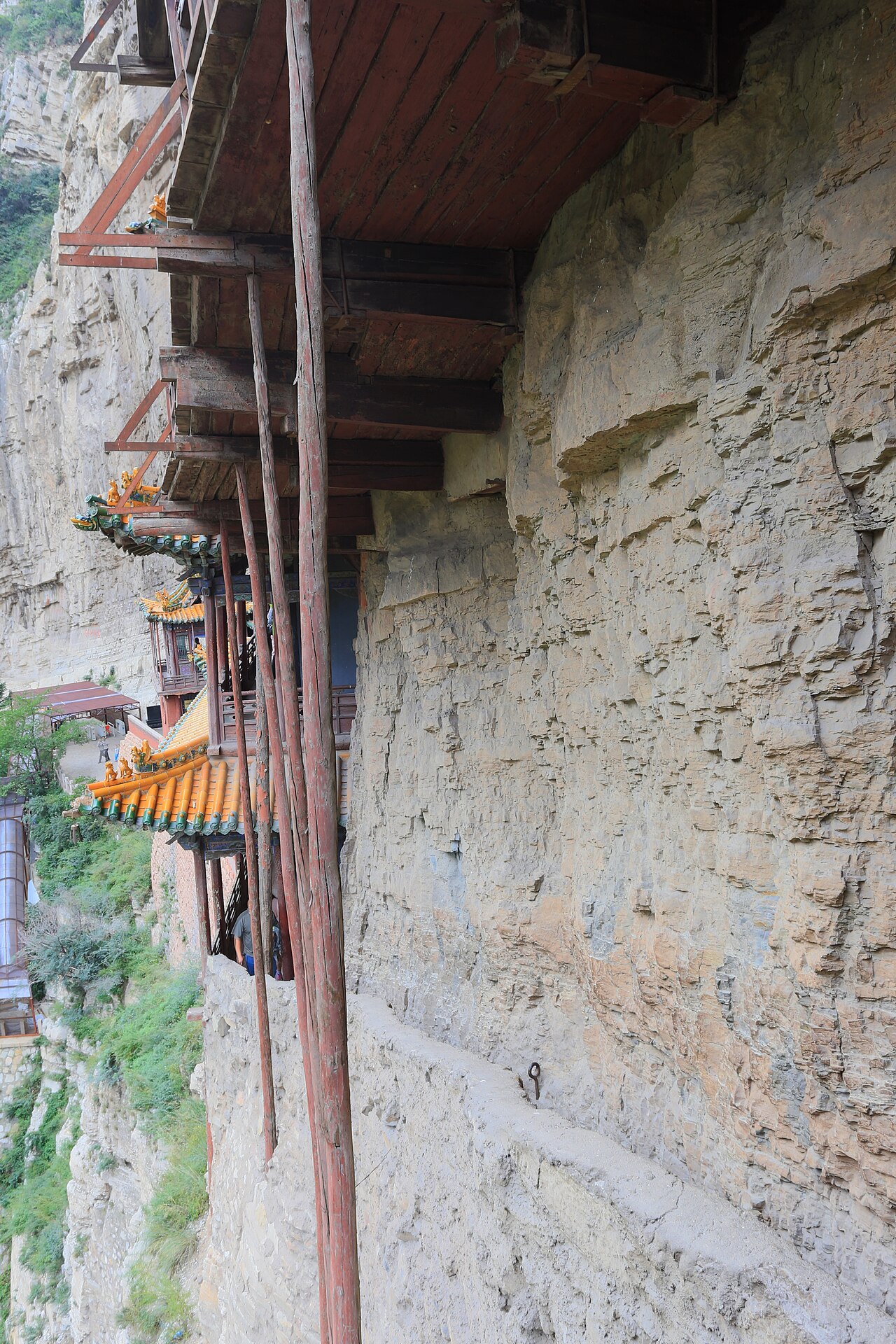
The Temple truly hangs. Its forty halls and pavilions rest on hemlock crossbeams soaked in tung oil and driven into sockets chiselled out of the cliff; many of the slender poles beneath the walkways are stabilisers added in later restorations, and some carry no load at all.
It guards the throat of Beiyue, Mount Heng, the Northern of China's Five Great Mountains, honoured in Taoist tradition as a grotto-heaven of the north and the realm of Xuanwu, the dark warrior of winter and water.
A Temple ordered into the air
One telling begins with a dying wish. Kou Qianzhi, the great Taoist master of the Northern Wei court, longed for a Temple built in the air, welcoming celestial guests above and cutting off the clamor of the world below. His followers carried the vision for decades, and in 491, the fifteenth year of the Taihe era, work began on the cliff. Another telling gives the labour to a single monk named Liaoran. Both agree on what came of it: a Temple that has clung to the rock for more than fifteen centuries.
The site was no accident. Jinlong Gorge, squeezed between Tianfeng Ridge and Cuiping Peak, was the pass through which Emperor Daowu of the Northern Wei had tens of thousands of soldiers carve a road south from his capital at Datong. The Temple was hung above that road, tucked into a recess of the west cliff beneath the overhanging summit. By the Jin and Yuan dynasties the south tower, the north tower and the plank bridge between them had taken their present arrangement, and the timber that stands today is largely the work of Ming and Qing rebuilders, with major repairs recorded in 1747 under the Qianlong emperor.
The gorge has kept famous company. In 735 the poet Li Bai climbed up, came down, and left two characters on a boulder beneath the Temple: zhuang guan, magnificent. Nine centuries later the Ming geographer Xu Xiake stood in the same gorge and pronounced the Temple a grand wonder under heaven.
What you'll actually see
1
The terrace and the stairways
The climb begins on a brick-faced terrace built against the base of the cliff, through a small dark gateway and up worn stone steps. From here the route is a single one-way circuit, and the corridors and wooden stairs that hug the rock are wide enough for one person at a time, so the Temple fills and empties in a slow, single file.
2
The Changxian plank bridge
A ten-metre plank road strung along the cliff links the south tower to the north tower. It is the narrowest moment of the circuit, one walker wide, with the gorge floor far below and the overhanging summit above. The spatial arrangement of the two towers and this bridge has stood since the Jin and Yuan dynasties.
3
The statues of three faiths
More than eighty statues in bronze, iron, clay and stone fill the small halls, many of them Ming era work: Buddhist, Taoist and Confucian figures distributed through some forty rooms and pavilions. The circuit ends at the highest of them, the San Jiao Hall, where the founders of the Three Teachings sit together.
Visitors moving in single file along the galleries of the Hanging Temple, its pavilions standing on slender stilts against the cliff of Jinlong GorgeThe walkway beams and slender wooden poles of the Hanging Temple seen edge-on along the rock face, with the gorge dropping away below
The galleries above Jinlong Gorge, and the beams and poles that meet the cliff · photos public domain Emmanuel Brunner and CC BY-SA 3.0 Zhangzhugang, Wikimedia Commons
The hall found nowhere else
San Jiao Hall: the Three Teachings seated together
At the highest point of the north tower, at the end of the one-way climb, stands a small timber hall. Inside, Sakyamuni Buddha sits at the centre, and Laozi, the sage of the Tao, and Confucius, the great teacher, sit at his sides. China's Temples were raised by all three traditions, and the three borrowed freely from one another, but only here have Buddhism, Taoism and Confucianism kept a common shrine in one hall through fifteen centuries. Even the Temple's name holds the meeting: it was first called Xuankong Ge, with xuan drawn from Taoist teaching and kong from Buddhist doctrine.
The hall comes near the end of the ascent circuit; ascent tickets are capped daily and sell out, so reserve online up to seven days ahead.
Plan your visit
By air
Datong Yungang Airport serves the region. The Temple lies about 65 km southeast of Datong city, in Hunyuan county, reached by taxi or tour coach.
By rail
Trains reach Datong; onward travel to the gorge is by road through Hunyuan county, about 65 km southeast of the city.
Timings
June to October 8:00 to 18:00; November to May 8:30 to 17:30. Ticket windows at the Hengshan tourist service centre run 7:30 to 16:30, and online sales open at 7:20 daily.
Entry
The entrance ticket is CNY 15 (half price CNY 8) and covers the gorge and the view of the Temple from below. Climbing the Temple itself costs a further CNY 100 (half price CNY 50).
The daily cap
Since 1 April 2026, ascent tickets are limited to 2,475 a day, reduced from 3,275, and the supply is planned to shrink each year for conservation. Online allocations can be booked up to seven days ahead and sell out quickly.
The route
The climb is a single one-way circuit: stone steps to the terrace, up through the south tower, across the ten-metre plank bridge to the north tower and the San Jiao Hall, then down the far side. The walkways themselves take roughly 20 to 45 minutes.
Best time
Come for opening time. Morning offline allocations are limited, the narrow walkways admit only a thin file of visitors at once, and queues build by mid-morning.
The Temple was first called Xuankong Ge: xuan taken from Taoist teaching and kong from Buddhist doctrine, so the name itself joins the traditions the Temple houses.
On a boulder below the Temple the poet Li Bai left the two characters zhuang guan, magnificent, after his visit in 735; the Ming geographer Xu Xiake called the Temple a grand wonder under heaven.
The State Council listed Xuankong Si in the second batch of national key cultural relics protection units in February 1982; a full restoration ran from 2015 to 2016, and fibre-optic sensors installed by the Shanxi Earthquake Agency now monitor the structure around the clock.
No monastic community lives here today. The Temple is managed as a protected monument, and its devotional life belongs to visiting worshippers rather than resident clergy.
Questions pilgrims ask
Do the poles under the Temple really hold it up?
Mostly, no. The load is carried by hemlock crossbeams, treated with tung oil against rot and insects, socketed deep into holes chiselled in the cliff; the bedrock does the real work. Many of the slender vertical poles were added in later restorations as stabilisers, some balance the differing heights of the pavilions, and some carry no load at all.
Is the Hanging Temple Buddhist, Taoist or Confucian?
All three. Tradition ties its founding both to the Taoist master Kou Qianzhi's vision and to the Buddhist monk Liaoran, and its halls hold Buddhist, Taoist and Confucian images side by side, with the San Jiao Hall enshrining the three founders together. It stands within the Taoist cosmos of Mount Heng, the Northern Great Mountain, and is listed here with the Taoist tradition.
Is the Temple still an active place of worship?
Honestly, only in a limited way. There is no resident clergy, and the Temple is managed today as a national protected monument with strict conservation rules and a daily visitor cap. Devotees still come and pay their respects along the circuit, but the site's first duty now is preservation.
Do I have to climb it, and can everyone manage the climb?
No. The CNY 15 entrance ticket gives the full view of the Temple from the gorge floor, which is how it has been seen for most of its history. The ascent needs a separate CNY 100 ticket, and the route is steep, narrow and one-way, with single-file plank walkways and wooden stairs; it is not passable by wheelchair and is hard going for anyone unsteady on steps.
Dharamshalas and guest houses near this Sthan, shared by devotees. Adisthan takes no bookings and no money; contact each stay directly.
No stays are listed here yet. Know one that serves pilgrims well?
Are you with the Hengshan scenic area administration or the cultural heritage authorities of Hunyuan county? Claim this page to keep its hours, ticket caps and conservation notices true for every devotee and visitor who comes to the cliff.