Opens 7:45 am summer · 8:45 am winter Darshan between curtains Jhulan swing · 15 Aug 2026 Rajasthani style · 1862 Free · no VIP darshan
The bazaar lane squeezes you long before the gate appears: garland sellers calling, baskets of marigold and white bela, the cry of Radhe Radhe rolling ahead of you like a wave. Inside, the crowd rises on tiptoe toward a single dark form dressed in flowers, and then the curtain swishes shut. A breath later it parts again. No bells ring in this Temple. No conch sounds. And the curtain Before Thakur Ji never stays open for long.
This is the shrine where darshan itself is rationed. The curtain Before Shri Banke Bihari closes and opens every few minutes, because tradition holds that whoever stares too long into His eyes would lose all self and He might walk away with them. The sevayats break the gaze for the devotee's own sake.
Shri Banke Bihari Is one form of two. When the celestial couple Appeared Before Swami Haridas at Nidhivan, they merged at his request into a single dark, charming vigraha, so Shri Radha and Lord Krishna Are Worshipped here together in one body, bent in three places, the tribhanga.
Thakur Ji Is Served as a child. No bells hang anywhere in the Temple and there is no dawn Mangala aarti, so that the child Lord may rest: Mangala aarti happens one morning a year on Janmashtami, and His feet Are Unveiled one morning a year on Akshaya Tritiya.
The song that brought Him out of the forest
Swami Haridas was born on Radha Ashtami of 1478 to Ashudhir and Gangadevi, in a village near Aligarh now called Haridaspur. When his young wife left her body in a blaze of devotion, he renounced the world and walked into the forests of Vrindavan, then a wilderness, and chose a secluded grove to sing in. That grove is Nidhivan. There he practised his music not as performance but as worship, and the songs he sang there would later shape the great dhrupad tradition; Tansen of Akbar's court is remembered as his student.
The legend says his disciples begged to see the one for whom he sang. Swami Haridas relented, and in the grove the divine couple, Shyama and Shyam, Appeared in person, smiling, radiant beyond bearing. The saint asked them to spare the world a brightness no eye could hold, and the two merged into one single black charming form: the very vigraha standing in the sanctum today. The Temple remembers that appearance every year on Bihar Panchami.
For generations Thakur Ji Was Served at Nidhivan by the line of Swami Haridas's family and followers. In 1862 a new Temple befitting His glory rose in the heart of Vrindavan's bazaar, built in the arched and balconied Rajasthani manner, and Shri Banke Bihari Moved the short distance from the grove to the hall where the curtain now opens and closes all day.
What you'll actually see
1
The lane and the carved gates
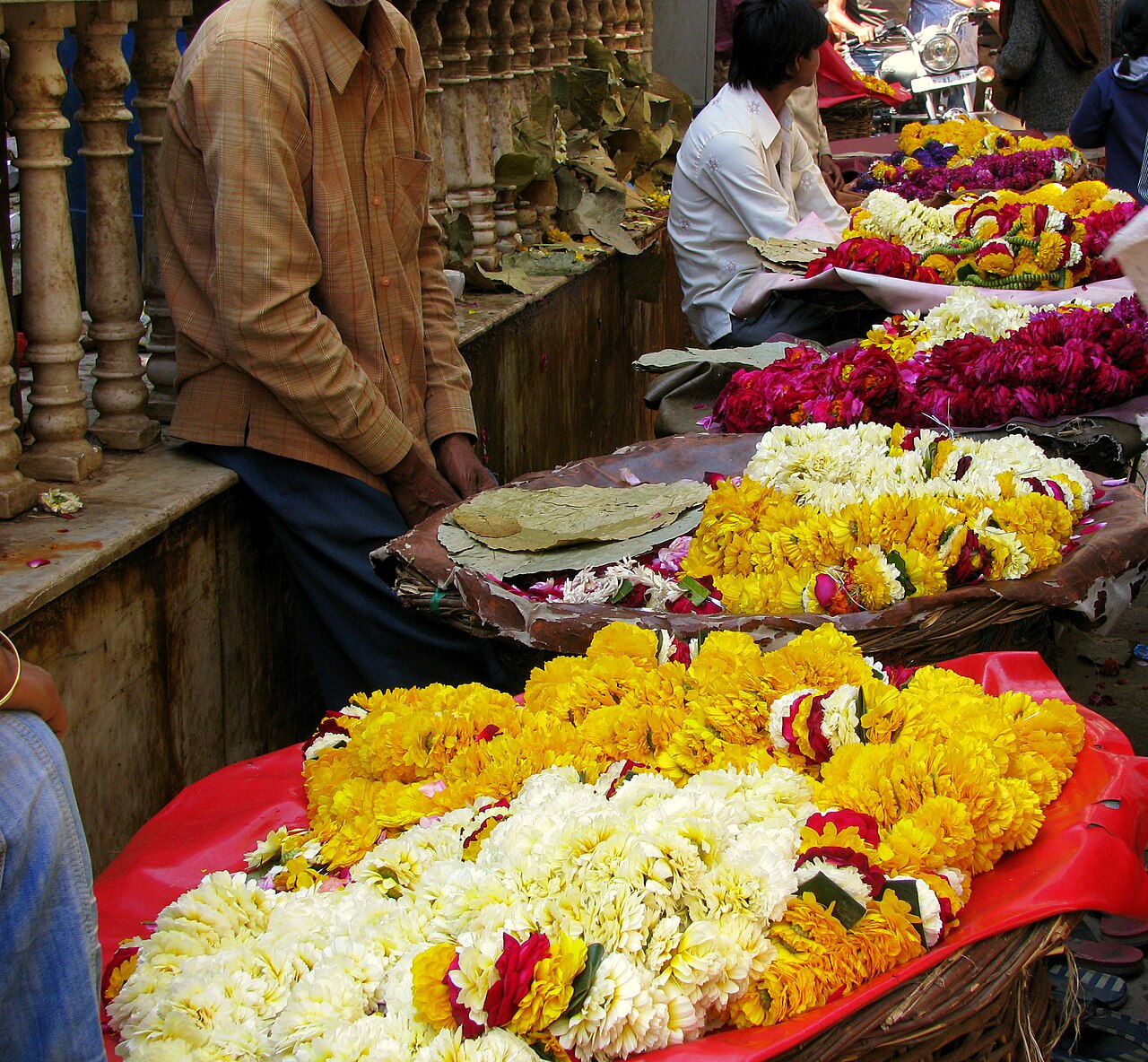
You approach on foot through a narrow market lane roofed with garland nets, past sellers threading marigold, rose and bela outside the walls. The Temple front rises in tiers of pink scalloped arches, carved balconies and latticework, with numbered gates; Gate No. 1 carries its name in Devanagari above a lotus-cusped doorway.
2
The rhythm of the curtain
Darshan here is not a long quiet look but a heartbeat. The yellow curtain Before Thakur Ji Is Drawn and parted again and again through every darshan session, and each opening lands like a small festival: arms rise, the hall cries Bihariji ki jai, and the black tribhanga form in His poshak and fresh flowers Shines for a few breaths before the cloth swings back.
3
The Phool Bangla of summer
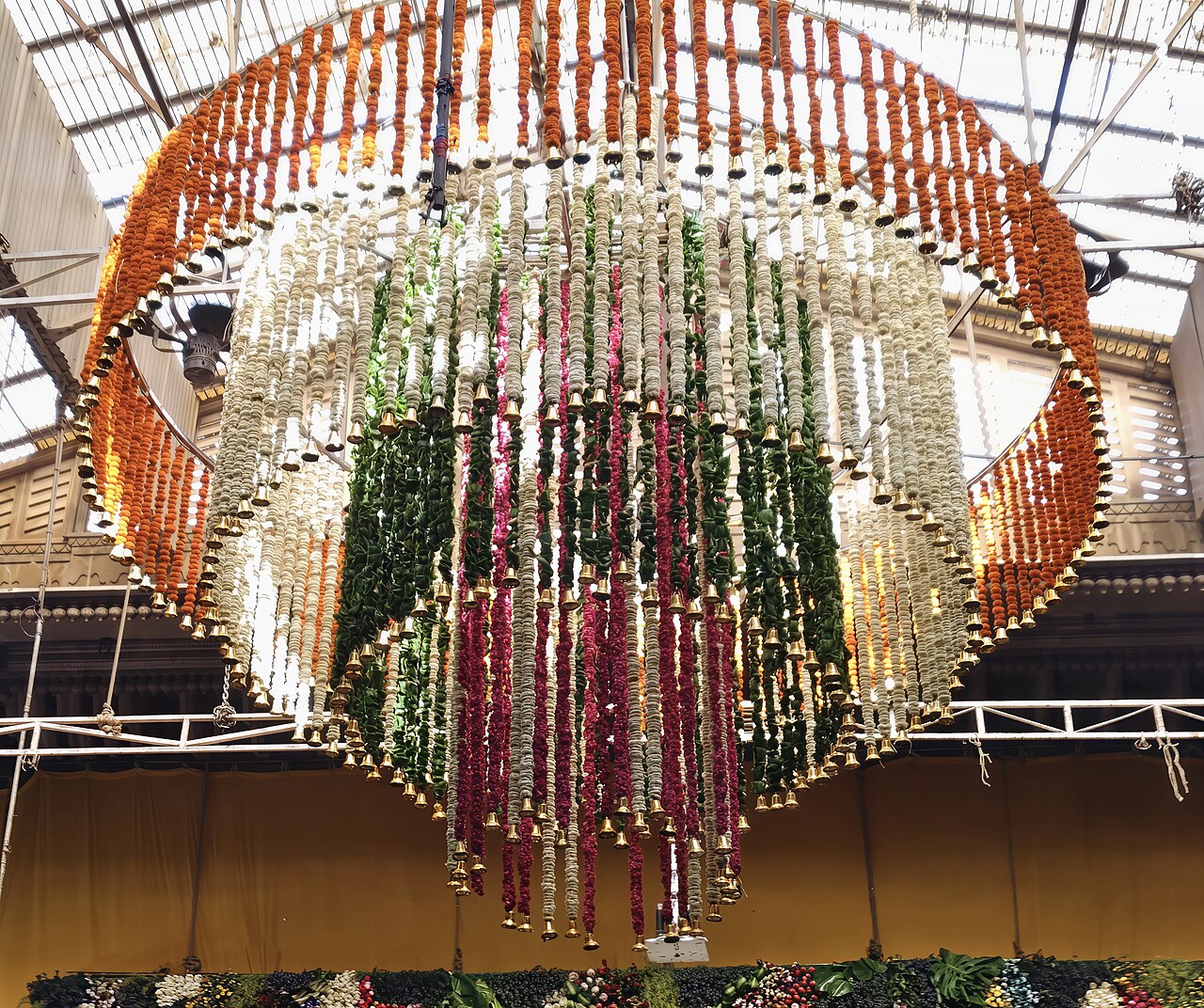
Through the hot months, from Kamda Ekadashi in late March to Hariyali Amavasya in August, the sevayats build Thakur Ji palaces of fresh flowers: walls, arches and whole chandeliers of jasmine, rose and marigold strung with tiny bells, raised to keep the child Lord cool in the Braj summer.
A floral chandelier of marigold, jasmine and rose strung with brass bells during Phool Bangla at Shri Banke Bihari MandirGarland sellers with baskets of marigold and rose in the lane outside Shri Banke Bihari Mandir, Vrindavan
The flower palace and the garland lane · photos by Aliva Sahoo and Ekabhishek, CC BY-SA 3.0, Wikimedia Commons. Photography of Thakur Ji Himself is not permitted, and this page honours that.
DARSHAN THAT COMES ONCE A YEAR
A calendar of once-only unveilings
What other Temples give daily, this Temple gives once a year, and Vrindavan counts its seasons by it. Mangala aarti, the dawn waking of Thakur Ji, happens only on Janmashtami, 4 September 2026. His feet, hidden all year beneath the poshak, Are Shown only on Akshaya Tritiya: charan darshan in the morning and sarvang darshan in the evening, 20 April 2026. He Takes the flute in His hands only on Sharad Purnima, the night of the Maha Raas, 26 October 2026. And on Hariyali Teej, 15 August 2026, He Swings on the jhoola as the whole town presses in for the Jhulan festival.
These are the Temple's heaviest days by far; arrive hours early, expect police-managed routes, and keep children and elders on the edges of the crowd.
Plan your visit
By air
Kheria Airport, Agra, is about 70 km; Indira Gandhi International Airport, Delhi, is about 150 km.
By rail
Mathura Junction is about 14 km from the mandir; taxis, autos and buses run from the station to Vrindavan.
By road
From Delhi/NCR take NH 44 or the Yamuna Expressway. The Temple stands in the old bazaar; the last stretch is on foot through the lane.
Timings
Summer (5 Mar to 10 Nov): 7:45 am to 12 noon and 5:30 to 9:30 pm. Winter: 8:45 am to 1 pm and 4:30 to 8:30 pm. Season boundaries shift; check bihariji.org.
The queue
Darshan is free and there is no VIP or paid queue; the Temple asks all devotees to follow the queue system. Timings extend on festivals.
What not to bring
Mobile phones, electronic gadgets, umbrellas and leather items are not allowed; footwear stays outside the premises.
Wheelchair help
Wheelchair assistance is available from outside Sneh Bihari Mandir, where an assistant brings the devotee to the Temple for darshan.
Best time
A weekday morning at opening hour is the calmest darshan; weekends, Ekadashi and festival days multiply the crowd many times over.
Banke means bent: the vigraha stands bent in three places, the tribhanga pose of Lord Krishna with the flute, and Bihari means the one who delights and roams, so the name is the Bent Enjoyer of Vrindavan's groves.
Nidhivan, the grove where Thakur Ji Appeared to Swami Haridas, is a short walk away and closes to all visitors at dusk; the appearance day is kept as Bihar Panchami, 14 December 2026.
After two devotees died in the Janmashtami crush of August 2022, crowd management is being rebuilt: in May 2025 the Supreme Court cleared a corridor plan around the Temple, and in August 2025 it appointed a high-powered committee to run the Temple's affairs while the dispute over a state ordinance is heard.
Keep a firm grip on spectacles and prasad in the lane: the Temple's own guidance is to beware of pickpockets and monkeys.
Questions pilgrims ask
Why does the curtain keep closing during darshan?
It is the Temple's most famous act of care. Tradition holds that the gaze of Shri Banke Bihari Is so strong that anyone who looks into His eyes too long would lose self-consciousness, so the sevayats draw the curtain every few minutes and open it again. The interrupted darshan is not a restriction; it is the seva.
Is there a morning Mangala aarti I can attend?
Not on ordinary days. Swami Haridas's line serves Thakur Ji as a small child who must not be woken early, so the Temple opens mid-morning and holds Mangala aarti only once a year, at Janmashtami, on 4 September in 2026.
Why are there no bells in the Temple?
For the same reason there is no dawn aarti: bells are not hung anywhere in the premises so that the child Thakur Ji Is never startled. The sound of this Temple is the human voice, thousands of devotees calling Radhe Radhe and Bihariji ki jai.
Can I see Thakur Ji's feet?
Only one morning a year. His feet stay covered by the poshak and flowers on every other day, and charan darshan is given on Akshaya Tritiya, which fell on 20 April in 2026, with sarvang darshan that evening.
Is there a paid or VIP darshan?
No. The Temple states plainly that it has no VIP darshan system and darshan is free for everyone. Anyone selling you fast-track darshan outside the lane is not speaking for the Temple.
The Sthan in photographs
Darshan from afar
From the temple's own channels. Nothing loads until you press play.
Dharamshalas and guest houses near this Sthan, shared by devotees. Adisthan takes no bookings and no money; contact each stay directly.
No stays are listed here yet. Know one that serves pilgrims well?
Are you a goswami, sevayat, or office-bearer of Shri Banke Bihari Mandir? Claim this page to keep timings, festival days and sewa guidance true for the devotees walking your lane.