Open 6:30 to 11:30 am · 4 to 9 pm Entry free Temple, mosque and church in one · 1938 Kumari Puja · 19 Oct 2026 Relics of Sri Ramakrishna Ferry from Dakshineswar
The ferry from Dakshineswar sets you down at a quiet ghat, and the city stays on the far bank. Paths run between clipped lawns, monks in ochre pass without hurry, and ahead the great Temple lifts its grey and pink chunar stone above the trees. Stand before the gate and it is a Temple. Move, and the domes answer like a mosque. Stand back, and the long pillared hall runs like the nave of a church. None of this is accident. It is the sermon, preached in stone.
In the sanctum of the main Temple rest the sacred relics of Sri Ramakrishna, kept inside a damaru shaped marble altar beneath his white marble form seated on a hundred petalled lotus. Swami Vivekananda carried them to this land on his own shoulder on 9 December 1898.
The great Temple of 1938, designed by his brother disciple Swami Vijnanananda, deliberately weaves Temple, mosque and church into one 34 metre building of chunar stone: the Order itself calls it a symphony in architecture.
This is the working headquarters of the Ramakrishna Math and Ramakrishna Mission, and the one riverbank where relics of Sri Ramakrishna, Holy Mother Sri Sarada Devi and Swami Vivekananda are all enshrined, each in a Temple of their own.
The promise kept on a shoulder
At Cossipore, in his last months, Sri Ramakrishna told the young Narendranath: wherever you will take me on your shoulders, there I will go and stay, be it under a tree or in a hut. The Master passed in 1886, and his young monks kept his relics through years of poverty and wandering. When Narendranath, now Swami Vivekananda, returned from the West, he acquired a stretch of riverbank at Belur in 1897. On 9 December 1898 he set the copper casket of relics on his right shoulder and walked it to the new ground himself, reminding his brothers of the promise as he went. In January 1899 the monks moved in, and the Ramakrishna Math had its home.
Swamiji dreamed of a Temple in which every faith could recognise itself, and Swami Vijnanananda, an engineer before he was a monk, drew it to that wish. Swamiji did not live to see it rise. On the morning of 4 July 1902 he taught Vedanta to his pupils, walked with Swami Premananda speaking of the Math's future, and passed that evening in meditation in his room overlooking the river. The foundation stone of the great Temple was laid on 13 March 1929, and on 14 January 1938, Makar Sankranti day, the Master's relics were installed in the sanctum where they remain, worshipped every day since.
What you'll actually see
1
The great Temple and its natmandir
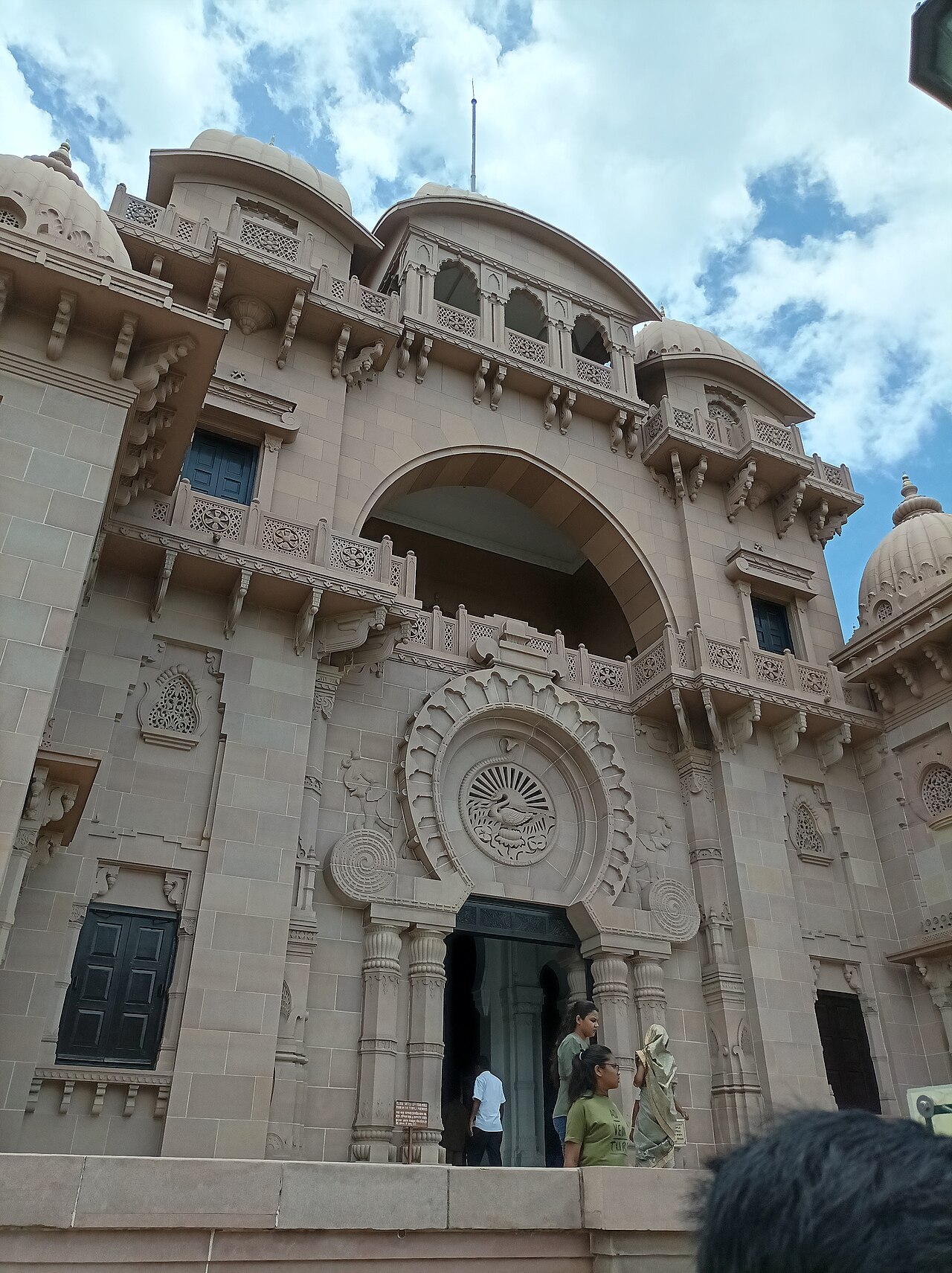
Above the entrance sits the emblem Swami Vivekananda designed for the Order, and beyond it a long congregational hall, the natmandir, runs unbroken to the sanctum like a nave. The garbhamandira itself is austere: Sri Ramakrishna in white Italian marble, sculpted by Gopeswar Pal, seated on a hundred petalled lotus over the damaru shaped altar that holds his relics. In a niche on the eastern wall the dust of Holy Mother's feet is worshipped, and in the western niche the small Baneshvara Shivalinga.
2
Swamiji's room and the mango tree
Southeast of the old shrine, the room where Swami Vivekananda lived is preserved with the things he used, and here he attained mahasamadhi on 4 July 1902. In the courtyard before it stands the mango tree under which he would sit on a camp cot, meeting monks, devotees and visitors. The old shrine nearby is where the Master's relics were worshipped from January 1899 until the great Temple was ready.
3
The shrines along the Ganga
Walk the riverbank and the family gathers. Holy Mother's Temple, consecrated on 21 December 1921, stands on the spot where her body was consigned to flames, and of all the Temples at Belur Math hers alone faces the Ganga. Beside the path rise the Temple of Swami Brahmananda, dedicated in 1924, and the Temple of Swami Vivekananda, consecrated on 28 January 1924 where he was cremated, with an alabaster OM in Bengali characters enshrined upstairs. Below them, the ghat receives the ferries from Dakshineswar.
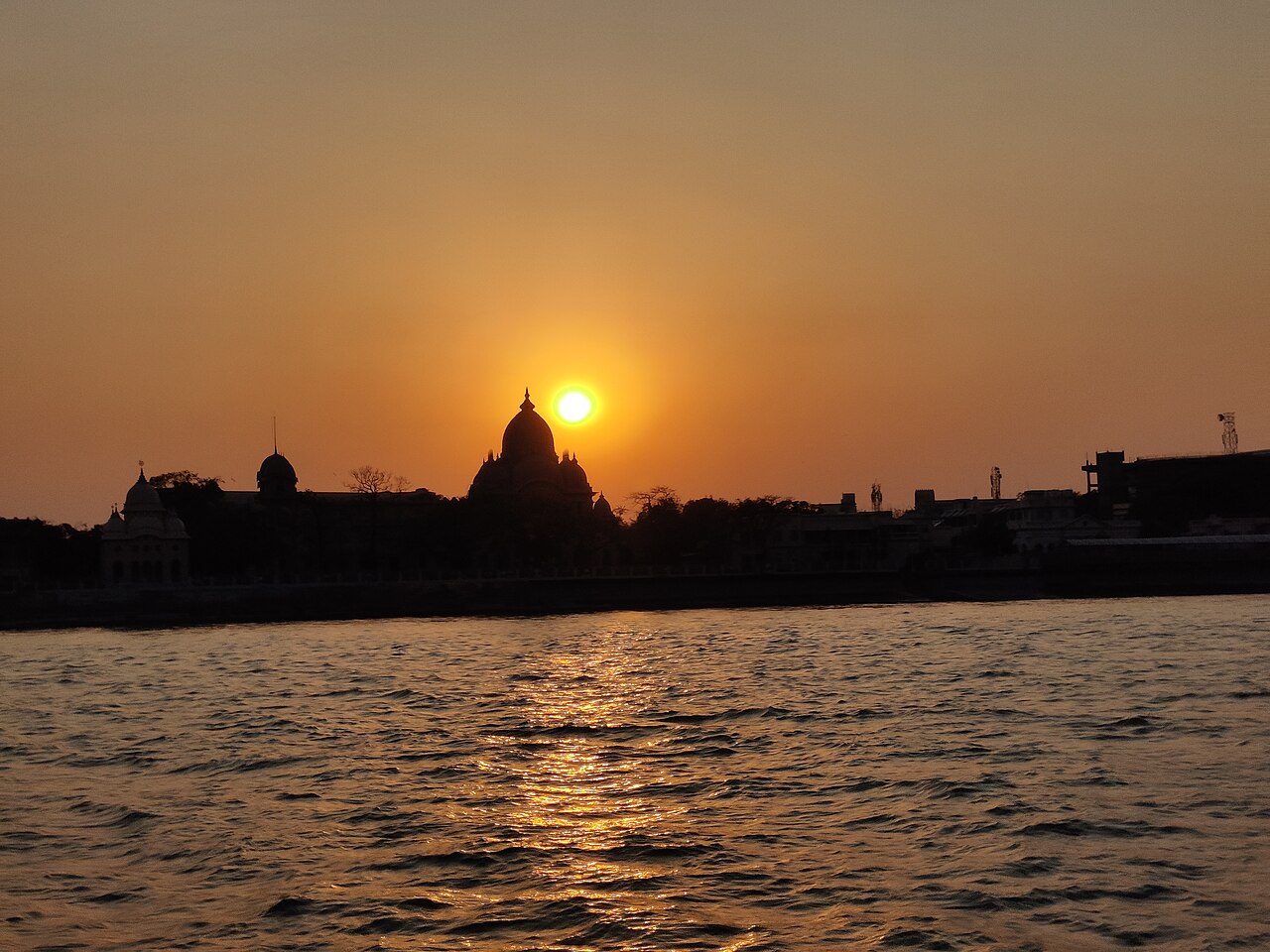
The carved entrance of the Sri Ramakrishna Temple at Belur Math, with the emblem Swami Vivekananda designed set above the doorThe domes of Belur Math against the sunset, seen from the Hooghly on the ferry crossing
The temple door and the river crossing · photos by Billjones94 and Sengkrak, CC BY-SA 4.0, Wikimedia Commons
The Puja Swamiji himself began
Durga Puja at Belur Math · Kumari Puja on Ashtami
A few days before Durga Puja in 1901, Swami Vivekananda had a vision of the worship being performed at the Math. He brought an image Of Maa Durga to Belur and held the monastery's first Durga Puja that autumn, with Holy Mother Sri Sarada Devi staying near on Shashthi day and thousands attending without distinction of caste or creed. That same year he began the Kumari Puja here, young girls Worshipped as living Maa Durga with the same offerings made To the Goddess, and Belur Math's Kumari Puja on Maha Ashtami remains the most famous in Bengal. In 2026 Maha Ashtami and the Kumari Puja fall on Monday 19 October; on Dashami the image is carried in procession to the riverbank and immersed in the Hooghly.
Ashtami morning draws the year's greatest crowd; arrive very early, or watch the rituals streamed live on the Math's official YouTube channel.
Plan your visit
By rail
Belur Math has its own suburban station on the Howrah Bandel line, opened in 2003, with EMU locals from Howrah; by road the Math is about 6.5 km north of Howrah station, and buses 51, 54 and 56 run up from Howrah.
By ferry
Boats cross from Dakshineswar to the Belur Math ghat roughly every half hour through the day, a ride of about 15 to 20 minutes for a fare of about ten to twenty rupees; many pilgrims count the crossing itself as part of the Darshan.
By air
Netaji Subhas Chandra Bose International Airport, Kolkata, is about 15 km away, roughly half an hour by cab outside the rush hours.
Timings
April to September 6:30 to 11:30 am and 4 to 9 pm; October to March the afternoon runs 3:30 to 8:30 pm. After the evening arati, only the Sri Ramakrishna Temple stays open to devotees.
The arati
Sandhya arati in the great Temple moves with the sun, from about 5:10 pm in November to about 6:50 pm in high summer; sit in the natmandir and let it close your day.
The museum
The Ramakrishna Sangraha Mandira near the gate keeps articles and history of Sri Ramakrishna, Holy Mother and Swamiji; open Tuesday to Sunday, mornings and afternoons, closed Mondays.
Dress and manner
Modest dress is the custom, and quiet is part of it: this is a living monastery, and silence inside the Temples is the courtesy the monks ask.
Photography is not allowed inside the Temples or the museum; the lawns and the riverbank are open to cameras, and the posted signs settle any doubt.
The emblem above the Temple door was designed by Swami Vivekananda himself: the waves are karma, the lotus bhakti, the rising sun jnana, the coiled serpent yoga, and the swan at the centre the Supreme Self.
Math means monastery: Belur Math is the working headquarters of the Ramakrishna Math and Ramakrishna Mission, the twin orders Swami Vivekananda founded, and its gates are open to people of every faith without any fee.
The Temple Of Maa Bhavatarini at Dakshineswar, where Sri Ramakrishna served as priest, faces Belur Math from the far bank of the Hooghly; the two are one pilgrimage, joined by the ferry.
Questions pilgrims ask
Is Belur Math a Temple or a monastery?
Both. It is the headquarters of the Ramakrishna Math and Ramakrishna Mission, where monks live and train, and its grounds hold the Temples of Sri Ramakrishna, Holy Mother Sri Sarada Devi, Swami Vivekananda and Swami Brahmananda. Everyone is welcome, of every faith, and entry is free.
What is actually inside the main Temple?
The sacred relics of Sri Ramakrishna, enshrined within a damaru shaped marble altar. Above them sits his full size image in white Italian marble on a hundred petalled lotus, and in wall niches beside him are kept the dust of Holy Mother's feet and the small Baneshvara Shivalinga, both worshipped daily.
Why does the Temple look like a mosque and a church as well?
By design. Swami Vivekananda wanted a Temple in which every faith could recognise itself, and Swami Vijnanananda built it so: Hindu, Buddhist, Islamic and Christian elements joined in one structure, consecrated on 14 January 1938. It is Sri Ramakrishna's teaching, as many faiths, so many paths, made permanent in stone.
Can I see the room where Swami Vivekananda passed away?
Yes. His room, southeast of the old shrine, is preserved with the articles he used, and it is where he attained mahasamadhi on 4 July 1902. Enter quietly; the mango tree in the courtyard outside is where he met visitors.
How do I combine Belur Math with Dakshineswar?
Take the ferry. Boats run between the Belur Math ghat and Dakshineswar roughly every half hour, and the fifteen minute crossing between the Master's monastery and the Temple where he served Maa Bhavatarini is itself part of the pilgrimage.
The Sthan in photographs
Darshan from afar
From the temple's own channels. Nothing loads until you press play.
Dharamshalas and guest houses near this Sthan, shared by devotees. Adisthan takes no bookings and no money; contact each stay directly.
No stays are listed here yet. Know one that serves pilgrims well?
Are you a monk or officer of the Ramakrishna Math and Ramakrishna Mission, Belur Math? Claim this page to keep the timings, arati hours and festival days true for the devotees who plan their journeys by them.