Climb sessions from 8:30 am Nine terraces · Three realms Vesak · 20 May 2027 9th century · Sailendra dynasty Climb quota 1,200 a day
Mist lies on the Kedu Plain, and the grey hill ahead of you turns out to be built. Volcanoes stand on every horizon, Merapi smoking to the east, as you cross the lawns toward fifty-five thousand cubic metres of carved andesite. At the stair your shoes come off and woven upanat sandals go on, and you begin to climb through galleries of storytelling stone. This is not a Temple you enter. It has no door, no hall, no inner sanctum. The path itself is the shrine.
The largest Buddhist Temple on earth: nine stacked platforms, six square and three circular, crowned by a central dome 35 metres above the plain, the whole monument laid out as a walkable mandala, a diagram of the Buddhist cosmos.
2,672 relief panels line its walls and balustrades. Read clockwise in pradakshina, keeping the stone always at your right hand, the narrative series runs some three kilometres, the longest sequence of Buddhist narrative carving in the world.
The climb passes through the three realms of Buddhist cosmology: Kamadhatu, the world of desire, at the base; Rupadhatu, the world of forms, on the square terraces; and Arupadhatu, the formless realm, where 72 latticed stupas each shelter a seated Buddha.
Built, buried, and brought back
In the ninth century, under the Sailendra dynasty of central Java, builders raised a stepped mountain of andesite block on block, without mortar, in stages across roughly fifty years, from about 780 to 833 CE. Javanese tradition remembers the architect as Gunadharma, a name kept by folk telling rather than by any inscription. Around and up the terraces the carvers set some 504 images of the Buddha and thousands of relief panels, so that the whole monument reads as one immense book of the Dharma.
Then the book closed. Between the tenth and eleventh centuries the kingdom's centre moved east, most likely after volcanic eruptions, and Borobudur was left to the ash and the jungle. It slept for centuries, a hill with a memory attached. In 1814 Thomas Stamford Raffles, then governing Java, heard of a great monument lost in the trees near the village of Bumisegoro and sent the engineer H. C. Cornelius, whose men began cutting the forest back from the stone.
Saving it took another two centuries of care. The Dutch engineer Theodoor van Erp led the first great restoration from 1907 to 1911. Between 1975 and 1982 the Indonesian government and UNESCO dismantled, catalogued and re-set over one million stones to rescue the monument from water and subsidence. In 1991 UNESCO inscribed Borobudur as a World Heritage Site.
What you'll actually see
1
The hidden foot
Beneath the processional platform lies a buried first gallery: the Karmawibhangga, 160 panels showing karma at work, each one a complete scene of deed and consequence, blameworthy acts and their punishments, good deeds and their rewards. The encasement base covers them still, but the southeast corner has been left open so you can see the hidden reliefs for yourself.
2
The gallery reliefs
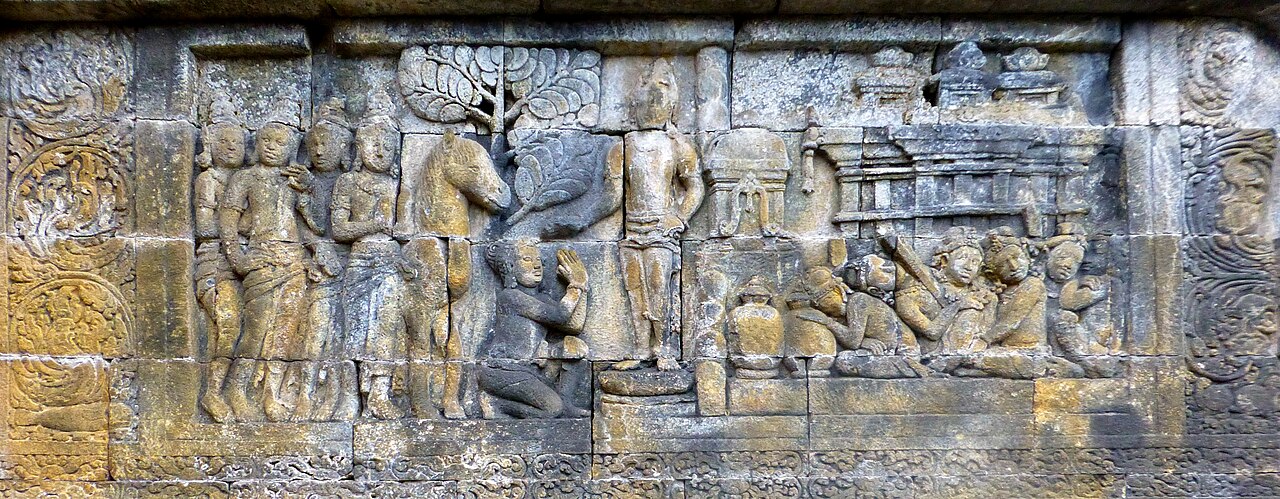
Four stairways climb the monument through arched gates watched by 32 stone lions. In the square galleries the Lalitavistara panels unroll the life of the Buddha, from the choice of his final birth to the first sermon, alongside tales of his former lives. Look past the main story and ninth-century Java itself sails by: ships, dancers, farmers, kings and markets carved in volcanic stone.
3
The 72 latticed stupas
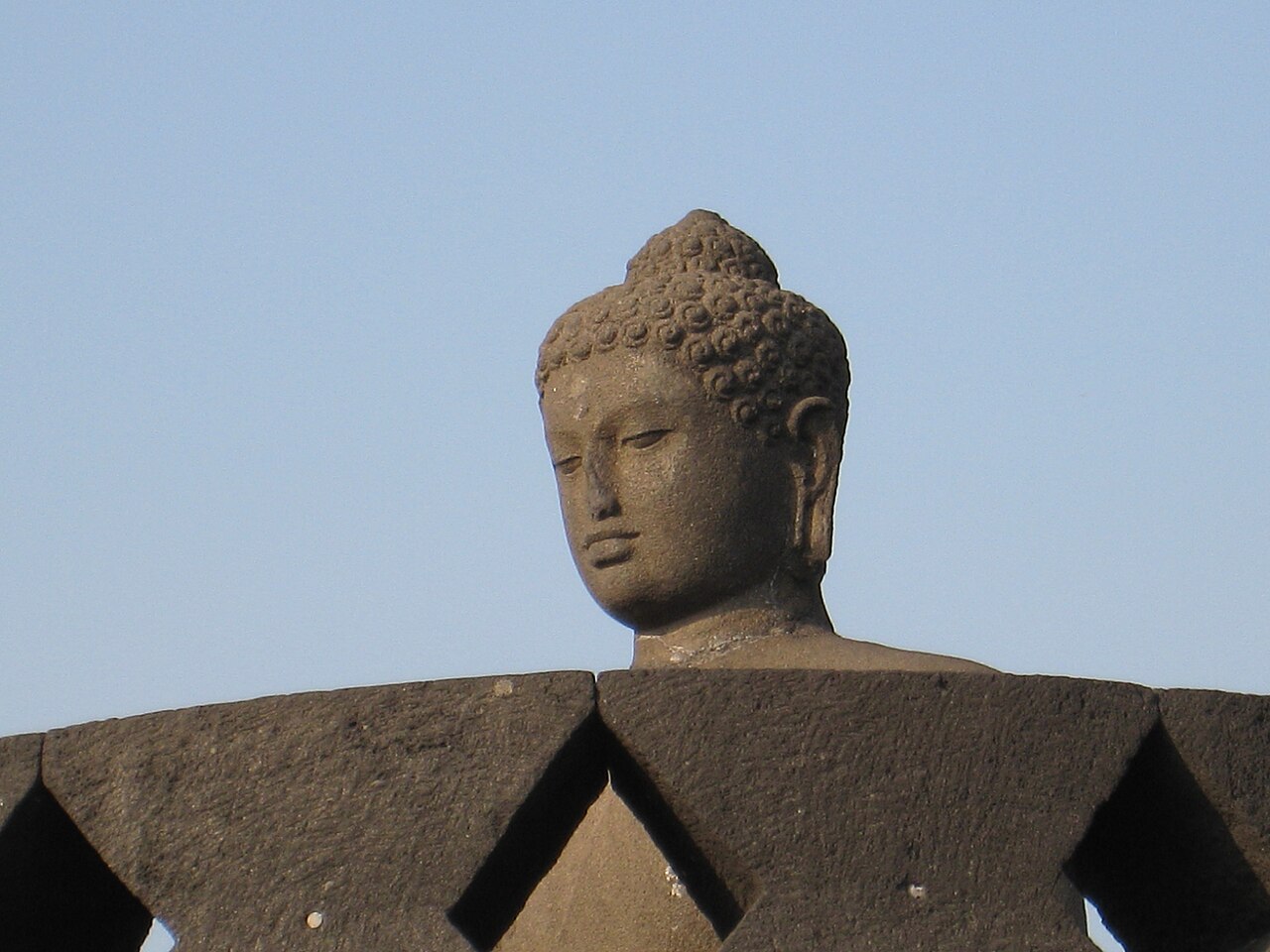
On the three bare circular terraces the carving stops and silence takes over. Seventy-two bell-shaped stupas, pierced with diamond and square lattice openings, each hold a seated Buddha half-seen through the stonework. Above them rises the great crowning stupa, and beyond it the cone of Merapi, still breathing smoke.
A stone Buddha freed from its latticed stupa gazes out over the Kedu Plain at BorobudurLalitavistara relief panel at Borobudur showing prince Siddhartha leaving the palace
A Buddha above the plain, and prince Siddhartha leaving the palace in the Lalitavistara reliefs · photos CC BY 2.0 Photo Dharma, Wikimedia Commons
The full moon of Vesak
Lanterns over the stupas
On the May full moon, Indonesian Buddhists mark the birth, enlightenment and passing of the Buddha at the monument itself. Monks and pilgrims walk the old processional way from Mendut Temple past Pawon to Borobudur, carrying holy water and sacred flame, then circle the terraces in pradakshina and sit in meditation. After dark, thousands of paper lanterns rise over the latticed stupas in ticketed release sessions, with a sunrise pradakshina and meditation the following morning. The next Vesak day falls on Thursday 20 May 2027.
Lantern-release seats are sold in timed evening sessions and sell out well ahead; book only through the park's official ticket channel.
Plan your visit
By air
Yogyakarta International Airport (YIA) is about 47 km away, roughly 1.5 to 2 hours by car.
By road
About 40 km northwest of Yogyakarta city on the Kedu Plain. Mendut and Pawon Temples stand on the same straight axis, 3 km and 1.75 km from the monument, and pilgrims traditionally visit all three.
Timings
Guided climb sessions run in timed slots from 8:30 am into the late afternoon, with last entry around 3:30 pm; Temple tours have run daily since July 2025. Book ahead on the official ticket site.
The climb
Ground and climb are separate tickets. The climb quota is about 1,200 people a day, roughly 150 an hour, and every session includes a certified guide and mandatory upanat sandals.
Fees
Foreign visitors: courtyard Rp 400,000 (about USD 25) adult, climb Rp 455,000 adult and Rp 305,000 child. Domestic visitors: courtyard Rp 50,000, climb Rp 120,000 adult.
Sunrise
Sunrise and sunset on the monument are premium programmes of about Rp 1,000,000, limited to 100 people a day. Punthuk Setumbu hill, about 4 km west, gives the classic view of the Temple rising from mist with the volcanoes behind.
Dress
Dress modestly, as at any sacred place. Your own shoes are not allowed on the stones; the woven upanat sandals that protect the andesite come with the climb ticket.
The name is usually read as boro, great, joined to budur, perhaps Buddha or an Old Javanese word for a high place, the great sanctuary on the hill; scholars still debate it.
Merapi is a living neighbour: its 2010 eruption dropped up to 2.5 cm of ash on the statues and closed the monument for days of cleaning, so short conservation closures can follow any eruption.
The monument has no interior at all and no shade on the upper terraces; bring sun protection and water.
Allow half a day: walking every gallery clockwise before the summit covers about three kilometres of carved stone.
Questions pilgrims ask
Can visitors still climb to the top?
Yes, but no longer freely. Access to the monument itself is by a separate timed ticket with a daily quota of about 1,200 people, always with a certified guide and in the provided upanat sandals. The ordinary courtyard ticket does not include the climb, and slots sell out in peak months.
Is there a shrine room or image to visit inside?
No. Borobudur has no interior and no sanctum. It is a single vast stupa and a mandala in stone; the worship it was built for is the walk itself, circling each terrace clockwise and rising realm by realm to the great stupa at the crown.
Is Borobudur still a living place of worship?
Yes. It is both a conserved national monument and an active Buddhist sanctuary. Indonesian Buddhists celebrate Vesak here on the May full moon, walking in procession from Mendut past Pawon to Borobudur, and monks lead pradakshina and meditation on the terraces.
What do the three levels mean?
The monument maps the Buddhist cosmos. The base is Kamadhatu, the world of desire, whose hidden Karmawibhangga reliefs show karma at work. The five square galleried terraces are Rupadhatu, the world of forms, where the life of the Buddha unrolls in relief. The three circular terraces are Arupadhatu, the formless realm, bare of ornament, holding only the latticed stupas and their Buddhas.
When is the best time to come?
The first climb sessions of the morning: cooler, quieter, and the volcanoes are most often clear before the haze rises. For the famous dawn view without a premium ticket, Punthuk Setumbu hill west of the Temple is the classic point.
Dharamshalas and guest houses near this Sthan, shared by devotees. Adisthan takes no bookings and no money; contact each stay directly.
No stays are listed here yet. Know one that serves pilgrims well?
Are you with the Borobudur park authority, the conservation office, or the sangha that keeps Vesak on this hill? Claim this page to keep its hours, quotas, and festival dates true for every pilgrim.