Boudha, Kathmandu Kora from about 5 am Om Mani Padme Hum Losar · 7 Feb 2027 NPR 400 foreign · SAARC 100 UNESCO 1979 · rebuilt 2016
You hear the kora before you see the stupa: a low river of footsteps moving clockwise, the creak of brass prayer wheels, the murmured mantra Om Mani Padme Hum, juniper smoke drifting over it all. Then the lane opens and the white dome fills the sky, pigeons wheeling off its whitewashed slope, and from the gilded tower above it two painted eyes look calmly back at you. There is no door into this shrine. You do not enter it. You circle it.
At about 36 metres tall, this is the largest spherical stupa, or chorten, in Nepal and one of the largest in the world: not a building around a hall, but a solid three-dimensional mandala you walk around.
Tradition holds that sealed within the dome are bone relics of Kassapa Buddha, the Buddha of the age before Shakyamuni, which is why Tibetans have counted this among the great wish-fulfilling shrines of the Himalayan world.
Since Tibetan refugees settled here after 1959, more than fifty gompas have risen around the stupa, making Boudha the living heart of Vajrayana Buddhism in Nepal, a little Tibet ringed around one white dome.
The promise that slipped from the king's tongue
The Tibetan telling begins with a poultry-woman. Jyazima, remembered in the old text as Samvari, raised fowl for a living, and out of her small earnings she formed one vast intention: to raise a great stupa holding the relics of the Tathagatas. She went to the king for land, and the king, hearing a poultry-woman ask to build what lords had not built, exclaimed jarung, let it be done. The word once spoken could not be recalled, for it had slipped, kha shor, from his tongue. So the stupa is called Jarung Khashor, the promise that slipped out, and when Jyazima died her four sons worked on until the dome was sealed.
The Newars of the valley keep an older name and an older memory. To them this is Khasti Chaitya, and their chronicles credit its founding to the Licchavi kings, some naming Vrisadeva around 400 CE, others Manadeva or Sivadeva in the generations after, and one telling holds that it was raised in atonement for a father's death caused unknowingly within the royal house. Both tellings are honored here, side by side, the way the stupa itself stood on the old trade road between the Kathmandu Valley and Tibet, receiving merchants and pilgrims from both directions.
The dome you circle today took its present form most likely in the fourteenth century, and it has been renewed again and again since, most recently after the 2015 earthquake cracked its spire. Buddhist communities rebuilt it with their own donations, and when it reopened in November 2016, lamas of the Nyingma, Kagyu, Sakya and Gelug traditions consecrated it together.
What you'll actually see
1
The dome and the eyes
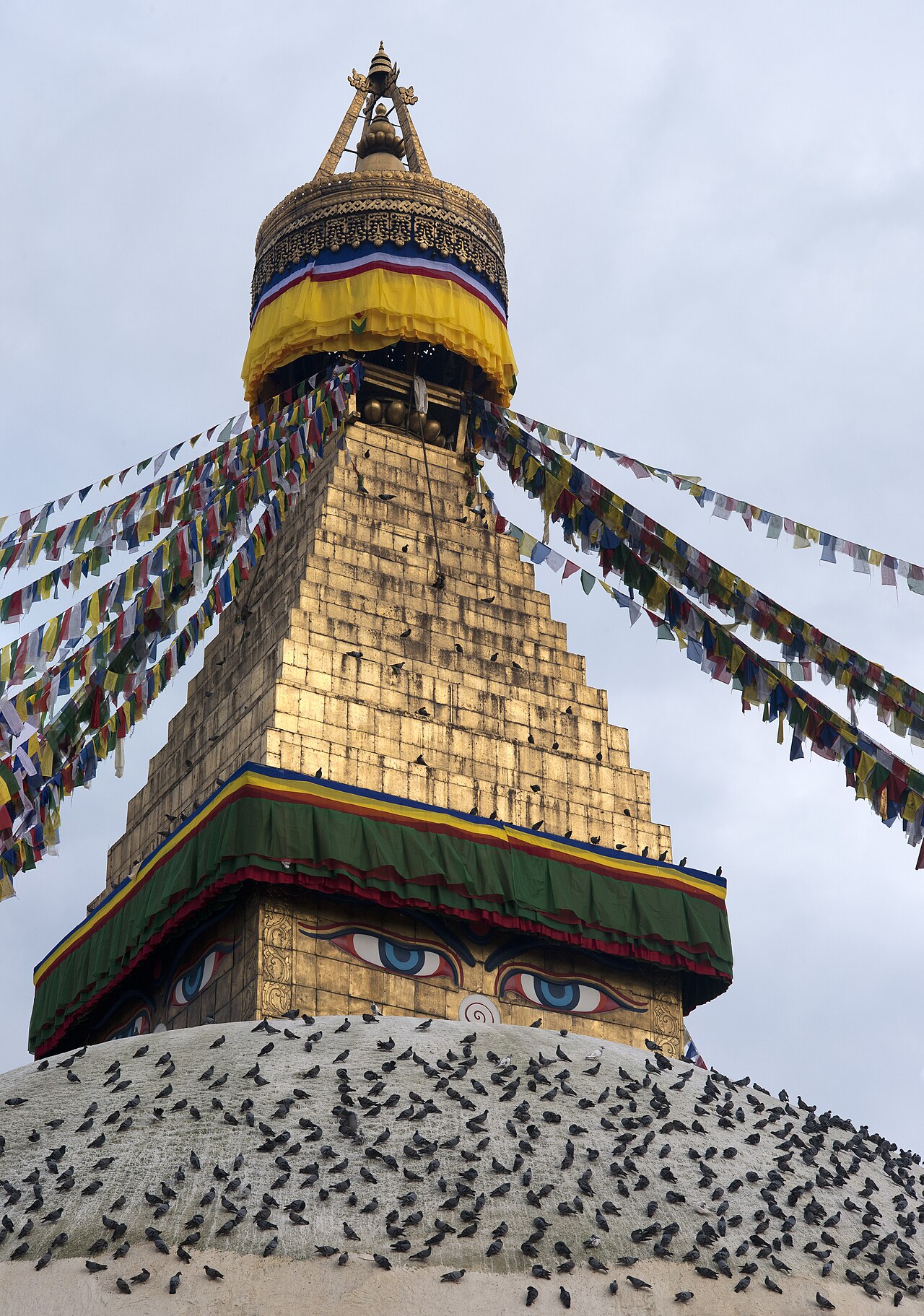
The whitewashed dome is washed each season with arcs of saffron water that dry into giant lotus petals. Above it rises the gilded harmika, painted on all four sides with the Buddha eyes gazing over the valley, a nose like the Nepali numeral one beneath them, and above that the spire climbs thirteen gilded steps, one for each stage of the bodhisattva path, to the parasol at the summit.
2
The kora and its wheels
The perimeter wall holds row upon row of brass prayer wheels in niches, each inscribed Om Mani Padme Hum, and the wide plaza between wall and dome is the kora path itself. Pilgrims move clockwise with malas in hand from before dawn, some spinning every wheel, some full-length in prostration. You can climb onto the three tiers of the mandala plinth and circle at the dome's own level, eye to eye with the prayer flags.
3
The gompas of little Tibet
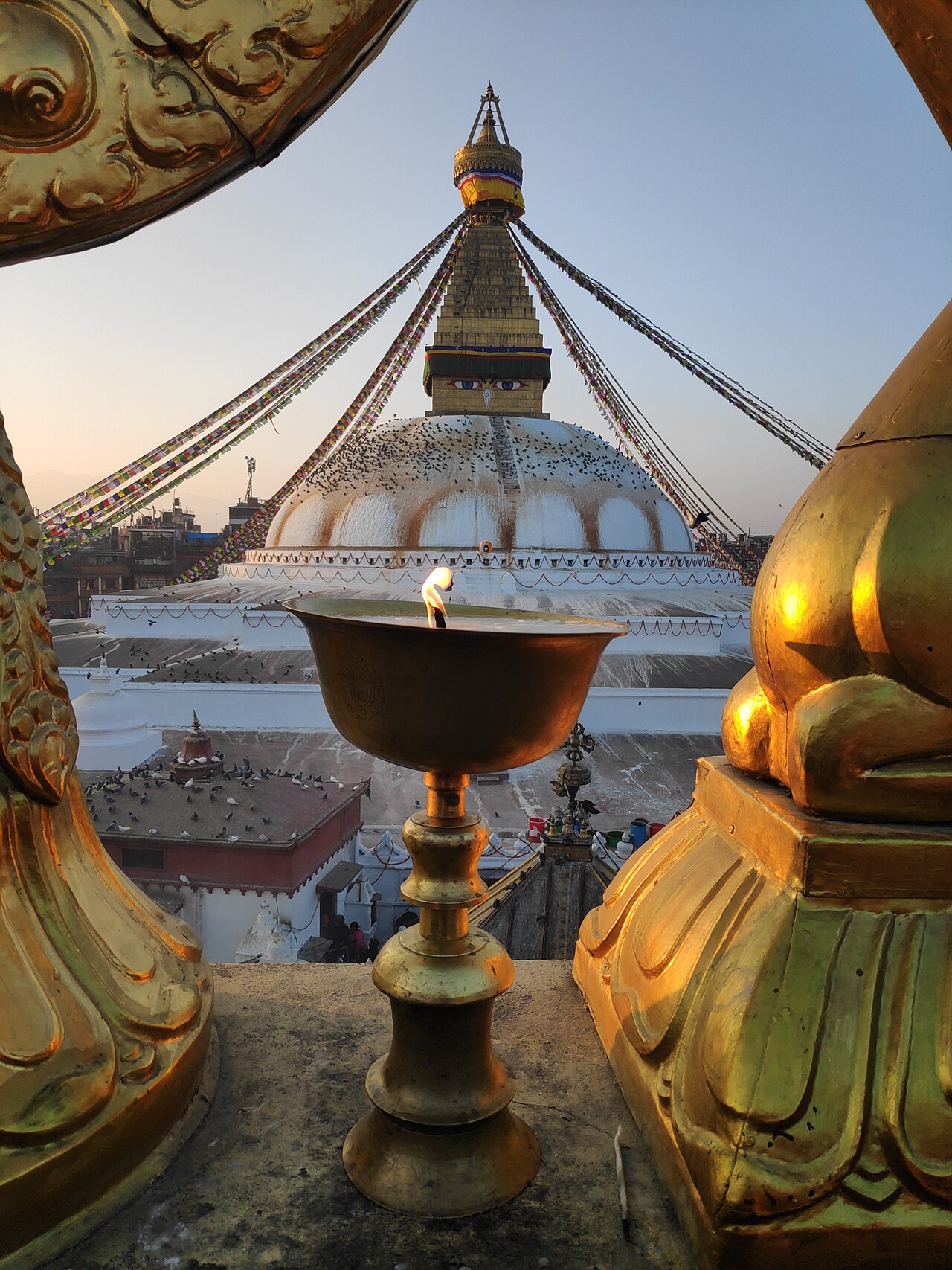
Monasteries ring the plaza and the lanes behind it, more than fifty by the common count, raised by the Tibetan community that settled here after 1959. Maroon-robed monks cross the plaza between prayer sessions, butter lamps burn in tiered racks facing the dome, and rooftop terraces around the ring look straight across at the eyes.
The Buddha eyes on the gilded harmika of Boudhanath, prayer flags streaming from the spire and pigeons resting on the whitewashed domeA butter lamp burning on a monastery terrace at dusk, the dome and spire of Boudhanath rising behind it
The all-seeing eyes and a butter lamp at dusk · photos by Ggia (CC BY-SA 3.0) and Gaurav Dhwaj Khadka (CC BY-SA 4.0), Wikimedia Commons
The new year of the Himalayas
Losar at the Great Stupa
In the days before Losar, the smell of juniper smoke and fresh-fried khapse pastry drifts through Boudha's lanes, and the tall prayer poles around the stupa are rewrapped and raised with new flags. On the third day of the new year the Tibetan community gathers at the stupa itself in new clothes for a great communal offering, and the kora fills shoulder to shoulder. Losar 2027 begins on 7 February, opening the Year of the Fire Sheep, 2154 in the Tibetan count, with the main celebrations running through the first three days.
The third-day gathering is the plaza at its absolute fullest; come early in the morning and expect the kora to move slowly.
Plan your visit
By air
Tribhuvan International Airport, Kathmandu is about 4 to 6 km away by road, roughly 15 to 30 minutes by taxi depending on traffic.
By road
About 7 km east of central Kathmandu; a taxi from Thamel takes 20 to 30 minutes, and local buses run from major points in the city. Pashupatinath is about half an hour away on foot.
Timings
The plaza wakes before dawn and stays alive past dark; ticket desks at the main gates for foreign visitors commonly operate about 5 am to 9 pm, shifting with season and festivals.
Entry
NPR 400 for foreign and Chinese nationals, NPR 100 for SAARC nationals, free for Nepali citizens and children under 10, per the Nepal Tourism Board. Bring cash.
Best time
Dawn, when locals walk the first kora in soft light, or dusk, when the butter lamps are lit and the circling crowd becomes a slow, glowing wheel. October to March is the mild season.
Custom
Dress modestly. Walk clockwise with the stupa on your right, spin the prayer wheels clockwise, and give way to prostrators.
The kora
One circuit at plaza level is an easy, level walk of a few minutes; pilgrims traditionally walk many. You may also climb the plinth terraces and circle at the dome's level. Allow 90 minutes to two hours for the stupa and a gompa or two.
The place carries three names in daily use: Newars say Khasti Chaitya, Tibetans say Jarung Khashor, and everyone in Kathmandu simply says Boudha.
The 2015 earthquake severely cracked the spire; the rebuilding cost about USD 2.1 million and more than 30 kg of gold, funded entirely by private donations from Buddhist groups, and the stupa reopened on 22 November 2016, the first of the valley's quake-hit heritage monuments to be restored.
Photography is welcome on the plaza and the terraces; inside the surrounding gompas ask permission first, and never interrupt a prayer session for a picture.
The stupa stands on the old Kathmandu-to-Lhasa trade route, and Tibetan merchants prayed here for safe passage over the passes for centuries before the modern town grew around it.
Questions pilgrims ask
Can I go inside the stupa?
No, and no one can: a stupa is a sealed reliquary, not a hall. Its dome is solid, holding the relics and offerings placed within it. The worship of a stupa is the kora, walking clockwise around it, and at Boudhanath you can also climb the three plinth terraces to circle close against the dome itself.
What do the painted eyes mean?
They are the eyes of the Buddha, painted on all four sides of the harmika so that they gaze over the whole valley. Tradition reads them as wisdom and method united; between them, what looks like a nose is the Nepali numeral one, a sign of the one path. Above them the spire's thirteen gilded steps stand for the thirteen stages of the bodhisattva's way to enlightenment.
Whose relics are enshrined here?
Tradition holds that the stupa enshrines bone relics of Kassapa Buddha, the Buddha of the age before Shakyamuni; some tellings add relics of Shakyamuni Buddha as well. The Tibetan and Newar traditions tell the founding differently, and the stupa honors both memories.
Is Boudhanath a monastery?
The stupa itself is not, but it is ringed by them. More than fifty gompas of the Nyingma, Kagyu, Sakya and Gelug traditions stand around the plaza and its lanes, most welcoming respectful visitors in daytime hours. The stupa is managed by the Boudhanath Area Development Committee.
When does the kora happen?
Every day, morning and evening, without invitation or ticket for the faithful: locals walk it from before dawn, and at dusk the butter lamps come out and the circle fills again. For the fullest days of the year, come for Losar in February or Buddha Jayanti on the full moon of May, 20 May in 2027.
Dharamshalas and guest houses near this Sthan, shared by devotees. Adisthan takes no bookings and no money; contact each stay directly.
No stays are listed here yet. Know one that serves pilgrims well?
Are you of the Boudhanath Area Development Committee or a gompa that keeps this kora? Claim this page to add true hours, ceremonies, and a way for pilgrims to reach you.