Gomti ghat, Dwarka · Devbhoomi Dwarka, Gujarat, India
The sea took the golden city. The King Of Dwarka never left His throne.
Be the first to check in
Entry tended 10 Jul 2026
Darshan 6:30 am to 1 pm · 5 to 9:30 pm Dhwaja changed five times daily Five storeys on 72 pillars Janmashtami · 4 Sep 2026 Free · phones not allowed
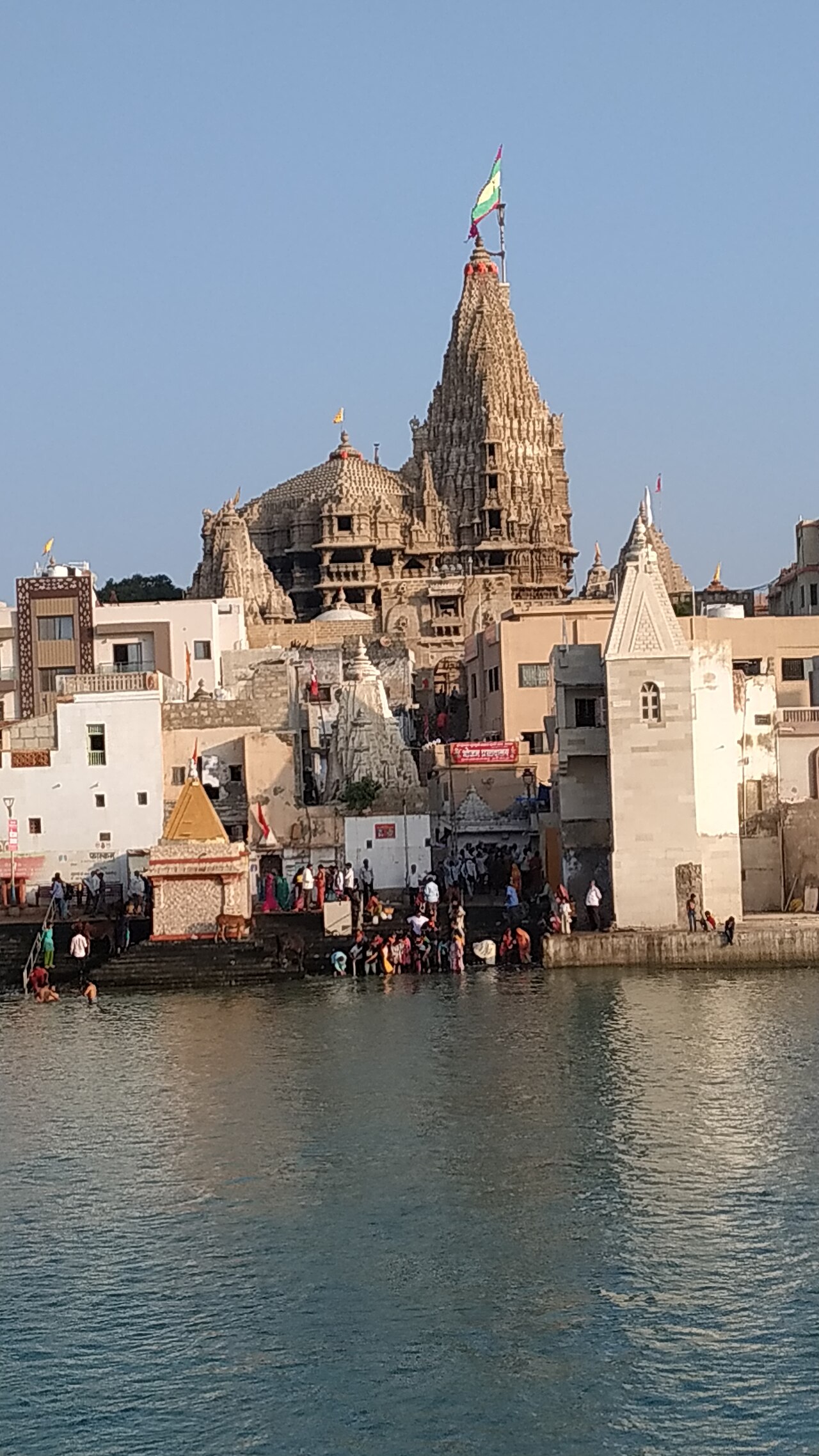
You climb toward it from the Gomti ghat, 56 stone steps rising from the water where the river meets the Arabian Sea, and the cry goes up around you: Jai Dwarkadhish. Above the carved sandstone tower a flag of fifty-two yards cracks and rolls in the sea wind, so high it seems to belong to the sky. Watch it. Before the day ends that flag will come down and a new one will rise, and then again, five times in all. In Dwarka the Lord Is still King, and a king's standard never rests.
The 52-yard dhwaja atop the shikhara is changed five times every day, three times each morning and twice each evening, and only the hereditary Aboti Brahmins of Dwarka may climb the tower to raise it. No other great Temple keeps such a rite.
Dwarka holds a threefold rank almost alone among the holy cities: the western seat of the Char Dham, one of the seven Sapta Puri whose soil grants liberation, and the 98th Divya Desam sung by the Tamil Alvar saints.
Tradition holds the first shrine was raised By Vajranabha, great-grandson of Lord Krishna, over the Lord's own residence, and that His golden city sank beneath the waves; marine archaeologists have lifted stone walls and anchors from the seabed just offshore.
The city the sea keeps
When the wars of Mathura pressed too hard upon His people, tradition holds that Lord Krishna led the Yadavas west to the far edge of Saurashtra and asked the ocean to yield Him ground. There He raised Dwarka, the city of doors, a golden capital where He Reigned not as warrior or cowherd but as King: Dwarkadhish, Lord Of Dwarka. The Mahabharata tells that when He Left this earth, the sea rose quietly and took the city back, street by golden street.
The sea kept it, but not entirely. Between 1983 and 1990 the Marine Archaeology Unit of India's National Institute of Oceanography, led by S. R. Rao, dived the waters off Dwarka and nearby Bet Dwarka and brought up dressed stone blocks, semicircular fortification walls and more than a hundred ancient stone anchors from depths of three to six metres and beyond. Rao read in them a drowned city-state; other scholars date the finds more cautiously. The findings and the tradition stand side by side here, and the pilgrim is free to hear both.
Above the water, worship never stopped. Tradition holds that Vajranabha, great-grandson of Lord Krishna, built the first Temple over the Lord's own dwelling, and archaeology suggests a shrine stood here as early as 200 BCE. Armies broke it, most terribly under Mahmud Begada in 1472, and devotees raised it again; the soaring limestone Temple you see today took its form in the 15th and 16th centuries. Adi Shankara came here in the 8th century and made Dwarka the western seat of his four great mathas, the Sharada Peetha, which still stands beside the Temple; a memorial inside the complex remembers his visit.
What you'll actually see
1
The shikhara and its flag
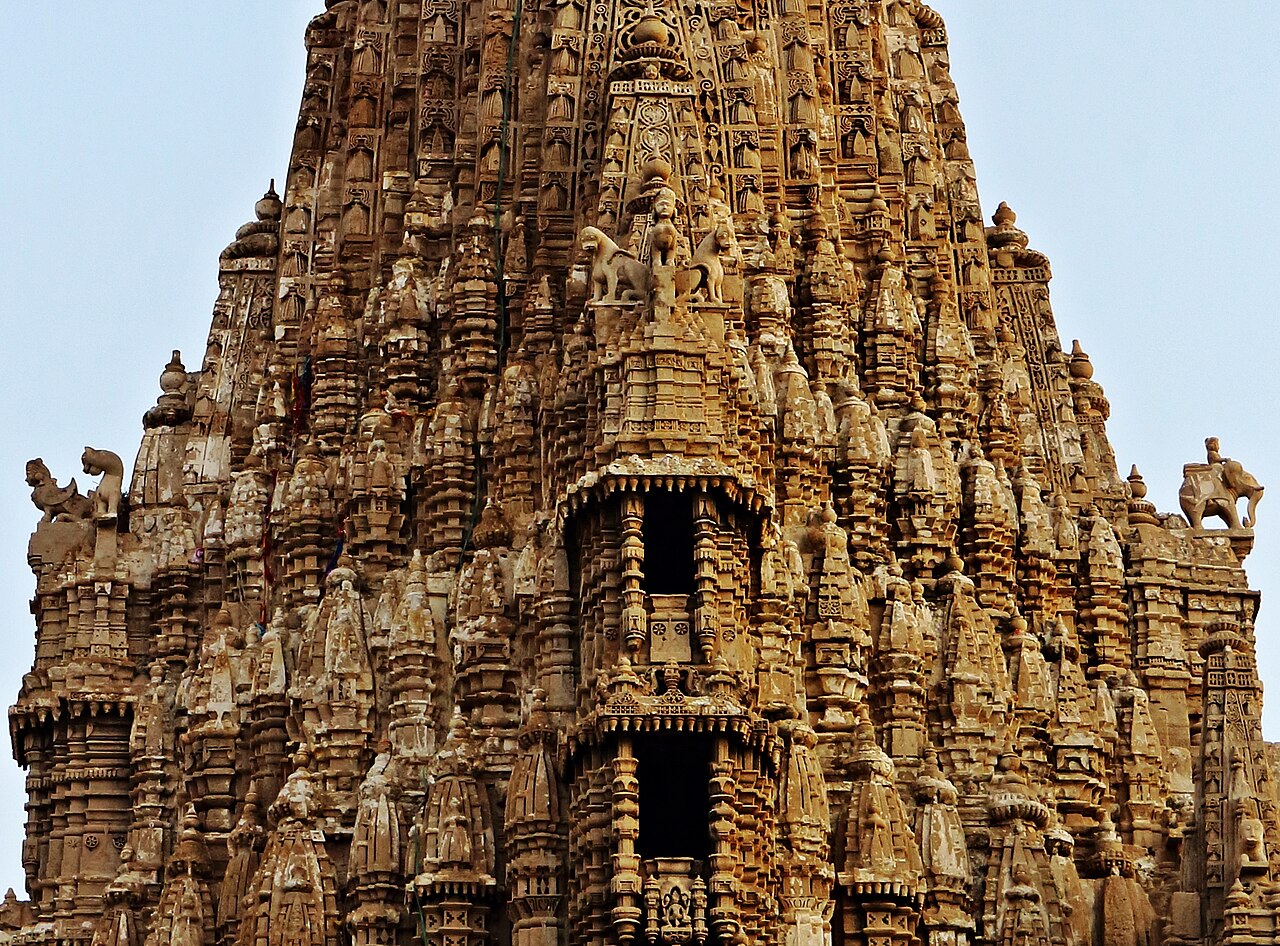
The main shrine, the Jagat Mandir, rises five carved storeys on 72 pillars of limestone and sandstone, its spire climbing about 78 metres above the town. Every inch of the tower is worked: dancers, elephants, riders and celestial beings stacked tier upon tier, and at the very top the great triangular dhwaja marked with the sun and moon, a sign that the Lord Remains while sun and moon endure.
2
Two doors, heaven and liberation
You enter from the north through the Moksha Dwar, the door of liberation, which opens toward the old market, and leave to the south through the Swarga Dwar, the door of heaven, where 56 steps descend to the Gomti ghat. Pilgrims bathe at the ghat where the Gomti meets the sea before climbing to darshan.
3
The seat of Adi Shankara
Beside the Temple stands the Sharada Peetha, the western matha of the four that tradition ascribes to Adi Shankara, still a living centre of Sanskrit learning; within the Temple complex a memorial marks the philosopher's visit. Smaller shrines ring the main sanctum across the courtyard.
Tier upon tier of carved figures on the shikhara of the Dwarkadhish TempleThe Dwarkadhish Temple rising above pilgrims bathing at the Gomti ghat
The carved tower, and the temple above the Gomti ghat · photos CC BY-SA 4.0 by MADHURANTHAKAN JAGADEESAN and Njoy deep, Wikimedia Commons
THE RITE FOUND NOWHERE ELSE
Dhwaja Arohan: the flag that never rests
Five times every day, three in the morning and two in the evening, the great flag of Sri Dwarkadhish comes down and a new one rises. Each dhwaja is stitched from 52 yards of cloth with fifty-two small flags joined around its border, remembering the 52 gates and quarters of Lord Krishna's Dwarka, and bears the sun and the moon, for the Lord Abides as long as they shine. The sponsoring family carries the new flag to the Temple in procession, singing, and feeds the Brahmins of Dwarka; then an Aboti Brahmin, of the community that alone holds this hereditary right, climbs the tower and raises it against the sea wind. Sponsorship is booked through the Shree Guggali 505 Brahmin Gnati office in Dwarka, and devotees sometimes wait as long as two years for their turn.
You need book nothing to watch: stand in the courtyard at flag-change and look up.
Plan your visit
By air
Jamnagar Airport is nearest, about 131 km, with direct flights from Mumbai and other cities; taxis run to Dwarka in about 2.5 to 3 hours.
By rail
Dwarka station, on the Ahmedabad to Okha line of Western Railway, sits within the town and takes regional and long-distance trains.
By road
About 217 km from Rajkot, 235 km from Somnath and 378 km from Ahmedabad; state buses run regularly.
Timings
6:30 am to 1 pm and 5 to 9:30 pm. Mangla Aarti 6:30 am, Shringar Aarti 10:30 am, Sandhya Aarti 7:30 pm, Shayan Aarti 8:30 pm. Timings can shift on festival days.
Best time
Come for Mangla Aarti at first light, or at evening flag-change; the gentle season is November to February, and Janmashtami is the great crowd.
Dress
Modest dress with shoulders and knees covered; shorts, sleeveless and short skirts are turned away at the gate.
On foot
56 steps link the Swarga Dwar to the Gomti ghat, and the Sudama Setu footbridge (7 am to 1 pm, 4 to 7:30 pm) crosses the Gomti to the Panchkui beach side.
Mobile phones and cameras are not allowed inside; deposit them free of charge at the counters near the gate before you queue.
Entry is free for all; the Temple is also called Jagat Mandir, shrine of the world, and Trilok Sundar, the beauty of the three worlds.
Dwarka means the city of doors, from dvara; at the ghat below the Temple the Gomti river meets the open Arabian Sea.
Bet Dwarka, the island shrine where tradition places Lord Krishna's household, lies about 30 km north via Okha, reachable since February 2024 across the Sudarshan Setu bridge.
Questions pilgrims ask
Is the sunken city of Dwarka real?
Underwater excavations by India's National Institute of Oceanography between 1983 and 1990 recovered stone walls, dressed blocks and over a hundred stone anchors off Dwarka and Bet Dwarka. Their leader S. R. Rao read them as a submerged city; other scholars date the remains more cautiously. Tradition holds without hesitation that the sea took Lord Krishna's golden capital when He Left the earth. The page of the sea is still being read.
Can I sponsor or watch the flag ceremony?
Anyone in the courtyard can watch the dhwaja change, five times daily. To sponsor a flag, apply to the Shree Guggali 505 Brahmin Gnati office in Dwarka; the waiting list can run to two years. Only the Aboti Brahmins may climb the tower to hoist it.
Is there an entry fee, and how long does darshan take?
Entry is free. On ordinary days the queue moves within the morning or evening darshan windows; on Janmashtami and holiday weekends expect several hours, with the Temple open late into the night of the Lord's birth.
Why is Dwarka called a Char Dham if the Char Dham are in the Himalaya?
There are two circuits. The small Char Dham lies in the Himalaya, but the original four dhams of Adi Shankara's tradition stand at the four corners of India: Badrinath in the north, Puri in the east, Rameswaram in the south, and Dwarka in the west. Dwarka is also one of the seven Sapta Puri, the cities that grant liberation.
What will I actually see in the sanctum?
The black four-armed form of Sri Dwarkadhish, Lord Krishna as King Of Dwarka, richly robed and crowned, enthroned in the Jagat Mandir that tradition says Vajranabha raised over the Lord's own palace.
The Sthan in photographs
Darshan from afar
From the temple's own channels. Nothing loads until you press play.
Dharamshalas and guest houses near this Sthan, shared by devotees. Adisthan takes no bookings and no money; contact each stay directly.
No stays are listed here yet. Know one that serves pilgrims well?
Are you a priest, trustee, or sevak of the Shree Dwarkadhish Mandir Vyavasthapak Samiti? Claim this page to keep timings, utsav dates, and dhwaja bookings true for pilgrims worldwide.