Gangaikonda Cholapuram · Ariyalur district, Tamil Nadu, India
The emperor's city has returned to the fields; the prayer he raised in granite has not.
Be the first to check in
Coming up: Maha Shivaratri · 6 MarEntry tended 29 Jun 2026
Lord Shiva as Peruvudaiyar Darshan 6 am to 12 noon · 4 to 8 pm Chola vimana of 1035 CE · 53 m Aadi Thiruvathirai · 10 Aug 2026 Entry free
The bus sets you down on a country road in Ariyalur district, between rice fields and rain trees, and there it is: a granite mountain rising alone out of the green. No city gate, no bazaar street, no pressing crowd. You cross a wide lawn, leave your sandals, and climb worn steps between colossal stone guardians to a dark sanctum where Lord Shiva still receives daily worship, nearly a thousand years after an emperor enthroned Him here. This was the capital of an empire that reached the Ganga and crossed the seas. Only the prayer survived.
The great vimana rises 53 metres over the sanctum with recessed corners and a gentle concave curve, the graceful answer to the straight and severe tower at Thanjavur; devotees have long called it the feminine of the two.
This is the Temple of the emperor who took the Ganga. The Tiruvalangadu copper plates record that vanquished kings carried Ganga water on their heads to fill the Cholaganga tank beside the new capital, a liquid pillar of victory.
The imperial city that surrounded it has vanished into farmland. The Temple alone survives, a UNESCO Great Living Chola Temple where the daily rites of Lord Shiva and Maa Brihannayaki are still performed four times a day.
The city the Ganga built, and the fields that took it back
In the early years of the eleventh century, Rajendra Chola I, son of the great Rajaraja, sent his armies up the eastern coast of India. By about 1021 his generals had reached the Ganga, and the Tiruvalangadu copper plates tell how the defeated chiefs of the north were made to carry pots of the sacred river home on their heads. Rajendra took the title Gangaikonda Cholan, the one who took the Ganga, poured the water into a vast new tank called the Cholaganga, and raised a capital around it: Gangaikonda Cholapuram, the city of the Chola who took the Ganga.
At its heart he built this Temple for Lord Shiva, completed in 1035 CE and named, like his father's wonder at Thanjavur, for the Great Lord: Brihadisvara in Sanskrit, Peruvudaiyar in Tamil. The son built in deliberate dialogue with the father, matching the axial plan and the massive linga, and tradition holds he kept his tower a little lower out of reverence. What he gave it instead was grace: a curving profile, and sculpture that scholars count among the finest work of the Chola age.
The city remained the capital of the Chola empire for some 250 years, until about 1279. Then the dynasty fell, and the city fell with it; the Pandyas who broke Chola power may have razed it, and later raids finished the work. Its bricks and stones were carried away over the centuries, some into the Lower Anaicut dam. Today fields grow where palaces stood. The Temple was never abandoned: worship continued, the Archaeological Survey of India took the monument into its care, and in 2004 UNESCO joined it to the Great Living Chola Temples.
What you'll actually see
1
The vimana and its guardians
Six pairs of massive monolithic dvarapalas, club-bearing door guardians far taller than any pilgrim, flank the entrances. Above them the granite tower climbs 53 metres in a single unbroken sweep, its corners recessed, its line curving softly inward as it rises, so that the whole mountain of stone seems to flex like a living thing.
2
The panel of Chandesanugraha
Beside the northern entrance steps waits the sculpture scholars cross the world to see: Lord Shiva, Maa Parvati at His side, Bending to garland the saint Chandesha. In the small kneeling figure tradition sees Rajendra himself, the emperor of half of Asia carved tiny before his Lord. A serene four-armed image of Maa Saraswati Rests in a niche nearby.
3
The lion well and the great Nandi
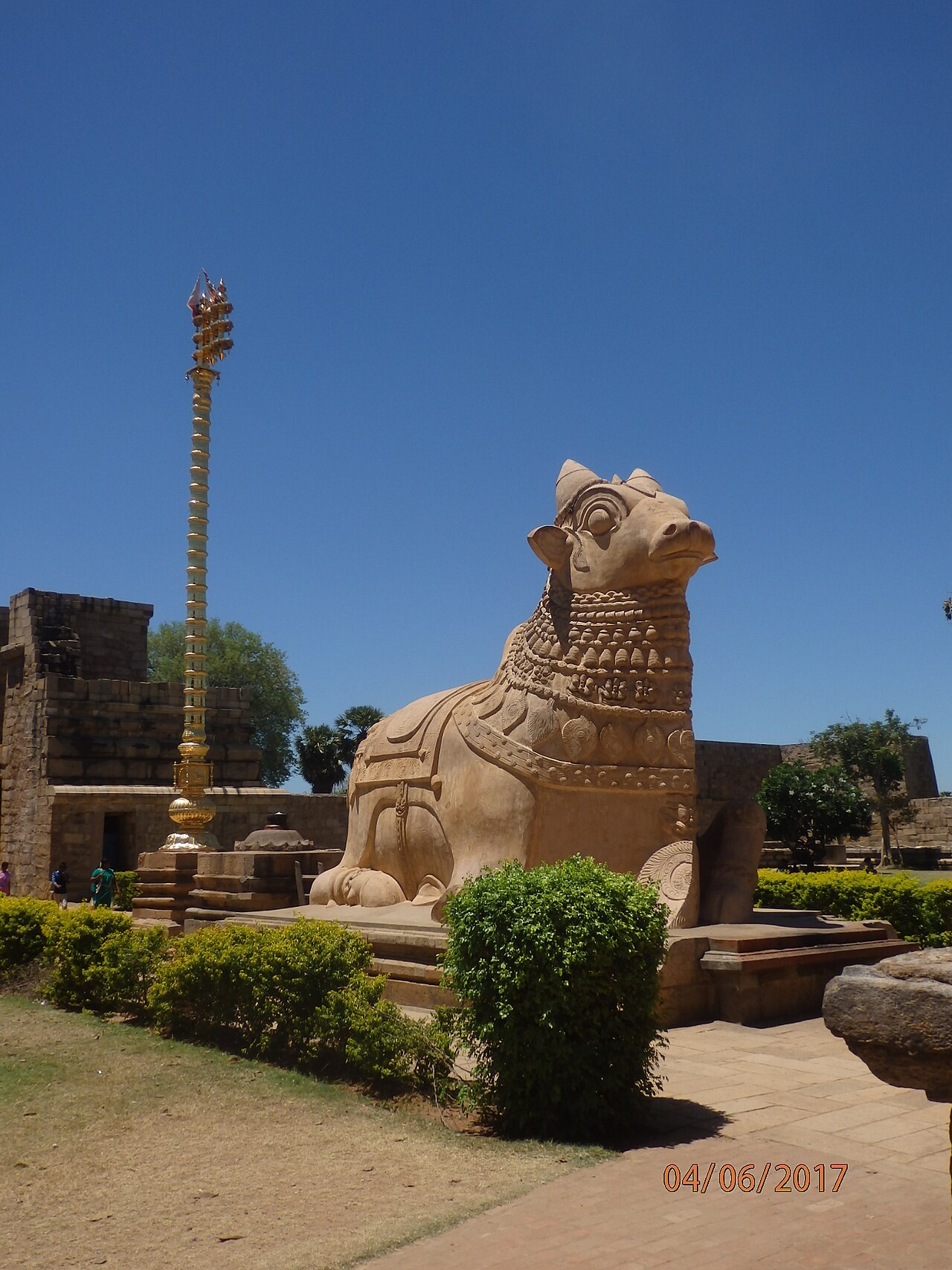
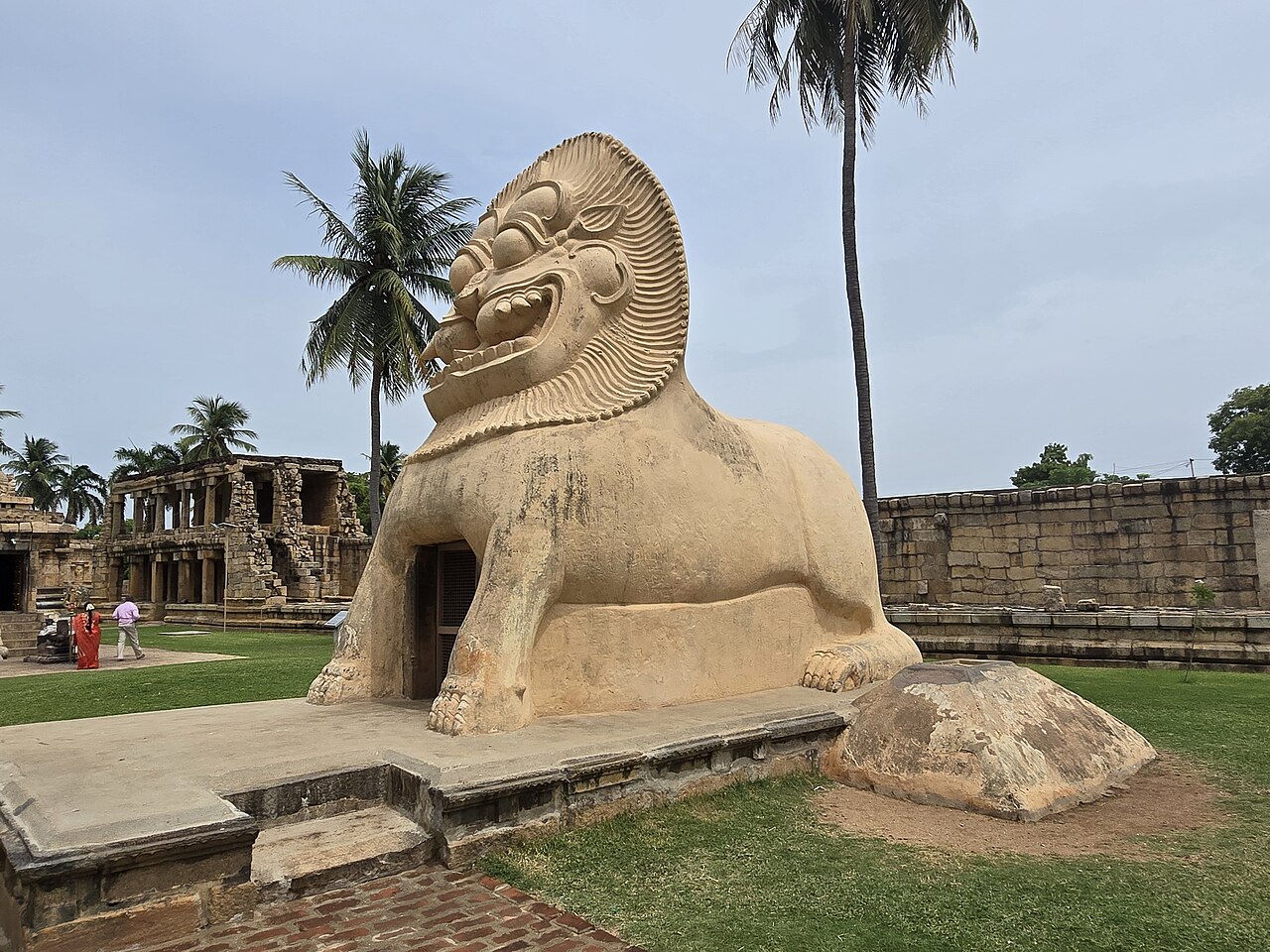
In the north of the compound a sculpted lion stands open-mouthed over a step well, the simhakeni; stairs descend through the lion's body to the water. Two hundred metres before the sanctum the massive Nandi, built of brick and stucco unlike the granite monolith at Thanjavur, keeps his patient watch, and to the north Maa Brihannayaki, The Great Lady, Receives worship in Her own shrine.
The great Nandi of Gangaikonda Cholapuram facing the sanctum across the open courtyardThe simhakeni, the lion-shaped entrance of the step well at Gangaikonda Cholapuram
The great Nandi, and the simhakeni lion well · photos by Phadke09 (CC BY-SA 4.0) and Kishore Kumar Kallayil (CC0), Wikimedia Commons
A FESTIVAL FOR AN EMPEROR
Aadi Thiruvathirai · Thiruvathirai star, 10 August 2026
Rajendra Chola I was born under the Thiruvathirai star, and since 2022 the Government of Tamil Nadu has honoured his birth anniversary here each year on that star in the Tamil month of Aadi. For a few days the vanished capital lives again: Carnatic concerts and therukoothu street theatre fill the Temple grounds, and pilgrims, historians, and dancers arrive by the thousand. In July 2025 the festival marked 1,000 years of Rajendra's maritime expedition to Southeast Asia, and the Prime Minister released a commemorative coin at the Temple. In 2026 the Thiruvathirai star of Aadi falls on 10 August.
The government announces the full programme dates closer to the festival; come early in the day, for the Temple is at its fullest on these days.
Plan your visit
By air
Tiruchirappalli International Airport (TRZ), about 111 km by road.
By rail
Kumbakonam station is about 35 km by road; Tamil Nadu Tourism lists Kutralam Junction, about 30 km away.
By road
10 km east of Jayankondam on the Tiruchirappalli to Chidambaram highway; Chidambaram is 50 km, Chennai about 280 km.
From Kumbakonam
Buses toward Jayankondam stop by the Temple; the ride takes about 55 minutes.
Timings
Sanctum worship 6 am to 12 noon and 4 to 8 pm; the ASI grounds stay open 6:30 am to 8:30 pm.
Gangaikonda Cholapuram means the city of the Chola who took the Ganga; the Lord here is Peruvudaiyar in Tamil and Brihadisvara in Sanskrit, the same Great Lord's name His father's Temple bears at Thanjavur.
The linga in the sanctum is about four metres tall, among the largest in South India; the Cholaganga tank still holds water nearby and is known today as Ponneri.
Stone from the ruined city was carried away for later works, some of it into the Lower Anaicut dam; the fields around the Temple are the old capital.
Leave footwear at the entrance; the open granite courtyard is fierce underfoot at midday and kind at dawn.
Questions pilgrims ask
Is this a living Temple or an archaeological monument?
Both. The Archaeological Survey of India protects and maintains the monument, and the daily worship of Lord Shiva continues, with poojas performed four times a day. UNESCO lists it among the Great Living Chola Temples precisely because the prayer never stopped.
How is it different from the big Temple at Thanjavur?
Thanjavur was built by the father, Rajaraja I, a generation earlier; this Temple by the son, Rajendra I, completed in 1035 CE. The son's tower is a few metres shorter and curves gently inward where the father's rises straight and severe, and its sculpture is counted among the finest of the Chola age.
Did the Ganga really come here?
Tradition and inscription say yes. The Tiruvalangadu copper plates record that Rajendra had the water of the Ganga carried south, borne on the heads of the kings he had defeated, and poured into the Cholaganga tank as a liquid pillar of victory beside his new capital.
What happened to the city?
It served as the Chola capital for some 250 years, until about 1279. Why it vanished is not fully settled: the Pandyas who overthrew the Cholas may have razed it, and raids of the early fourteenth century likely finished the ruin. Its stones were quarried away over centuries, and farmland now covers the old streets.
Who is the Goddess here?
Maa Brihannayaki, The Great Lady, Consort of the Lord Peruvudaiyar. Her shrine stands to the north of the main Temple, and She Is honoured with the Lord in the daily rites.
Dharamshalas and guest houses near this Sthan, shared by devotees. Adisthan takes no bookings and no money; contact each stay directly.
No stays are listed here yet. Know one that serves pilgrims well?
Do you serve Peruvudaiyar as a priest, trustee, or officer of the HR&CE or the ASI at Gangaikonda Cholapuram? Claim this page to keep its timings, poojas, and festival dates true for every pilgrim who comes to the emperor's Temple.