The bull sank into the mountain; the hump remained, and it is still warm with prayer.
Be the first to check in
Coming up: Kapat Closing on Bhai Dooj · 10 NovEntry tended 24 May 2026
3,583 m in the Garhwal Himalaya 16 km trek from Gaurikund Open 22 Apr to about 10 Nov 2026 Maha Abhishek from 4 am Free darshan · registration mandatory
Every step to this door is earned. From Gaurikund the trail climbs beside the young Mandakini for sixteen kilometres, past waterfalls and pine, into air that grows thinner and colder, until the valley opens and the grey stone Temple stands against the white wall of the Kedarnath peaks. Bells carry far up here, and breath comes short. Inside, in the dim light of lamps, pilgrims bow not to a carved murti but to a hump of living rock. Here the mountain itself is the deity.
This is the highest of the twelve jyotirlingas of Lord Shiva, standing at 3,583 metres, higher than any other, and the shrine is reached only on foot, by pony or palki, or by helicopter: no road touches Kedarnath.
The lingam here is svayambhu, self-arisen: a three-sided ridge of natural rock revered as the hump of Lord Shiva's bull form, rising from a pedestal about 3.6 metres around, worshipped where it broke from the earth.
Kedarnath heads the Panch Kedar, five Himalayan shrines that together hold the bull's body: the arms at Tungnath, the face at Rudranath, the navel at Madhyamaheshwar, the hair at Kalpeshwar, and the hump here.
The bull who would not be caught
After the war of Kurukshetra the Pandava brothers came into the Himalaya seeking Lord Shiva, longing to be freed of the sin of killing their own kin. Tradition holds that Lord Shiva did not wish to be found so easily, and grazed among the herds of the Kedar valley in the form of a bull. Bhima knew him. When the great Pandava reached out to seize the animal, the bull sank into the earth, and only the hump remained above ground at Kedarnath. The arms rose at Tungnath, the face at Rudranath, the navel and stomach at Madhyamaheshwar, the hair at Kalpeshwar. Over the hump the Pandavas raised the first shrine, and the five places together became the Panch Kedar.
No record names the builder of the present Temple. The Skanda Purana already speaks of Kedara around the seventh or eighth century, and by the twelfth the shrine appears in the Kritya-kalpataru of Bhatta Lakshmidhara as one of the great pilgrimages of the land. Tradition holds that Adi Shankara renewed the Temple in the eighth century and completed his life here: behind the sanctum stands his samadhi, swept away in the flood of 2013 and rebuilt as a stone chamber, where a twelve foot statue of the acharya was unveiled in November 2021.
The Temple keeps a mountain rhythm. Its Raval, the head priest, comes by centuries of custom from the Veerashaiva community of Karnataka. Each year on Bhai Dooj the doors close, and the Panchmukhi doli of Baba Kedarnath descends by stages through Gaurikund, Phata and Guptkashi to the Omkareshwar Temple at Ukhimath, where worship continues through the snowbound months until the doors open again in spring.
What you'll actually see
1
The grey stone Temple
Enormous, evenly cut slabs of grey mountain stone, fitted by hands no chronicle names, with the Kedarnath massif rising sheer behind the shikhara. A stone Nandi keeps watch outside, and the first hall holds figures of the five Pandavas, Krishna, Nandi and Virabhadra, the family of the legend gathered around its Lord.
2
The hump in the sanctum
The garbhagriha holds no carved murti. The jyotirlinga is a conical, three-sided ridge of natural rock on a pedestal about 3.6 metres around, honoured as the bull's hump. At the 4 am Maha Abhishek the head priest performs the great bathing rites; through the day pilgrims file past the bare rock in lamplight.
3
The samadhi of Adi Shankara
A few steps behind the Temple lies the rebuilt samadhi sthal of Adi Shankara, who tradition holds attained samadhi here in the eighth century. The 2013 flood destroyed the old memorial; the new stone chamber holds a 35 tonne, twelve foot statue of the acharya, carved by the Mysuru sculptor Arun Yogiraj and unveiled on 5 November 2021.
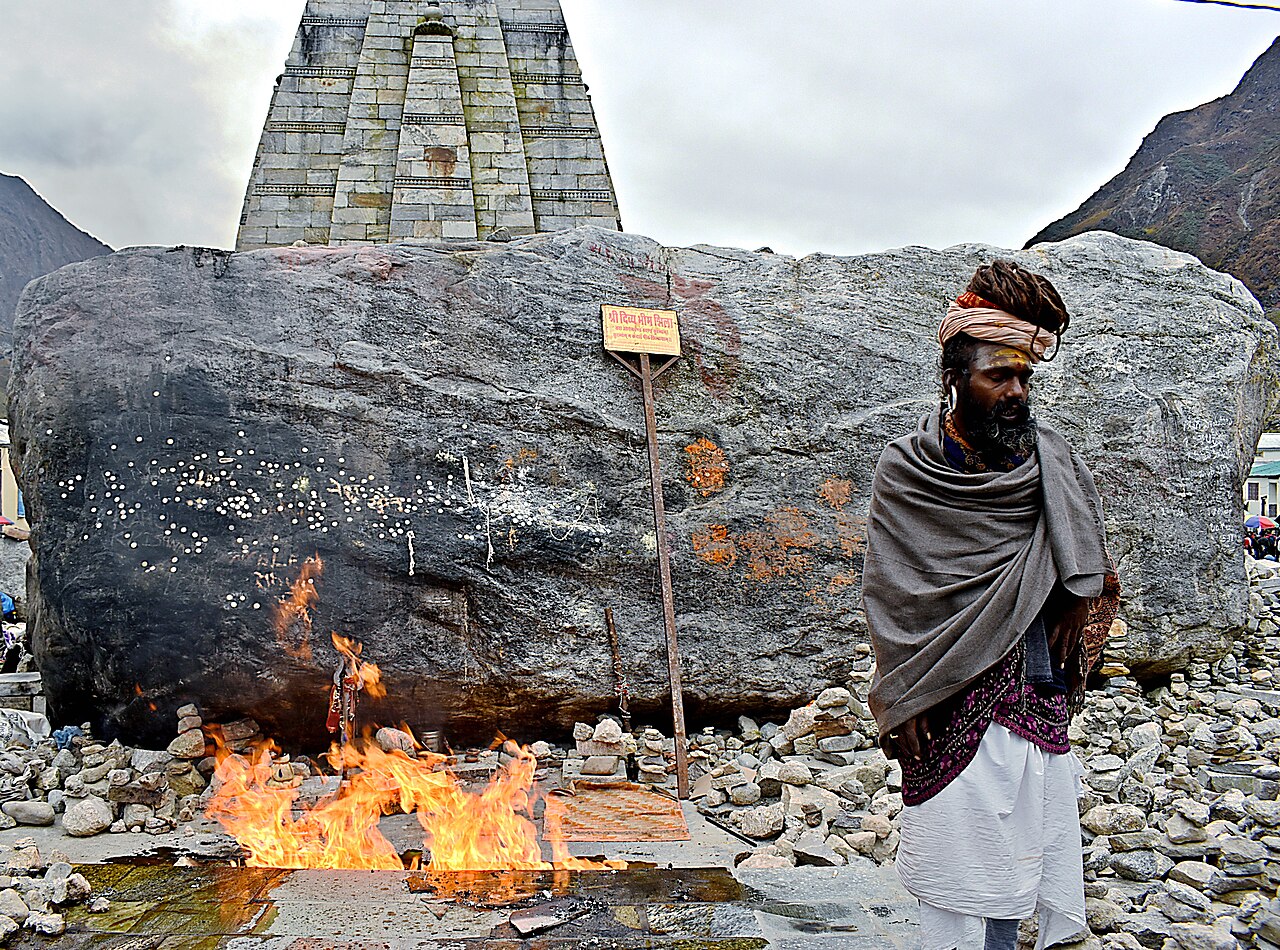
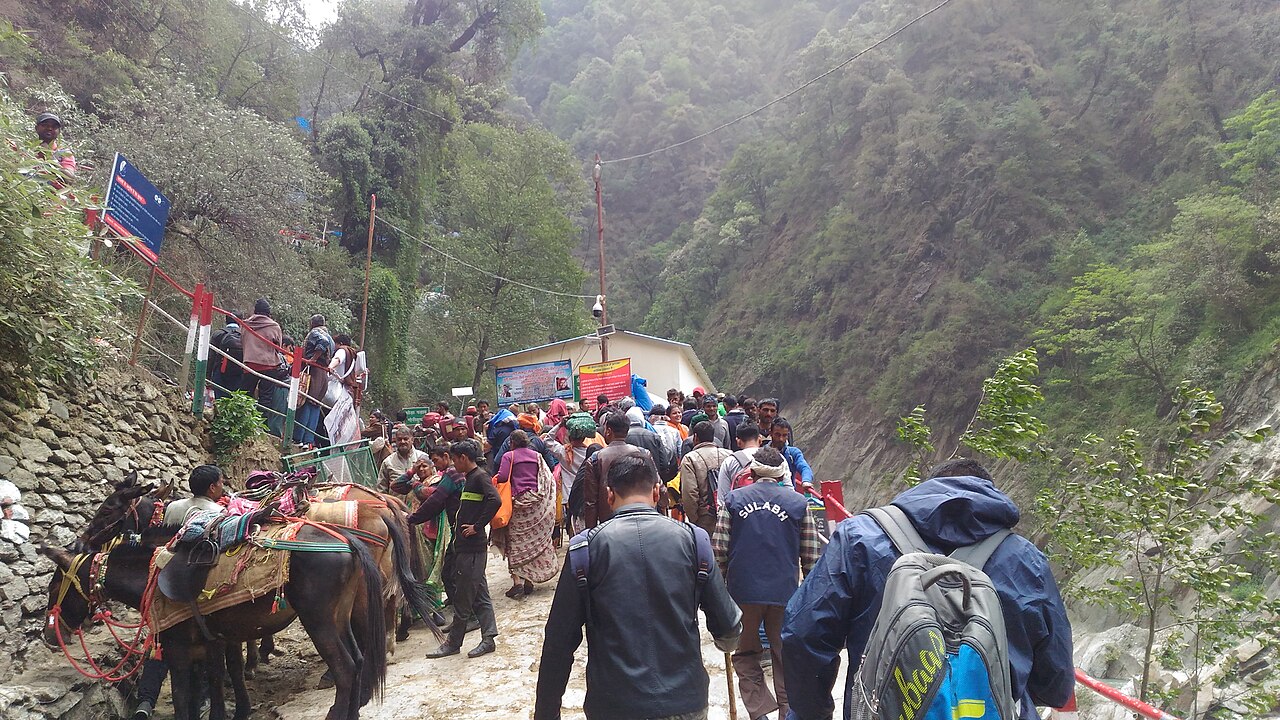
Bhim Shila, the boulder lodged behind Kedarnath Temple since the flood of 2013, now honoured by pilgrimsThe mountain trail between Gaurikund and Kedarnath, the 16 km footpath every pilgrim shares
Bhim Shila and the Gaurikund trail · photos CC BY-SA 4.0, Wikimedia Commons (Rohit14400, Prateek as a traveller)
THE ROCK THAT STOOD BEHIND THE TEMPLE
Bhim Shila, the shield of 2013
In June 2013 a cloudburst broke the glacial lake above the town, and the Mandakini came down carrying boulders, mud and meltwater through Kedarnath. The settlement around the Temple was largely destroyed, and thousands of lives were lost across the valley. Yet as the torrent reached the shrine, a massive boulder carried by the flood lodged in the ground directly behind the sanctum and split the waters, sending the debris around both sides of the Temple. The old walls held. Pilgrims now worship that boulder as Bhim Shila, and it rests exactly where it stopped, a few steps behind the Temple.
Walk behind the Temple after darshan: Bhim Shila and the rebuilt samadhi of Adi Shankara stand within the same few steps.
Plan your visit
By air
Jolly Grant Airport, Dehradun, about 238 km from Kedarnath; helicopters fly the last leg from Phata, Sirsi and Guptkashi helipads, booked only at heliyatra.irctc.co.in.
By rail
Rishikesh is the practical railhead, about 216 km; buses and shared taxis run via Rudraprayag to Sonprayag.
By road
Private vehicles stop at Sonprayag, where yatra registration is checked; local jeeps shuttle pilgrims on to Gaurikund, the trailhead.
The trek
About 16 km from Gaurikund on the trail rebuilt after 2013, via Jungle Chatti, Bhimbali and Lincholi. Ponies, palkis and kandis are booked only at the government prepaid counters at Sonprayag and Gaurikund.
Timings
The Temple opens about 4 am with the Maha Abhishek; general darshan from about 6 am to 3 pm and 5 pm to 7 pm; evening aarti about 6 pm and Shayan Aarti at 7 pm. Times shift with weather and ritual days.
Season 2026
The doors opened on 22 April 2026 at 8 am; they close on Bhai Dooj, expected 10 or 11 November 2026, the final day announced by the Temple committee.
Fee & registration
Darshan is free. Char Dham Yatra registration is mandatory and free at registrationandtouristcare.uk.gov.in; paid pujas are booked only through badrinath-kedarnath.gov.in.
Best time
May, June and September to early November are the settled windows; the monsoon months of July and August bring landslide risk on the mountain roads. Reach the Temple by early morning for the quietest darshan.
Kedar means field, and Kedarnath is the Lord of the Field; the trailhead Gaurikund carries the name Of Maa Gauri, Who Is said to have performed tapasya there for Lord Shiva.
The altitude is real: 3,583 metres. Walk slowly, drink water, and carry warm layers and rain cover in every season; the weather can turn from sun to sleet within an hour.
Helicopter seats are sold only at heliyatra.irctc.co.in, the IRCTC portal. Lookalike websites and self-described agents running online ads are frauds; no other site or company is authorized, and money sent to personal UPI accounts is lost.
When you cannot climb, the Temple committee streams darshan and aarti on its official YouTube channel, BKTC Official.
Questions pilgrims ask
Is there an idol of Lord Shiva to see inside?
No. The sanctum holds a natural three-sided ridge of rock, the svayambhu lingam revered as the hump of Lord Shiva's bull form. Pilgrims bow to the bare rock itself; that is the darshan of Kedar Baba.
Can I drive to the Temple?
No road reaches Kedarnath. Vehicles stop at Sonprayag; from Gaurikund it is a trek of about 16 km on foot, by pony, palki or kandi, or a helicopter hop from Phata, Sirsi or Guptkashi.
When can I visit in 2026?
The doors opened on 22 April 2026 and close for winter on Bhai Dooj, expected 10 or 11 November 2026; the Temple committee announces the exact day and hour in advance. Through the winter Baba Kedarnath is worshipped at the Omkareshwar Temple in Ukhimath, which pilgrims may visit year round.
How do I book the helicopter safely?
Only at heliyatra.irctc.co.in, the IRCTC Heli Yatra portal, after completing your yatra registration. Beware lookalike domains and anyone calling themselves an agent; if defrauded, report at once to the cybercrime helpline 1930 or cybercrime.gov.in.
Do I need to register for the yatra?
Yes. Char Dham Yatra registration is mandatory for every pilgrim and free, done online at registrationandtouristcare.uk.gov.in; it is checked at Sonprayag before you reach Gaurikund.
The Sthan in photographs
Darshan from afar
From the temple's own channels. Nothing loads until you press play.
Dharamshalas and guest houses near this Sthan, shared by devotees. Adisthan takes no bookings and no money; contact each stay directly.
No stays are listed here yet. Know one that serves pilgrims well?
Are you a priest, an officer of the Shri Badrinath Kedarnath Temple Committee, or a tirtha purohit of the dham? Claim this page to keep timings, kapat dates and yatra guidance true for every pilgrim who climbs to Baba Kedarnath.