The Sun was given a chariot of stone, and it has been morning here ever since.
Be the first to check in
Coming up: Konark Dance Festival · 1 DecEntry tended 25 May 2026
Open sunrise to sunset ₹40 Indian · ₹600 foreign Magha Saptami Mela · 13 Feb 2027 13th-c. Kalinga · UNESCO 1984 24 wheels · 7 horses
The sea wind arrives before the Temple does, carrying salt across wide lawns. Then the stone rises: a carved mountain of dark khondalite, guarded by lions rearing over elephants. Walk closer and the base resolves into wheels, wheel after towering wheel, each carved deep enough to lose your hand in, with seven straining horses at the eastern stair. You are not approaching a building. You are walking beside a chariot, halted in full flight, built so that Lord Surya might ride the dawn out of the Bay of Bengal.
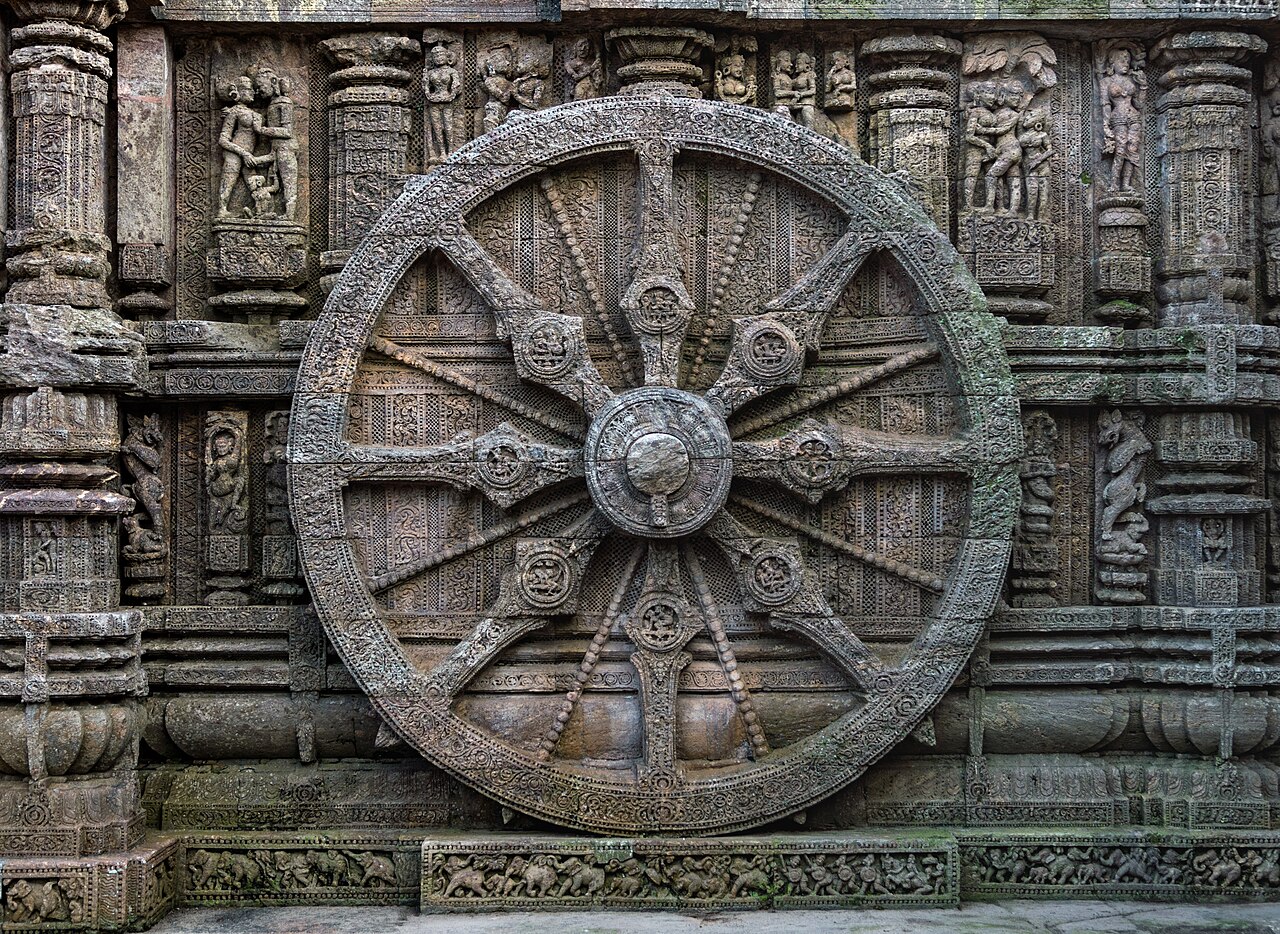
The entire Temple is conceived as the chariot of Lord Surya: twelve pairs of exquisitely carved stone wheels, each around three metres across, drawn by seven rearing horses, the whole sanctuary rolling eastward to meet the sunrise.
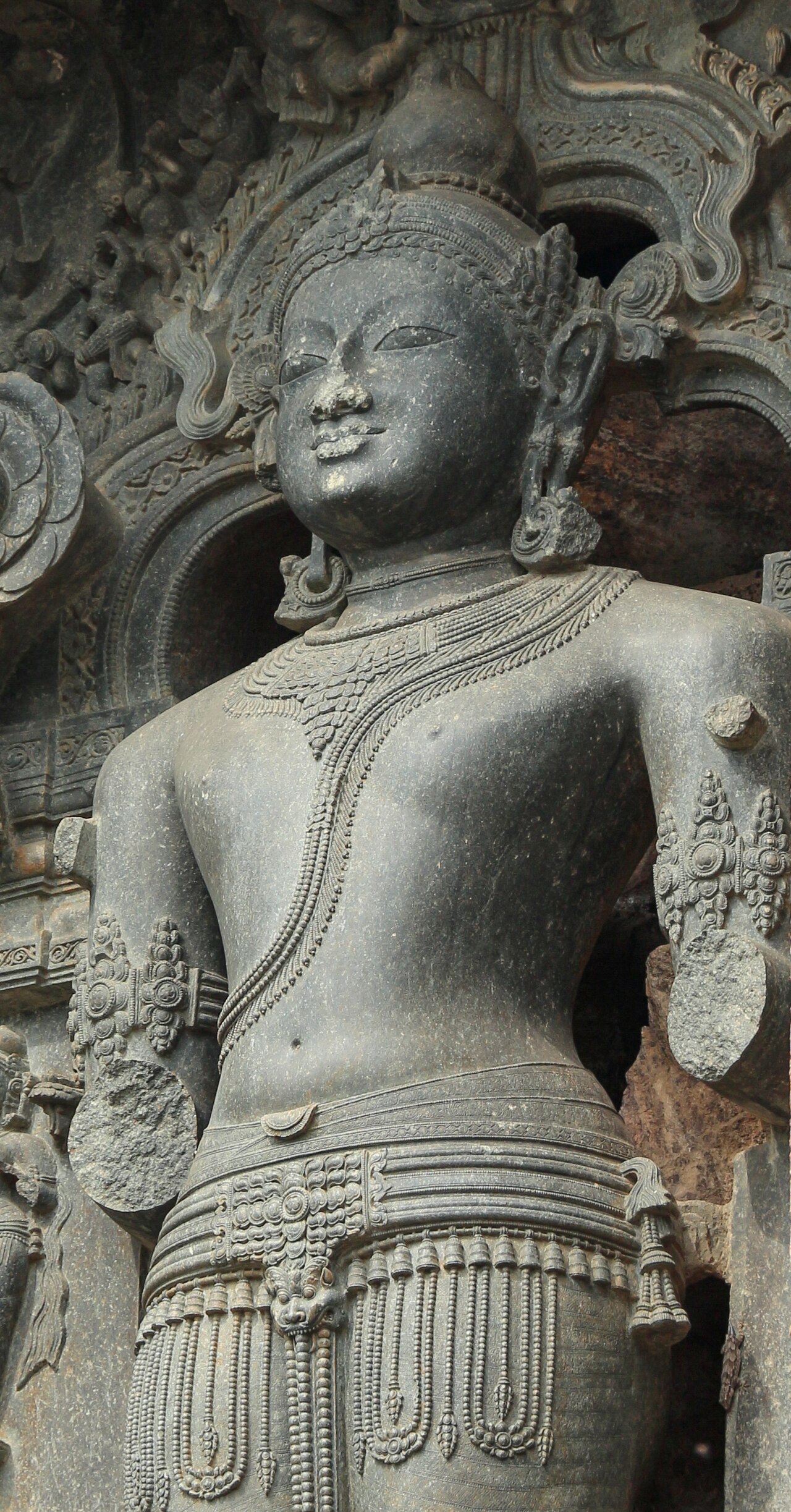
Its sculpture keeps time. The great wheels work as sundials that can be read to the minute, and three green chlorite images of Lord Surya are set on the sanctum's three faces to receive the morning, midday and setting sun in turn.
The sanctum is no longer enshrined, yet the worship of the Sun never ended here: each Magha Saptami, pilgrims in their lakhs bathe in the sea at the Chandrabhaga shore before first light and greet Lord Surya rising from the water, a rite the Brahma Purana prescribes.
The chariot the king built for the Sun
In the oldest hymns, Lord Surya crosses the sky in a chariot drawn by seven horses, with Aruna, the dawn, holding the reins. Around 1250 CE, King Narasimhadeva I of the Eastern Ganga dynasty resolved to give that image a body of stone at Arka Kshetra, the field of the Sun, whose very name joins kona, the corner, with arka, the Sun. The undertaking was vast enough that its planning survives: palm-leaf manuscripts recording the construction, written in Sanskrit in the Odia script, were discovered in a village in the 1960s, a rarity among Hindu Temples.
The builders raised it from three stones: khondalite for the walls, laterite for the cores, and green chlorite for the doorframes and the images of the Lord, finished in ashlar so fine the joints nearly vanish. European sailors steering up the Bay of Bengal called it the Black Pagoda and paired it with the White Pagoda of Lord Jagannath at Puri, twin landmarks of the coast. The main tower is estimated to have stood close to seventy metres. When and why it fell is still argued: accounts have it ruined by the late sixteenth century or after, and the last of it came down in 1837.
In 1903 the British administration sealed the surviving jagamohana and filled it with sand so it would not follow. Tradition holds the Lord's image was carried to Puri, where the worship of Lord Surya continues. The chariot remains: a World Heritage Site since 1984, a monument of devotion still circled by pilgrims, and each Magha Saptami the sea at the Chandrabhaga shore fills before dawn.
What you'll actually see
1
The lions and the dance hall
You enter from the east past two great lions rearing over crouching elephants, then climb the freestanding nata mandira, the dance hall, standing on its own high platform carved with musicians, dancers and processions. From its top step the whole chariot Temple lines up before you against the sky.
2
The twenty-four wheels
Around the base run the wheels, each about three metres across with eight broad spokes, every spoke and medallion carved with deities, vines and scenes of daily life. They are working sundials: guides show how the shadow falling across the carved rim gives the hour, read to the minute.
3
The three faces of the Sun
Set in the three projections of the ruined sanctum stand images of Lord Surya in polished green chlorite, placed to catch the sun at dawn, at noon and at evening: youthful in the morning light, full of power at midday, and weary as the day ends.
A carved stone chariot wheel of the Konark Sun Temple, its spokes and medallions cut deep into khondaliteA chlorite image of Lord Surya standing in a niche of the Konark Sun Temple
A chariot wheel, and the chlorite Lord Surya of the sanctum wall · photos CC BY-SA 4.0 Subhrajyoti07 and CC BY-SA 3.0 Bernard Gagnon, Wikimedia Commons
The living worship of the Sun
Magha Saptami at the Chandrabhaga · 13 February 2027
On Magha Saptami, the seventh dawn of the bright fortnight of Magha, the Sun's own festival returns to Konark. Through the night pilgrims gather at the Chandrabhaga beach, three kilometres east of the Temple, and before first light they enter the sea for the ceremonial bath the Brahma Purana prescribes, then turn east to greet Lord Surya rising out of the Bay of Bengal and come to the chariot Temple for darshan of the stones. The gathering has outlived the tower and even the Chandrabhaga river itself, which silted away centuries ago: the bathing assembly is recorded from at least the fifteenth century.
Arrive the previous evening: the bathing hour is before dawn, and the beach road fills long before sunrise.
Plan your visit
By air
Biju Patnaik International Airport, Bhubaneswar, about 60 km by road.
By rail
Puri railway station, about 35 km; buses and taxis run through the day.
By road
The coastal marine drive links Puri and Konark, about 35 km; Bhubaneswar is about 60 km.
Timings
Open sunrise to sunset, every day of the week.
Entry
₹40 for Indian and SAARC or BIMSTEC visitors, ₹600 for others, slightly less online; children under 15 free.
Best time
Early morning: the Temple faces east, and its sculpture was set out for the rising sun. October to February is the kindest season.
Allow
Two to three hours for the chariot, the dance hall and the subsidiary shrines; add an hour for the ASI Sun Temple Museum nearby.
The name joins kona, corner, and arka, the Sun; European mariners knew it as the Black Pagoda, the dark twin of Puri's White Pagoda, and steered by both.
The interior of the jagamohana has been sealed and sand-filled since 1903 to hold the structure up; the ASI began drawing the sand out in 2022, so conservation work may be visible when you visit.
Look for the detached Navagraha slab of the nine planetary deities, carved on a single stone of about 26 tonnes; the Temple's Aruna Stambha pillar now stands before the Jagannath Temple in Puri.
The Konark wheel rides on the Indian ten-rupee note, and the Temple's original doorstep once faced a river that no longer flows.
Questions pilgrims ask
Is Lord Surya still worshipped inside the Temple?
No. The sanctum is no longer enshrined and the Temple is a protected Archaeological Survey of India monument, not a place of daily worship. Tradition holds the Lord's image was carried to Puri, where His worship continues. The living rite at Konark itself is the Chandrabhaga Mela each Magha Saptami, when pilgrims bathe in the sea at dawn and greet the rising sun.
Can people of every faith enter?
Yes. It is a ticketed monument open to all, sunrise to sunset. The interior of the great hall is sealed, so what you come for is the outside: the wheels, the horses, the carvings and the three images of Lord Surya.
What should I make of the erotic carvings?
They belong to the Temple's full picture of life. Hindu tradition counts kama, desire, among the four aims of human existence alongside dharma, wealth and liberation, and Konark's couples stand amid friezes of farmers, soldiers, musicians, pilgrims and kings. The carvers gave the whole of life to the Sun.
How do the wheel sundials work?
Each wheel has eight broad spokes dividing the day, and the shadow cast across the carved rim marks the hour; the reading is said to be accurate to the minute. Local guides demonstrate it in seconds, and it is the single most delightful thing to learn on the spot.
Is Konark worth pairing with Puri?
The two belong together. The coastal road between them is about 35 km, the Jagannath Temple holds Konark's Aruna Stambha at its gate, and pilgrims have long taken darshan of both the White Pagoda and the Black.
The Sthan in photographs
Darshan from afar
From the temple's own channels. Nothing loads until you press play.
Dharamshalas and guest houses near this Sthan, shared by devotees. Adisthan takes no bookings and no money; contact each stay directly.
No stays are listed here yet. Know one that serves pilgrims well?
Do you serve in the care of the Sun Temple, with the ASI, the district administration, or the organisers of the Chandrabhaga Mela? Claim this page to keep timings, mela dates and conservation notices exact for those who come to walk beside the chariot of Lord Surya.