Here the Buddha was born: four words cut in stone, and the world still walks to read them.
Be the first to check in
Coming up: Buddha Jayanti (Vesak / Buddha Purnima) · 20 MayEntry tended 11 Jul 2026
Rupandehi, Nepal Terai Garden open about 6 am to 6 pm Ashoka pillar · 249 BCE Buddha Jayanti · 20 May 2027 NPR 700 foreign · SAARC 400 UNESCO World Heritage 1997
The Terai lies flat and green to the horizon, and the warm air carries birdsong out of the sal trees. Strings of prayer flags stream toward a single white building, and bhikkhus in saffron, maroon and grey circle it, chanting low. Inside, in the half-dark, pilgrims file along a raised walkway above ancient brick. Below them, behind glass, sits a stone about the size of a doorstep. It marks the exact spot where the Buddha was born.
The Ashoka pillar beside the Temple has stood since about 249 BCE. Its Brahmi line, hida budhe jate sakyamuniti, here the Buddha, sage of the Shakyas, was born, is the oldest inscription on earth naming the Buddha's birthplace.
Under the Maya Devi Temple, archaeologists have traced shrine built over shrine, down to a structure radiocarbon-dated to the sixth century BCE, and at the centre a marker stone set to fix the birth spot itself.
Around the sacred garden, some thirty nations have raised viharas side by side: Theravada to the east of the central canal, Mahayana and Vajrayana to the west. Nowhere else does the whole Buddhist world keep house together.
The grove between two cities
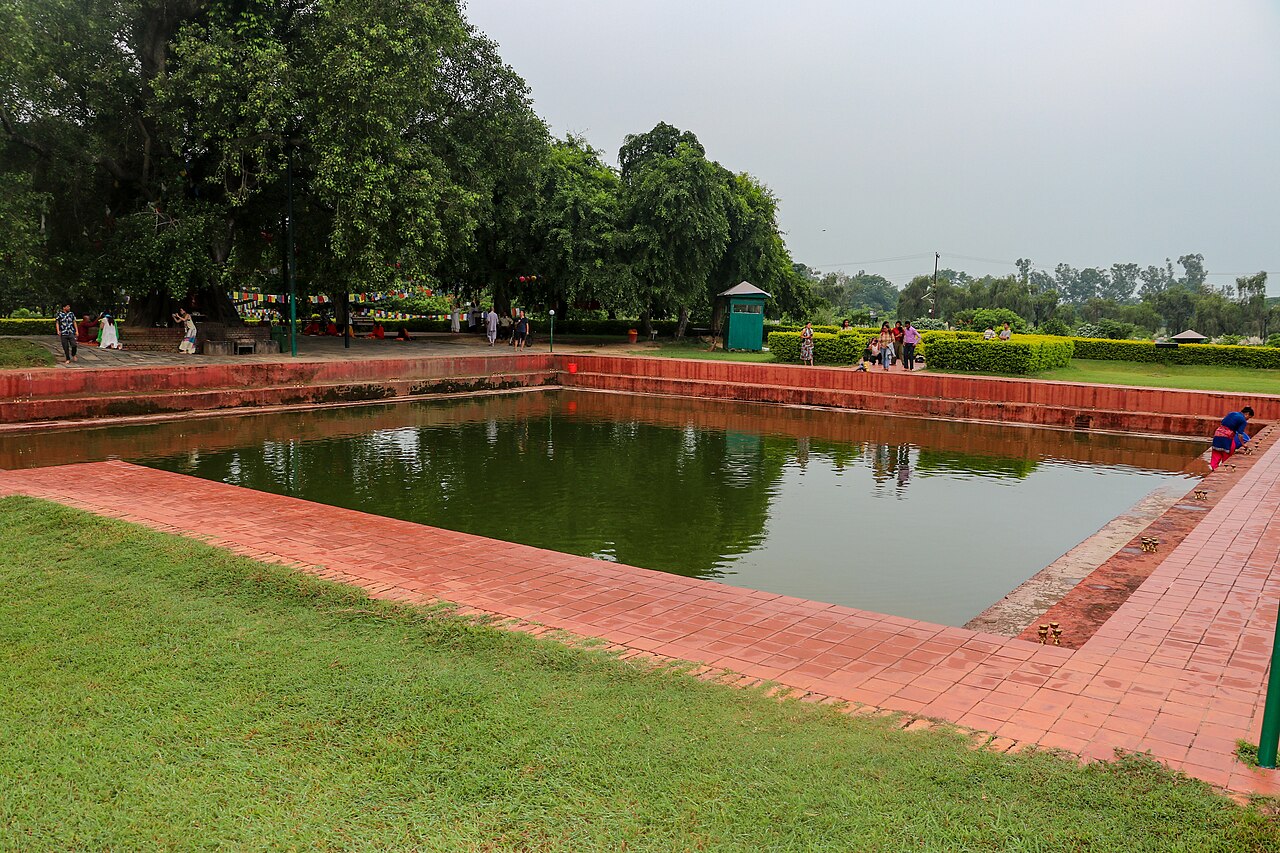
Tradition holds that Queen Maya Devi, wife of King Shuddhodana of Kapilavastu, was travelling to her parental home when she came to a grove of sal trees at Lumbini. She bathed in the pond called Puskarini, and resting in the grove she grasped the branch of a sal tree and there gave birth to the Bodhisattva, prince Siddhartha of the Shakya clan, the child who would awaken as Shakyamuni, the Buddha. The tradition tells that the newborn stood, took seven steps, and was first bathed at that same pond.
More than two centuries after the Buddha's parinirvana, the emperor Ashoka came here in the twentieth year of his reign, worshipped at the spot, lightened the village's taxes, and raised a polished sandstone pillar declaring that the Blessed One was born here. Chinese pilgrim monks recorded the pillar and the garden centuries later, and then the grove slipped out of the world's sight, under grass and forest, for hundreds of years.
In December 1896 the pillar was found again and its Brahmi lines were read, and the birthplace returned to the map of the living world. A visit by the United Nations Secretary-General U Thant in 1967 set in motion an international plan for the site, drawn by the Japanese architect Kenzo Tange, and in 1997 UNESCO inscribed Lumbini as a World Heritage Site. The grove where a mother stopped to rest is again what Ashoka found it to be: a place the world walks to.
What you'll actually see
1
The Maya Devi Temple
A plain whitewashed shell, rebuilt in 2003 by the Lumbini Development Trust, protects the open archaeology beneath it: brick shrine layers spanning roughly the sixth century BCE to the fifteenth century CE. A raised walkway leads over the ruins to the marker stone, a sandstone conglomerate about 70 by 40 centimetres, sealed under bulletproof glass at the birth spot, and to the worn red nativity sculpture of Maya Devi grasping the sal branch with the newborn below her.
2
The pillar that speaks
Just outside stands Ashoka's pillar of polished sandstone, about six metres of it above ground, its top long broken. The five Brahmi lines cut into it around 249 BCE were read again after the pillar's rediscovery in December 1896, and they remain the earliest epigraphic evidence of where the Buddha was born. Pilgrims circle it slowly under lines of prayer flags.
3
Puskarini and the sacred garden
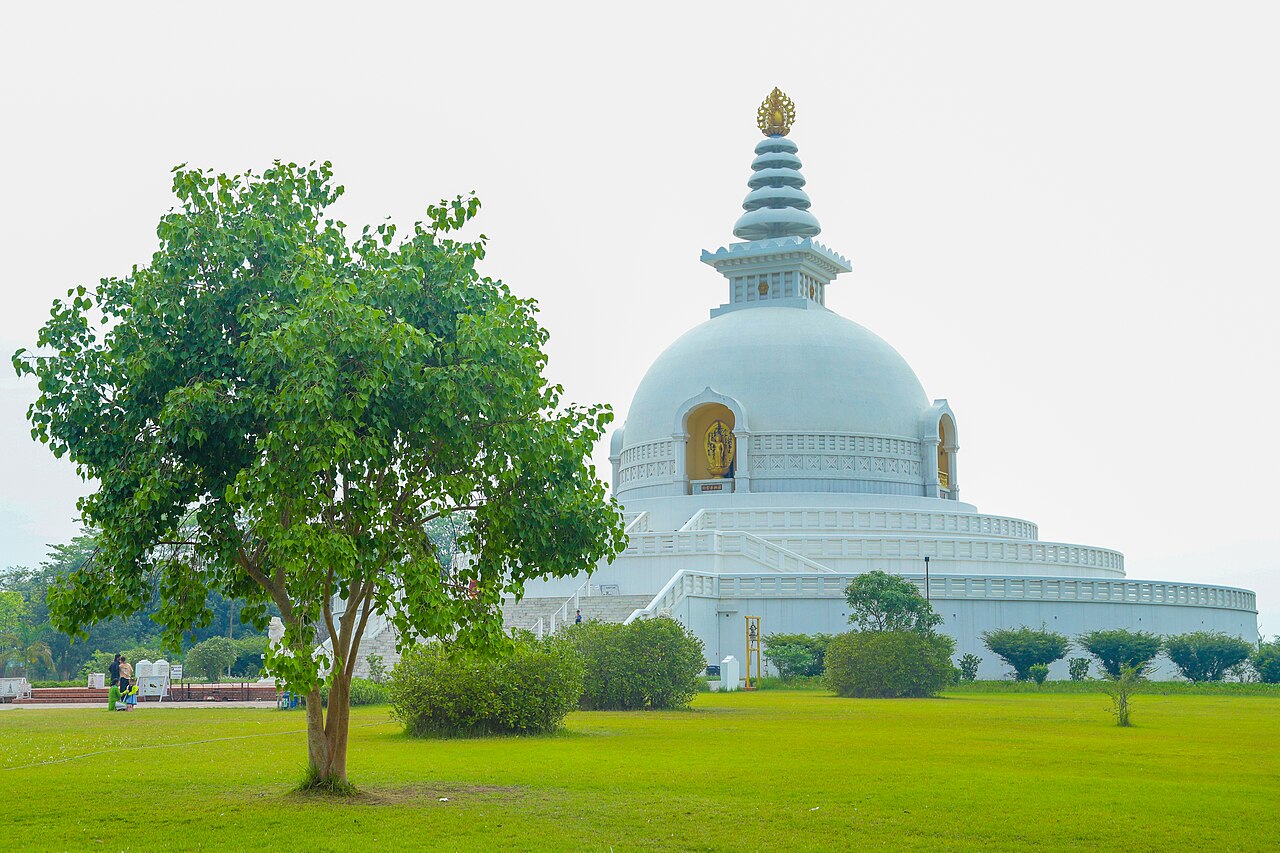
South of the Temple lies the stepped, square pond where tradition says the queen bathed before the birth and the infant was first washed. A great Bodhi tree hung with thousands of flags leans over the water, and around both spread the excavated brick stupas and viharas left by pilgrims from the third century BCE onward. From here the long central canal runs north through the monastic zones toward the World Peace Pagoda.
The Puskarini, the sacred pond where tradition says Queen Maya Devi bathed before the birth of the Buddha, with the Bodhi tree beside itThe white dome of the World Peace Pagoda at the northern end of Lumbini's master plan axis
The sacred pond and the monastic landscape · photos by Shadow Ayush and Mohammad Ayub Musalman, CC BY-SA 4.0, Wikimedia Commons
The birthday kept at the birthplace
Buddha Jayanti on the Baisakh full moon
On the full moon of Baisakh, the birthplace keeps the birthday. Bhikkhus of every lineage chant through the sacred garden, the viharas of the east and west monastic zones hold their own ceremonies, lamps and candles ring the Puskarini, and pilgrims from Nepal, India and across the Buddhist world file through the Maya Devi Temple past the marker stone. Buddhists remember the Buddha's birth, his awakening and his parinirvana on this one moon. The next Buddha Jayanti falls on Thursday 20 May 2027.
This is the sacred garden's fullest day of the year; arrive at dawn and arrange lodging early.
Plan your visit
By air
Gautam Buddha International Airport at Bhairahawa, about 18 km east, is roughly half an hour by taxi; it opened to international flights in May 2022 and has short daily connections to Kathmandu.
By road
About 280 km west of Kathmandu by road. Local buses run from Bhairahawa, and the Sunauli border crossing with India is about 30 km from Lumbini.
Timings
The sacred garden is open daily from around sunrise to sunset, about 6 am to 6 pm; confirm with the Lumbini Development Trust, which sells e-tickets at tickets.lumbinidevtrust.gov.np.
Entry
NPR 700 for foreign nationals, NPR 400 for SAARC nationals, NPR 20 for Nepalis, per the Nepal Tourism Board's fee list; the Maya Devi Temple is within the ticketed sacred garden.
Dress
Shoes come off before entering the Maya Devi Temple; dress modestly with shoulders and knees covered, as in any vihara.
On foot
The master plan area runs about three miles south to north; pilgrims walk the canal-side paths or hire bicycles and rickshaws between the sacred garden, the monastic zones and the World Peace Pagoda.
Best time
Early morning, when the monasteries are chanting and the Terai is still cool; October to March is the mild season, and the plains are very hot in high summer.
The pillar's own word for the place, Lumbini gama, the village of Lumbini, is still the name it carries twenty-three centuries later.
Nepal's tradition, followed in the UNESCO listing, places the birth in 623 BCE; many modern scholars place it nearer 563 BCE. The stone fixes the where and holds the when lightly.
Photography is not permitted inside the Maya Devi Temple, where the marker stone sits under bulletproof glass in low light.
Tilaurakot, about 27 km west, is Nepal's candidate for ancient Kapilavastu, the Shakya capital where prince Siddhartha lived his first twenty-nine years; its museum and quiet ramparts pair naturally with a Lumbini pilgrimage.
Questions pilgrims ask
Is Lumbini in India or in Nepal?
In Nepal. Lumbini lies in Rupandehi District of Nepal's western Terai, about 30 km from the Indian border at Sunauli. The Buddha was born a prince of the Shakyas, and the pillar Ashoka raised at the spot in about 249 BCE stands on Nepali soil.
What exactly do I see inside the Maya Devi Temple?
Excavated brick shrine layers viewed from a raised walkway, the fourth-century nativity sculpture of Queen Maya Devi holding the sal branch, and at the centre the marker stone under bulletproof glass, placed to fix the exact spot of the birth. Photography inside is not allowed.
When was the Buddha born, 563 BCE or 623 BCE?
Both dates are honestly held. The UNESCO listing follows the tradition of 623 BCE, while many historians reckon about 563 BCE from other chronologies. What is not disputed is the place: Ashoka's inscription of about 249 BCE is the oldest written evidence naming Lumbini as the birthplace.
Can I visit the international monasteries?
Yes. Most viharas of the East Monastic Zone (Theravada) and the West Monastic Zone (Mahayana and Vajrayana) welcome respectful visitors in daytime hours. Enter quietly, remove shoes where asked, and give way to any practice in progress.
Is one day enough for Lumbini?
The sacred garden itself asks a half day: the Temple, the pillar, the Puskarini and the ruins. Add the monastic zones and the World Peace Pagoda and a full unhurried day is right, with Tilaurakot as a second day for those tracing the Buddha's early life.
The Sthan in photographs
Darshan from afar
From the temple's own channels. Nothing loads until you press play.
Dharamshalas and guest houses near this Sthan, shared by devotees. Adisthan takes no bookings and no money; contact each stay directly.
No stays are listed here yet. Know one that serves pilgrims well?
Are you of the Lumbini Development Trust or the sangha that keeps this garden? Claim this page to add true hours, ceremonies, and a way for pilgrims to reach you.