Darshan from 5:30 am (summer) Sandhya aarti · 6:30 / 7 pm Kali Puja · 8 Nov 2026 Navaratna · consecrated 1855 Entry free
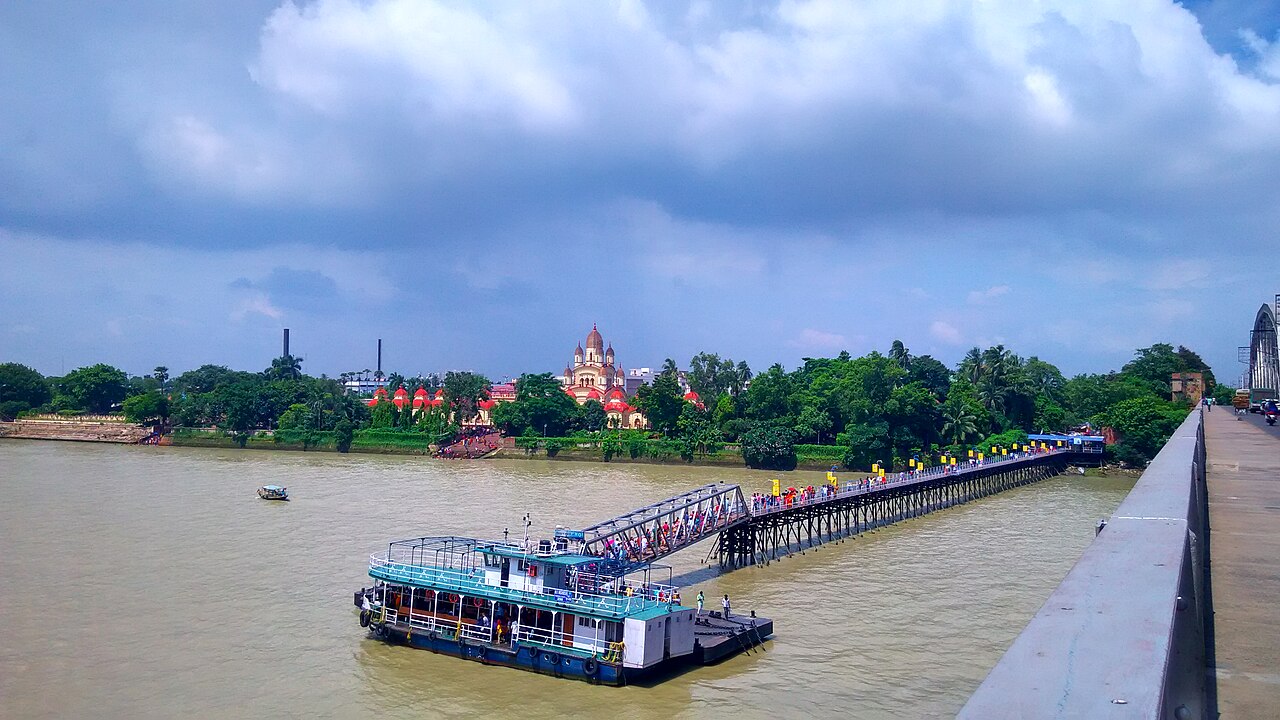
The river gives you the Temple before the gate does: nine pale spires above a line of twelve red-roofed shrines, conch and bell drifting over brown water. You come down from the skywalk into a tide of hibiscus and sweet sellers, cross the wide paved courtyard, and join the line under the colonnade. Ahead, on a silver lotus of a thousand petals, Maa Bhavatarini Stands upon Shiva. In a small room off this courtyard, a young priest once wept until She Answered, and the world came to see what he had seen.
This is the Kali Temple of Sri Ramakrishna Paramahamsa. Here the young priest Gadadhar begged Maa Bhavatarini To Show Herself, and his realization in this courtyard became the Ramakrishna movement that now circles the world.
The Temple was raised By no king but by Rani Rashmoni, a widowed zamindar born of the kaivarta fisherfolk community, who built Maa Her Temple even when orthodox priests refused to serve in it.
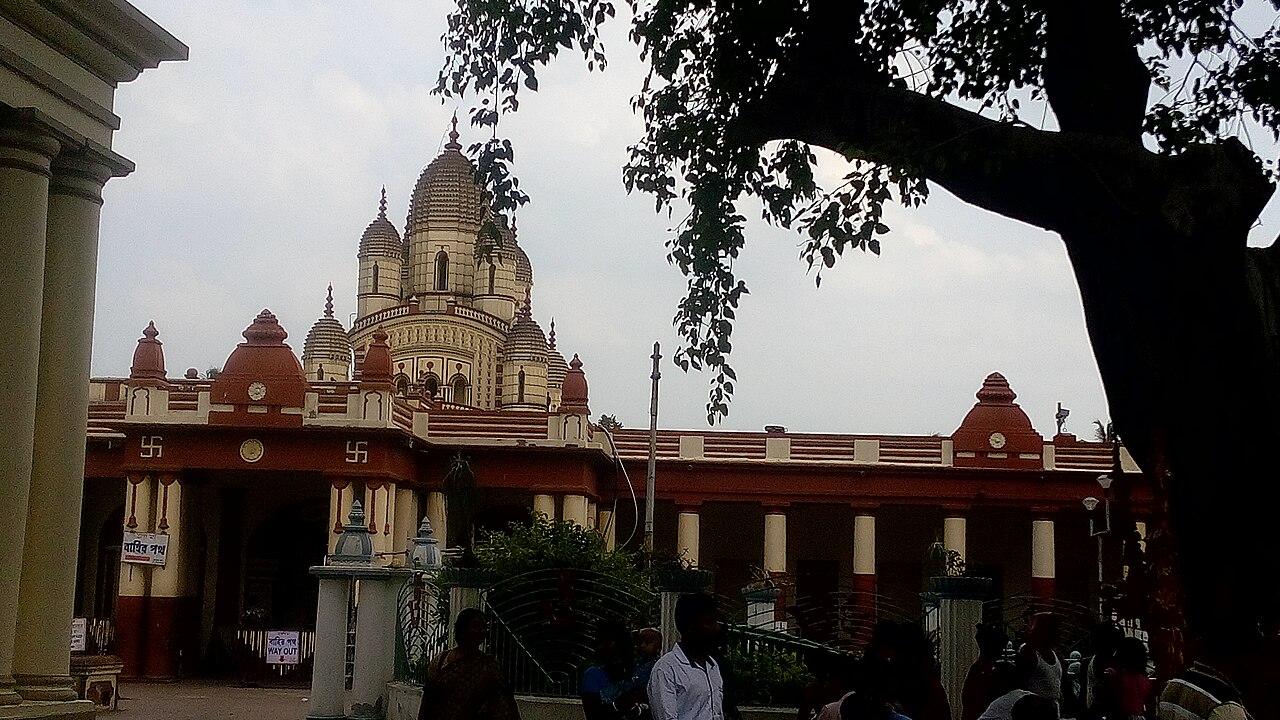
It is a navaratna, nine-spired, Temple built on the grand scale: a 46 foot square tower rising over 100 feet, set in a fortress-like court with twelve aat-chala Shiva Temples in a line along the Hooghly.
The dream that turned the boats around
In 1847 Rani Rashmoni, the widowed zamindar of Janbazar, had her boats loaded for the river pilgrimage to Kashi. The night before sailing, tradition holds, Maa Kali Came to her in a dream and Said: install My image in a beautiful Temple on the bank of the Ganga, arrange My worship there, and I Shall Accept it. The boats were unloaded. Her money bought twenty acres at Dakshineswar, a plot called Saheban Bagicha, part of it shaped like a tortoise, a form held auspicious for the worship of Shakti.
The Temple took eight years and nine months to build, and nine lakh rupees. Then came the wall her money could not move: because the Rani was born of the kaivarta community, orthodox brahmins refused to serve as priests in her Temple. It was Ramkumar Chattopadhyay, a priest from the village of Kamarpukur, whose counsel opened the way, and he himself accepted the priesthood. On 31 May 1855, Snan Yatra day, the image of Maa Was Installed as Sri Sri Jagadiswari Kalimata Thakurani. The Rani lived five years and nine months more, just long enough to see her dream standing in stone.
Ramkumar had brought his youngest brother from Kamarpukur, a boy named Gadadhar. When Ramkumar died in 1856 the young man took up the worship, and the Temple's deeper story began: he wept before Maa Bhavatarini, begging Her To Show Herself, until tradition holds She Flooded him with light. As Sri Ramakrishna Paramahamsa he practised under the Panchavati grove, received sannyasa there from the monk Totapuri in 1864, and drew all Calcutta to his room in the northwest corner. His words became the Sri Sri Ramakrishna Kathamrita, and one young listener, Narendranath Dutta, carried them to the world as Swami Vivekananda.
What you'll actually see
1
The nine-spired tower
The main Temple stands south-facing on a high plinth, a 46 foot square rising more than 100 feet through three storeys, its nine ribbed spires gathered in two tiers. In the sanctum, the Image Of Maa Bhavatarini Stands upon the prone form of Shiva, both set on a thousand-petalled lotus throne of silver.
2
The twelve Shiva Temples and the chadni
Along the riverfront runs a line of twelve identical Shiva Temples in the curved-roofed aat-chala style of Bengal, each holding a black stone linga: six to one side and six to the other of the chadni, the pillared landing where pilgrims come up wet from the bathing ghat. Their red-and-white roofs are the first thing you see from the water.
3
The Panchavati and the Master's room
North of the courtyard stands the Panchavati, a grove of five sacred trees, banyan, peepal, neem, amalaki and bel, where Sri Ramakrishna practised his sadhanas. His room at the northwest corner, with its semicircular verandah facing the river, is preserved, and the Nahabat music tower nearby was the home of Holy Mother Sri Sarada Devi.
The nine spires of the Temple Of Maa Bhavatarini rising above the red colonnade of the inner courtyard at DakshineswarPilgrims crossing the jetty walkway to the ferry at Dakshineswar, with the Temple and the twelve Shiva shrines behind
The courtyard and the river approach · photos by Mam Pal and Dhrubajyoti, CC BY-SA 4.0, Wikimedia Commons
The first morning of the year
Kalpataru Utsav · 1 January
On 1 January 1886, at a garden house in nearby Cossipore, the ailing Sri Ramakrishna touched his devotees one by one and blessed them into awakening; his followers named it the day he became the Kalpataru, the wish-fulfilling tree. Ever since, Bengal has kept New Year's Day as Kalpataru Utsav, and Dakshineswar is one of its principal seats: on 1 January 2026 the gates opened around 5 am and lakhs of devotees filed through them to begin the year at the feet Of Maa Bhavatarini. The next Kalpataru Utsav falls on Friday, 1 January 2027.
Come before dawn if you can; the queue runs for hours, and the first hour is the sweetest.
Plan your visit
By metro
Dakshineswar station is the northern terminus of Kolkata Metro's Blue Line (opened February 2021): one straight ride from central Kolkata, then the skywalk to the Temple approach.
By rail
Dakshineswar suburban railway station, 13 km from Sealdah on the local line, is beside the Temple bazaar.
By air
Netaji Subhas Chandra Bose International Airport, Kolkata, is about 9 km away by road.
The skywalk
The 340 m Dakshineswar Rani Rashmoni Skywalk (2018) lifts you over the bazaar from the station area to the Temple gate, with escalators and lifts.
By ferry
Boats cross from Maa Bhabatarini Jetty to Belur Math, the home of the Ramakrishna Order, on the far bank; Vivekananda Setu (the old Bally bridge) crosses just downstream.
Timings
Summer roughly 5:30 am to 11:30 am and 3:30 pm to 9 pm; winter 6 am to 12:30 pm and 3 pm to 8:30 pm. The trust posts no hours online, so confirm by phone: (033) 2564 5222.
Best time
A weekday morning soon after opening, when the courtyard is cool and the line short; October to February is the kind season for the open courtyard.
Dress
Modest dress; shorts and short skirts are out of place. Shoes, phones and cameras are all deposited at the counters by the gate.
Phones and cameras are not allowed inside the Temple complex: deposit them, with your shoes, at the counters by the gate before you join the Darshan line.
The land the Rani bought was called Saheban Bagicha, the Englishman's garden; part of the plot is shaped like a tortoise, held auspicious in Tantra for the worship of Shakti.
Bhog coupons are sold in the morning and anna-prasad is served around midday; ask at the counter when you arrive, as arrangements change on festival days.
The Adyapeath Temple up the road belongs to a separate trust, the Dakshineswar Ramakrishna Sangha; the Rani's riverside Temple Of Maa Bhavatarini is the one this page describes.
Questions pilgrims ask
Is Dakshineswar one of the Fifty-One Shakti Peethas?
No. The Temple is young as tirthas go, consecrated in 1855, and does not stand in the Peetha lists; Kalighat, downstream in the city, is Kolkata's Shakti Peetha. Dakshineswar's holiness has a different root: here Maa Bhavatarini Answered a living priest, and the world believed him.
Who Is Maa Bhavatarini?
A form Of Maa Kali. The trust's formal name for Her is Sri Sri Jagadiswari Kalimata Thakurani, the Mother Who Creates the universe; devotees read the name Bhavatarini as She Who Carries souls across the ocean of becoming. Her Image Stands upon Shiva on a thousand-petalled silver lotus.
Can I see Sri Ramakrishna's room?
Yes. The room where he lived stands at the northwest corner of the courtyard, its semicircular verandah facing the Hooghly. It is kept as a place of silence; enter barefoot and sit a while.
How do I visit Belur Math from the Temple?
Take the ferry from Maa Bhabatarini Jetty beside the Temple; Belur Math faces Dakshineswar from the far bank of the Hooghly, and the crossing itself is part of the pilgrimage.
When is the Temple busiest?
Kali Puja night and 1 January above all, when lakhs pass through the gates. For a quiet Darshan, come on an ordinary weekday morning soon after opening.
The Sthan in photographs
Darshan from afar
From the temple's own channels. Nothing loads until you press play.
Dharamshalas and guest houses near this Sthan, shared by devotees. Adisthan takes no bookings and no money; contact each stay directly.
No stays are listed here yet. Know one that serves pilgrims well?
Are you a sevait, officer, or trustee of the Dakshineswar Kali Temple and Debottar Estate? Claim this page to keep the timings, aarti hours, and festival days true for the devotees who plan their journeys by them.