Public darshan · Maha Navami only Behind the Golden Gate, 1754 Tutelary Goddess Of the Malla kings Bhaktapur Durbar Square Hindus only, within Mul Chok
In brick-red Bhaktapur you walk beneath the Golden Gate, the Sun Dhoka, where a gilded Garuda wrestles serpents above your head and a ten-armed Goddess watches from the torana. Beyond it lies the oldest heart of the Royal Palace, and within that, a courtyard most of the world has never seen. Maa Taleju receives the public one single day each year. The rest of the time, Her priests keep the old royal worship exactly as the kings once did, in a kingdom that no longer exists.
Maa Taleju Bhavani was The royal Goddess of the Malla kings, the power behind their throne; her yantra, not an image, is the seat of worship, in the old Tantric way.
The sanctum in Mul Chok opens To the public only on Maha Navami, the ninth day of Dashain. Thousands queue from before dawn for the one darshan of the year.
Bhaktapur's Taleju priests hold that the worship of the living goddess Kumari, The child embodiment Of Maa Taleju, began here before it spread to Kathmandu and Patan.
The Goddess who outlived her kingdom
The old chronicles say that when the armies of Ghiyasuddin Tughlaq sacked Simraongarh in 1326, King Harisimhadeva of the Karnata line fled north into the hills carrying one thing above all: the yantra of Maa Bhavani, his family's Goddess. She found a new seat in Bhaktapur, and the Malla kings who rose in the valley took Her as their own. Taleju became The Goddess Of the throne itself: no king ruled without Her blessing, and Her Temples rose inside the palaces of all three royal cities, Bhaktapur, Kathmandu and Patan.
Bhaktapur's shrine is the oldest of the three, folded into the palace's inner courtyard, Mul Chok, and reached through the Sun Dhoka, the Golden Gate that King Bhupatindra Malla began and Jaya Ranjit Malla finished in 1754. Art historians count that gilded doorway among the great treasures of the entire valley. When the Gorkha conquest ended Malla rule in 1769, the dynasty fell but the worship did not: the priests of Maa Taleju have continued the daily rites through kingdom, monarchy and republic alike.
What you'll actually see
1
The Golden Gate, Sun Dhoka
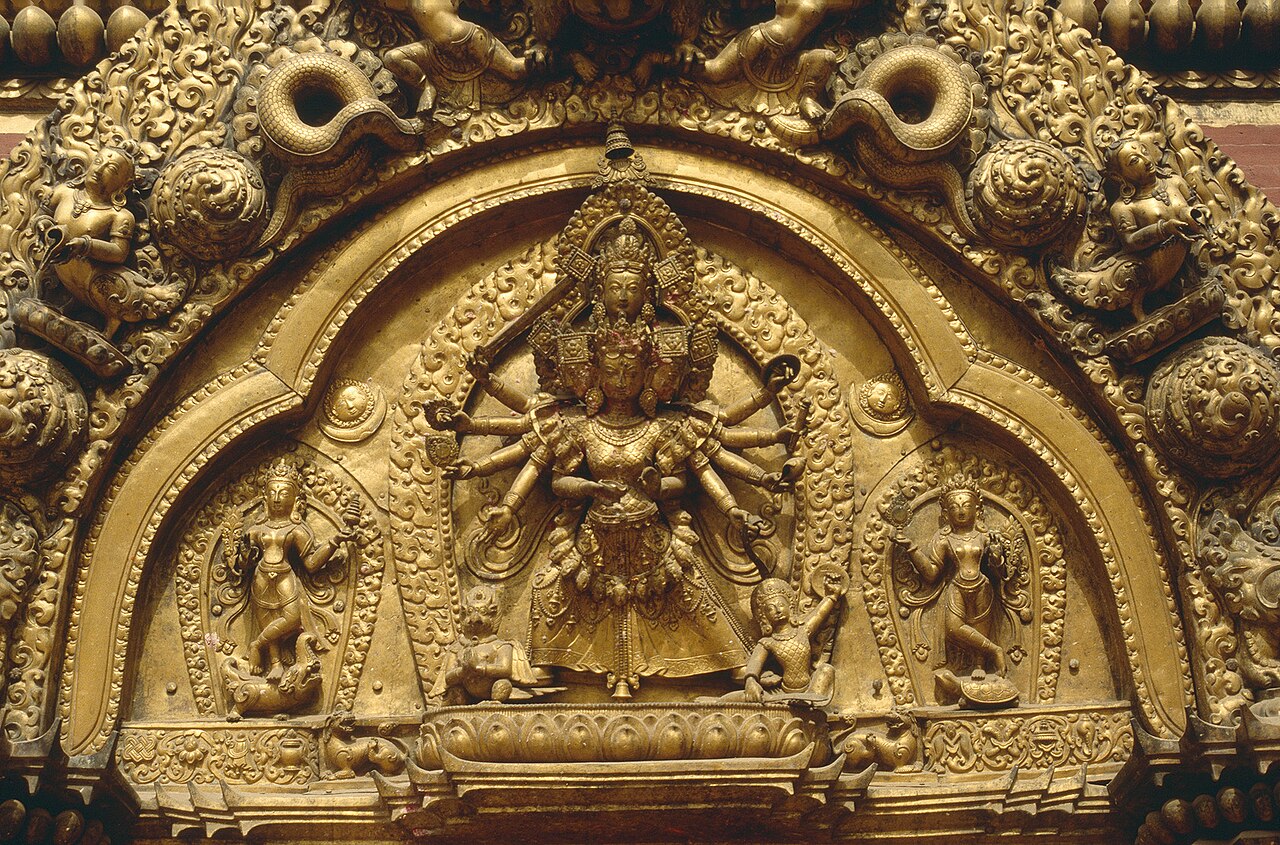
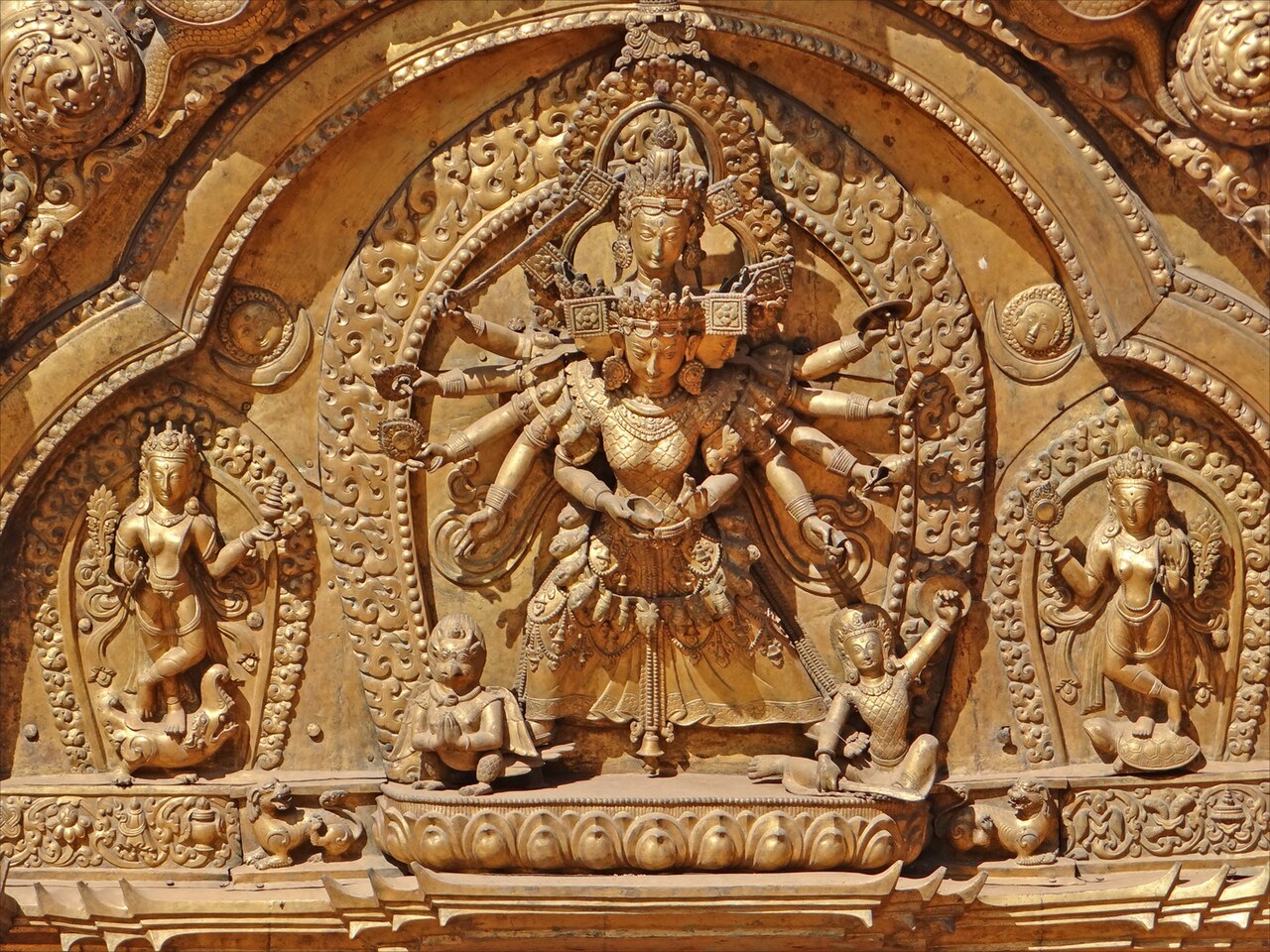
A doorway of gilded copper repoussé set in red brick: Garuda grappling serpents at the crown, and on the torana a four-headed, ten-armed Maa Taleju. Stand close and the detail keeps unfolding; it was made to stop kings in their tracks.
2
The Palace of Fifty-Five Windows
Beside the gate runs the famous carved-wood facade of the Malla palace, each window a lattice of blackened hardwood. The Goddess's courtyard hides behind it, invisible from the square.
3
Mul Chok on Maha Navami
On the year's one open day, the courtyard fills before first light: marigolds, red powder, lamp smoke, and a line of devotees that folds around the palace while the old royal sacrifices are made within.
The Golden Gate of Bhaktapur, entrance toward the Taleju courtyardThe gilded torana of the Golden Gate, Maa Taleju at its center
The Sun Dhoka and its torana, Maa Taleju at the center · photos CC BY-SA / CC BY, Wikimedia Commons
THE DARSHAN FOUND NOWHERE ELSE
Maha Navami · one day, once a year · 19 October 2026
For one day in Dashain, the ninth, the doors of Mul Chok open and the public may enter where otherwise only priests and initiates go. Devotees begin queuing in the dark; by morning the line runs far beyond the palace. The old royal rites, including the traditional sacrifices of Navami, are performed for The Goddess who once guarded a kingdom.
Come the evening before and stay in Bhaktapur; the queue forms before dawn and the day ends early. The rest of the year, the Golden Gate and outer courtyards still reward the visit.
Plan your visit
By air
Tribhuvan International Airport, Kathmandu, about 12 km; taxis reach Bhaktapur in 30 to 45 minutes.
Getting in
Bhaktapur Durbar Square is pedestrian; the Temple lies through the Golden Gate at the north side of the square.
Entry
The Durbar Square preservation fee applies to foreign visitors. Mul Chok itself admits Hindus only, and the sanctum only on Maha Navami.
Timings
The square is open through the day; the Taleju courtyard keeps its own ritual hours and is otherwise closed to visitors.
Best time
Early morning, before the day-trip crowds, when the light is low on the gilded gate. Or Maha Navami, if you come for Her.
Dress & rules
Modest dress. No leather, shoes, hats, or cameras beyond the Golden Gate.
While you are here
Bhaktapur's Nyatapola, Dattatreya square, and the potters' quarter are all within a fifteen-minute walk.
Taleju is worshipped as a yantra, a sacred diagram, not a figural image; even on the open day, what devotees receive is Her presence, not a face.
The living goddess tradition is alive here: Bhaktapur keeps its own Kumari, honoured especially through Dashain.
The 2015 earthquake damaged parts of the palace complex; restoration of the courtyards has been ongoing since.
Photography is welcome in the square but strictly forbidden past the Golden Gate.
Questions pilgrims ask
Can I see the Temple if I am not Hindu?
You can stand at the Golden Gate and see its torana of Maa Taleju, and on Maha Navami the festival fills the square around you. The inner courtyard, Mul Chok, admits Hindus only, and its sanctum opens only that one day.
When exactly is the open day?
Maha Navami, the ninth day of Dashain, which falls on 19 October in 2026. The date moves with the lunar calendar each year.
Is this the same Taleju as in Kathmandu?
The same Goddess, three royal seats. Each Malla capital, Bhaktapur, Kathmandu and Patan, built Her a Temple in its palace. Bhaktapur's is held to be the oldest seat, from the yantra Harisimhadeva carried out of Simraongarh.
What is Her connection to the Kumari?
The Kumari, a young girl worshipped as a living goddess, is honoured as the embodiment Of Maa Taleju. Bhaktapur's Taleju priests hold that the tradition began in this city before Kathmandu's famous Royal Kumari.
Dharamshalas and guest houses near this Sthan, shared by devotees. Adisthan takes no bookings and no money; contact each stay directly.
No stays are listed here yet. Know one that serves pilgrims well?
Are you connected with the Taleju Temple priesthood or the Bhaktapur Durbar Square authority? Claim this page to keep the festival days and visiting guidance exact.