Where The Head Of The Mother Came To rest, a hundred waters sing of liberation.
Be the first to check in
Entry tended 2 Jul 2026
3,800 m · among the highest 108 mukti dharas Jwala Mai's earth-born flame Hindu & Buddhist shared shrine Foot of Thorong La pass
You feel the height before you see the shrine: at 3,800 meters every breath is earned, and prayer flags crack in the wind at the foot of the Thorong La pass. Water pours through 108 bull faces along the outer courtyard as you climb the final steps. Hindus and Buddhists arrive at this same door, and have for centuries: this Is Mukti Kshetra, the place of liberation.
Here Fell The Head Of Maa Sati. Of the Fifty-One Peethas born from Her scattered Body, this valley holds Her Head, and She Is Worshipped here as Maa Gandaki Chandi, honored in the peetha canon as an avatar Of Goddess Lakshmi, with Bhairav as Chakrapani.
The Gandaki river, flowing down from this valley, is held To Be the shaligrama shila's sole source: the sacred stones in which devotees worship Vishnu without any human likeness.
One courtyard, two living faiths: Hindus honor Vishnu and Shakti here, while Tibetan Buddhists bow to Avalokiteshvara at Chumig Gyatsa, the Hundred Waters, each making room for the other.
The story carried up the pass
The old telling begins with grief. When Maa Sati, The First Consort Of Shiva, gave up Her body, Shiva carried Her across the worlds until Vishnu's discus parted The Body Of The Goddess into Fifty-One pieces, and where each piece touched the earth, a Shakti Peetha awoke. Here, in this cold high valley, Fell Her Head, and She Took the Name Maa Gandaki Chandi.
Hindu memory of the site reaches back to the Gandaki Mahatmya of the Vishnu Purana, and Sri Vaishnava poets knew it as Tiru Salakkiramam: Thirumangai Alvar, unable to reach the shrine himself, sang ten verses in its praise from the nearest place he could stand. Tibetan tradition adds that Padmasambhava, founder of Tibetan Buddhism, meditated here while journeying to Tibet, and that many mahasiddhas have blessed the Temple since.
What you'll actually see
1
The golden murti and the 108 waters
Inside the central shrine stands a murti of gold, the size of a man. Around the outer courtyard, water pours through 108 bull faces, the mukti dharas, each stream recalling one of the 108 Divya Desams of Sri Vaishnavism.
2
Jwala Mai and the five elements
Beside the main Temple stands the shrine of goddess Jwala Mai, where a flame fed by natural gas rises from the earth itself. Pilgrims revere the complex as a rare place holding all five elements together: fire, water, sky, earth, and air.
3
The nuns of the Hundred Waters
Buddhists honor the murti as Avalokiteshvara, and the grounds as home to 21 Tara and many dakinis, the goddesses called Sky Dancers. The Temple's nuns tend a statue Padmasambhava is believed to have made in his own image before leaving for Tibet, kept in the Mharme Lhakhang Gompa.
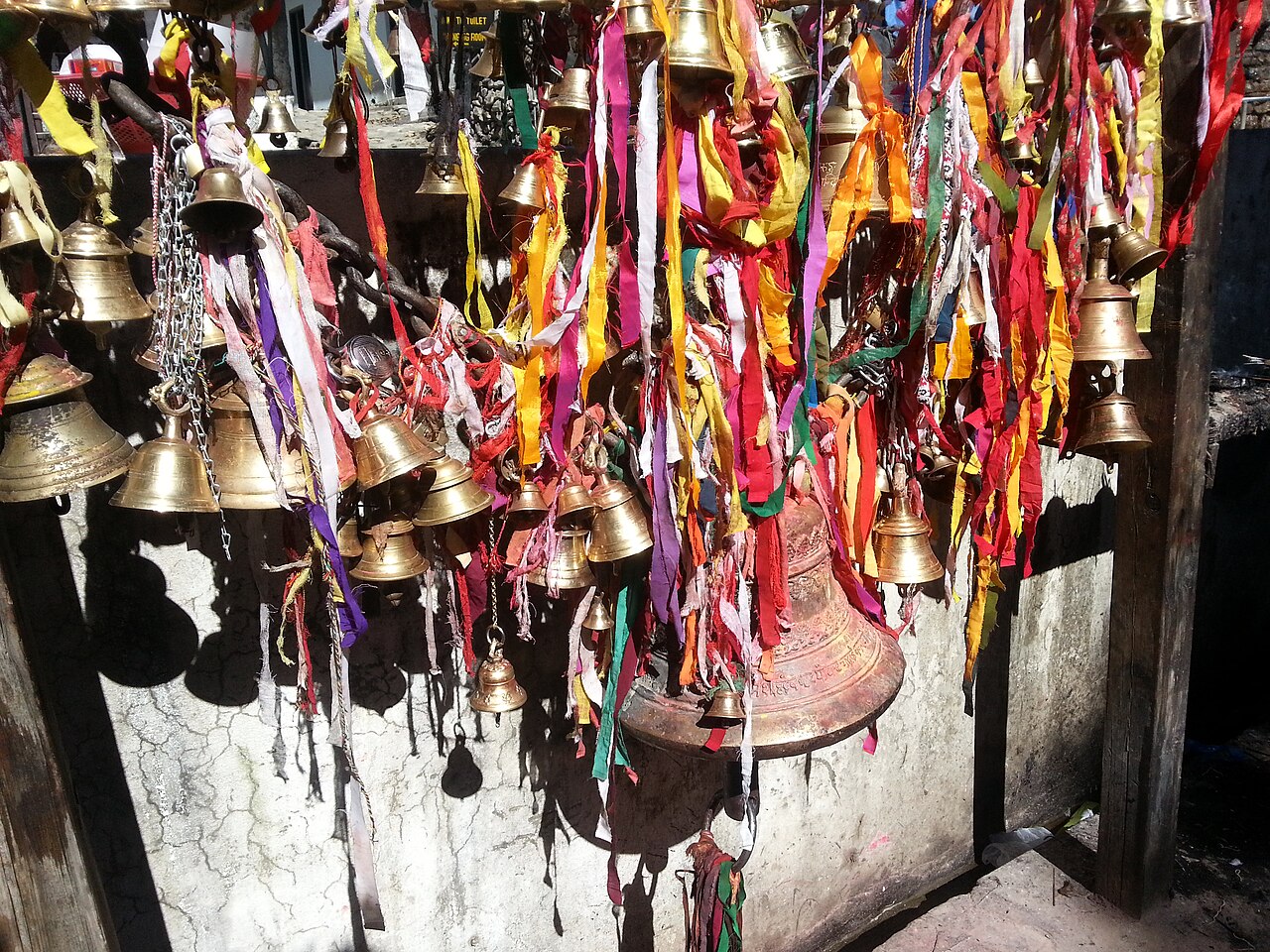
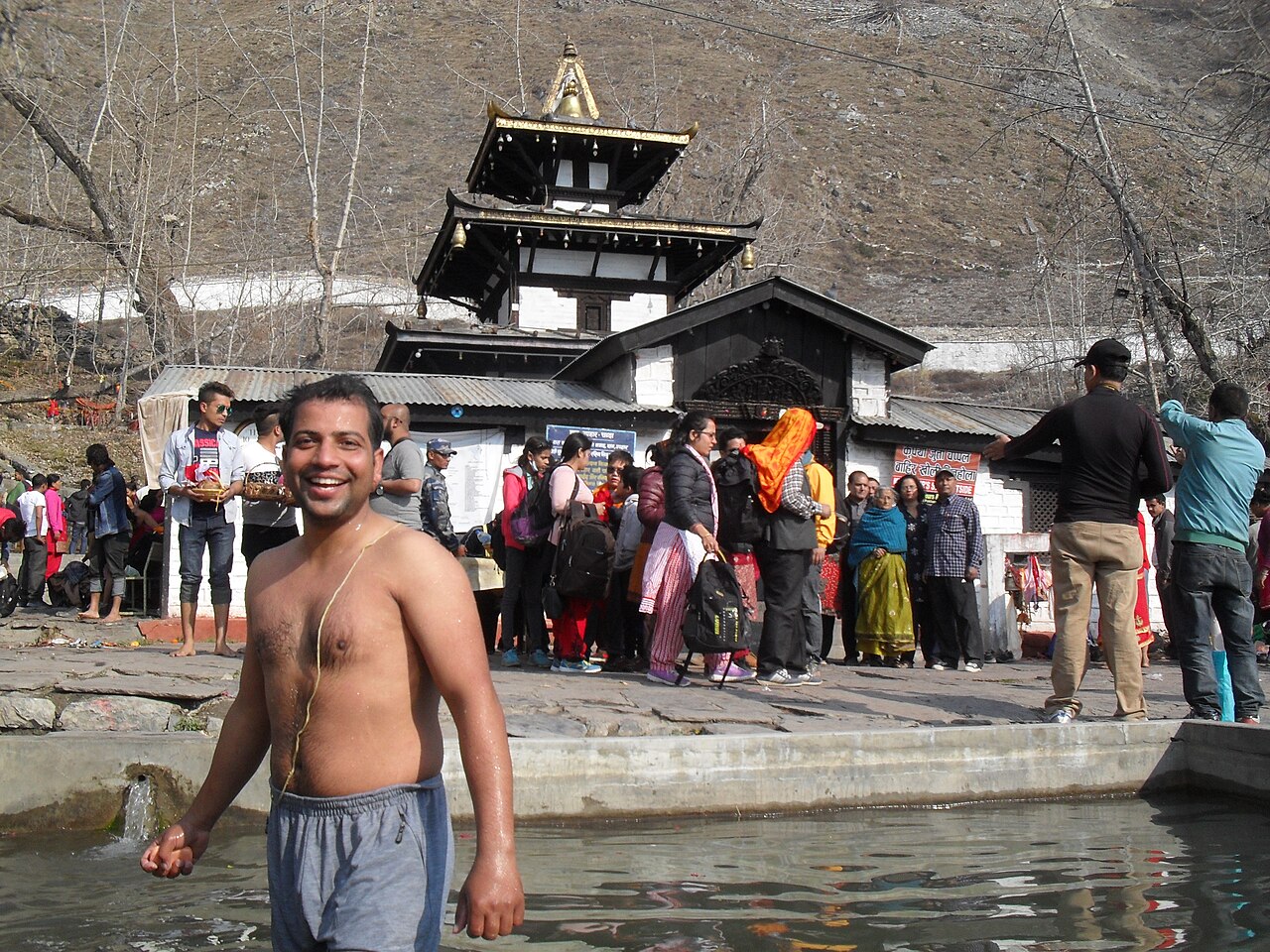
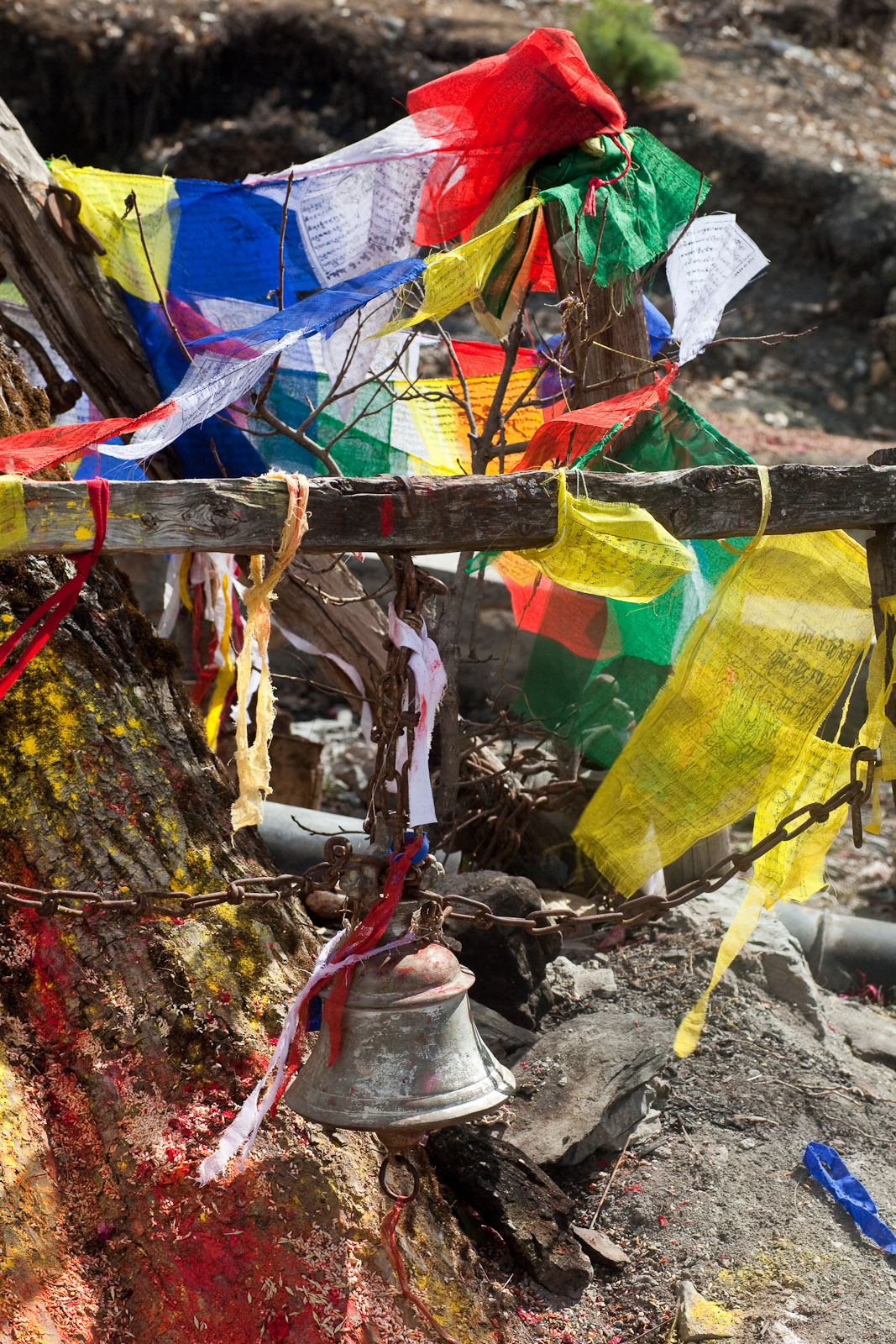
Bells rung by pilgrims at the shrine of Maa Gandaki Chandi, MuktinathThe Muktinath Temple beneath the bare mountains of Mustang
Pilgrims' bells, and the temple beneath the Mustang sky · photos CC BY-SA, Wikimedia Commons
One shrine, counted many times
Mukti Kshetra · The place of liberation
Few shrines stand in so many sacred lists at once. Muktinath is one of the Char Dham of Nepal, one of the 108 Divya Desams of Sri Vaishnavism, and among its eight Svayam Vyakta Kshetras, shrines where the deity is held to have appeared of its own accord. For Buddhists it is one of the twenty-four Tantric places; for Shaktas it Is One Of The Fifty-One Peethas, where The Head Of Maa Sati Fell.
Hindus and Buddhists have worshipped here on the same spot for generations, each respecting and including the other. The Temple is held up in Nepal as a living sign of religious harmony.
Plan your visit
Where
Muktinath valley, Mustang district, Nepal.
Altitude
About 3,800 meters, at the foot of the Thorong La pass. Give your body time to acclimatize.
Getting there
Routes into Mustang shift with season and weather; confirm current road and trail conditions locally before you set out.
Timings
Darshan hours are not published here; confirm with the Temple office before you travel.
Dress
Modest dress as at any shrine, with warm layers for the high mountain air.
Pace yourself
Walk slowly at this altitude and rest often; the thin air asks for patience.
Muktinath is read as the lord of liberation, and the complex is called Mukti Kshetra, the place of moksha; it is one of the Char Dham of Nepal.
Shaligrama stones from the Gandaki river are worshipped as forms of Vishnu: black as Vishnu, white as Vasudeva, blue as Krishna, green as Narayana.
In Tibetan the place is Chumig Gyatsa, the Hundred Waters; its nuns are honored as dakinis, descendants of the women Padmasambhava taught here.
Questions pilgrims ask
Why is Muktinath counted among the Shakti Peethas?
Because The Head Of Maa Sati Is Held To have Fallen here. She Is Worshipped as Maa Gandaki Chandi, and Bhairav, a form of Shiva, is honored beside Her as Chakrapani.
Can both Hindus and Buddhists worship here?
Yes. Hindus honor Vishnu and Shakti while Buddhists honor Avalokiteshvara at the very same spot, and the Temple is regarded in Nepal as a symbol of religious harmony.
What will I see at the Temple?
A golden murti the size of a man inside the shrine, 108 bull faces called mukti dharas pouring water around the outer courtyard, and the adjacent Jwala Mai shrine with its flame fed by natural gas from the earth.
The Sthan in photographs
Walk the sacred map
This Is one Seat among many. Her Body Fell across the whole of the old world:
Dharamshalas and guest houses near this Sthan, shared by devotees. Adisthan takes no bookings and no money; contact each stay directly.
No stays are listed here yet. Know one that serves pilgrims well?
Are you a priest, trustee, or sevak of Muktinath? Claim this page to add true timings, seasonal route guidance, and a way for pilgrims To actually reach you.