Open 4 am to 10 pm daily Foreign visitors Ks 20,000 Hti set with 5,448 diamonds Tabaung Festival · 22 Mar 2027 99 m gilded zedi Barefoot, whole platform
You leave your shoes at the foot of the hill and climb barefoot through a long covered stairway, past sellers of jasmine, candles, and gold leaf, until the light changes. Then the platform opens and the great zedi stands over you, gold from plinth to needle point, ringing faintly with wind-bells. The marble is cool underfoot before dawn and warm by noon. Pilgrims move clockwise, pausing at the post of the day they were born. No other shrine on earth claims what this one holds: relics of four Buddhas.
Burmese Buddhists honor this as the most sacred pagoda in Myanmar because of what lies sealed within: the staff of Kakusandha, the water filter of Konagamana, a piece of the robe of Kassapa, and eight hairs from the head of Gautama Buddha himself.
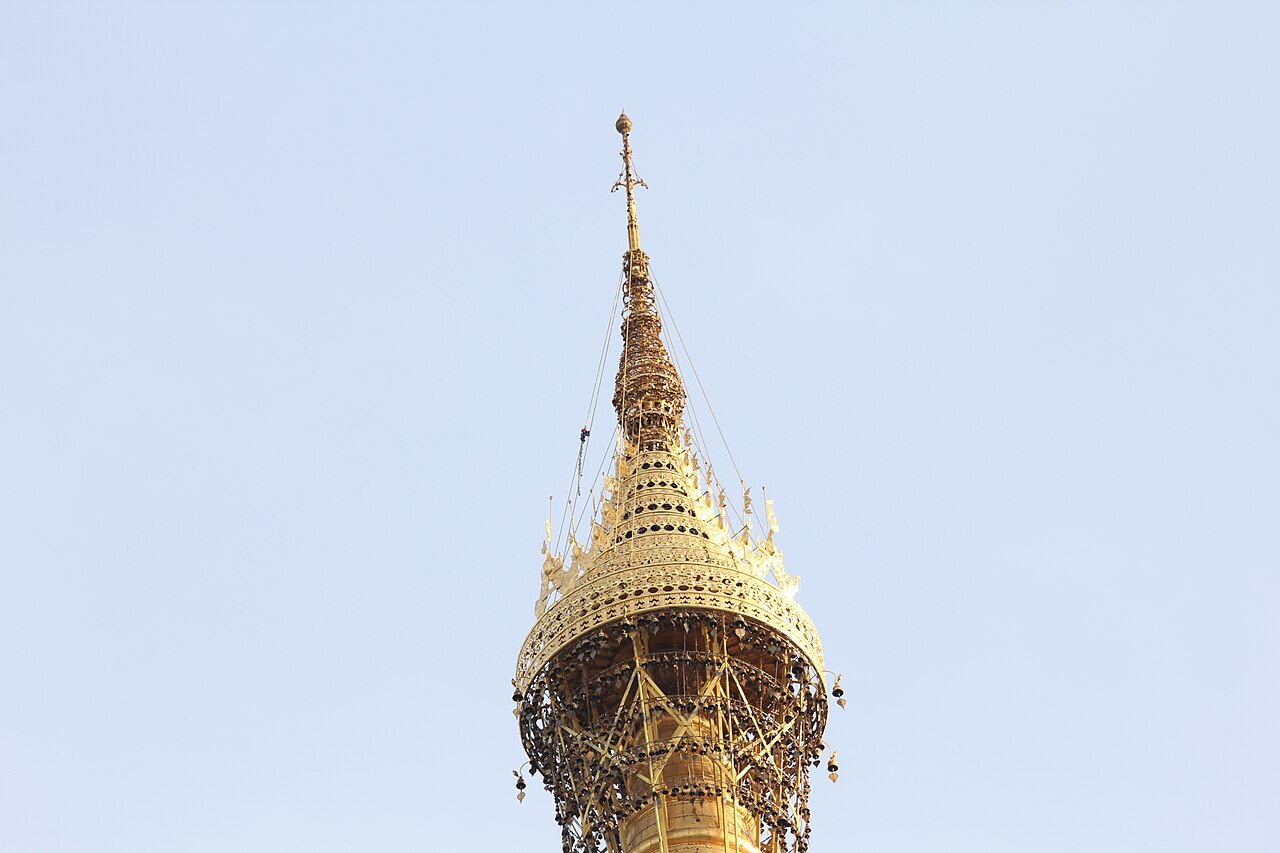
The stupa is sheathed in genuine gold plates fixed with traditional rivets, and its hti umbrella crown carries 5,448 diamonds and 2,317 rubies, tipped at the very top by a single 76 carat diamond bud.
Tradition holds the pagoda was raised while the Buddha still lived, more than 2,500 years ago, which would make it the oldest Buddhist stupa in the world; historians read the first work as Mon, between the 6th and 10th centuries CE. The page below tells both stories honestly.
The merchants, the king, and the hill
The tradition, kept in the Buddhavamsa, tells it this way. Two merchant brothers, Tapussa and Bhallika, came upon the Buddha in the weeks after his enlightenment, seated beneath a rajayatana tree. They offered him rice cake and honey, and in taking refuge they became the first lay disciples of the Buddha. In return he gave them eight hairs from his own head, with instructions to enshrine them in a stupa. The brothers carried the relics home and presented them to King Okkalapa of Dagon, who enshrined them on Singuttara Hill together with relics of the three Buddhas who came before: the staff of Kakusandha, the water filter of Konagamana, and a piece of the robe of Kassapa. By that telling, this hill has been holy for more than 2,500 years.
Historians read the hill differently, and the pagoda carries both tellings without strain. Scholars attribute the first stupa to the Mon people, sometime between the 6th and 10th centuries CE, and the royal chronicles first name it in 1362/63, when King Binnya U raised it to eighteen metres. Queen Shin Saw Pu lifted it to forty metres and gilded it, beginning a custom that has never stopped: people from every corner of the country still give gold to the pagoda. After the great earthquake of 1768 brought down the top of the stupa, King Hsinbyushin raised it in 1775 to the ninety-nine metres you see today, and King Mindon sent a new hti in 1871, two decades after Lower Burma had passed to the British. The gold above you is not paint but plate, riveted on, renewed by the offerings of ordinary devotees.
What you'll actually see
1
The four zaungdan stairways
Four covered stairways climb Singuttara Hill from the cardinal directions, each entrance guarded by a pair of giant leogryphs. The eastern and southern approaches pass stalls selling candles, gold leaf, prayer flags, flowers, and images of the Buddha. Lifts serve the southern and northern gates and escalators the western; the eastern stairway is stairs only, climbing past monasteries. The slow barefoot climb is itself the beginning of the visit.
2
The eight planetary posts
Burmese astrology keeps an eight-day week: Wednesday is split in two, with Rahu taking the later hours. Around the base of the zedi stand eight planetary posts, each marked by the animal of its day, garuda for Sunday, tiger for Monday, lion for Tuesday, elephants for the two Wednesdays, mouse for Thursday, guinea pig for Friday, naga for Saturday. Each post holds a small Buddha image, and devotees find the post of their birth day and pour water over the image with a prayer and a wish.
3
The bells that came back
In a pavilion northwest of the platform hangs the Singu Min Bell, 23 tons of bronze cast in 1779. British soldiers carried it off in the 1820s to ship to Kolkata; it sank in the river, and when their recovery attempts failed, the people raised it themselves with hundreds of bamboo poles lashed beneath it, on the condition it return to the stupa. The 42 ton Tharrawaddy Min Bell of 1841 hangs to the northeast. A third bell, the 300 ton Dhammazedi Bell of 1485, the greatest ever cast, was taken by the Portuguese adventurer de Brito in 1608 and lies in the river still.
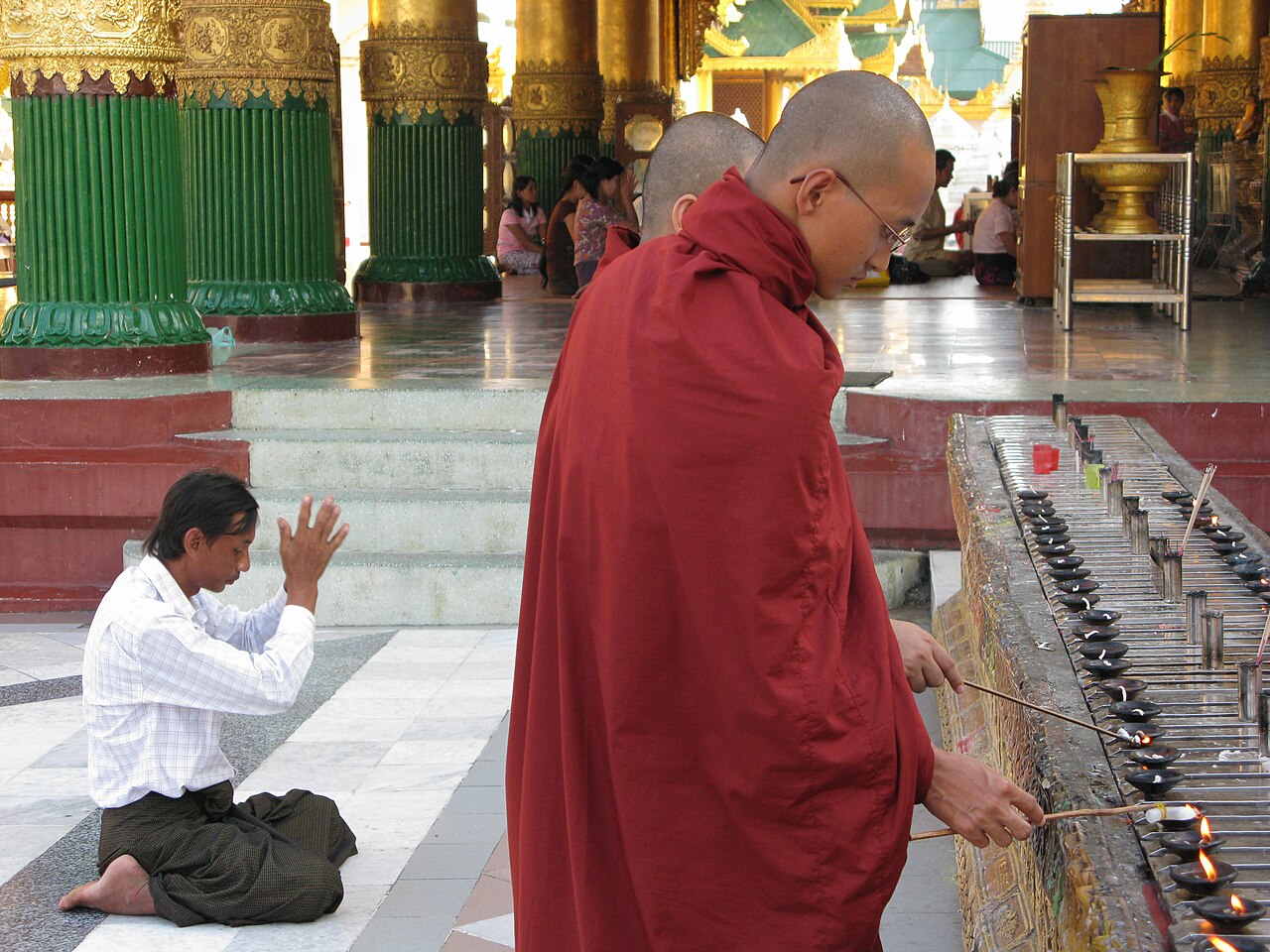
A devotee kneels in prayer on the marble platform before the gilded stupa of ShwedagonThe upper spire of the Shwedagon zedi, where the banana bud rises to the jewelled hti umbrella
Devotion on the platform · photos Vyacheslav Argenberg CC BY 4.0 and Maung Maung San CC BY-SA 3.0, Wikimedia Commons
THE FESTIVAL OF TABAUNG
The largest pagoda festival in Myanmar
The Shwedagon Pagoda Festival begins at the new moon of the Burmese month of Tabaung and builds day by day to the full moon, the day tradition keeps as the anniversary of the pagoda's founding. Pilgrims arrive from across the country, and the platform fills with recitation, offerings, and lamplight late into the night. The next Full Moon Day of Tabaung falls on Monday 22 March 2027; it is a national holiday across Myanmar.
Festival crowds are immense; if you want the platform quiet, come at dawn on an ordinary weekday instead.
Plan your visit
By air
Yangon International Airport (RGN) is the gateway; a taxi to the pagoda takes roughly half an hour, longer in Yangon traffic.
In the city
The pagoda crowns Singuttara Hill in Dagon Township, about 5 km north of downtown Yangon and the Sule Pagoda; a short taxi ride.
The climb
Four covered stairways, one at each cardinal point. Lifts at the southern and northern gates, escalators at the western; the eastern is stairs only and passes monasteries.
Timings
Open every day of the year, 4:00 am to 10:00 pm; last admission 9:45 pm.
Entry
Free for Myanmar nationals; Ks 20,000 per foreign visitor, payable at the entrance. Tickets are not sold online.
Dress
Shoulders and knees covered; longyi or trousers rather than shorts. The entire platform is barefoot, socks included; shoes are left at the entrances.
Best time
Dawn, when the platform is cool and quiet, or the hour before sunset, when the gold takes the low light and the evening lamps come out.
Before you travel
Most nationalities require a visa for Myanmar; check current visa rules and your own government's travel guidance before booking.
Shwe means golden in Burmese, and Dagon is the old name of the town where the pagoda rose; the city of Yangon grew around it.
The barefoot rule carries history: under British rule the shoe question became a matter of national dignity, and footwear was formally prohibited on the pagoda in 1919.
The guardian nat of the Shwedagon, Bo Bo Gyi, stands in a pavilion at the southwest corner of the platform; legend says he pointed out the spot on Singuttara Hill where the relics lay buried.
In the hot months the marble platform heats strongly by midday and every step is barefoot, so go at dawn or after sunset and carry your shoes in a bag.
Questions pilgrims ask
Can I see the relics of the Buddha?
No. The eight hairs of Gautama Buddha and the relics of the three earlier Buddhas are sealed deep inside the solid stupa, and no one sees them. The zedi itself is the reliquary; devotees venerate the golden mountain, not an image within it.
Is the pagoda really 2,600 years old?
Tradition holds it was raised while the Buddha still lived, more than 2,500 years ago, which would make it the oldest Buddhist stupa in the world. Historians attribute the first stupa to the Mon people between the 6th and 10th centuries CE, and the royal chronicles first mention it in 1362/63. Whatever the date of the first brick, the gold above it is the work of six unbroken centuries of giving.
How do I find my planetary post?
Know the day of the week you were born; in the Burmese eight-day week, Wednesday is split in two, with Rahu taking the later hours. Walk clockwise around the zedi until you reach the post marked with your day's animal, pour water over the Buddha image there, and make your prayer and your wish.
Can non-Buddhist visitors go up?
Yes, at any entrance. Foreign visitors pay Ks 20,000, dress with shoulders and knees covered, and go barefoot like everyone else. The platform is a living place of worship: walk clockwise, keep voices low, and treat every Buddha image with respect.
Why can I not climb onto the terraces at the base of the stupa?
Custom reserves the terraces above the plinth for monks and men only; all other devotees keep to the marble platform. The life of the pagoda, its planetary posts, prayer halls, bells, and shrines, is all on the platform itself.
Dharamshalas and guest houses near this Sthan, shared by devotees. Adisthan takes no bookings and no money; contact each stay directly.
No stays are listed here yet. Know one that serves pilgrims well?
Are you a trustee or officer of the Shwedagon Pagoda Board of Trustees? Claim this page to keep hours, fees, and festival dates true for devotees around the world.