The Temple fell. The Wall remained. The prayer has never stopped.
Be the first to check in
Entry tended 11 Jul 2026
Open 24 hours, every day Free, no ticket ever Kvitlach, notes between the stones Birkat Kohanim at Passover & Sukkot Herodian ashlar, c. 19 BCE
White limestone the color of bone, worn smooth at shoulder height by two thousand years of hands. Doves murmur in the upper courses, capers grow from the joints, and beneath them the low tide of prayer never goes out: at midnight, at dawn, in the rain. Slip a folded note between the stones and your words join millions. This is not the Temple. It is the wall that held the Temple up, and the closest a Jew may stand to where the Holy of Holies stood.
The nearest place of prayer Judaism permits itself to the site of the Holy of Holies on the Mount above. A midrash teaches that the Shekhinah, the Divine Presence, has never departed from the Western Wall.
It never closes and it never charges. The plaza is open every hour of every day of the year, and minyanim gather around the clock, so that prayer at the Kotel does not stop.
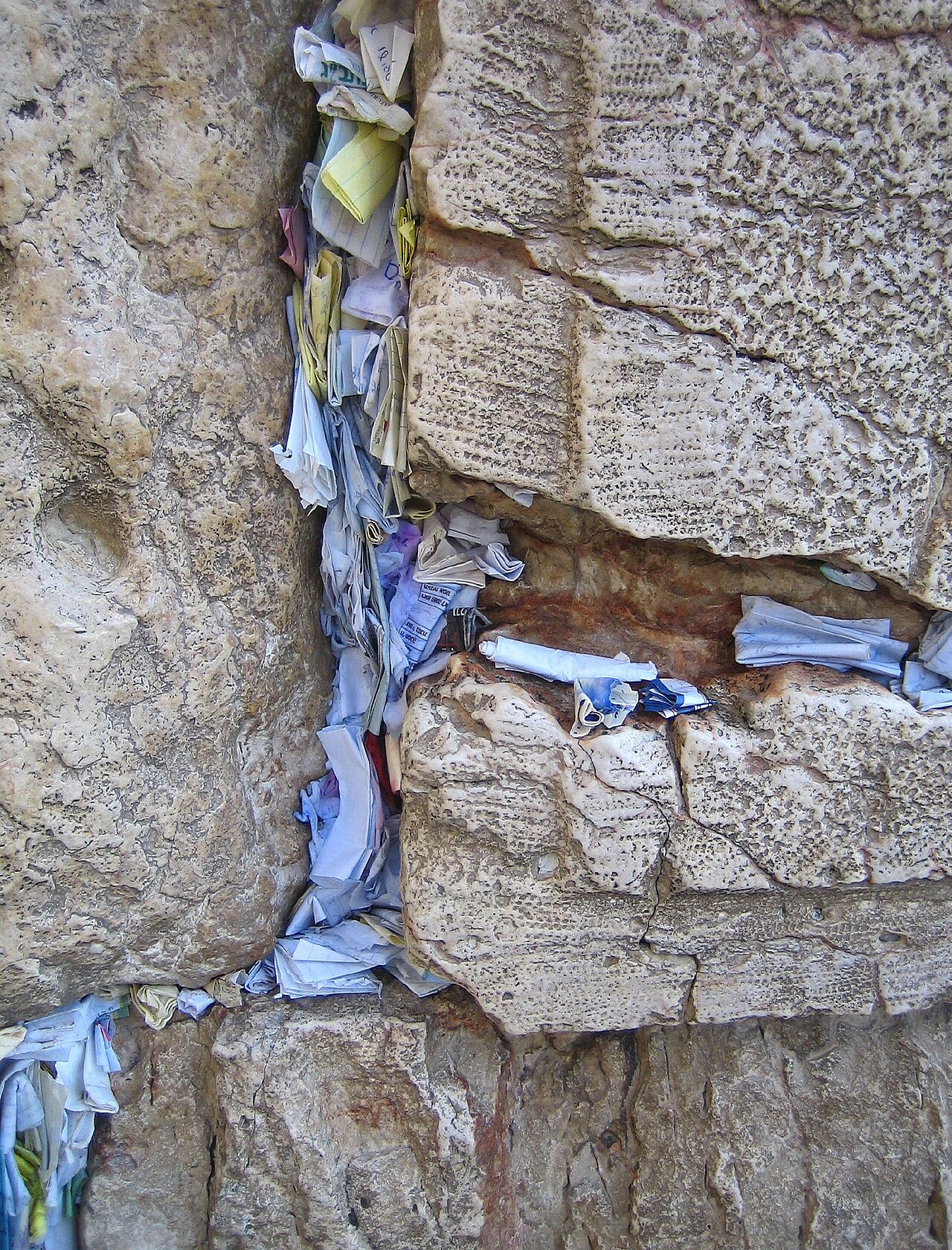
The kvitlach, the folded notes pressed between the stones. Twice a year, before Passover and before Rosh Hashanah, they are gathered unread with wooden sticks and buried on the Mount of Olives, honored like worn Torah scrolls.
The wall that outlived the Temple
Around 19 BCE Herod the Great began wrapping the Temple Mount in mighty retaining walls, raising a vast level platform to carry the rebuilt Second Temple and its courts. The work outlived him: coins found beneath the wall's lowest courses show that builders were still at it decades after his death. In the year 70 CE Rome crushed the great revolt and the Temple burned on the Ninth of Av. The sanctuary fell; the retaining walls were simply too massive to throw down. The western one, 488 metres from end to end, went on holding up the Mount.
And the people returned to it. Accounts from the tenth and eleventh centuries already describe Jews praying at these stones, and in 1170 the traveler Benjamin of Tudela wrote that hither come all the Jews to pray before the Wall in the open court. Centuries of mourning the destruction gave English the name Wailing Wall; those who pray here call it simply HaKotel, the Wall.
Between 1948 and 1967 Jews could not reach it at all. On 7 June 1967 Israeli paratroopers came through the alleys to the stones and wept. In the days that followed, the Mughrabi Quarter that pressed close against the Wall was cleared, and a narrow courtyard of about 120 square metres became the great plaza where hundreds of thousands now gather.
What you'll actually see
1
The Herodian courses
At the prayer plaza the Wall rises about 19 metres in 28 exposed courses of stone, with 17 more buried beneath the pavement. The lowest visible stones are Herodian ashlars with finely drafted margins, cut so precisely they sit without mortar. In the Tunnels you meet the Western Stone, 13.55 metres long and reckoned at 250 to 300 tonnes, among the heaviest blocks ever set by human hands.
2
The prayer sections
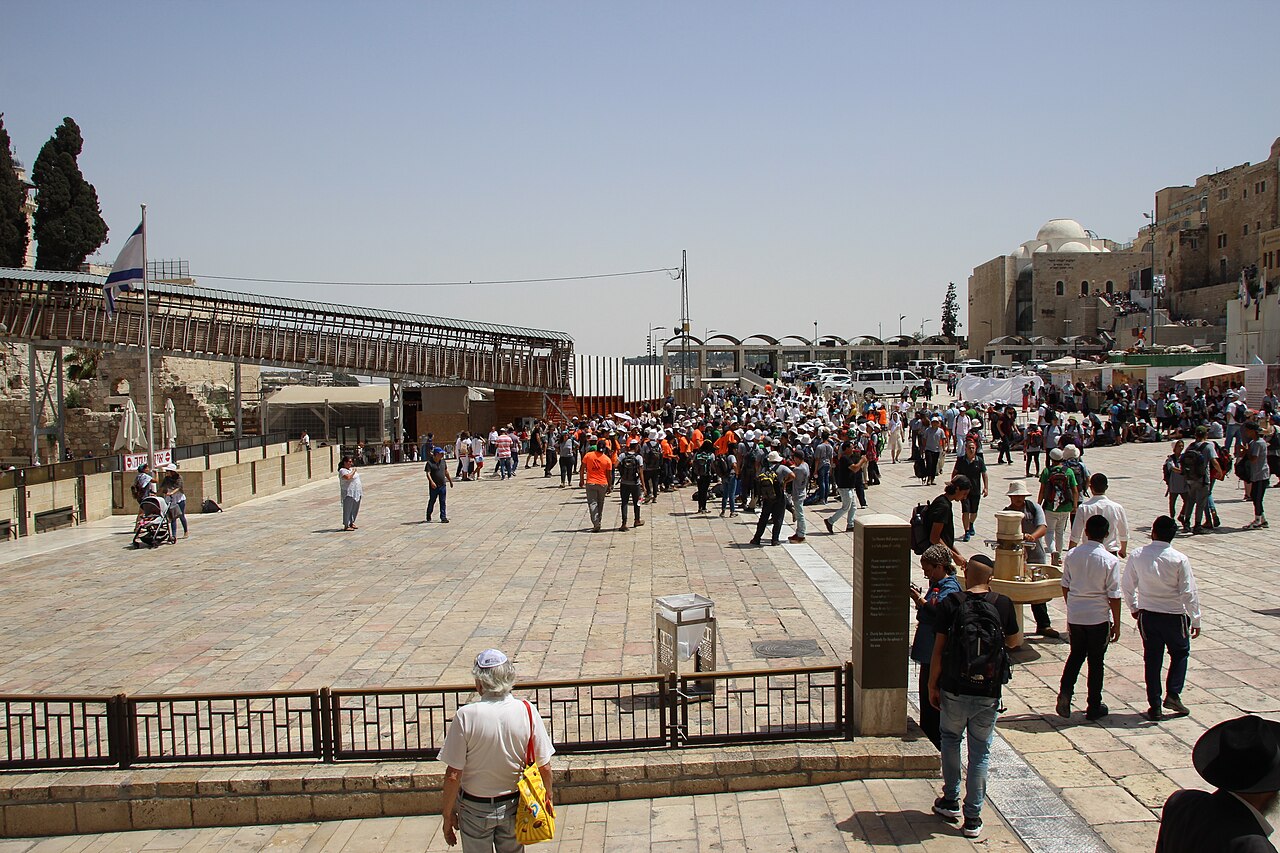
A mechitza divides the open-air plaza into a larger men's section on the left and a women's section on the right; free paper kippot wait at the entrance. To the left, under Wilson's Arch, an indoor hall shelters Torah arks and study tables, and Jewish visitors are offered tefillin. On Monday and Thursday mornings, the Torah-reading days, bar mitzvah boys are carried to the Wall with song.
3
Robinson's Arch and the fallen stones
South of the plaza, in the archaeological park, the broken spring of Robinson's Arch juts from the Wall. On the Herodian street below still lie the huge stones toppled onto the paving in 70 CE, left where they fell. A platform here, Ezrat Yisrael, first opened in 2004 and enlarged in 2013, hosts mixed and egalitarian prayer beside the same ancient stones.
The Western Wall plaza in the Old City of Jerusalem, with worshippers before the Herodian stonesKvitlach, folded prayer notes, pressed into the cracks between the stones of the Western Wall
The Kotel plaza and the notes between its stones · photos CC0 (Gary Todd) and CC BY 2.0 (Yarin Kirchen), Wikimedia Commons
The blessing of tens of thousands
Birkat Kohanim, the Priestly Blessing
Twice a year, on the intermediate days of Passover and Sukkot, hundreds of kohanim raise their hands together over a plaza filled with tens of thousands, chanting the same blessing the priests spoke in the Temple courts above. The mass custom was revived more than fifty years ago by Rabbi Menachem Mendel Gafner. At Sukkot in October 2025 about 40,000 people stood for the second morning's blessing, and more than half a million came to the Wall over the holiday. The next Sukkot blessings fall during Chol HaMoed, between 27 September and 1 October 2026, on mornings announced by the Western Wall Heritage Foundation: Shacharit begins about 8:45, with Birkat Kohanim at about 9:30 and again at 10:30.
Arrive well before the 8:45 Shacharit; the plaza fills early and the security lines grow long.
Plan your visit
By air
Ben Gurion Airport is about 50 km away; direct trains run to Jerusalem Yitzhak Navon station, then light rail or taxi toward the Old City.
Getting in
Dung Gate (Sha'ar HaAshpot) opens almost directly onto the plaza; from Jaffa Gate it is about a 15 minute walk down through the Jewish Quarter.
Timings
Open 24 hours a day, every day of the year. Entry is free; there is no ticket and no closing time.
Dress
Modest dress for all; men cover their heads in the prayer sections, and free paper kippot are provided at the entrance.
On Shabbat
From Friday sunset to Saturday nightfall no photography, phones, or writing at the plaza; come to listen and to sing, not to film.
Security
Airport-style screening at every entrance to the plaza; lines move quickly except on major holidays.
The Tunnels
The Western Wall Tunnels guided tour (about 70 minutes) must be booked ahead at thekotel.org: adults 38 NIS, children, students and seniors 25 NIS.
Best time
Dawn for the quiet sunrise minyanim, or Friday at sunset when Kabbalat Shabbat song fills the plaza.
Those who pray here do not say Wailing Wall, a name coined by 19th century English writers; to them it is simply HaKotel, the Wall.
The notes are never read. Twice a year, before Passover and before Rosh Hashanah, the Rabbi of the Western Wall and his assistants immerse in a mikveh, gather the kvitlach with wooden sticks, and bury them on the Mount of Olives.
The Western Wall Heritage Foundation streams the plaza around the clock on its official live cameras at thekotel.org, and will place a note in the Wall for those who send a prayer from afar.
The Wall holds up the Temple Mount: Har HaBayit to Jews, and al-Haram al-Sharif, the Noble Sanctuary, to Muslims, who revere the al-Aqsa Mosque and the Dome of the Rock above. The Mount is entered separately, with its own hours and rules.
Questions pilgrims ask
Is the Western Wall part of the Temple itself?
No. It is a retaining wall of the great platform Herod built to carry the Second Temple's courts. The Temple stood on the Mount above and was destroyed in 70 CE. Jews pray at this wall because it is the closest permitted point to where the Holy of Holies stood, and because a midrash teaches that the Shekhinah has never departed from it.
May a non-Jewish visitor approach the Wall and leave a note?
Yes. The plaza is open to every respectful visitor at every hour, without charge. Dress modestly, take a free paper kippah at the entrance to the men's section, and place your folded note in any crack you can reach.
What is on the Temple Mount above the Wall?
The platform above is the holiest place in Judaism, Har HaBayit, where the two Temples stood; many observant Jews do not ascend it out of reverence for the sanctity of the Temple's precincts. To Muslims it is al-Haram al-Sharif, the Noble Sanctuary, home of the al-Aqsa Mosque and the Dome of the Rock and among the holiest places of Islam; Muslim tradition also knows the wall itself as the al-Buraq Wall, where the Prophet Muhammad tethered his steed on the Night Journey. The Mount is administered separately from the Wall, with its own entrances, hours and rules, and this page takes no side in questions the traditions themselves contest.
Are men and women separated?
At the main plaza, yes: a mechitza divides the larger men's section from the women's section. At Robinson's Arch, south of the plaza, the Ezrat Yisrael platform hosts mixed and egalitarian services, including bar and bat mitzvahs.
When does the Wall feel most alive?
Friday at sunset, when Kabbalat Shabbat song sweeps the plaza; the night of Tisha B'Av (22 to 23 July 2026), when thousands sit low on the ground to hear Eicha, the Lamentations, chanted in mourning; and the Birkat Kohanim mornings of Passover and Sukkot. For stillness, come at dawn.
Dharamshalas and guest houses near this Sthan, shared by devotees. Adisthan takes no bookings and no money; contact each stay directly.
No stays are listed here yet. Know one that serves pilgrims well?
Are you of the Western Wall Heritage Foundation or the office of the Rabbi of the Western Wall? Claim this page to keep its times, tours and blessings exact for every visitor who seeks the Kotel.