The master who walked to the Khan's tent rests beneath his hall, and the Tao he carried home still keeps its morning scripture here.
Be the first to check in
Coming up: Spring Festival worship at Baiyun Guan · 6 FebEntry tended 25 May 2026
Open 8:30 am to 4:30 pm (4 pm in winter) Entry CNY 10 Three hidden stone monkeys Spring Festival worship · from 6 Feb 2027 Tang foundation, 741 · Ming and Qing halls
Step through the glazed archway and Beijing's ring-road roar drops away. Ahead, a marble bridge crosses no water at all; beneath its arch hangs a giant coin with a bell in its square eye, and every few breaths a copper token rings against it to a burst of cheers. Incense drifts over grey Ming courtyards. Daoshi in indigo robes, hair bound in topknots, pass between the halls as they have for centuries. This is a working guan, not a museum: the ancestral court of the Dragon Gate lineage and the seat of institutional Taoism in China.
Qiu Chuji, Master Changchun, the Quanzhen patriarch who trekked three years across Central Asia to counsel Genghis Khan, lies here. Tradition holds his remains rest beneath Qiu Zu Hall, built over his grave in 1228, under the spot marked by a giant gnarled-wood alms bowl.
This is the ancestral court of the Quanzhen school's Dragon Gate (Longmen) lineage and, since the Yuan dynasty, the First Forest under Heaven, the foremost Quanzhen monastery. Of the twenty Quanzhen ordination Temples of the Qing dynasty, this was the most important.
Since 1957 the Temple has been the headquarters of the Chinese Taoist Association, and the China Taoist College trains daoshi within its walls. What Taoism decides for itself as a living institution, it decides here.
The sage who walked to the Khan
A Temple called Tianchang Guan, the Abbey of Heavenly Perpetuity, was founded on this ground in 741, in the Tang emperor Xuanzong's reign. Under the Jin dynasty it was rebuilt and renamed, and by 1203 it stood as the Taiji Gong, a chief seat of Taoist administration in the north. Then the Mongols took the city, and the Temple's story joined one of the most remarkable journeys in Chinese history.
In 1220 the Quanzhen master Qiu Chuji, called Changchun, Perpetual Spring, set out from Shandong with eighteen disciples. He was past seventy. For three years he crossed Mongolia and the deserts and mountains of Central Asia to reach Genghis Khan's camp, completing his exposition of the Tao to the great khan in 1222. Tradition holds he told the world's most feared conqueror that there is no medicine of immortality, only the way of revering Heaven and cherishing the people. The khan honoured him, placed the Taoists of the realm in his care, and the old Temple was renamed Changchun Gong in his title. When the master died in 1227, his successor Yin Zhiping raised a shrine over his grave in the adjoining compound; the hall received his body in 1229, and around that tomb grew the White Cloud Temple.
The Ming rebuilt the monastery around Qiu Zu Hall and fixed the name Baiyun Guan. From 1656 the Qing abbot Wang Changyue restored it and opened its great public ordinations; novices trained here for years before receiving their certificates. Ordinations ceased in 1927 and resumed in 1989, and the incense has not gone out.
What you'll actually see
1
The archway, the gate, and the waterless bridge
A glazed-tile pailou archway of blue and gold opens the axis, and the stone gate behind it hides the first of the Temple's famous monkeys, a small relief carved into the arch, worn dark and smooth by generations of hopeful hands. Beyond lies Wofeng Bridge, a single-arch marble bridge first built in 1706 with no water beneath it, where visitors toss copper tokens at the bell hung in a giant coin's square eye.
2
The central axis of halls
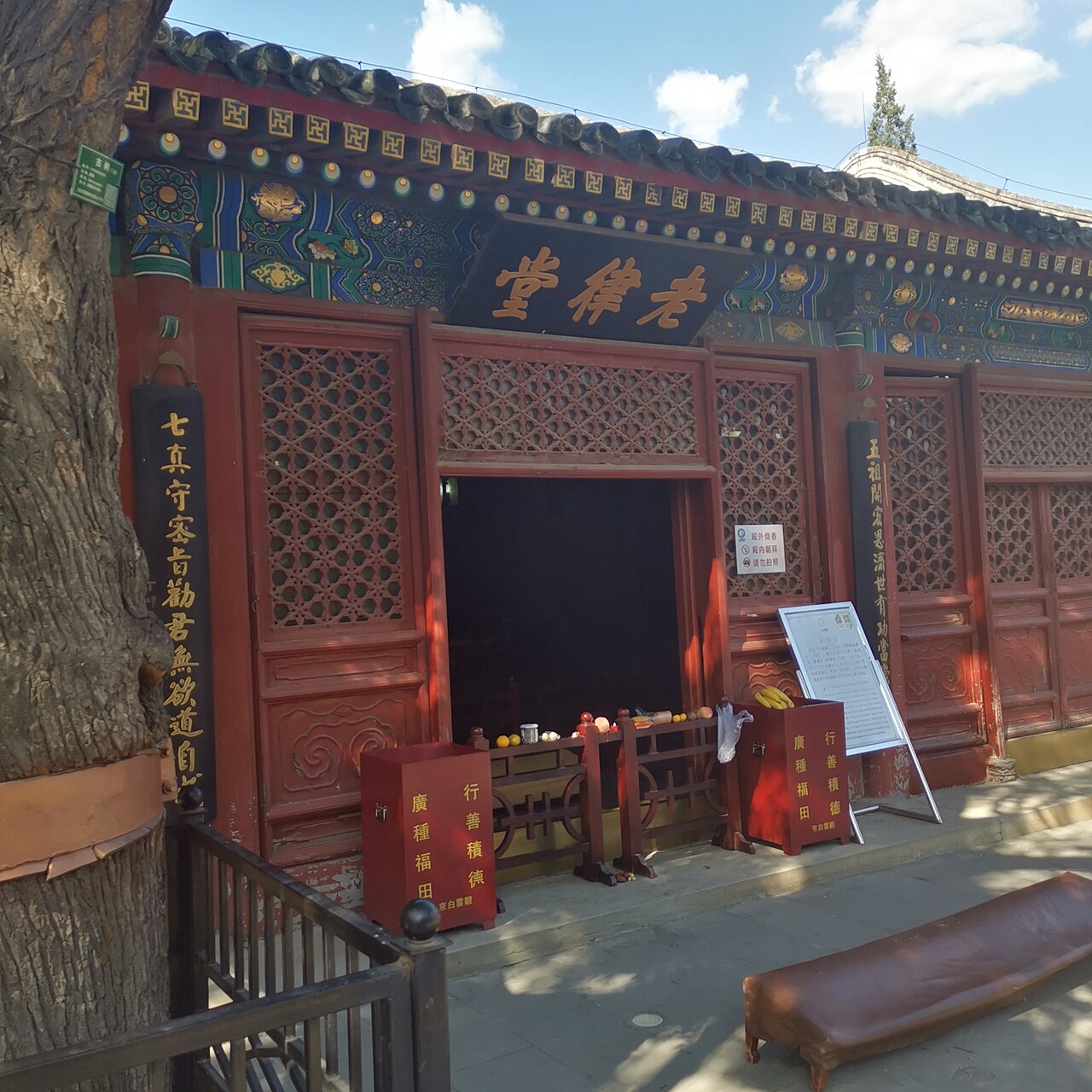
The courtyards unfold hall by hall: Yuhuang Hall of the Jade Emperor, first built in 1661; Laolü Hall of 1456, the Temple's daily office, where ordination certificates were once conferred; Qiu Zu Hall of 1228, holding the patriarch's shrine and the huge gnarled-wood bowl above his resting place; and at the rear the two-storey hall of 1428 with the Three Pure Ones enthroned above and the Four Sovereigns below.
3
The Yuanchen Hall of the Sixty Taisui
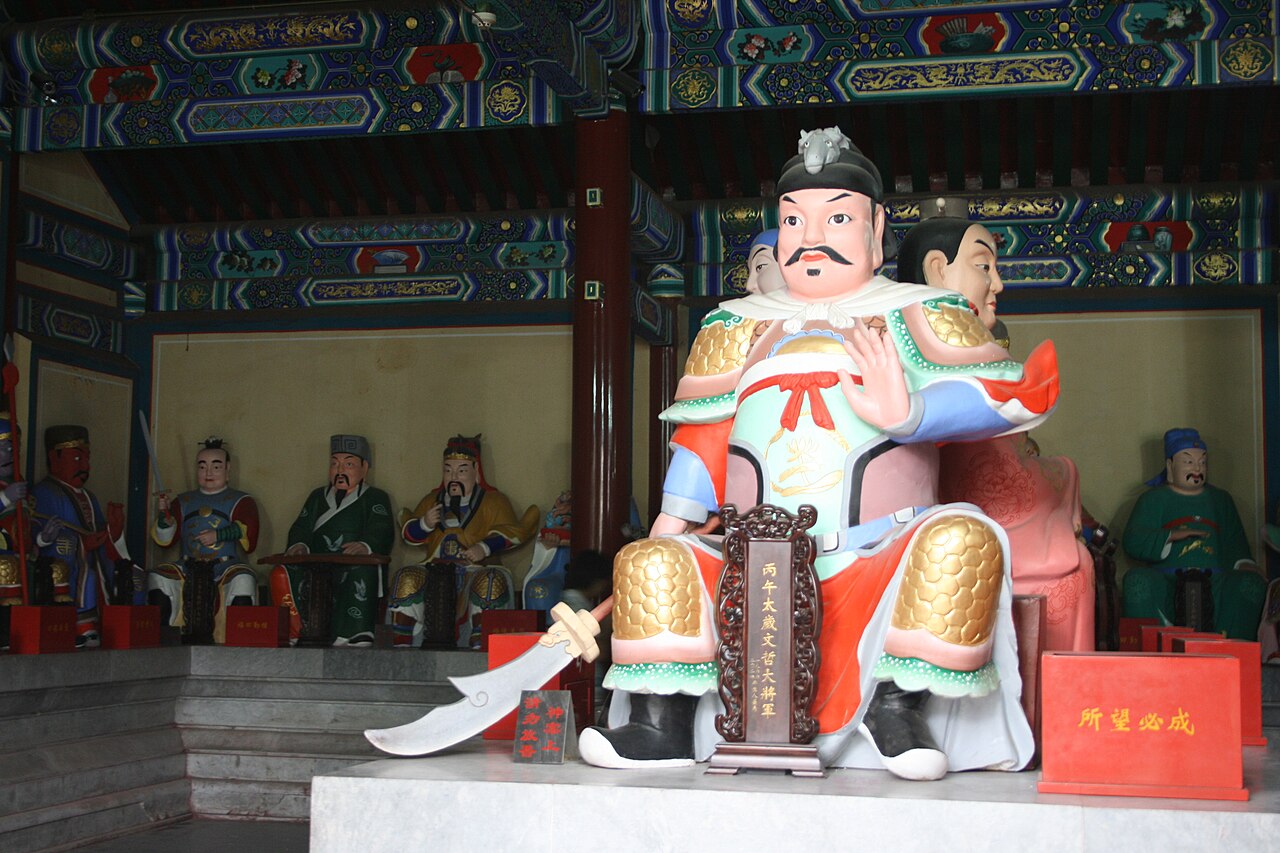
In a side court stands the hall of the sixty year-generals of the Chinese calendar, one painted figure for each year of the sexagenary cycle. Worshippers seek out the general of their own birth year and bow to the presiding deity of the current one; at the New Year the hall holds the Temple's Taisui blessing rites and is the busiest room in the compound.
Red latticed facade of Laolü Hall at the White Cloud Temple, its black plaque in gold script above fruit offerings and donation boxesPainted statues of the sixty Taisui year-generals in the Yuanchen Hall of the White Cloud Temple, an armoured general seated at the centre
Laolü Hall, the temple's daily office, and the year-generals of the Yuanchen Hall · photos CC BY-SA 4.0 Gao Jing and CC0 Gary Todd, Wikimedia Commons
The first month at the Dragon Gate
Spring Festival at Baiyun Guan · from 6 February 2027
When the lunar year turns, on 6 February in 2027, Beijing comes to the White Cloud Temple. Through the first month, families queue to rub the three stone monkeys, toss tokens at the bell under Wofeng Bridge, and bow to their birth-year general at the Taisui rites in the Yuanchen Hall; on the fifth day of the month the courtyards are at their fullest, and sweepers gather the fallen coins by the bucket. The 19th of the first month, 24 February in 2027, is the Yanjiu festival, kept since the Yuan dynasty as Qiu Chuji's birthday, when old Beijing believed the immortal returned to walk unrecognised among the crowds. The grand Temple fair held on the grounds from 1987 to 2007 is no longer staged, but the worship, and the crowds, remain.
The fifth and nineteenth days of the first lunar month draw the densest crowds and traffic controls around Xibianmen; come early on a weekday for a quieter courtyard.
Plan your visit
By metro
Muxidi Station on Lines 1 and 16, then about 15 minutes on foot south to Baiyunguan Street. Buses 26, 45, 80 and 320 stop at Baiyunguan, just west of the gate.
By air
Beijing Capital or Daxing airport, then the airport express and metro, or a taxi to Xicheng District. The Temple stands just outside the old Xibianmen gate, southwest of the city centre.
Timings
8:30 am to 4:30 pm from May to September; 8:30 am to 4:00 pm from October to April.
Entry
CNY 10. Tokens for the coin toss at Wofeng Bridge are sold separately, about 10 yuan for fifty.
Best time
A weekday morning, when the courtyards are quiet and the daoshi go about the daily office. Early April brings the magnolias; the first lunar month brings the year's biggest crowds.
Worship
This is an active monastery of the Quanzhen way. Incense is offered at the burners outside the halls, worship is made inside, and photographing the altars is not permitted.
The Temple has carried four names: Tianchang Guan under the Tang, Taiji Gong under the Jin, Changchun Gong under the Yuan, and Baiyun Guan, the White Cloud Temple, since the Ming.
The three stone monkeys hide in different corners, so old Beijing says the three monkeys never meet: one in the gate's arch, one on a wall west of the gate, and one on a stone tablet in the eastern courts. Monkey, hou, puns on the word for a marquis, so touching all three is held to dispel misfortune and raise one's fortunes.
The complex was listed among the fifth batch of Major National Historical and Cultural Sites of China in 2001.
Qing-era novices lived here three years before facing a hundred days of ordination training, the strictest in the Quanzhen world; public ordinations resumed in 1989 after a sixty-year silence.
Questions pilgrims ask
Is the White Cloud Temple Buddhist?
No. It is a guan, a Taoist Temple, and among the most consequential in China: the ancestral court of the Quanzhen school's Dragon Gate lineage, the foremost Quanzhen monastery since the Yuan dynasty, and since 1957 the headquarters of the Chinese Taoist Association. The resident daoshi are Quanzhen monastics, recognisable by their indigo robes and topknots.
Is Qiu Chuji really buried here?
Tradition holds that he is. When the master died in 1227, his successor Yin Zhiping built a memorial hall over his grave, and his body was laid there in 1229. Today's Qiu Zu Hall stands on that spot, and the great gnarled-wood alms bowl in the hall marks where the patriarch of the Dragon Gate rests.
Where are the three stone monkeys?
One is carved into the stone arch of the gate, one into a wall west of the gate, and one into the base of a stone tablet in the eastern courtyard. Finding and touching all three is a beloved Beijing custom, busiest at the New Year, and the first monkey is worn smooth from centuries of hands.
Can anyone visit, or is it only for Taoists?
Anyone may enter with the CNY 10 ticket during opening hours. It is a living monastery, so visitors are guests: offer incense outside the halls, keep voices low during rites, and leave the altars unphotographed.
What happens in the hall of the sixty Taisui?
The Yuanchen Hall holds the sixty year-generals of the sexagenary calendar. Worshippers find the general who presides over their own birth year and pay respects to the general of the current year, a rite especially observed at the New Year, when the Temple holds its Taisui blessing services.
Dharamshalas and guest houses near this Sthan, shared by devotees. Adisthan takes no bookings and no money; contact each stay directly.
No stays are listed here yet. Know one that serves pilgrims well?
Are you a daoshi of Baiyun Guan or with the Chinese Taoist Association? Claim this page to keep its hours, rites and festival dates true for every seeker who comes to the Dragon Gate.