About 3,100 m in the high Himalaya Open 19 Apr to about 10 Nov 2026 Ganga aarti on the Bhagirathi bank White granite · Gorkha, early 1800s Free darshan · yatra registration required
The river speaks first. Long before the Temple gate, the Bhagirathi is a grey-green roar over boulders, so cold it stings the hand you dip in prayer. Deodars stand on the slopes, bells ring thin in mountain air, and then the small white Temple appears against a wall of snow peaks, almost plain, almost humble. Every other Temple keeps its goddess within walls. Here the walls stand beside Her: The Goddess Is the river itself.
This Is the source shrine of the Ganga, where Maa Ganga Is Worshipped at the spot tradition holds She First Touched the earth. The young river here bears the name Bhagirathi, and only at Devprayag does it take the name Ganga.
Gangotri completes the Char Dham circuit of the Garhwal Himalaya with Yamunotri, Kedarnath and Badrinath, and pilgrims have climbed to it for centuries; the true glacial source at Gaumukh lies a further 18 to 19 km up the gorge.
In the riverbed near the Temple rests the Jalamagna Shivling, a natural rock revered as the very place where Lord Shiva sat to receive Maa Ganga into his matted locks. It stays submerged through the pilgrim season and shows itself only when the waters drop toward winter.
The king who called The River down
The legend begins with ash. The sixty thousand sons of King Sagar, burned by the glance of the sage Kapila, could not cross to the next world until the river of heaven washed their remains. Generations of their house tried and failed, until King Bhagirath came to this valley and stood in tapasya, unmoving through the seasons, asking Maa Ganga To Descend. She Consented, but Her fall carried the force to split the earth open, so Lord Shiva stood beneath the falling torrent and caught Her in his matted locks, letting Her out gently, stream by stream. She Followed the king's chariot down the mountains to the sea, and for his penance the river at Gangotri still carries his name, Bhagirathi. A slab of rock beside the Temple, the Bhagirath Shila, is honoured as the seat of that tapasya.
The shrine that now marks the spot is young beside its story. The Gorkha general Amar Singh Thapa raised the present Temple of white granite around the early nineteenth century, in the years of Gorkha rule over Garhwal, and it was restored later that century. Its pujaris come from one house, the Semwal family of Mukhba village down the valley, and when the Temple closes each winter Maa Ganga Goes with them: Her utsav murti travels by palanquin to Mukhba, where Her worship continues unbroken beneath the snow line.
What you'll actually see
1
The white Temple by the river
A compact shrine of whitewashed granite in the plain hill style of the Garhwal Himalaya, its spire and small pinnacles rising only about six metres. It sits directly on the right bank of the Bhagirathi, close enough that the river's roar underlies every bell and every mantra in the courtyard.
2
Bhagirath Shila
A few steps from the Temple stands the rock slab where tradition holds King Bhagirath performed his tapasya. Pilgrims touch it, circle it, and leave flowers on it before or after darshan; it is the oldest object of veneration here, older in memory than any built wall.
3
The ghats and the Jalamagna Shivling
Stone steps lead from the Temple to the water, where pilgrims take a brief, icy snan in the glacial water and fill bottles of Gangajal to carry home. In the riverbed nearby lies the submerged natural Shivling, visible only in late autumn when the Bhagirathi thins toward its winter sleep.
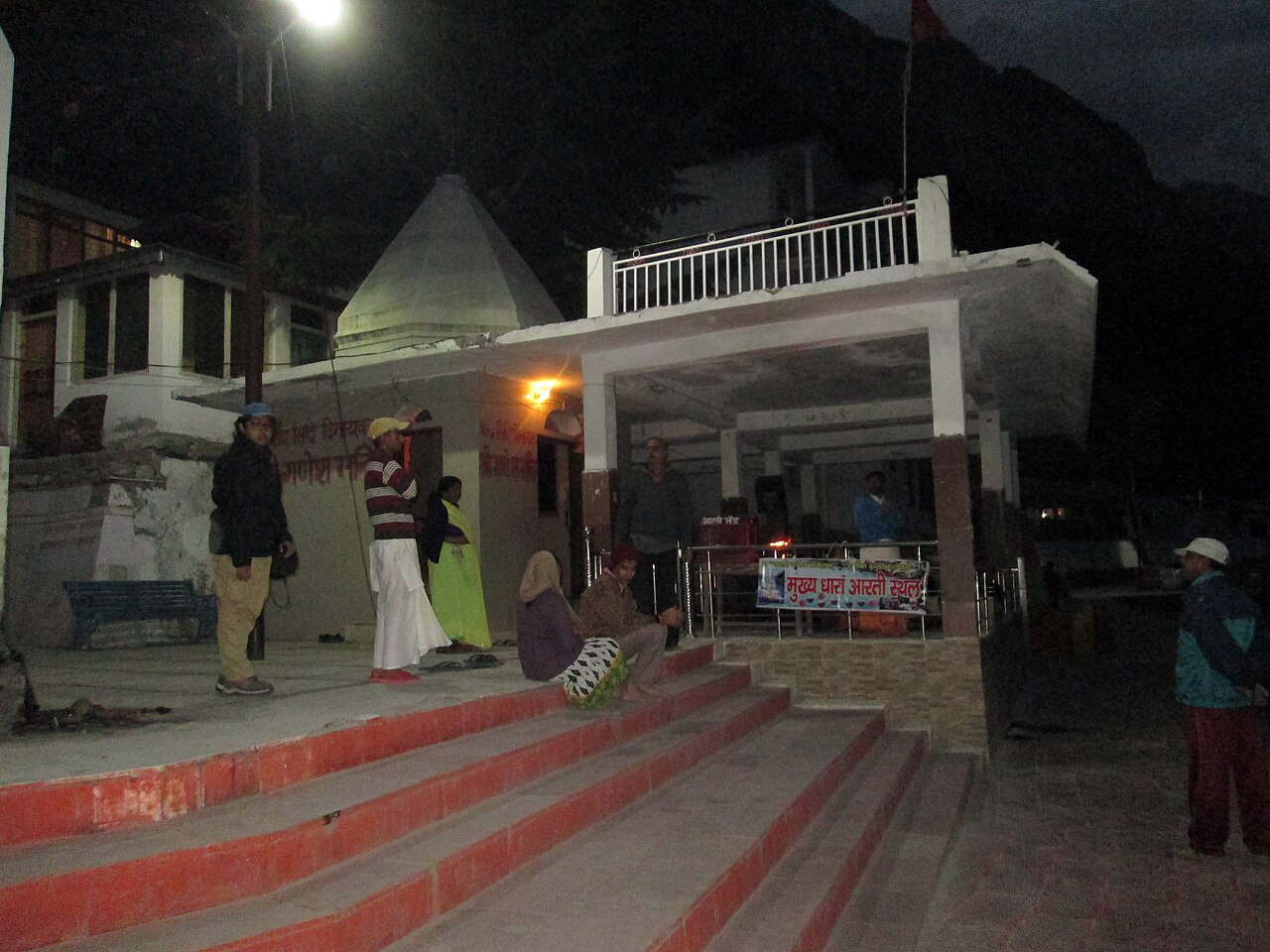
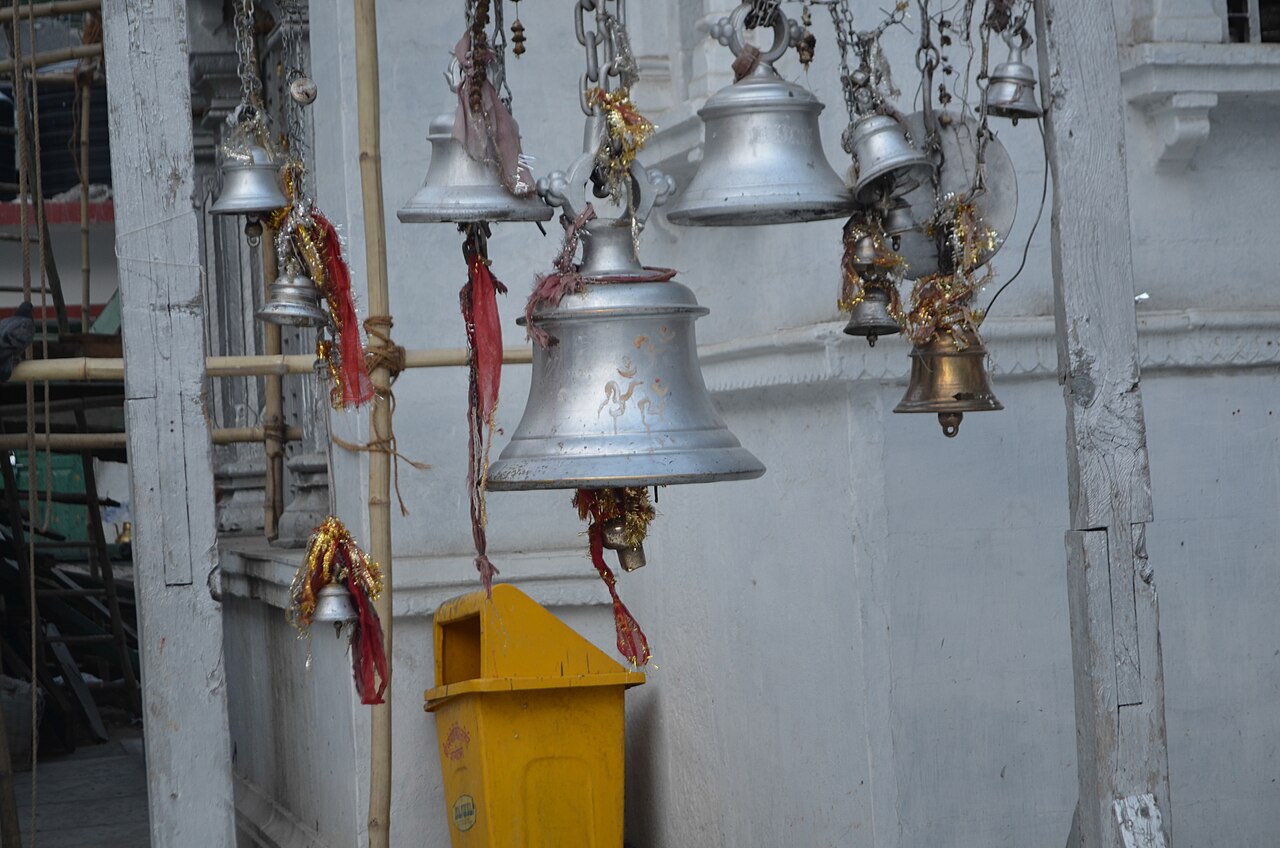
Evening arati offered To Maa Ganga at the Gangotri Temple courtyardRows of Temple bells hung at Gangotri Dham, rung by passing pilgrims
Evening arati and temple bells at Gangotri · photos CC BY-SA 4.0, Wikimedia Commons (Asish Das75, schwiki)
THE GODDESS WHO MOVES WITH THE SEASONS
Six months by the river, six months in the village
Gangotri keeps a rhythm no lowland Temple keeps. On Akshaya Tritiya the doors open for the summer: in 2026 they opened on 19 April at 12:15 pm, with the Chief Minister of Uttarakhand attending the first worship, and the Char Dham Yatra began that morning. Around the Diwali period the doors close again, expected on or near 10 November 2026, the exact day and hour fixed by the Temple's priests and announced in the weeks before. Then the utsav murti Of Maa Ganga Is Carried By palanquin down the valley to Mukhba village near Harsil, Her winter seat, where the Semwal pujaris continue Her daily worship until spring.
Plan your darshan between late April and early November; the road, the lodges and the Temple all close together for winter.
Plan your visit
By air
Jolly Grant Airport, Dehradun, is the nearest airport, roughly 250 km from Gangotri; the drive takes most of a day.
By rail
Rishikesh and Dehradun (about 240 to 250 km) are the practical railheads; buses and shared taxis run via Uttarkashi.
By road
Gangotri is reached directly by road, no trek required. The route runs through Uttarkashi, about 100 km below the shrine; roughly 200 to 250 km from Rishikesh in total.
Timings
Darshan roughly 6:15 am to 2 pm and 3 pm to 9:30 pm; morning aarti around 6 am, evening Ganga aarti about 7 to 7:45 pm. Confirm locally, hours shift with season.
Season 2026
Opened 19 April 2026 (Akshaya Tritiya); closes for winter around 10 November 2026, the exact date announced by the Temple committee beforehand.
To Gaumukh
The glacier snout, the physical source, is an 18 to 19 km trail via Chirbasa and Bhojbasa; a forest permit is required and daily entry is capped at about 150 trekkers.
Dress
Warm layers even in June; nights fall near freezing at this altitude. Modest Temple dress as at any dham.
Fee & registration
Darshan is free. Char Dham Yatra registration is mandatory and free, online at registrationandtouristcare.uk.gov.in, with Aadhaar details required in 2026.
The river at the Temple is called Bhagirathi, honouring King Bhagirath; it takes the name Ganga only from Devprayag onward, where it meets the Alaknanda.
Gangotri stands at about 3,100 m (some sources cite figures up to 3,415 m); walk slowly on arrival, drink water, and give yourself a night to acclimatize before any trek.
The monsoon months of July and August bring landslides on the Uttarkashi road; late April to June and September to early November are the settled windows.
Gangajal drawn here is carried across India to be poured on Lord Shiva; bottles are filled at the ghats below the Temple.
Questions pilgrims ask
Is Gangotri the actual source of the Ganga?
The physical source is the ice cave at Gaumukh, 18 to 19 km further up the gorge, where the Bhagirathi leaves the Gangotri Glacier. Gangotri is where tradition holds Maa Ganga First Descended to earth, and it is the highest point the pilgrim road reaches; the walk to Gaumukh is a separate permit-controlled trek.
When can I visit in 2026?
The doors opened on 19 April 2026, on Akshaya Tritiya, and are expected to close around 10 November 2026, in the days after Diwali. The exact closing day and hour are fixed by the Temple priests and announced in advance. In winter Maa Ganga Is Worshipped at Mukhba village instead.
Do I need to register for the yatra?
Yes. Char Dham Yatra registration is mandatory for every pilgrim and is free, done online at registrationandtouristcare.uk.gov.in or through the state's app and offline counters; in 2026 Aadhaar details are required and a QR code is checked en route.
Can I see the submerged Shivling?
Usually only near the end of the season. The natural rock Shivling in the riverbed stays under the Bhagirathi's summer flow and emerges as the water drops toward the winter closing, so late autumn pilgrims have the best chance.
Dharamshalas and guest houses near this Sthan, shared by devotees. Adisthan takes no bookings and no money; contact each stay directly.
No stays are listed here yet. Know one that serves pilgrims well?
Are you a pujari of the Semwal family, a trustee, or a sevak of Gangotri Dham? Claim this page to keep timings, aarti hours and the yearly kapat dates true for every pilgrim who seeks Maa Ganga.