Main hall 6 am to 5 pm · grounds always open Free entry Hidden golden Kannon · never shown Sanja Matsuri · third weekend of May Kannon-dō main hall · rebuilt 1958
You enter beneath a red paper lantern the size of a small boat, while Fūjin and Raijin, the wind god and the thunder god, watch from their alcoves. Nakamise funnels you north, all grilled senbei and painted fans, until the Hōzōmon rises ahead with its giant straw sandals. Then the courtyard: smoke curling off the great bronze incense burner, pilgrims wafting it over their shoulders, the rattle of omikuji drawers. Somewhere behind the altar sits the statue that began all of this. No one alive has ever seen it.
The principal image, a golden Kannon said to stand just 5.5 centimetres tall, was netted from the Sumida River by two fishermen brothers in 628 and sealed away as a hibutsu, a hidden buddha, in 645. It has never once been displayed in nearly fourteen centuries.
This is Tokyo's oldest established Temple and, with over 30 million visitors a year, by common count the most widely visited religious site in the world. The hall is free, and the grounds never close.
Since 1950 Sensō-ji has been the head Temple of its own Shō-Kannon school, independent of the Tendai sect it long served under. Its formal mountain name is Kinryū-zan, Golden Dragon Mountain.
The fishermen and the golden Kannon
Early on the morning of 18 March in the year 628, the legend says, the brothers Hinokuma Hamanari and Hinokuma Takenari were fishing the Sumida River when their net came up holding a small golden statue. The village headman, Haji no Nakatomo, recognised it as Kannon, the bodhisattva of compassion, remade his own house into a Temple for it, and gave the rest of his life to its worship. In 645 the priest Shōkai built a proper hall for the Kannon and, guided by a revelation in a dream, resolved that the statue should never be shown. It has remained unveiled ever since, an act of reverence that turned a fishing village's treasure into one of Japan's great mysteries.
The Temple grew with the city that grew around it. In 942 the military commander Taira no Kinmasa raised the first Kaminarimon and pagoda. In 1590 Tokugawa Ieyasu, newly arrived in Edo, designated Sensō-ji an official place of prayer for the shogunate and granted it 500 koku of land, and under Edo patronage the Nakamise stalls took root along the approach, making it one of Japan's oldest shopping streets.
On 10 March 1945 the firebombing of Tokyo burned the main hall and pagoda to the ground. What followed tells you what the Temple means to its city: the Kannon-dō rose again in 1958, the Kaminarimon in 1960 with funding from Kōnosuke Matsushita, founder of Panasonic, and the five-story pagoda in 1973, while in 1950 the Temple stepped out of the Tendai sect to stand as head of its own Shō-Kannon school.
What you'll actually see
1
Kaminarimon and the great lantern
The Thunder Gate, formally Fūraijinmon, is the Temple's face to the city: 11.7 metres of vermilion housing Fūjin the wind god on the east and Raijin the thunder god on the west. From its beam hangs the great chōchin lantern, 3.9 metres tall, 3.3 metres wide, and about 700 kilograms, periodically remade by Kyoto lantern makers. Look up as you pass under it: a dragon is carved on its base.
2
Nakamise-dōri and the Hōzōmon
The 250-metre approach from the gate to the Temple runs between 87 shops descended from Edo-era stallholders. It ends at the two-storey Hōzōmon, guarded by a pair of Niō figures 5.45 metres tall, with giant waraji straw sandals, 4.5 metres long and about 400 kilograms each, hung on its rear face. Its upper storey is a treasure house holding a copy of the Lotus Sutra designated a National Treasure of Japan.
3
The Kannon-dō, the jōkōro, and the pagoda
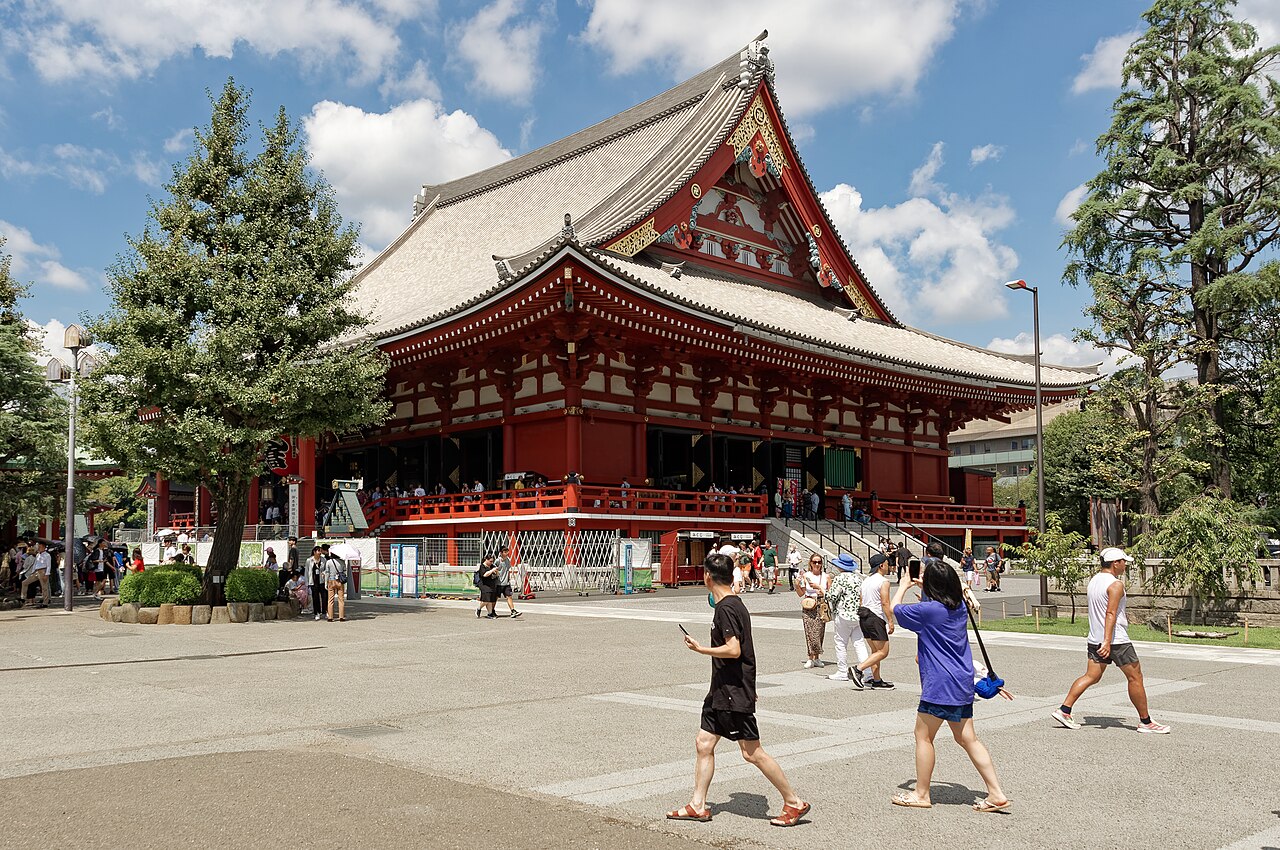
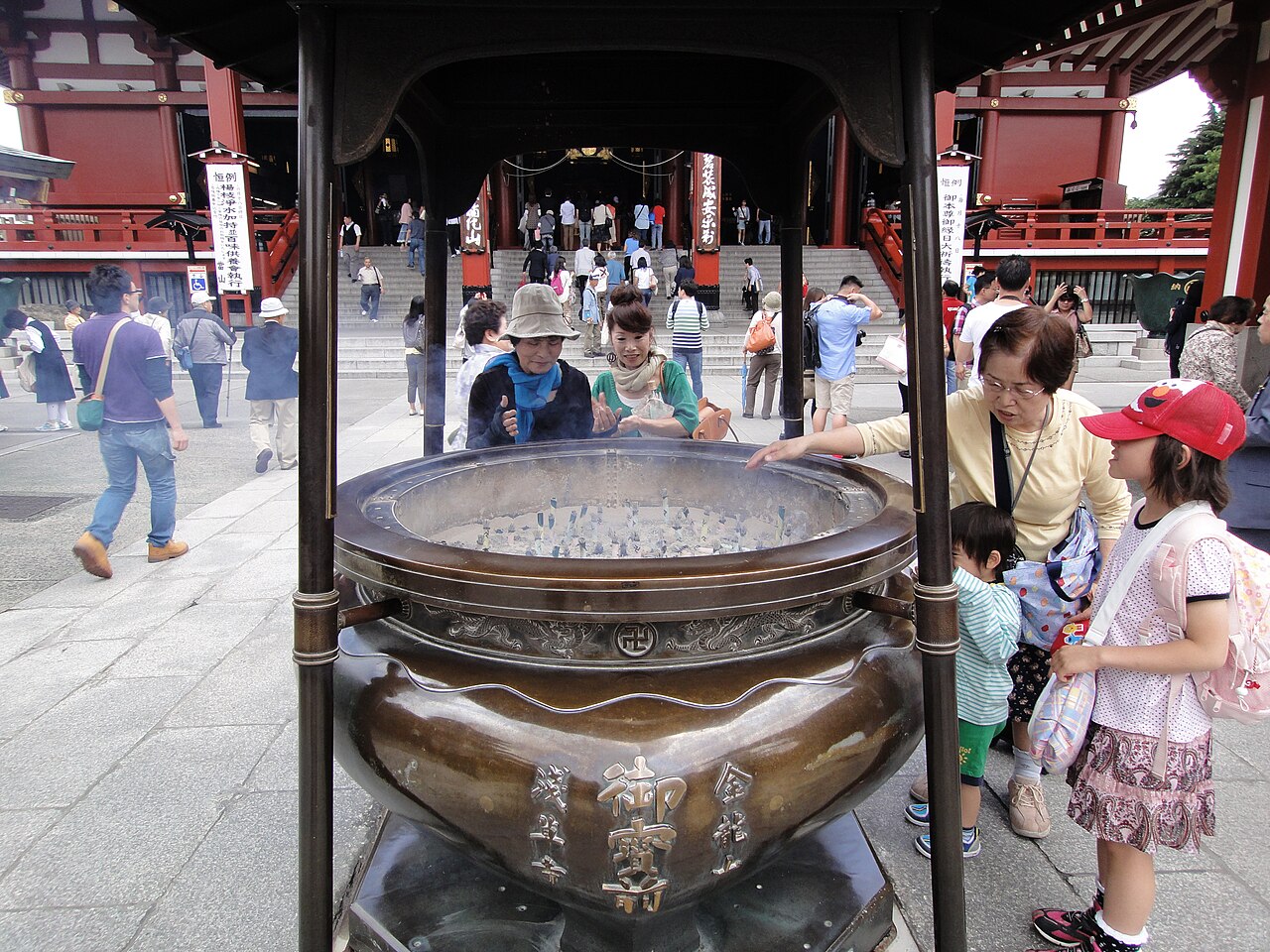
In the main courtyard stands the great bronze incense burner, the jōkōro, where visitors fan the smoke over themselves, said to ease ailments and improve health. Beyond it the broad-roofed Kannon-dō main hall, rebuilt in 1958, holds the hidden image behind its altar, and to the west the five-story pagoda of 1973 rises above the rooflines, lit against the night sky until late evening.
The Kannon-dō main hall of Sensō-ji, rebuilt in 1958, with worshippers on its broad stepsVisitors waft incense smoke over themselves at the jōkōro burner before the main hall of Sensō-ji
The Kannon-dō main hall, and pilgrims bathing in incense smoke at the jōkōro · photos CC BY 4.0 Jakub Hałun and CC BY 2.0 Dick Thomas Johnson, Wikimedia Commons
The weekend the district carries its gods
Sanja Matsuri · third full weekend of May
Strictly speaking, Sanja Matsuri belongs to Asakusa Jinja, the Shinto shrine standing just east of the main hall, and its three kami are the men who founded Sensō-ji: the fishermen Hinokuma Hamanari and Takenari and the headman Haji no Nakatomo. For three days on the third full weekend of May, the shrine's three great mikoshi, each weighing about a ton and borne by teams of roughly forty, and around a hundred neighbourhood mikoshi besides, are shouldered, bounced, and roared through the Temple district, drawing 1.5 to 2 million people. In 2026 it ran 15 to 17 May; the 2027 dates follow the same third-weekend rule and are announced by the shrine.
Come early on the Sunday, when the three main mikoshi leave the shrine; the streets around Nakamise carry the densest crowds of Tokyo's festival year.
Plan your visit
By train
Asakusa Station, about five minutes on foot from four lines: Tokyo Metro Ginza line, Toei Asakusa line (exit A4), Tobu Skytree line, and Tsukuba Express.
The approach
Enter through Kaminarimon and walk the 250 metres of Nakamise to the Hōzōmon. The Temple has no parking of its own, so come by rail.
Timings
Main hall 6 am to 5 pm daily, opening 6:30 am from October to March. The grounds themselves never close, and the buildings are illuminated until about 11 pm.
Entry
Free. An omikuji fortune costs 100 yen at the counters before the main hall; offerings and amulets are the only other costs you choose.
Best time
Be there for the 6 am opening, before the Nakamise shutters rise, when the courtyard belongs to local worshippers; or come after dark for the illuminated pagoda and near-empty grounds.
Worship
Fan smoke from the jōkōro over yourself before the hall, offer a coin, bow, and draw an omikuji; a poor fortune is customarily left tied at the racks.
Kannon's day
The 18th of every month is the honzon's ennichi, with a service in the main hall at 2 pm; a sutra service is held on the 1st of each month at 10 am.
Temple and district share one name: the characters 浅草 read in the Japanese manner are Asakusa, and in the Sino-Japanese manner Sensō, so Sensō-ji is simply the Temple of Asakusa, also called Asakusa Kannon.
The building just east of the main hall is Asakusa Jinja, a Shinto shrine honouring the Temple's three founders; you are welcome at both, but you are crossing between two religions when you pass from one to the other.
Sensō-ji is the thirteenth Temple of the Bandō Sanjūsankasho, the old eastern pilgrimage circuit of thirty-three Kannon sites.
The Temple office answers calls on 03-3842-0181 between 9 am and 4:30 pm, except Sundays and holidays.
Questions pilgrims ask
Can I see the golden Kannon?
No. The image has been a hibutsu, a hidden buddha, since 645 and is never displayed, so even its true form is unknown; tradition describes a golden figure about 5.5 centimetres tall. Worshippers pray toward the closed altar, which is the point: the Temple asks for faith, not inspection.
Is Sensō-ji a Temple or a shrine?
A Buddhist Temple, dedicated to Kannon, the bodhisattva of compassion. The Shinto shrine next door, Asakusa Jinja, honours the Temple's three human founders and holds the Sanja Matsuri; the two stand side by side but belong to different religions.
Does it really receive 30 million visitors a year?
That is the commonly cited figure, which by some counts makes Sensō-ji the most widely visited religious site in the world. Yet the crowds are a daytime tide: at the 6 am opening, and again after the shops close, the courtyard is nearly quiet.
What is the smoke everyone is fanning over themselves?
Incense from the jōkōro, the great burner before the main hall. Wafting the smoke over the body is said to ease ailments and improve health, so you will see visitors guiding it toward whatever hurts.
The Sthan in photographs
Darshan from afar
From the temple's own channels. Nothing loads until you press play.
Dharamshalas and guest houses near this Sthan, shared by devotees. Adisthan takes no bookings and no money; contact each stay directly.
No stays are listed here yet. Know one that serves pilgrims well?
Are you with the Temple office of Kinryū-zan Sensō-ji? Claim this page to keep its hours, services, and festival guidance true for every devotee who comes to the Asakusa Kannon.