One tooth of the Buddha, and an island that shaped itself around it.
Be the first to check in
Entry tended 11 Jul 2026
Open daily 5:30 am to 8 pm Thewava three times daily Esala Perahera · 18 to 27 Aug Kandyan royal shrine · 1595 Foreign visitors LKR 3,000
The hewisi drums reach you first, rolling out over Kandy Lake in the early light, with the forested ridge of Udawattakele standing behind the Temple like a green wall. White-clad devotees stream along the lakeside carrying trays of jasmine and lotus, past the moat, past the octagonal Paththirippuwa, in under the golden canopy. Upstairs a queue inches toward a silver-worked door framed by elephant tusks. Behind it, sealed inside seven nested golden caskets, rests the left canine tooth of the Buddha. No one sees it. The whole island lives around it.
The dalada is sovereignty itself. For centuries, tradition held that whoever possessed the Sacred Tooth Relic held the right to rule Lanka, and the capital of the island moved wherever the relic moved, from Anuradhapura through Polonnaruwa to Kandy.
The thewava, the daily service of the relic, is performed three times every day, at dawn, at midday and in the evening, to the beat of the hewisi drums. What the devotee glimpses through the open shrine door is the outermost of seven gem-studded golden caskets, shaped like a dagoba.
Each Esala season the Temple pours into the streets as the Kandy Esala Perahera: ten nights of tuskers in embroidered cloaks, Kandyan dancers, whip-crackers and drummers honouring the relic, a procession the Temple traces back to the relic's arrival in the fourth century.
The tooth that crossed the sea
When the Buddha's body was cremated at Kusinara, the chronicles say his disciple Khema drew the left canine tooth from the ashes of the pyre and carried it to King Brahmadatta of Kalinga, who enshrined it in his city of Dantapura, the city of the tooth. For centuries kings venerated it there, and kings made war for it, because already it was more than a relic: it was a claim.
In the fourth century, tradition holds, King Guhasiva of Kalinga saw that the tooth would be taken from him by force. He entrusted it to his daughter, Princess Hemamala, and her husband Prince Dantha, who crossed the sea disguised as pilgrims, the relic hidden in the coils of the princess's hair. The Temple's own telling places their landing in the year 310, in the reign of King Kithsirimewan, who received the relic with royal honours at Anuradhapura.
From that day the tooth and the throne were one. As the capital fell back from Anuradhapura to Polonnaruwa and onward through the hill country, the relic travelled with the king, until it came to rest in Kandy, the last kingdom. King Vimaladharmasuriya I raised the first shrine beside his palace in 1595; later kings enlarged it, and the last king, Sri Vikrama Rajasinha, added the moat and the octagonal Paththirippuwa. The kingdom ended in 1815. The thewava never stopped.
What you'll actually see
1
The moat and the Paththirippuwa
You arrive along a white parapet carved like rolling water, its niches once lit with coconut-oil lamps, beside the moat of the old royal palace. Above it rises the Paththirippuwa, the octagonal pavilion built under Sri Vikrama Rajasinha, the last king of Kandy, from which the relic was shown to the people.
2
The drummers' courtyard and the silver door
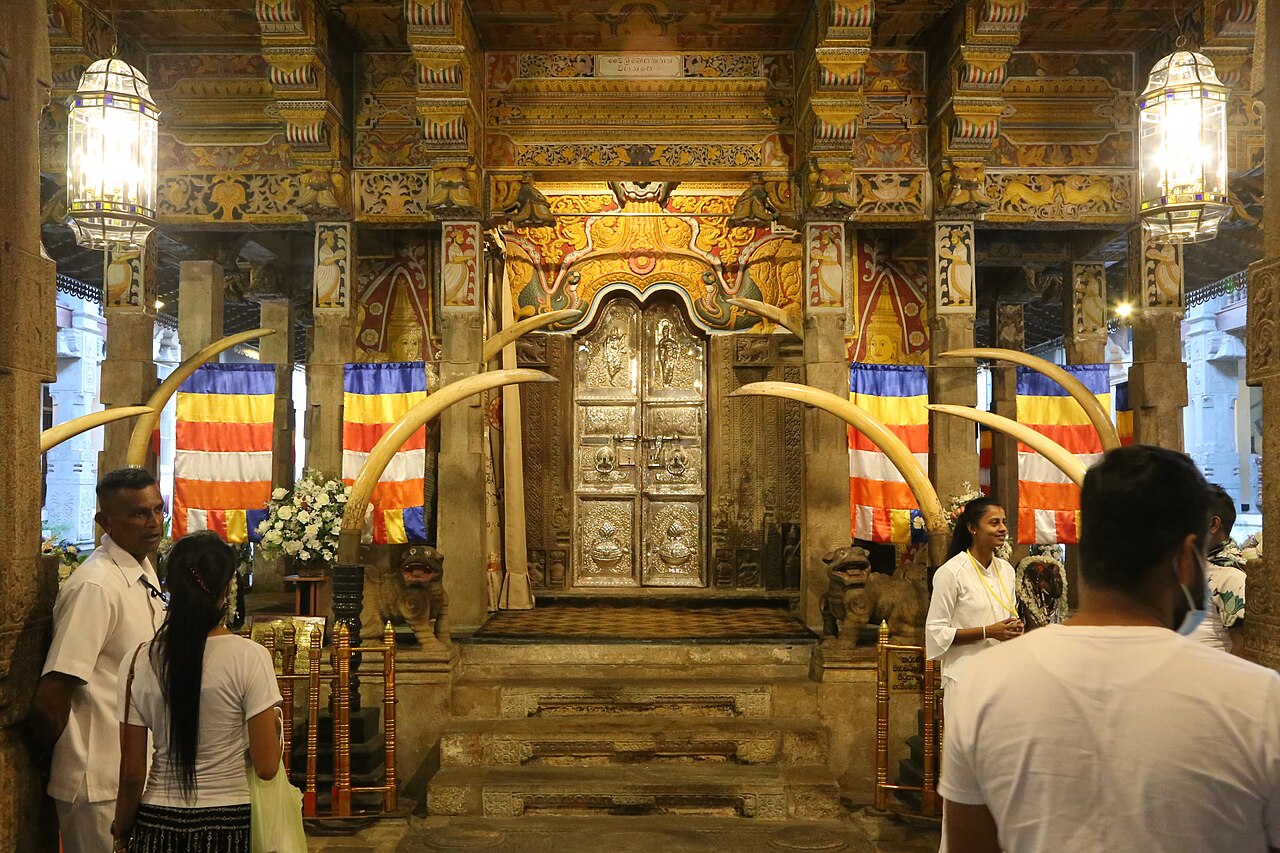
Inside, the two-storey shrine stands in a courtyard that fills with the sound of hewisi drumming at every service. The relic chamber's entrance is a door sheathed in worked silver, flanked by curving elephant tusks and Buddhist flags, beneath painted beams of lotus and dancer motifs.
3
The golden canopy and the casket above
Over the relic chamber gleams the golden canopy raised in 1987, visible from across Kandy Lake. Upstairs, during the thewava, the queue passes the open shrine door for a few seconds' view of the outermost golden casket, a gem-inlaid dagoba that holds six more caskets within it, the tooth at their heart.
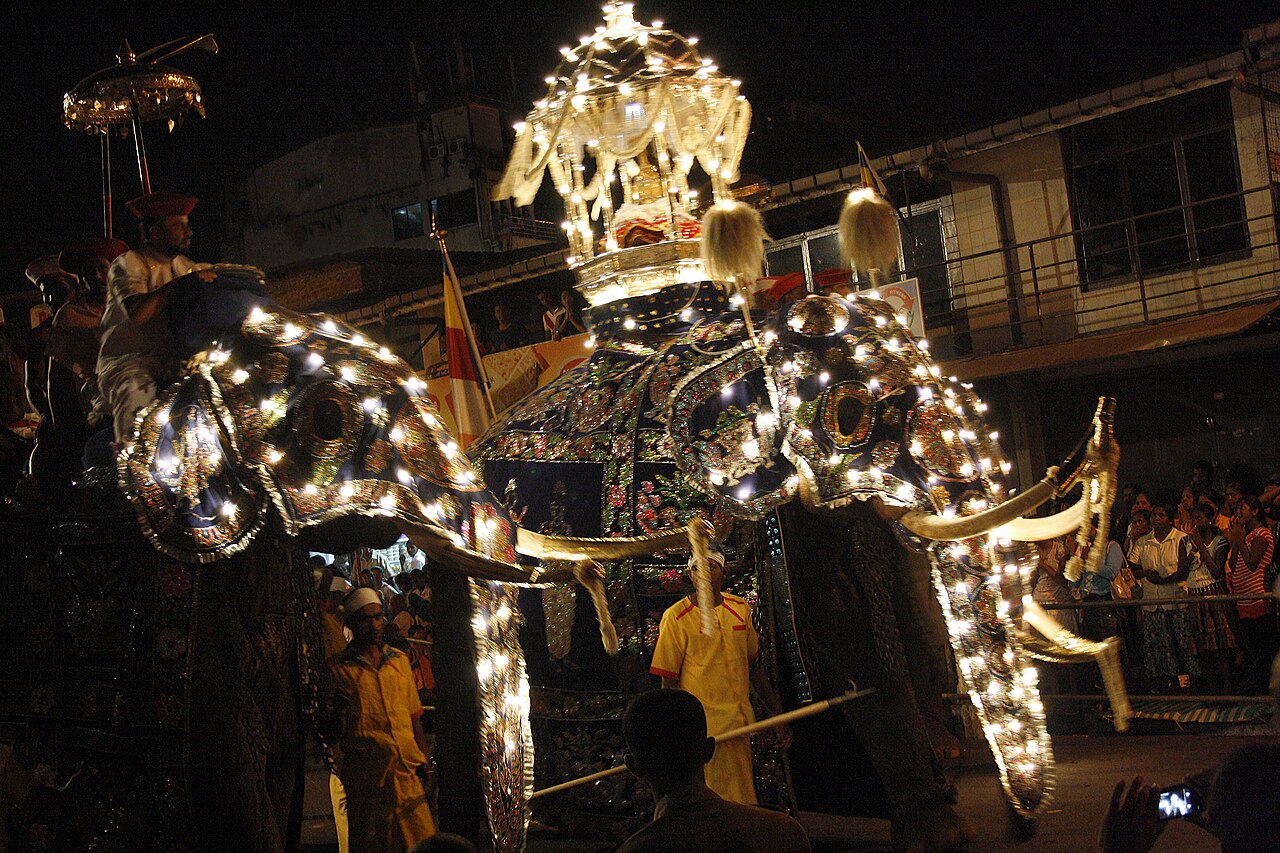
The silver-worked door of the relic shrine, framed by elephant tusks and Buddhist flagsA tusker robed in lights bearing the illuminated casket at the Kandy Esala Perahera
The silver door of the relic shrine, and a tusker bearing the casket at the Esala Perahera · photos CC0 and CC BY-SA, Wikimedia Commons
The ten nights of Esala
The Kandy Esala Perahera, 18 to 27 August 2026
Once a year the relic's honour takes to the streets. The 2026 festival opens with the planting of the kap at the four devalas on 13 August; the five Kumbal Perahera nights run 18 to 22 August and the five grander Randoli Perahera nights 23 to 27 August, each procession leaving the Temple at dusk. Scores of tuskers walk in embroidered cloaks among Kandyan dancers, drummers, whip-crackers and fire-wheel spinners, and at the centre the Maligawa tusker carries the golden perahera casket, honoured by devotees as the living presence of the Buddha. The festival closes with the water-cutting ceremony and the Day Perahera.
The pavements fill hours before each night's perahera and viewing seats sell out well in advance, so plan your place early, and stand when the casket passes.
Plan your visit
By air
Bandaranaike International Airport (Colombo) is roughly 105 km away; allow 3 to 4 hours by road.
By rail
Kandy railway station is about 1.5 km from the Temple, an easy walk; the hill-country line from Colombo Fort takes around 3 hours.
By road
Kandy is about 115 km from Colombo. The Temple stands beside Kandy Lake in the heart of the city, with Udawattakele forest rising behind it.
Timings
Open daily 5:30 am to 8:00 pm. Thewava services roughly 5:30 to 7:00 am, 9:30 to 11:00 am, and 6:30 to 8:00 pm.
Best time
Come for a thewava, when the shrine door opens and the drums sound; the dawn service is the quietest. On Wednesdays the relic is symbolically bathed with herbal water in the Nanumura Mangallaya.
Dress
Legs and shoulders covered; no shorts, sleeveless or revealing wear. Devotees traditionally wear white. Shoes are left at the token booths by the entrance.
Tickets
Foreign visitors LKR 3,000 (about USD 10); SAARC, Thai and Myanmar nationals LKR 2,500, from 1 July 2026. The ticket covers the Temple, museum and grounds.
At the gate
Expect airport-style security screening at the entrance; avoid bringing polythene or plastic bags, and leave pets behind.
Sri Dalada Maligawa means the shrine-palace of the Sacred Tooth: dalada is the Tooth Relic, and Maligawa recalls that this was the relic house of the royal palace, within the Sacred City of Kandy inscribed by UNESCO in 1988.
You will not see the tooth itself; devotees venerate the outermost of the seven golden caskets. Public expositions of the relic are rare: the Siri Dalada Wandanawa of April 2025 was the first in sixteen years.
On 25 January 1998 the LTTE detonated a truck bomb at the Temple, killing more than a dozen people and shattering the entrance moonstone; the damage has been fully restored, and today's strict security is part of that story.
The Temple's ritual life is headed by the Diyawadana Nilame, the chief lay custodian, an office descended from the officials of the Kandyan court, alongside the bhikkhus who perform the daily thewava.
Questions pilgrims ask
Will I actually see the Buddha's tooth?
No. The tooth rests inside seven nested golden caskets and is not on display. During the thewava the shrine door opens and devotees file past for a brief view of the outermost gem-studded casket. The relic itself is shown only at rare expositions; the one held in April 2025 was the first in sixteen years.
When is the best moment to be inside the Temple?
During one of the three thewava services, roughly 5:30 to 7:00 am, 9:30 to 11:00 am and 6:30 to 8:00 pm, when the hewisi drums sound and the relic chamber is open. The dawn service is the calmest; evenings are the fullest.
Can non-Buddhists enter?
Yes, visitors of every faith are welcome throughout opening hours. Cover legs and shoulders, leave your shoes at the entrance booths, and expect airport-style security screening on the way in.
Does the tooth relic itself go out in the Esala Perahera?
The Maligawa tusker carries the golden perahera casket in the procession, and devotees honour it as they would the relic itself, as the living presence of the Buddha. The Sacred Tooth remains enshrined within the Temple.
Why is a tooth so bound up with kings?
From the time the relic reached Lanka in the fourth century, possession of the Sacred Tooth was held to confer the right to rule the island. Capitals rose and moved around it, from Anuradhapura to Polonnaruwa to Kandy, which is why the relic house stands within the last royal palace.
Dharamshalas and guest houses near this Sthan, shared by devotees. Adisthan takes no bookings and no money; contact each stay directly.
No stays are listed here yet. Know one that serves pilgrims well?
Are you of the Sri Dalada Maligawa, the office of the Diyawadana Nilame, or the Temple administration? Claim this page to keep the thewava times, perahera dates and visitor guidance true for devotees across the world.