Car Street (Ratha Beedi) · Udupi, Karnataka, India
The Lord Turned to face His singer, and He Has never turned back.
Be the first to check in
Coming up: Paryaya · 18 JanEntry tended 29 Jun 2026
Poojas from 5:00 am Darshan through the Kanakana Kindi Janmashtami & Vittla Pindi · 4 to 5 Sep 2026 Founded 13th c. by Sri Madhvacharya Free · Anna prasada at noon
Car Street is awake before the first bell: woodsmoke and sambar drifting from the matha kitchens, pilgrims circling the green water of the Madhva Sarovara, the buildings of the eight mathas standing shoulder to shoulder around the square. Yet the strangest thing about this Temple is what you do not do. You do not walk in and stand before the Lord. At Udupi every pilgrim, from visiting pontiff to barefoot villager, Receives darshan through a small silver-plated window. Tradition holds the Lord Chose the window Himself.
The murti of Bala Krishna Was Installed here in the 13th century By Sri Madhvacharya, founder of the Dvaita school of Vedanta, who found the Lord hidden inside a ball of gopichandana clay carried by a ship he had saved from a storm. Tradition holds the image was worshipped by Queen Rukmini herself at Dwarka.
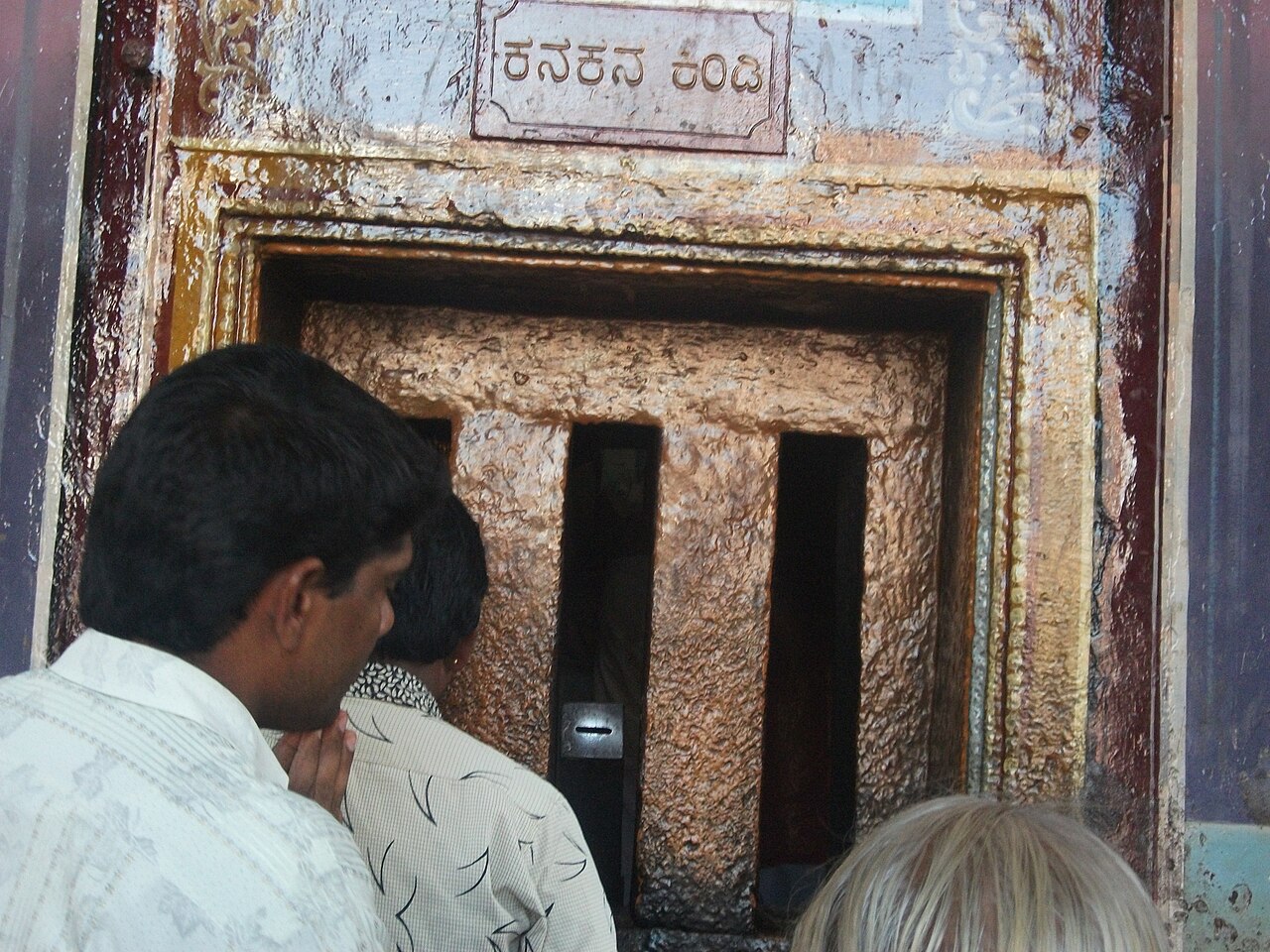
Darshan is through the Kanakana Kindi, a silver-plated window with nine openings. Tradition holds the Lord Turned westward so the saint-poet Kanakadasa, denied entry at the gate, could see Him from outside, and He Faces that window still.
Eight monasteries founded by Sri Madhvacharya, the Ashta Mathas, hand the Lord's worship from one to the next every two years in an unbroken relay called the Paryaya, a tradition that passed its five hundredth year in 2021.
The ship, the clay, and the window
The legend says the Lord Came to Udupi by sea. A trading vessel out of Dwarka was labouring in a storm off the coast when Sri Madhvacharya, standing on the shore, raised his upper cloth and waved the ship safely through to calm water. The grateful captain offered the saint anything in his cargo, and the acharya asked only for two lumps of gopichandana, the sacred clay used for tilaka. When one was broken open there stood within it a murti of Lord Krishna as a child, churning rod and rope in hand, exactly as He played in Gokula. Tradition holds that Queen Rukmini had this very image made and worshipped it at Dwarka, and that the sea had kept it in clay for ages until the Lord Chose His new home. Sri Madhvacharya installed Bala Krishna beside the tank now called the Madhva Sarovara and entrusted the worship to his disciples, from whom the eight mathas descend.
Centuries later the singer Kanakadasa came to Udupi. Born Veera Nayaka, a soldier turned poet of the Lord, he was not permitted to enter the Temple, so he sang from a hut behind it. Tradition holds that Lord Krishna Turned in His sanctum to face His devotee, and a crack opened in the western wall so Kanakadasa could see Him. The telling recorded in the 1860s remembers an earthquake splitting the wall; what matters is what happened next. Vadiraja Tirtha, rather than seal the crack, widened it into a window. Silver-plated, pierced with nine openings, it is the Kanakana Kindi, the window of Kanaka, and every darshan of the Lord at Udupi now passes through it.
What you'll actually see
1
The Kanakana Kindi
On the western side of the shrine, framed in worked silver and pierced with nine openings, is the window the whole Temple turns around. Pilgrims file past it slowly, pausing one by one to look through at Bala Krishna within. The arch outside is named for Kanakadasa, the devotee whose song opened the wall.
2
The Madhva Sarovara
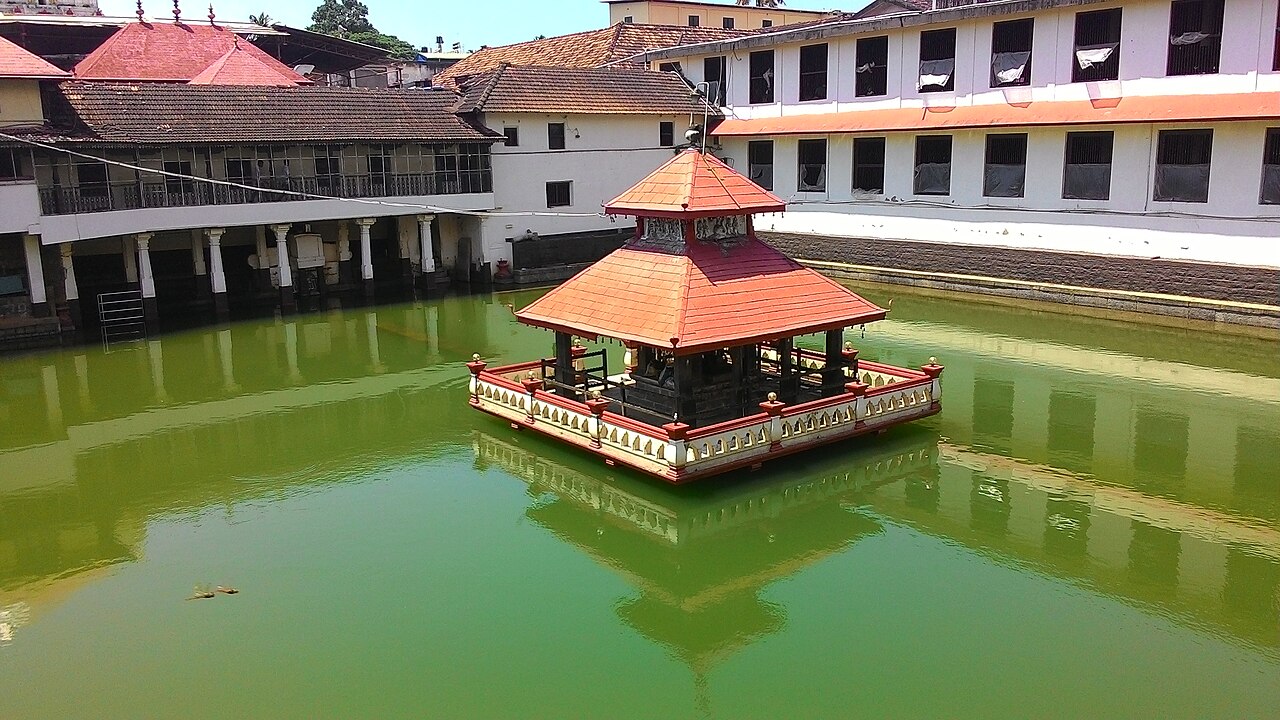
The stepped Temple tank beside the matha, where pilgrims circle the water before darshan. On the day after Janmashtami the clay image of Lord Krishna Is Immersed here at the end of the Vittla Pindi procession, and during the Paryaya its ghats fill with lamps and devotees.
3
Car Street and the Ashta Mathas
The square around the Temple, Ratha Beedi, holds the tall wooden chariots that carry the utsava processions, ringed by the buildings of the eight mathas. Across from the Krishna Matha stands the far older Anantheshwara Temple, where tradition places Sri Madhvacharya's own early education.
The silver-plated Kanakana Kindi window through which pilgrims receive darshan of Lord Krishna at UdupiThe Madhva Sarovara, the stepped Temple tank beside the Udupi Sri Krishna Matha
The Kanakana Kindi and the Madhva Sarovara · photos CC BY-SA, Wikimedia Commons
THE HANDOVER KEPT FOR FIVE CENTURIES
Paryaya · next on 18 January 2028
In the small hours of 18 January in every even-numbered year, Udupi changes hands. The incoming swamiji takes a ritual dip at Dandatirtha near Kaup, then rides in procession from Jodukatte along Car Street before dawn, through music, chariots and folk dancers, to ascend the Sarvajna Peetha inside the matha, where the outgoing pontiff hands over the Akshaya Patra and the shrine keys. For the next two years that matha alone conducts every pooja of the Lord. On 18 January 2026, Sri Vedavardhana Tirtha Swamiji of the Shiroor Matha Assumed the Paryaya for the 2026 to 2028 term, with annadana arranged for tens of thousands of devotees in a single day. The next Paryaya falls on 18 January 2028.
Come the night before and find a place along Car Street by 2 am; the procession reaches the matha before dawn and the town stays full for days.
Plan your visit
By air
Mangaluru International Airport, about 60 km by road from Udupi.
By rail
Udupi station on the Konkan Railway, about 3 km from the matha, with direct trains toward Mumbai, Mangaluru and Bengaluru.
By road
The matha stands on Car Street in the heart of Udupi town; Bengaluru is about 400 km away, an 8 to 10 hour drive.
Timings
The day's worship runs from the 5:00 am Nirmalya Visarjana to the 8:50 pm Ekanta Seva, with the Mahapooja at 11:00 am; timings shift on festival days, so confirm locally.
Best time
The early morning poojas, when the Vishwaroopa Darshana at about 6:20 am draws the day's most devoted queue.
Dress
A dress code applies from 19 January 2026: no jeans, T-shirts or sleeveless wear; men remove shirts before the inner areas; women wear modest traditional attire.
Entry
Darshan is free.
Anna prasada
The matha serves prasada meals at noon; its annadana is so vast that devotees call it Anna Brahma.
Udupi cuisine was born in these kitchens, where Madhva Brahmin cooks devised ever-new offerings for the Lord; the dosa itself is credited to Udupi.
There are two windows between you and the Lord: the inner Navagraha Kindi and the outer Kanakana Kindi, and the murti Faces west, towards His singer.
This is a working monastery, not only a Temple: the day's poojas are performed personally by the pontiffs of the Ashta Mathas under the reigning Paryaya swamiji.
The rotation order of the eight mathas is fixed: Palimaru, Adamaru, Krishnapura, Puttige, Shiroor, Sodhe, Kaniyooru and Pejawara, each holding the Lord's worship for two years.
Questions pilgrims ask
Can I stand directly before the murti inside the sanctum?
No, and that is the heart of this place. Everyone Sees Lord Krishna through the nine openings of the silver-plated Kanakana Kindi, the window tradition holds the Lord Himself Turned to face. There is no separate inner darshan to seek.
Who performs the worship?
The pontiff of whichever of the eight Ashta Mathas holds the biennial Paryaya. For the 2026 to 2028 term that is Sri Vedavardhana Tirtha Swamiji of the Shiroor Matha, who assumed charge on 18 January 2026.
Is there really a free meal for everyone?
Yes. The matha serves prasada at noon and its annadana tradition is so large that devotees call the Temple Anna Brahma. At the January 2026 Paryaya, meals were arranged for around 50,000 people in a single day.
What should I wear?
Since 19 January 2026 the matha enforces a dress code: jeans, T-shirts and sleeveless clothing are not permitted, men remove their shirts before entering the inner areas, and women wear modest traditional attire.
When is the town at its fullest?
Sri Krishna Janmashtami, 4 September in 2026, followed the next day by the Vittla Pindi procession with its curd-pot breaking on Car Street, and above all the Paryaya of 18 January in even years, when over a lakh devotees come for the handover.
Dharamshalas and guest houses near this Sthan, shared by devotees. Adisthan takes no bookings and no money; contact each stay directly.
No stays are listed here yet. Know one that serves pilgrims well?
Are you a pontiff, administrator or sevak of the Paryaya matha or the Ashta Mathas of Udupi? Claim this page to keep pooja timings, seva details and festival dates true for the devotees who plan their journeys by them.