Open daily 8:30 am to 4:30 pm 500 baht · Thai nationals free The Emerald Buddha · 66 cm of green stone Songkran · 13 to 15 Apr Rattanakosin style · 1780s
You pass beneath towering yaksha guardians sheathed in glass mosaic and gilt, and the roar of Bangkok falls away behind the white crenellated wall. Ahead a golden chedi burns in the sun beside spires of mirrored glass and porcelain flowers. Inside the ubosot, above kneeling worshippers and a haze of incense, a small dark-green figure sits high on a golden throne, dressed in gold. This is the Emerald Buddha, and this wat, alone among the great Temples of Thailand, has no monks at all.
The Emerald Buddha, Phra Kaew Morakot, is the palladium of the Thai kingdom: a seated Buddha image 66 cm tall, carved from a single block of green stone, jasper or jade rather than emerald, and the most revered Buddha image in Thailand.
This is the Chapel Royal, not an ordinary wat. Raised by King Rama I inside the Grand Palace when Bangkok became the capital, it is a fully consecrated Temple where no monks reside, kept for the kingdom's royal ceremonies.
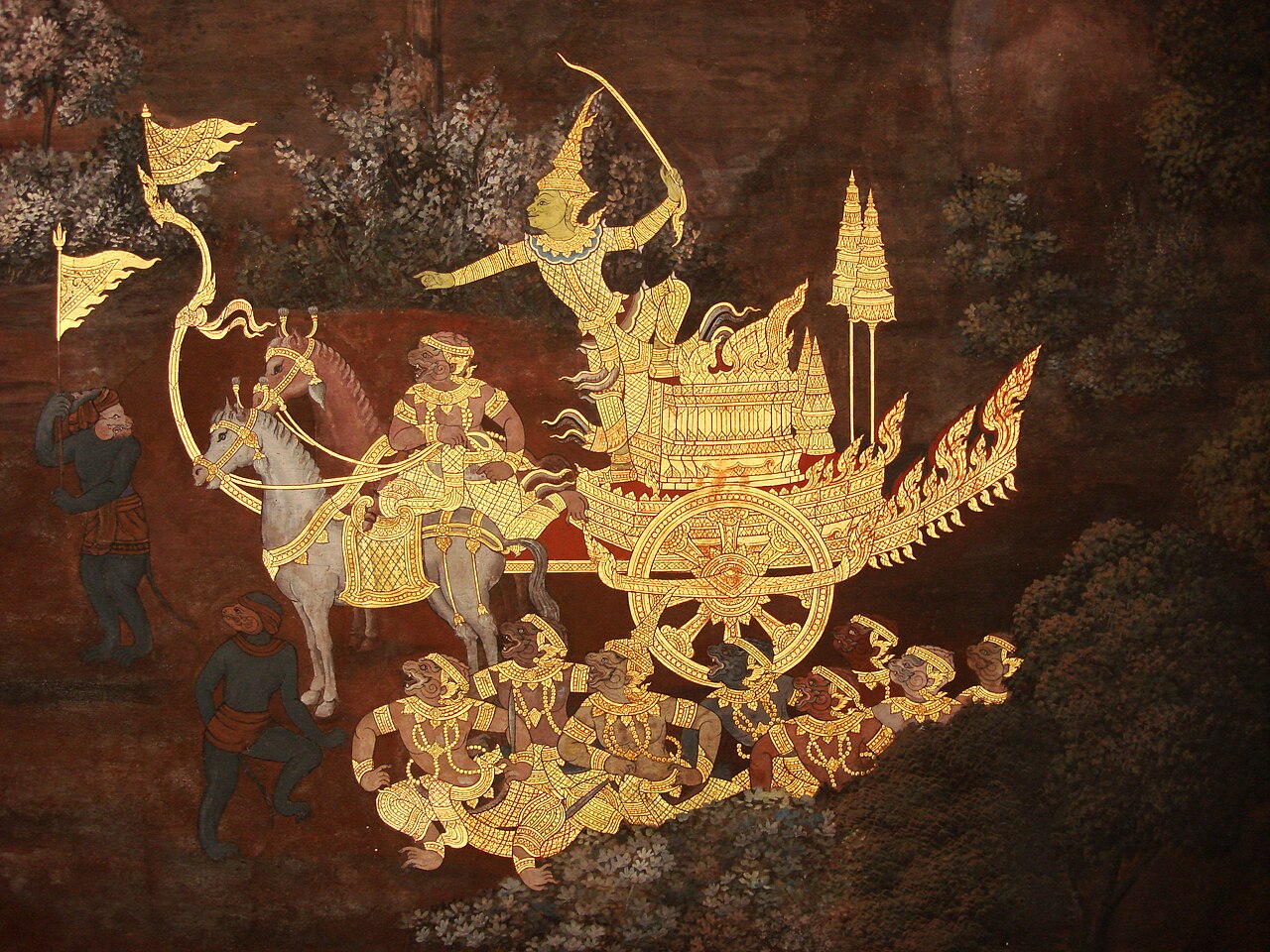
A covered gallery wraps the entire compound with the complete Ramakien, Thailand's telling of the Rama epic, painted in 178 scenes in the reign of Rama I around 1797 and repainted under Rama III.
The Buddha that lightning revealed
Tradition holds that in 1434 lightning split a chedi at a Temple in Chiang Rai, and inside stood a Buddha image covered in plain stucco. When the plaster began to flake away, green stone showed beneath, and word spread through the north that a Buddha of emerald had been found. The image never stayed anywhere for long by accident. Kings sent for it, kept it, and lost it: Lampang held it from 1434 to 1468, Chiang Mai enshrined it at Wat Chedi Luang until 1552, then it crossed the Mekong to Luang Prabang, and from 1564 it sat for more than two centuries in Vientiane.
In 1779 the Siamese general Chao Phraya Chakri brought the image back from Vientiane at the end of his Lao campaign and placed it in a shrine near Wat Arun in Thonburi, the capital of that time. Three years later he took the throne himself, founding the Chakri dynasty as King Rama I, and moved the capital across the river to Bangkok.
There he built the Grand Palace, and within its walls a Temple worthy of the image that had followed him home. The Emerald Buddha was enshrined in the new ubosot with great ceremony, by the traditional dating on 22 March 1784, though some Thai records place the final installation in early 1785. It has not left since. Where the Emerald Buddha sits, Thai tradition holds, there sits the legitimacy of the kingdom.
What you'll actually see
1
The ubosot of the Emerald Buddha
The great gilded ordination hall stands on marble, ringed by gilt garuda figures and guarded by bronze lions. Inside, the Emerald Buddha sits far above eye level on a tiered golden throne, small, dark green, and dressed in the gold robe of the current season. Worshippers kneel on the carpet below in prayer. Photography inside is strictly prohibited: you look, you bow, you remember.
2
The upper terrace
Beside the ubosot rises Phra Si Rattana Chedi, the golden bell-shaped stupa built in 1855 to enshrine relics of the Buddha brought from Sri Lanka, its surface covered in gold tiles imported from Italy under Rama V. Next to it stands Phra Mondop, the library, holding a mother-of-pearl inlaid cabinet of the Tripitaka, the Buddhist canon, and a detailed stone model of Angkor Wat commissioned by Rama IV.
3
The Ramakien cloister
The walls of the surrounding gallery carry the longest painted story in Thailand: 178 mural scenes of the Ramakien, with monkey armies in gold leaf, demon kings, and golden chariots rolling through forests of dark lacquer. Each scene carries a short synopsis, and the guardians of the story, giant yaksha figures in glass mosaic, watch the gates of the compound itself.
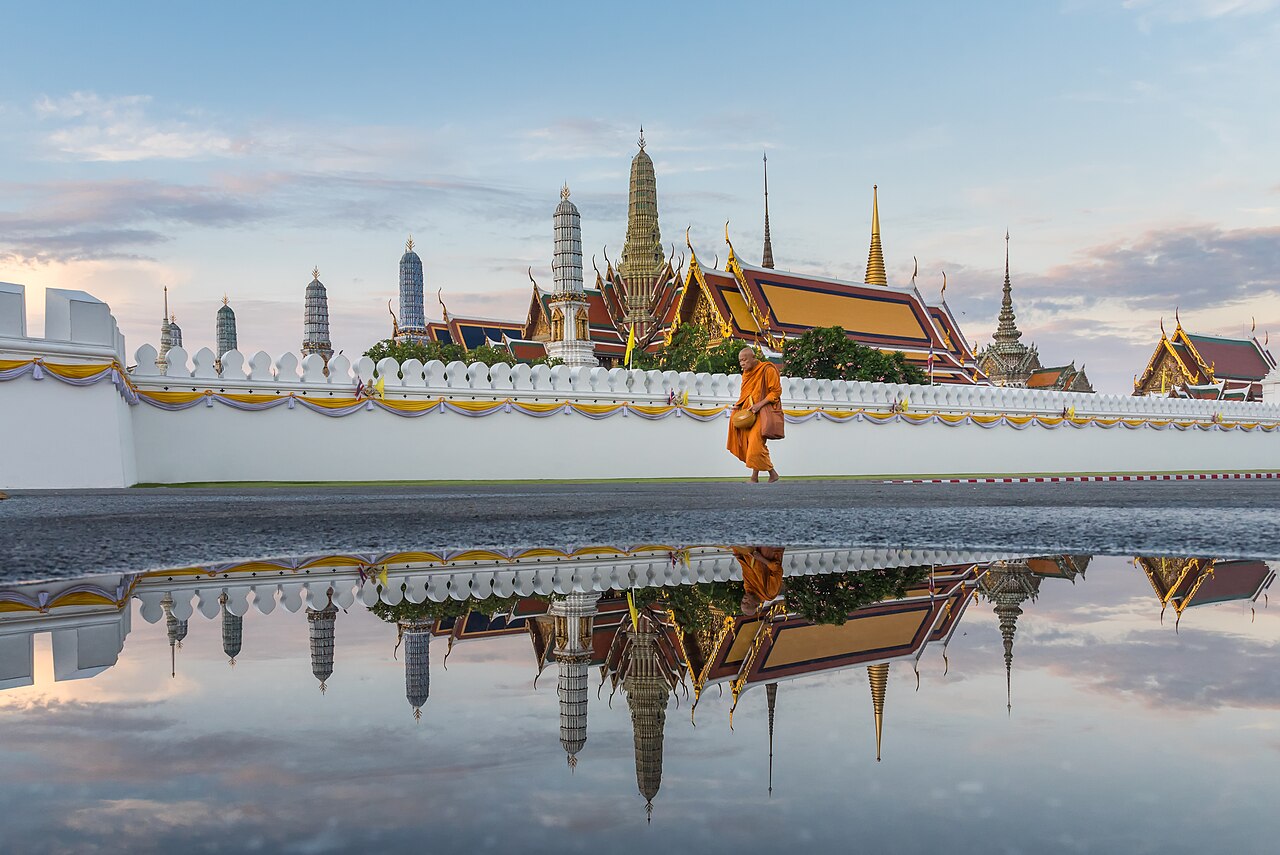
A Ramakien mural in the cloister of Wat Phra Kaew: a golden chariot and monkey soldiers in gold leaf on dark lacquerA monk in orange robes walks past the white crenellated wall of Wat Phra Kaew at dawn, the spires reflected in rainwater
A Ramakien mural in the cloister, and a monk passing the temple wall at dawn · photos CC BY 2.0 Jorge Láscar and CC BY-SA 4.0 Nawit science, Wikimedia Commons
The rite found nowhere else
The King changes the robes of the Emerald Buddha
The Emerald Buddha owns three seasonal costumes of gold: a diamond-studded golden robe for the cool season, a solid gold robe for the hot season, and a gilded monk's robe for the rainy season. Three times a year, on the first waning moon of the fourth, eighth, and twelfth Thai lunar months, falling around March, July, and November, the King of Thailand comes in person to the ubosot, cleanses the image, and changes its robes, a rite that by tradition only the reigning monarch may perform, invoking blessings on the kingdom for the season ahead.
The ceremony follows the Thai lunar calendar rather than fixed dates; Buddhist holy days also bring royal ceremonies and larger crowds, so come early on those mornings.
Plan your visit
By river
Chao Phraya Express Boat to Tha Chang pier, close to the palace entrance; from the BTS, ride to Saphan Taksin (exit 2) and take the express boat from Sathorn Pier.
By metro
MRT Sanam Chai station, exit 1, then bus routes 3, 9, 44, 47, 53, or 82 toward the Grand Palace, or walk up through the old city.
Timings
Open daily 8:30 am to 4:30 pm; tickets are sold from 8:30 am to 3:30 pm.
Entry
500 baht for foreign visitors, covering the Grand Palace, Wat Phra Kaew, and the Queen Sirikit Museum of Textiles. Thai nationals enter free with ID.
Dress
Strictly enforced: shoulders and knees covered. No sleeveless or see-through tops, shorts, torn or tight pants, or mini skirts. Cover-ups are available near the gate if you arrive short.
Best time
Be at the gate for the 8:30 am opening, before the tour groups arrive in force; allow two to three hours for the Temple and the palace around it.
The official name is Wat Phra Si Rattana Satsadaram; kaew means glass or jewel in Thai, so the "emerald" of the name describes the colour of the stone, not the mineral.
Photography is welcome in the courtyards but strictly prohibited inside the ubosot where the Emerald Buddha sits; drones are banned across the whole palace.
This is living worship: remove shoes and hats at the ubosot, sit with your feet pointed away from the Buddha image, and keep your voice low while people pray.
The Grand Palace grounds cover 218,000 square metres, so the Temple visit is also a walk; carry water and sun protection for the open courtyards.
Questions pilgrims ask
Is the Emerald Buddha actually made of emerald?
No. It is carved from a single block of semi-precious green stone, described as jasper or jade, 66 cm tall. In Thai, kaew means glass or jewel, and the image has been called emerald for its deep green colour since it emerged from its stucco covering.
Can I photograph the Emerald Buddha?
No. Photography is prohibited inside the ubosot, and the rule is enforced. You may photograph freely in the courtyards outside. Inside, do as Thai devotees do: kneel, bow three times, and simply look.
Do monks live at Wat Phra Kaew?
No. Unlike every ordinary Thai wat, the Temple has no resident monastic community and no living quarters. It is the Chapel Royal of the Chakri kings, a fully consecrated Temple kept for royal religious ceremonies, with monks invited in for rites.
Is it still a place of worship or just a monument?
It is very much alive. Thai Buddhists come to make merit and pray before the Emerald Buddha, royal ceremonies are held on Buddhist holy days, and the King himself changes the image's golden robes three times a year at the turn of each season.
Dharamshalas and guest houses near this Sthan, shared by devotees. Adisthan takes no bookings and no money; contact each stay directly.
No stays are listed here yet. Know one that serves pilgrims well?
Are you with the Bureau of the Royal Household or the offices that keep Wat Phra Kaew? Claim this page to keep its hours, ceremonies, and visiting guidance true for every devotee who comes to the Emerald Buddha.