What you request is what you get: a shepherd boy's promise, kept for a hundred years beneath the towers of Kowloon.
Be the first to check in
Coming up: First Incense Offering, Lunar New Year · 5 FebEntry tended 25 May 2026
Open 7:30 am to 4:30 pm daily Free · Taisui Yuanchen Hall HK$100 Kau chim fortune sticks First incense · Lunar New Year eve Five Phases layout · Grade I historic
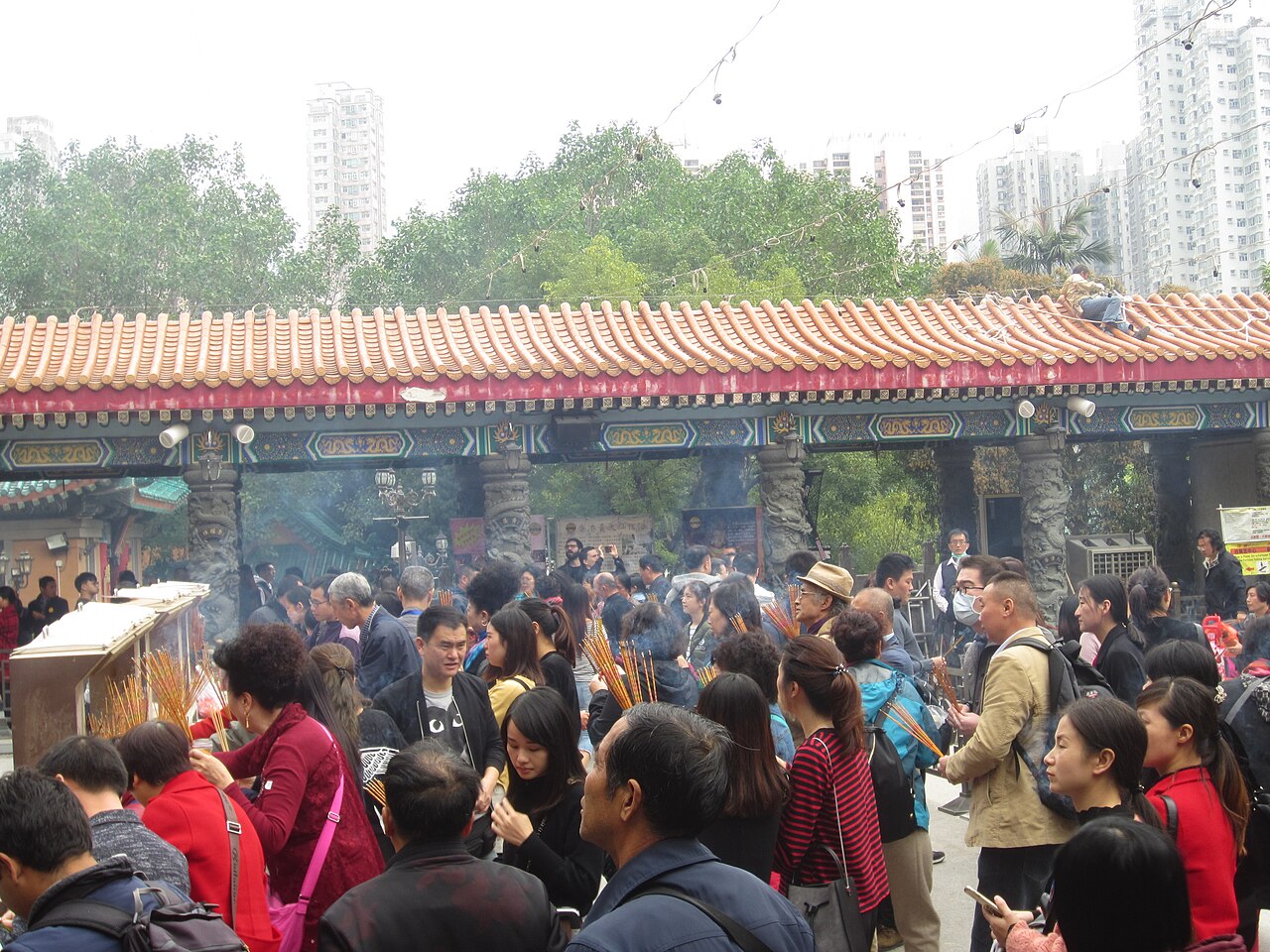
The sound reaches you before anything else: a dry, urgent rattling, hundreds of bamboo cylinders shaken at once, each holding its sheaf of numbered sticks. Incense smoke drifts over the kneeling crowd on the worshipping platform, and beyond them the red pillars and gilded roof of the Main Altar stand framed by the tower blocks of Kowloon. Somewhere in the din a single stick works itself loose and falls. This Temple was built on a promise, and Hong Kong has held it to that promise for a century: yau kau bit ying, what you request is what you get.
This is Hong Kong's great seat of kau chim, the bamboo fortune sticks. A worshipper kneels, asks one clear question, and shakes the cylinder until a single numbered stick falls; beside the Temple, an arcade of 160 soothsayers' stalls waits to read the answer.
Three teachings share one Temple. Sik Sik Yuen holds Taoism, Buddhism and Confucianism in equal honour: Master Wong Tai Sin at the Main Altar, Bodhisattva Guanyin in the Three Saints Hall, and Confucius in his own hall, under the principle of Three Religions with One Respect.
The Temple itself was laid out by its own deity. Tradition holds that the Master chose the site in 1921 through fuji planchette writing, and in 1937 directed that five of its buildings embody the Five Phases of metal, wood, water, fire and earth, never to be altered.
The shepherd, the boulders, and the flock
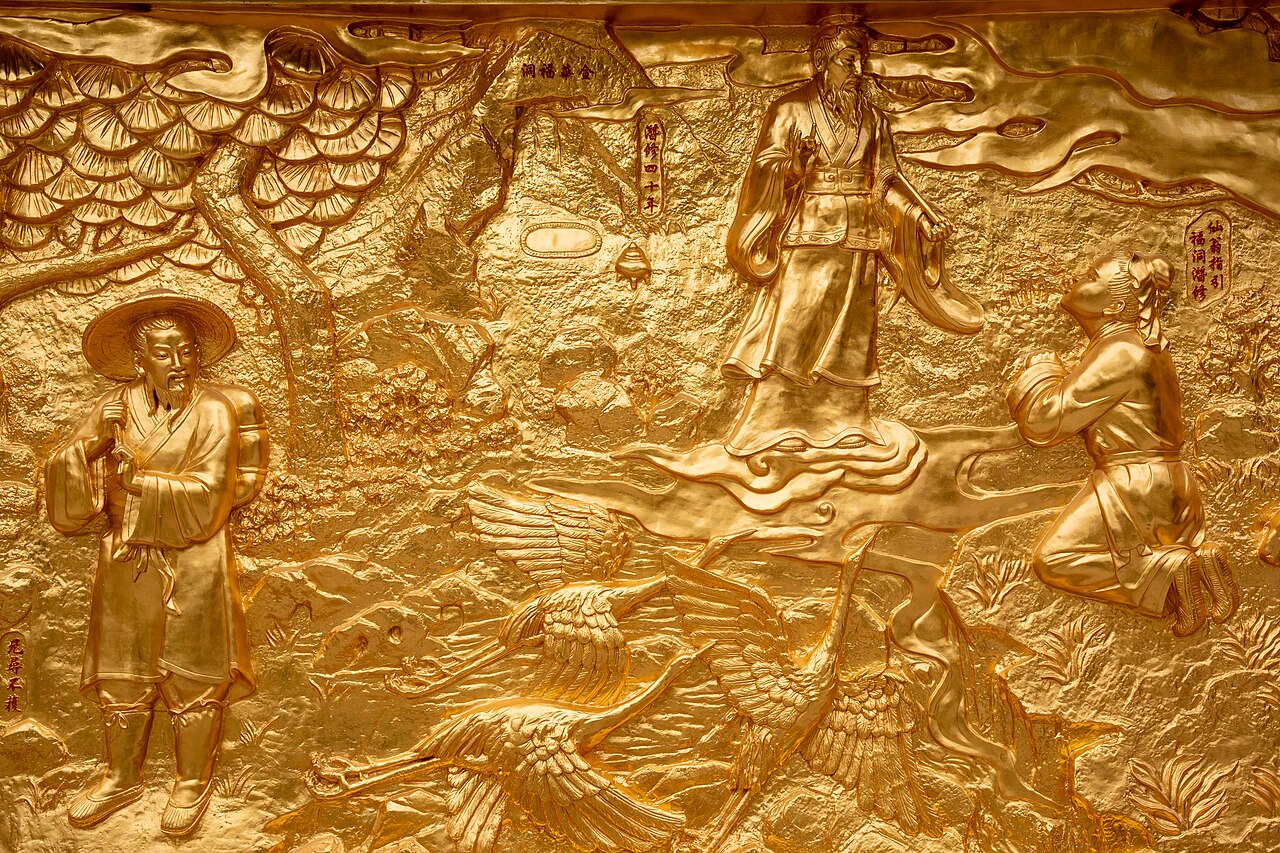
In the year 328, tradition holds, a boy named Wong Cho-ping was born to a poor family near Jinhua in Zhejiang. At eight he was herding sheep on Jinhua Mountain; at fifteen an immortal led him away to practise the Tao in a stone cave. His elder brother Wong Cho-hei never stopped searching, and after some forty years a Taoist priest finally brought the brothers together. When Cho-hei asked what had become of the flock, the Master led him to a heap of white boulders on the east side of the mountain and called out. The rocks stirred and rose as sheep. Cho-hei stayed, practised beside his brother, and attained the Tao in his turn. Because the Master perfected himself on Red Pine Hill, he is honoured as the Red Pine Immortal, Tsik Chung Wong Tai Sin.
The Great Immortal crossed to Hong Kong in a portrait. In 1915 the Taoist Leung Yan-am carried the Master's image from Namgong village in Guangdong to Wan Chai, setting up an altar first in his flat and then behind his herbal medicine shop. Fire destroyed the shop in 1918, but in April 1921 fresh guidance came through the planchette: build at Chuk Yuen in Kowloon, a place shaped like the wings of a phoenix. The Taoists marked the spot with a bamboo stick, raised the Main Altar that year, and in 1922 received the name Sik Sik Yuen from Emperor Wenchang through the same divine writing.
For decades the shrine was private, open only to Taoists and their families. From 1934 the gates opened to all during the first lunar month each year, and in 1956 the Temple opened fully to the public, its ten-cent entry fee given to the Tung Wah hospitals. That bargain set the Temple's character for good: what the Great Immortal receives, Sik Sik Yuen gives away, in clinics, schools and care for the elderly, under the Master's own teaching, to act benevolently and to teach benevolence.
What you'll actually see
1
The Main Altar
The heart of the Temple: red pillars, a golden roof with blue friezes, bronze lions draped in red sashes, and the plaque of the Red Pine Wong Immortal Shrine over the doors. Inside is the Master's throne, guarded on its left by the Monkey King. Rebuilt in 1973 and expanded from 2008 to 2010, it was declared a Grade I historic building in May 2010.
2
The kau chim platforms and the soothsayers' arcade
Before the Main Altar spread the worshipping platforms where devotees kneel with bamboo cylinders, the rattle rising and falling like weather. The numbered stick is exchanged for a printed slip, then carried to the Fortune-telling and Oblation Arcade beside the Temple, 160 stalls run by the Tung Wah Group of Hospitals, where soothsayers read the verse, palms and faces.
3
The Good Wish Garden and the Nine-Dragon Wall
Behind the halls lies a 5,580 square metre Chinese garden opened in 1991: winding corridors, a waterfall, an artificial lake, pavilions square, round, hexagonal and fan-shaped. Its path leads to a replica of Beijing's Nine-Dragon Wall from Beihai Park, and to a white jade flock of immortal sheep, a gift from the government of Lanxi, the Master's homeland.
Gilded relief mural at Wong Tai Sin Temple showing the Great Immortal Wong on clouds, the shepherd's forty years of cultivation, and cranes in flightDevotees raising bundles of incense sticks amid smoke before the pillared gateway of Wong Tai Sin Temple
The Master's legend in gilded relief, and devotees raising incense before the temple · photos CC BY 2.0 Raita Futo and CC BY-SA 4.0 Another Believer, Wikimedia Commons
The night Hong Kong queues for luck
The First Incense · Lunar New Year's Eve, 5 February 2027
On the last night of the lunar year the Temple does not close. In recent years the gates have reopened around 9 pm, and by 11 pm the presiding Taoist priest leads the offering of the year's first incense to the sound of drums and bells. As midnight turns, thousands press toward the Main Altar with glowing sticks held high, for tradition holds that the earlier your incense reaches the Great Immortal, the greater your share of the new year's luck. The Temple then stays open through the night and the first day. The Year of the Fire Goat arrives on 6 February 2027; the first incense belongs to the night of 5 February.
Crowd control is strict, with a one-way flow of worshippers; come hours early, travel by MTR, and keep your incense to three sticks.
Plan your visit
By rail
MTR Wong Tai Sin Station, Exit B2; the Temple gate is about three minutes on foot. The station, and the whole district, are named after the Master.
By air
Hong Kong International Airport; take the Airport Express toward Kowloon and continue by taxi, or ride the MTR network to Wong Tai Sin Station.
Timings
7:30 am to 4:30 pm daily, free. On the 1st and 15th of each lunar month the Temple stays open to 9 pm. Good Wish Garden and Taisui Yuanchen Hall, 8 am to 4:30 pm.
Entry
The Temple is free of charge. The Taisui Yuanchen Hall costs HK$100, half price for those aged 65 or above and visitors with disabilities.
Best time
Early on an ordinary weekday morning, when the platforms are quiet. The 1st and 15th lunar days, Lunar New Year and the Master's birthday bring the densest crowds of the year.
Kau chim
Kneel before the Main Altar, fix one clear question in your mind, and shake the bamboo cylinder gently until a single stick falls. Exchange its number for a printed verse, then take it to the arcade for interpretation.
Worship
Dress neatly and worship with sincerity, as the Temple asks. Offer a single stroke of three incense sticks; the Temple discourages burning more, and a bunch of flowers is welcomed as an ideal offering.
The name Sik Sik Yuen was given through planchette writing by Emperor Wenchang in 1922; the Great Immortal Wong is likely the only deity in the world with an MTR station named after him.
This was the first Taoist Temple in Hong Kong authorized by the government to conduct Taoist weddings and issue marriage certificates.
Wong Tai Sin belief and customs are inscribed on China's national list of intangible cultural heritage, and the Main Altar is a declared Grade I historic building.
In the underground Taisui Yuanchen Hall, home of the Sixty Taisui deities beneath an LED night sky of Hong Kong, the Temple provides sandalwood in place of burning incense as part of its green Temple commitment.
Questions pilgrims ask
Is Wong Tai Sin Temple Taoist, Buddhist or Confucian?
It is a Taoist Temple whose custodian body, Sik Sik Yuen, holds all three teachings in one respect. Master Wong Tai Sin presides at the Main Altar; the Three Saints Hall enshrines Lord Guandi, Bodhisattva Guanyin and Patriarch Lüzu together; and the Confucian Hall, the earliest public venue for worshipping Confucius in Hong Kong, holds the statue of the great sage.
How does kau chim actually work?
You kneel before the Main Altar with a bamboo cylinder of numbered sticks, silently ask one question, and shake the cylinder until one stick falls out. Its number matches a printed verse, which a soothsayer at the arcade beside the Temple interprets for you. Many worshippers carry the same verse to more than one stall to compare readings.
Do I have to pay to enter?
No. The Temple has always been free since it opened fully to the public, and Sik Sik Yuen is a registered charity: donations fund its clinics, schools and elderly care. The one paid hall is the Taisui Yuanchen Hall, at HK$100.
Who is the Great Immortal Wong?
A shepherd boy of fourth-century Zhejiang, Wong Cho-ping, who tradition says attained immortality after forty years of practice in a mountain cave, and proved it by turning white boulders back into his flock. He is loved as a healer, and his Temple's fame rests on the saying yau kau bit ying: what you request is what you get.
When is the Master's birthday?
The 23rd day of the eighth lunar month, which falls on 3 October in 2026. Sik Sik Yuen marks it with a full ritual celebration at the Main Altar, and the Temple is at its most festive.
Darshan from afar
From the temple's own channels. Nothing loads until you press play.
Dharamshalas and guest houses near this Sthan, shared by devotees. Adisthan takes no bookings and no money; contact each stay directly.
No stays are listed here yet. Know one that serves pilgrims well?
Are you with Sik Sik Yuen or the keepers of Wong Tai Sin Temple? Claim this page to keep its hours, rituals and festival dates true for every devotee who comes seeking the Great Immortal.