Gates from 4 or 5 am daily Chadar and rose offerings 815th Urs · from 11 Dec 2026 Qawwali at the mazar daily Free entry · all welcome Marble dome raised 1532
The lane narrows before it opens. Rose sellers press baskets of petals into the crowd, shops hang velvet chadars beside prayer caps, and somewhere ahead a harmonium finds its note. Then the yellow Nizam Gate lifts above the bazaar, and beyond it the white dome of the mazar floats over eight hundred years of arrivals. Look at the queue for ziyarat: pilgrims of every faith stand in it together. Gharib Nawaz, the benefactor of the poor, receives them all.
This is the tomb of Hazrat Khwaja Moinuddin Chishti, the saint who established the Chishti order in India, and it has been South Asia's principal Sufi shrine since the 13th century, drawing sultans, Mughal emperors, and millions of ordinary pilgrims.
In its courtyards stand the two great deghs, cauldrons gifted by Akbar in 1568 and Jahangir in 1614. The larger cooks up to 4,800 kg of sweet saffron rice at a time, counted among the largest cooking vessels on earth, and its blessed rice feeds thousands.
Devotion here crosses every community. Akbar walked from Agra on foot to give thanks for a son, and to this day Hindu, Sikh, Christian and Muslim pilgrims offer chadars side by side, including one sent each Urs by the Prime Minister of India.
The friend of the poor
Khwaja Moinuddin Chishti was born in Sistan, in eastern Persia, in 1143. Orphaned young, he gave away what he inherited and took the road of the seekers, becoming the disciple of Khwaja Usman Harooni in the Chishti line that traces its chain of transmission back to the Prophet Muhammad, peace be upon him. Tradition holds that the Khwaja reached Ajmer around 1192, in the last days of the Chauhan kingdom; historians place his settling here in the early years of the 13th century. He built no fort and sought no court. He fed the hungry, taught love towards all and malice towards none, and the town began to call him Gharib Nawaz, the benefactor of the poor.
On 6 Rajab 633 in the Islamic calendar, March 1236, the Khwaja passed into union with the Divine Beloved. That is why his death anniversary is called the Urs, the wedding. His mazar became a place of pilgrimage almost at once, and the great of the world came as beggars: Sultan Mahmud Khalji raised the Buland Darwaza, the marble dome rose over the tomb chamber in 1532, and Akbar came on pilgrimage at least fourteen times, walking the roughly 370 km from Agra in early 1570 to give thanks for the birth of his son Salim.
The Mughals kept building what devotion demanded: Shah Jahan's white marble mosque of 1637, his daughter Jahanara's Begumi Dalan before the tomb, Jahangir's degh, and in 1911 the Nizam of Hyderabad added the gate through which most pilgrims still enter. The shrine has never stopped growing, because the giving has never stopped.
What you'll actually see
1
The gates, one inside another
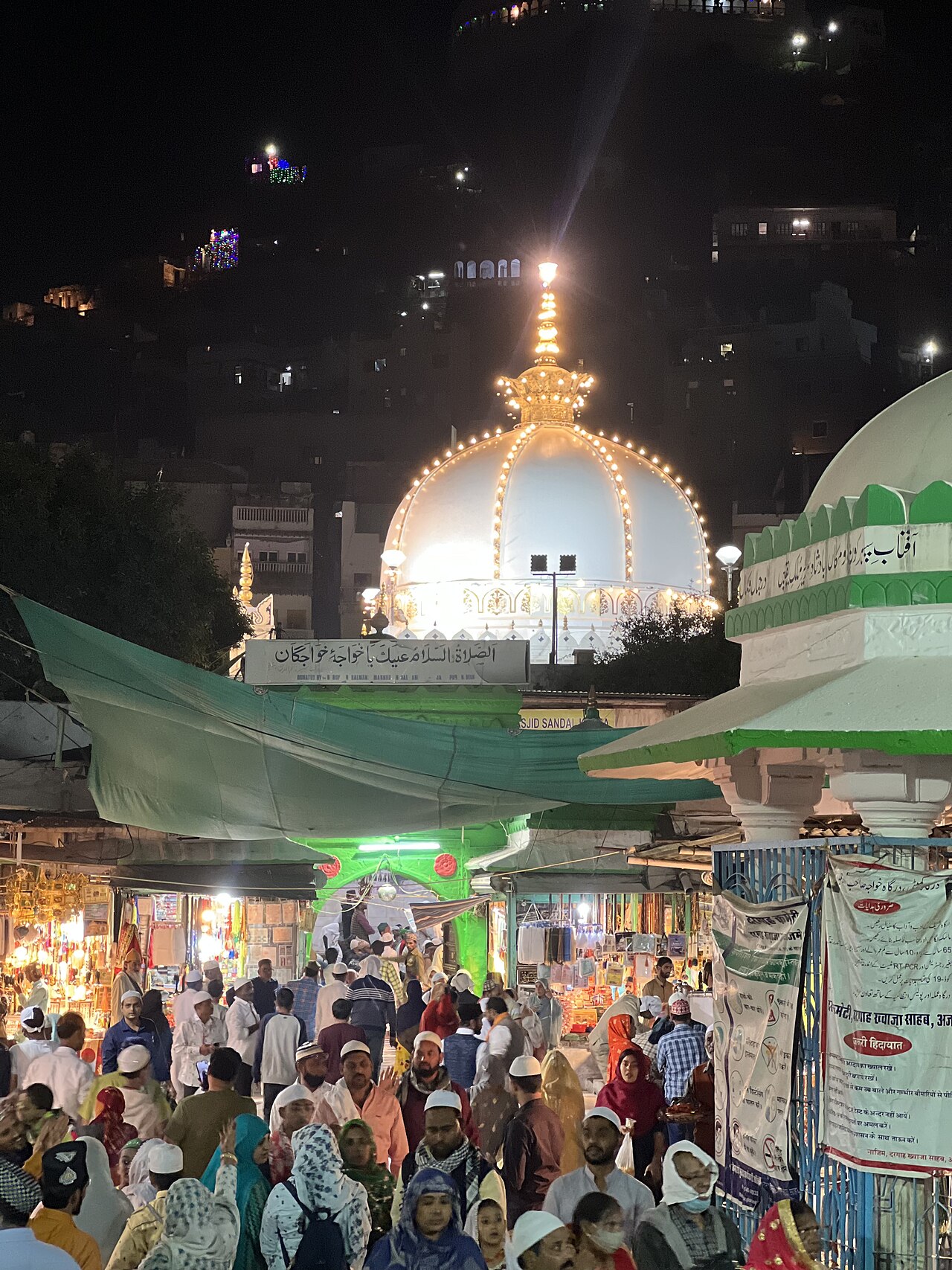
You enter through the Nizam Gate of 1911, a tall yellow gateway given by Mir Osman Ali Khan, the seventh Nizam of Hyderabad. Behind it stands the Shahjahani Gate, the Mughal emperor's offering, and behind that the older Buland Darwaza of Sultan Mahmud Khalji, on which the Urs flag is hoisted. Each gate is a century speaking to the next.
2
The two great deghs
Near the Buland Darwaza sit the two enormous cauldrons. The badi degh, presented by Akbar in 1568, cooks up to 4,800 kg of sweet rice with ghee, saffron, and dry fruits; the chhoti degh, given by Jahangir in 1614, holds about 2,240 kg. Pilgrims sponsor a degh and the blessed rice, tabarruk, is shared out to all present.
3
The mazar beneath the dome
The tomb chamber is small and blazing with love: silver railings around the grave, a canopy above it, mounds of rose petals and folded chadars, the scent of attar and sandal. Khadims, the hereditary servants of the shrine, receive pilgrims and recite fatiha. Above it all sits the white dome of 1532, crowned in gold.
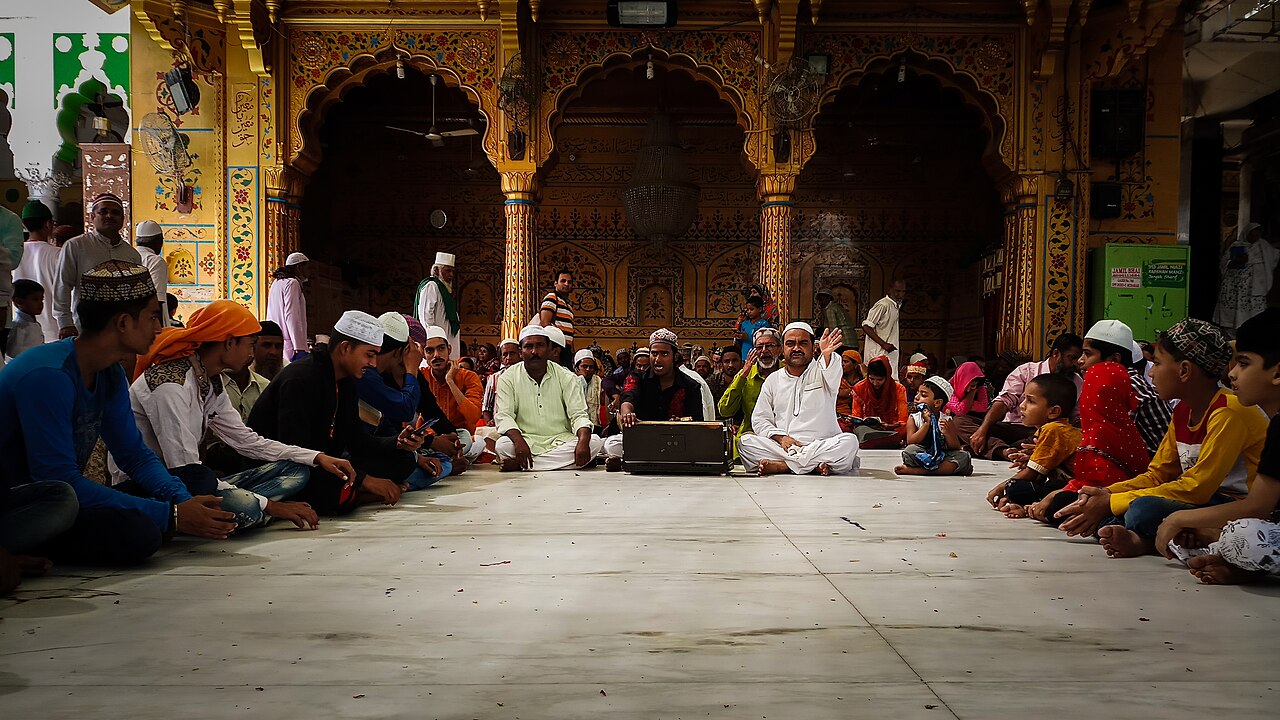
Qawwals with harmonium singing before pilgrims seated in a courtyard of the Ajmer Sharif DargahThe illuminated white dome of the Ajmer Sharif Dargah rising over the crowded bazaar during the Urs
Qawwali and the dome during Urs · photos CC BY-SA 4.0 and CC BY 4.0, Wikimedia Commons
The six days of the Urs
A death remembered as a wedding
Every year in the month of Rajab the dargah holds the Urs of Gharib Nawaz, six days marking his union with the Divine Beloved. The flag rises on the Buland Darwaza days before, the silver Jannati Darwaza opens, the deghs cook around the clock, and the mehfil-e-sama fills the nights with qawwali until the Qul on Chatti, the sixth of Rajab. Hundreds of thousands come, and by long custom the Prime Minister of India sends a chadar. The 815th Urs is expected from about 11 December 2026, with the main days running to Chatti on about 16 December and the flag ceremony on 5 December; final dates follow the sighting of the moon.
Urs crowds are immense and queues run for hours; for a quiet ziyarat, come in an ordinary month and enter soon after the gates open.
Plan your visit
By air
Kishangarh Airport is about 27 km northeast of Ajmer, with taxis to the dargah area.
By rail
Ajmer Junction is about 2 km from the dargah, with direct trains from Delhi, Jaipur, Ahmedabad and Mumbai.
On foot
From the station the walk runs through Dargah Bazaar; vehicles stop short of the gates, so the last stretch is always walked.
Timings
Roughly 5 am to 9 pm in winter and 4 am to 10 pm in summer; the mazar closes briefly in the afternoon for khidmat.
Dress
Cover your head inside (caps and scarves are sold and lent in the bazaar) and dress modestly; women are welcome.
Entry
Free for all. Footwear is deposited at stalls near the gates; offerings of chadar and flowers are by choice, never a condition.
Nearby
The pilgrimage town of Pushkar lies about 15 km away across the Nag Pahar hills; many pilgrims visit both.
Gharib Nawaz means benefactor of the poor, the name Ajmer gave the Khwaja in his own lifetime for the way he fed and sheltered whoever came.
The shrine is administered by the Dargah Committee constituted under the Dargah Khwaja Saheb Act of 1955 under the Government of India, while hereditary khadim families conduct the rituals and guide pilgrims through ziyarat.
The silver Jannati Darwaza opens on only a few occasions each year, chiefly the six days of the Urs, Eid ul-Fitr, the Urs of Khwaja Usman Harooni, and Eid al-Adha.
Degh offerings can be sponsored through the shrine's service families, and the sweet rice is distributed to everyone present, whoever they are.
Questions pilgrims ask
Can non-Muslims visit the dargah?
Yes. The dargah has welcomed pilgrims of every faith for centuries, and on most days a large share of visitors are not Muslim. Everyone covers their head, removes footwear, and is received the same way at the mazar.
What happens during ziyarat?
Pilgrims pass through the gates to the tomb chamber, where khadims receive them, offer their chadar or flowers at the grave, and recite fatiha. There is no fixed payment; give what your heart and means allow.
When is the next Urs?
The 815th Urs falls in Rajab 1448, expected from about 11 December 2026 with Chatti, the great sixth day, around 16 December. Islamic dates are confirmed by the moon sighting, so check with the dargah before travelling for the exact days.
What are the two giant cauldrons?
The deghs, gifts of the emperors Akbar and Jahangir. Sweet saffron rice is cooked in them, up to 4,800 kg at once in the larger, and shared as tabarruk, blessed food, with all present. Only sweet rice is cooked, so every community may eat from the same vessel.
Is photography allowed inside?
Rules change and are enforced by the khadims and the Dargah Committee, and photography close to the mazar is generally discouraged. Ask before raising a camera, and follow whatever you are told at the gates.
Dharamshalas and guest houses near this Sthan, shared by devotees. Adisthan takes no bookings and no money; contact each stay directly.
No stays are listed here yet. Know one that serves pilgrims well?
Do you serve the Dargah Committee or belong to a khadim family of Ajmer Sharif? Claim this page to keep timings, Urs dates, and degh offerings true for the pilgrims who set out towards Gharib Nawaz.