Two Imams rest under one gold, and Kadhimiya has never stopped walking to them.
Be the first to check in
Coming up: Martyrdom of Imam Musa al-Kadhim · 3 JanEntry tended 24 May 2026
Tombs of the 7th and 9th Imams Twin gold domes · four minarets Rebuilt by Shah Ismail I · 1502 to 1524 25 Rajab ziyarat · expected 3 to 4 Jan 2027 Free, by visitor accounts · no official fee listing found Kadhimiya, west bank of the Tigris
You come to Kadhimayn through the bazaar lanes on the Tigris' west bank, past copper sellers and shrouded black flags, and the twin domes rise gold above the rooftops before the gates do. Inside the marble sahn the noise falls away. Zuwwar in black move toward a corridor of mirrored tile that joins two shrine chambers into one, and a lattice of silver and gold encloses both graves at once. This is not one shrine built for one saint. It is two Imams, grandfather and grandson, sharing a single ground of gold.
Beneath the twin domes lie two of the Twelve Imams of Twelver Shia Islam: Musa al-Kadhim, the seventh Imam, buried here in 799 CE after dying in the custody of the Abbasid caliph Harun al-Rashid, and his grandson Muhammad al-Jawad, the ninth Imam, buried beside him in 834 CE.
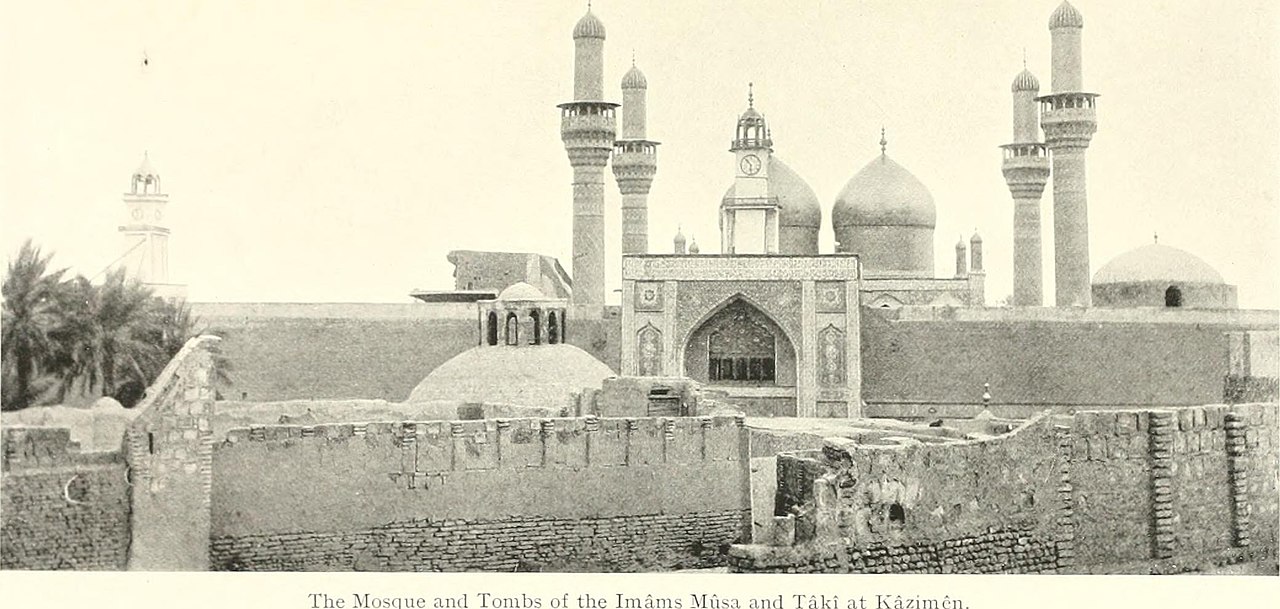
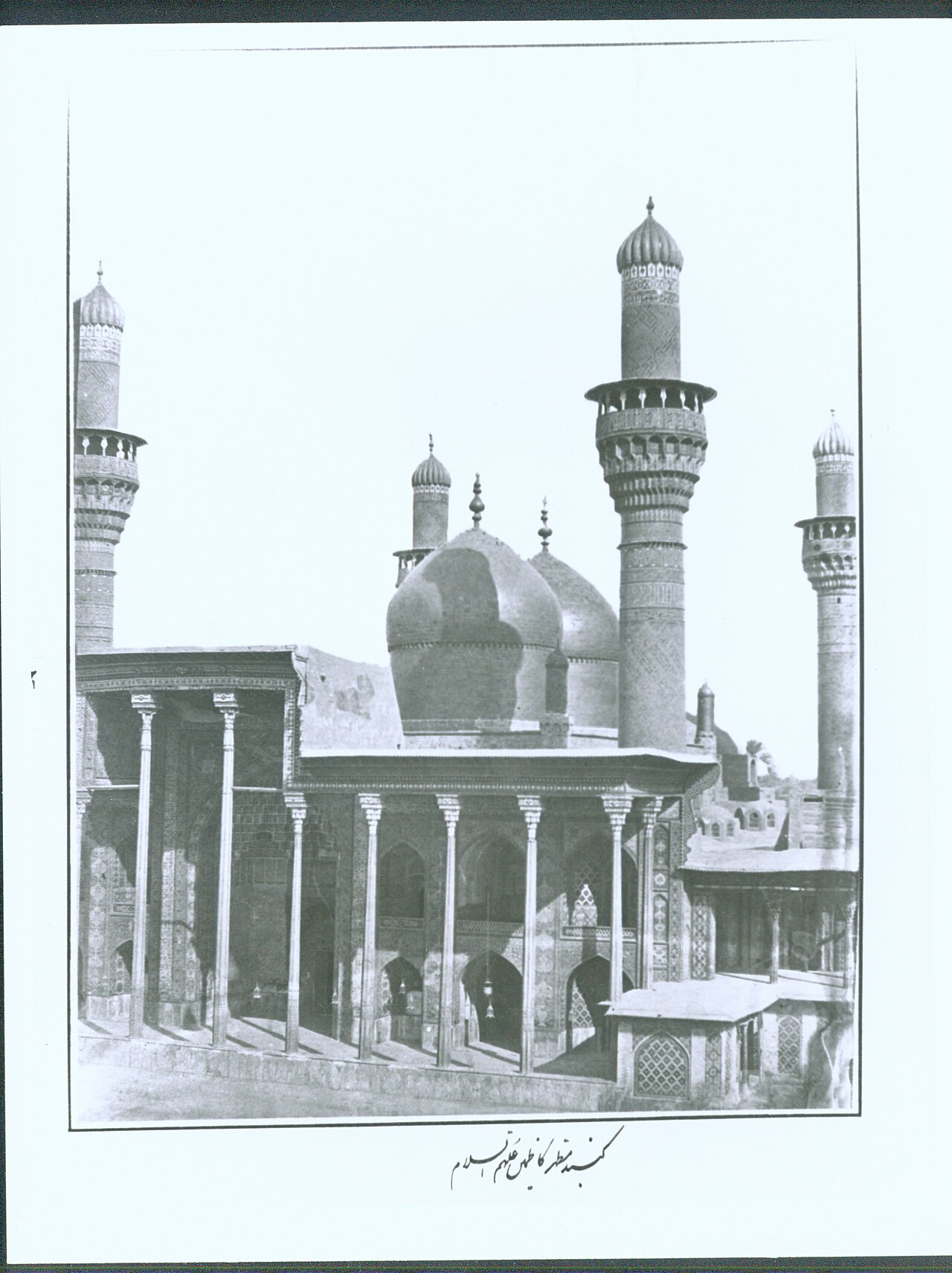
The building standing today was raised new by the Safavid Shah Ismail I between 1502 and 1524, then further ornamented by the Ottoman Sultan Suleiman the Magnificent after 1534. Its two domes are sheathed in some 9,000 bricks of pure gold over a ceiling twenty-five metres high, with four gilded minarets rising another thirty-five metres above it.
Kadhimayn is also a resting place of scholarship: buried within its walls are Shaykh al-Mufid and Nasir al-Din al-Tusi, foundational figures of Shia theology and philosophy, and, in two adjacent shrines, the brothers al-Sharif al-Radi, who compiled Nahj al-Balagha, and al-Sharif al-Murtaza.
Two Imams, one ground of gold
The ground beneath Kadhimayn was a graveyard before it was a shrine: a burial place for the family of the Abbasid caliphs, laid out with Baghdad's Round City in 762 CE and known locally as Shoneezi. Into that ground, in 799 CE, was lowered Musa al-Kadhim, the seventh Imam, who had spent his final years imprisoned in Baghdad on the order of Caliph Harun al-Rashid. Shia tradition holds that he was poisoned in custody and that his body lay exposed for three days before burial, proof, his followers insisted, that he had died a natural death and not by violence. His epithet, al-Kadhim, means the forbearing, the one slow to anger.
His grandson followed him into the same ground. Muhammad al-Jawad, the ninth Imam, died at little more than twenty-five in 834 CE; Shia sources hold he was poisoned by his estranged wife at the instigation of the caliph al-Mu'tasim. Jawad means the generous. Buyid rulers raised the first domed shrine and wooden enclosure over the two graves in the mid-tenth century and walled the precinct soon after, but the building that stands today is largely the work of the Safavid Shah Ismail I, who demolished the older structure and rebuilt it between 1502 and 1524, and of Suleiman the Magnificent, who ornamented it further once Ottoman Baghdad took it under its care after 1534.
Later centuries added what pilgrims see now: repeated regilding of the domes under Qajar and modern patronage, clock towers finished in 1884, and, from 1611, a firman of the Ottoman Sultan Ahmed I granting the mosque's custodianship to a family descended from Jamal al-Din bin Mullah Ali. Kadhimiya, the town that grew up around the shrine, takes its name from the two Imams' resting place; today the district and the shrine are simply called Kadhimayn, the two Kadhims, and pilgrims from across the Shia world still walk to them.
What you'll actually see
1
Through the gates into the sahn
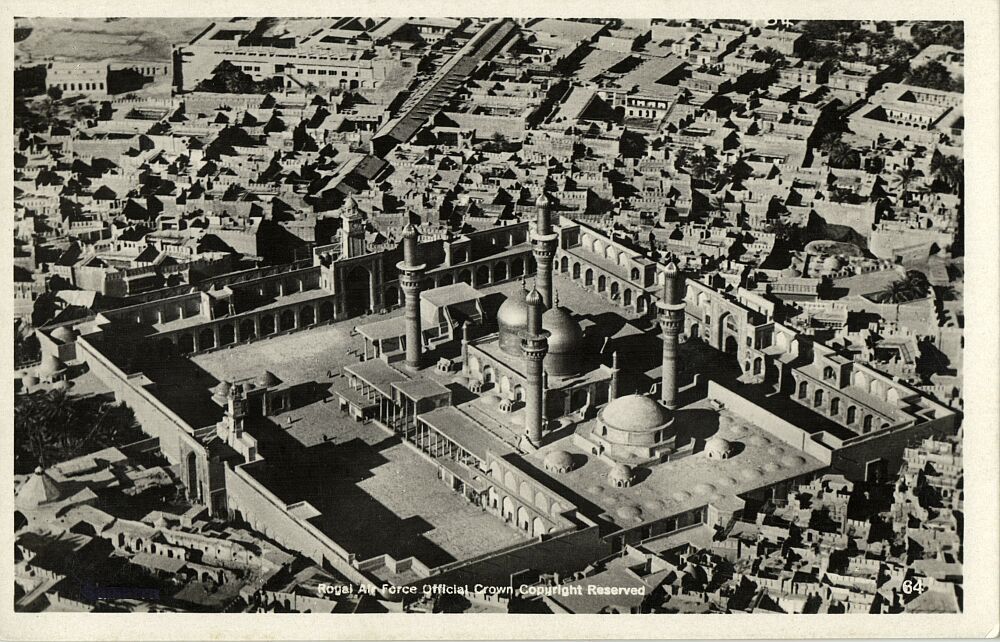
Several gates open onto the shrine, among them Bab al-Qibla and Bab al-Dirwaza; a gate for women, Bab al-Fatimah, was added in the shrine's modern expansion. Past security screening, the gates give onto a wide marble sahn, ringed by arcaded rooms once used for teaching, where the crowd gathers before the two great domes.
2
The twin domes and four minarets
Overhead, two domes of matching size, sheathed in thousands of bricks of pure gold, rise from a ceiling twenty-five metres up; four gilded minarets climb a further thirty-five metres beside them, and four smaller gilded turrets stand at the corners. Up close the gatehouses and iwans are worked in mirror mosaic and coloured tile, calligraphy and geometric pattern layered over every surface.
3
The rawdah and the zarih
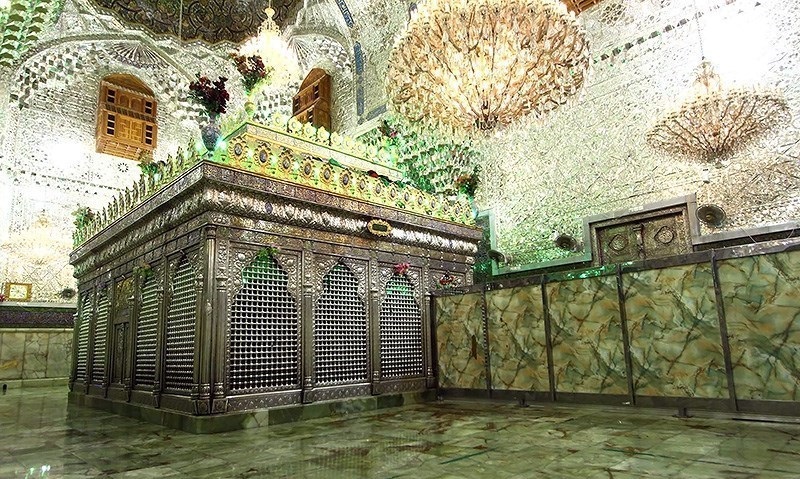
Inside, two rectangular shrine chambers, one for each Imam, are joined by a corridor of six doors so that visitors pass between them without leaving the sanctuary. A single lattice screen of silver and gold, the zarih, encloses both graves, and pilgrims press close to it in ziyarat, reciting salutations to the two Imams before circling toward the exit.
The Kadhimayn shrine's twin golden domes and minarets lit up against the night sky over BaghdadDaytime view of the Al-Kadhimiya Mosque's gold domes and minarets rising above the surrounding rooftops of the Kadhimiya district
The shrine by night and by day · photos by Muhammad Mahdi Karim, GNU Free Documentation License 1.2, and Sayed Mahmoud Javadi, CC BY 3.0, Wikimedia Commons
THE DAY KADHIMAYN TURNS TO MOURNING
The martyrdom of Imam Musa al-Kadhim · expected around 3 to 4 January 2027
On 25 Rajab the shrine is draped in black for the martyrdom of Imam Musa al-Kadhim, and zuwwar walk into Kadhimiya from across Baghdad and beyond, gathering for majalis of mourning poetry and recitation around the sahn. It is the single busiest day in the shrine's calendar, and its history carries real weight: on 31 August 2005, during this same ziyarat, a false rumour of a suicide bomber triggered a crush on the nearby Al-A'imma bridge that killed 965 pilgrims, one of the deadliest single losses of life in Iraq's post-2003 years, and in May 2016 a bomb attack during the same commemoration killed 21 more. Security around the day has been rebuilt heavily since.
Roads across western Baghdad close and security is at its tightest on this day; this is not a day for an independent first visit, and any visit should be arranged through a trusted local contact.
Plan your visit
By air
Baghdad International Airport lies about 29 km south of Kadhimiya. A taxi transfer is commonly cited at around half an hour in light traffic, though checkpoints across the city can extend this considerably.
Getting there
Baghdad has no metro serving Kadhimiya; visitors arrive by taxi or as part of an organised pilgrimage group and approach the shrine on foot through the Kadhimiya bazaar, which surrounds the complex on several sides.
Timings
The shrine functions around the five daily prayers and stays open to ziyarat through the day. Visitor accounts describe access from early morning into the evening, but no official visiting-hours schedule was found; expect longer closures around each prayer and on 25 Rajab. Confirm locally.
Entry
Entry is described as free by visitor accounts and travel guides. No official fee schedule was found to confirm this independently.
Dress
Modest dress is expected of all visitors, with women covering the hair; as at other Iraqi Shia shrines, a black abaya is commonly worn or offered to women at the entrance, though this shrine's specific practice could not be verified from an official source.
Security
Given the shrine's history of attack, security is reported by visitors as strict: bag checks, metal detectors, and restrictions on cameras and phones beyond the checkpoints. Treat this as a working description from visitor reports, not an official policy.
Non-Muslim visitors
Some tour operators and visitor accounts describe non-Muslim visitors as welcome outside major commemorations. No official statement confirming this was found, and security conditions can change access on short notice. Arrange any visit through a knowledgeable local guide.
The names Kadhim, the forbearing, and Jawad, the generous, are the epithets of Musa al-Kadhim and Muhammad al-Jawad; the shrine and the district around it are known together as Kadhimayn, the two Kadhims.
This is a different shrine from Najaf, resting place of the first Imam, Ali, and Karbala, resting place of the third Imam, Husayn; the three cities form separate pilgrimage destinations within Iraq's Shia geography.
The shrine's forecourts have been expanded in recent years, a project reported to have removed older houses and Ottoman-era buildings from the surrounding quarter, a matter of ongoing concern among heritage advocates.
The mosque continues to serve as a working Friday congregational mosque as well as a shrine, so the sahn fills further at jumu'ah.
Questions pilgrims ask
Is this the same shrine as Najaf or Karbala?
No, and the three are often confused. Najaf holds the tomb of Imam Ali, the first Imam; Karbala holds the tomb of Imam Husayn, the third Imam, and of Abbas ibn Ali; Kadhimayn holds Musa al-Kadhim, the seventh Imam, and his grandson Muhammad al-Jawad, the ninth. Each is a distinct pilgrimage city in Iraq's Shia geography.
Why does the shrine have two golden domes?
Because it holds two Imams. Musa al-Kadhim and his grandson Muhammad al-Jawad are buried side by side in adjoining chambers joined by a shared corridor, each beneath its own dome, enclosed together within a single lattice screen, the zarih. It is one of very few shrines built for two Imams at once.
Can non-Muslims visit?
Accounts differ and no official policy could be confirmed. Several tour operators and visitor reports describe non-Muslim visitors as welcome outside the busiest commemorations, subject to modest dress and security screening, but access can tighten without notice given the shrine's security history. Anyone planning a visit should go with a trusted local guide rather than relying on general claims found online.
What happened near the shrine in 2005?
On 31 August 2005, during the ziyarat for Imam Musa al-Kadhim's martyrdom anniversary, a rumour of a suicide bomber among roughly a million pilgrims caused a panic on the nearby Al-A'imma bridge over the Tigris. The crush and the collapse of a railing killed 965 people, one of the single deadliest losses of life in Iraq since 2003. It is remembered with grief in Kadhimiya, and it is part of why security around the 25 Rajab commemoration remains heavy today.
Who else is buried at the shrine?
Alongside the two Imams lie the theologian Shaykh al-Mufid and the polymath Nasir al-Din al-Tusi, both central figures in the development of Twelver Shia scholarship. Two smaller shrines directly beside the mosque hold the brothers al-Sharif al-Radi, compiler of the classic anthology Nahj al-Balagha, and al-Sharif al-Murtaza, along with the early jurist Qadi Abu Yusuf al-Ansari.
Dharamshalas and guest houses near this Sthan, shared by devotees. Adisthan takes no bookings and no money; contact each stay directly.
No stays are listed here yet. Know one that serves pilgrims well?
Do you serve the endowment or administration of the Kadhimayn shrine? Claim this page to keep its guidance exact for every pilgrim who walks to Kadhimayn.