Prayer inside is for Muslims Lives around the five daily prayers Jumu'ah of tens of thousands Dome of the Rock · 691 CE Ramadan · from about 8 Feb 2027 Free entry
You climb through the stone alleys of the Old City, pass under an arched gate, and the noise falls away. Fourteen hectares of open esplanade spread before you: cypress and olive trees, worn pavements, domes small and great, and above them all a dome of gold that holds the morning light. At the southern end waits a long prayer hall under a dome of silver-grey lead. Know this, for it changes everything you see: the whole walled sanctuary, every court and colonnade of it, is al-Masjid al-Aqsa, the Farthest Mosque of the Night Journey.
The destination of the Isra. The Quran opens its seventeenth surah here: Glory to the One Who carried His servant by night from al-Masjid al-Haram to al-Masjid al-Aqsa (Quran 17:1). Tradition holds that the Prophet Muhammad, peace be upon him, led the prophets in prayer on this spot, then ascended through the heavens in the Mi'raj.
The first qibla of Islam. The Prophet, peace be upon him, and his companions prayed facing Bayt al-Maqdis for sixteen or seventeen months after the hijrah, before the qibla was turned to the Kaaba (Sahih al-Bukhari 399). It is also one of the only three mosques to which the Prophet said a journey may be set out (Sahih al-Bukhari 1189).
The second mosque placed on earth. When Abu Dharr asked which mosque was built first, the Prophet, peace be upon him, answered al-Masjid al-Haram, then al-Masjid al-Aqsa, forty years between them (Sahih al-Bukhari 3366). At its heart stands the Dome of the Rock of 691 CE, the oldest surviving work of Islamic architecture on earth.
The blessed precinct
This limestone height was holy long before the first minaret rose over it. Here stood the ancient Temples of the Jewish people: the First Temple, destroyed by Babylon in 586 BCE, and the Second Temple, destroyed by Rome in 70 CE. To Judaism the platform is the Temple Mount, its holiest place, and the western retaining wall below is the Kotel at which Jews have prayed for centuries. Islam arrived carrying its own bond to the same rock: the Night Journey of the Prophet, peace be upon him, and the first qibla toward which the first Muslims turned their faces.
When the caliph Umar, may Allah be pleased with him, received the city in the seventh century, tradition tells that he had the esplanade cleansed and a simple prayer hall raised at its southern edge. The Umayyads built in glory upon it: Abd al-Malik raised the Dome of the Rock over the Foundation Stone in 691 to 692 CE, and the congregational mosque took form by the reign of al-Walid I, around 705 to 715 CE. Earthquakes threw the hall down more than once; the mosque a pilgrim enters today still follows the Fatimid caliph al-Zahir's rebuilding of about 1035.
Crusaders took the city in 1099 and made the mosque a palace, then the headquarters of the Knights Templar. When Salah ad-Din restored Jerusalem in 1187, the sanctuary was returned to prayer within a week, and the carved minbar that Nur ad-Din had prepared for that day was carried in. Today the sanctuary is administered by the Jerusalem Islamic Waqf under the Hashemite custodianship of Jordan, within the Old City that UNESCO inscribed as World Heritage in 1981.
What you'll actually see
1
The Qibli Mosque, under the silver dome
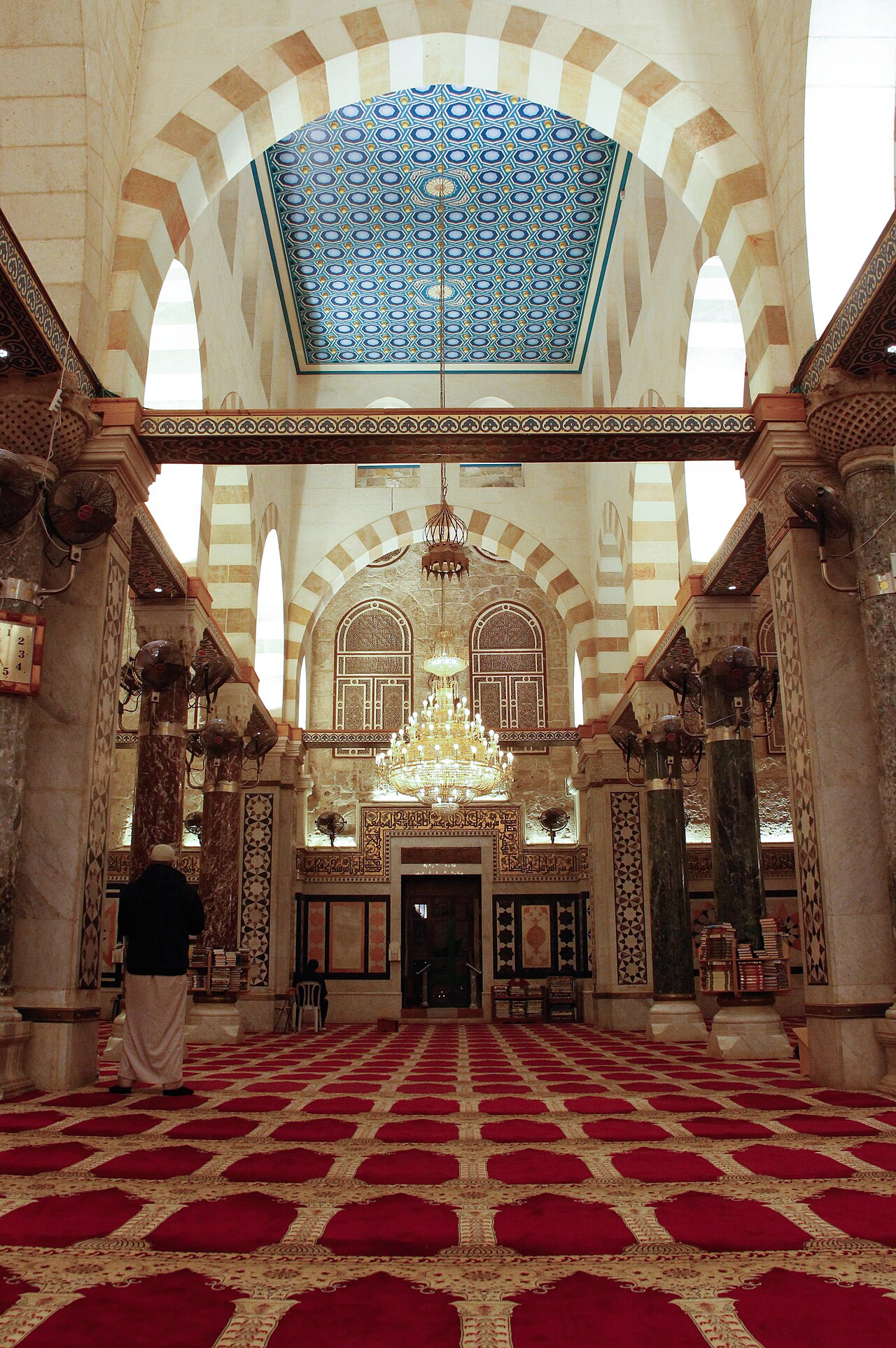
The long hall at the southern wall is the congregational mosque, called al-Jami' al-Aqsa or the Qibli Mosque because it stands nearest the qibla. Seven aisles of marble columns run under a dome sheeted in silver-grey lead, and about 5,000 worshippers fill its carpets at prayer. Beside the mihrab stands the minbar of Salah ad-Din, burned in an arson attack in 1969 and remade by Jordanian craftsmen in 2007, joined in the old way without a single nail.
2
The Dome of the Rock
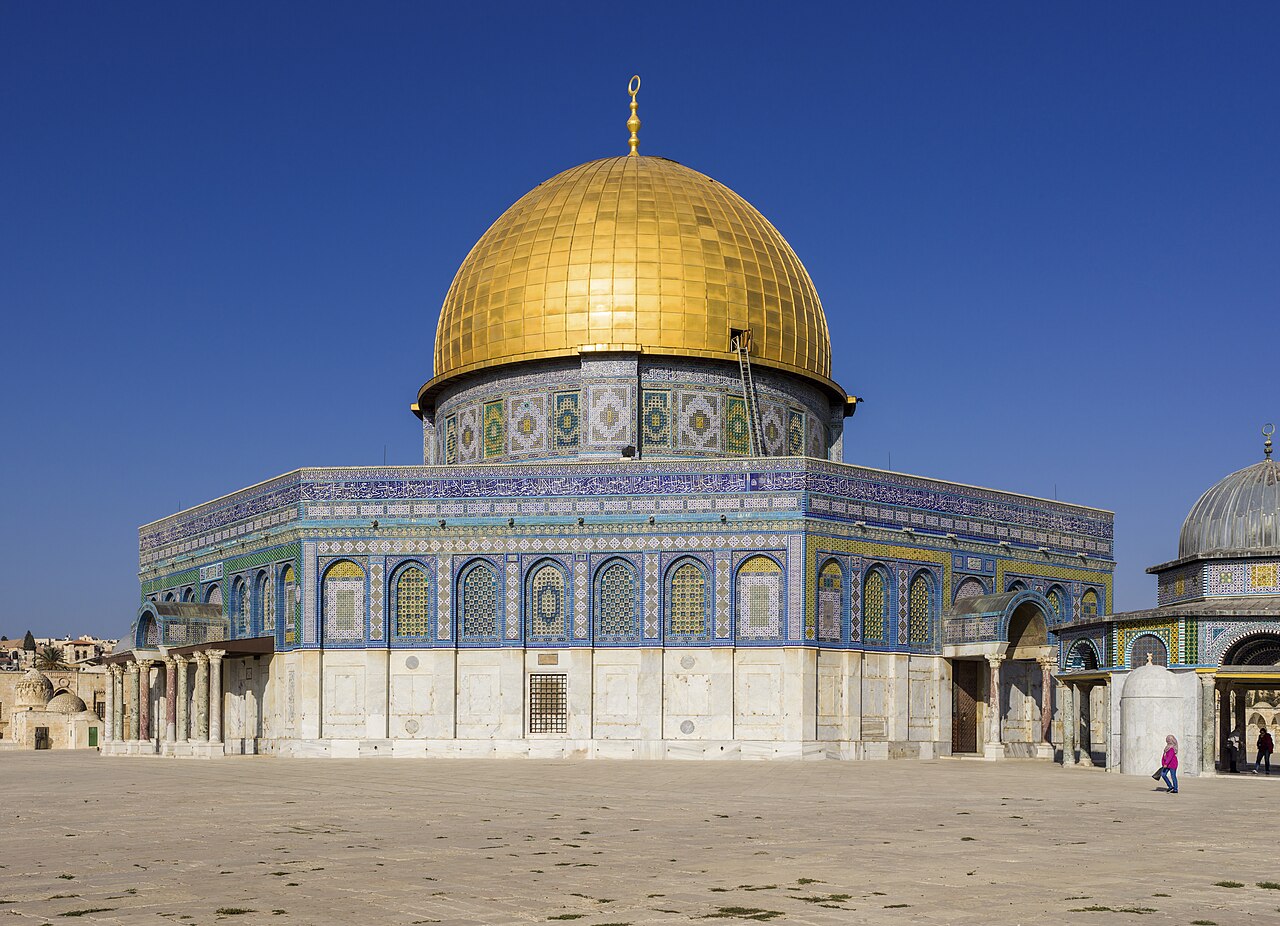
At the centre of the esplanade, on a raised platform reached by free-standing arched stairways, stands Qubbat al-Sakhra: an octagon of Persian tiles and Quranic calligraphy crowned in gold, completed in 691 to 692 CE under Abd al-Malik. Within it lies the Foundation Stone, from which tradition holds the Prophet, peace be upon him, ascended in the Mi'raj. Its dome was regilded in 1993 with 80 kilograms of gold given by King Hussein of Jordan.
3
The esplanade and its quiet corners
Between the two great buildings spreads the sanctuary itself: fountains for wudu, the small Dome of the Chain marking the compound's exact centre, olive groves where families sit between prayers, and stairways where students recite. Under the southeastern corner the vast vaulted Marwani prayer hall opens underground. On Ramadan nights the courts themselves become one immense mosque, filled far beyond a hundred thousand worshippers.
The golden Dome of the Rock on its raised platform at the centre of the Al-Aqsa compoundMarble columns and carpets inside the prayer hall of the Qibli Mosque
The Dome of the Rock and the Qibli prayer hall · photos CC BY-SA 4.0 (Godot13, Moataz1997), Wikimedia Commons
THE MONTH THE COURTS OVERFLOW
Ramadan at al-Aqsa · expected from about 8 February 2027
Each Ramadan the sanctuary becomes what its name promises: one mosque fourteen hectares wide. Worshippers spread across the courts for tarawih under the open sky, and on the nights sought for Laylat al-Qadr the crowds swell into the hundreds of thousands; the Jerusalem Islamic Waqf counted about 180,000 at isha and tarawih on the 26th night of Ramadan in March 2026, and around 100,000 at a single Ramadan jumu'ah that year. Ramadan 1448 is expected to begin around 8 February 2027, with Eid al-Fitr prayer expected around 9 March 2027, both subject to the sighting of the moon.
Come early on Ramadan Fridays and the last ten nights; access arrangements around the gates change at short notice, so check locally before setting out.
Plan your visit
By air
Ben Gurion Airport is about 50 km away; direct trains run to Jerusalem Yitzhak Navon station, then light rail or taxi toward the Old City.
Getting in
Muslim worshippers enter through the sanctuary's many open gates from the surrounding streets, such as Bab al-Silsila and Bab Hutta. Non-Muslim visitors are admitted only through the Mughrabi Gate, reached from the Western Wall plaza.
Timings
The sanctuary lives around the five daily prayers, Fajr, Dhuhr, Asr, Maghrib and Isha, with jumu'ah replacing Dhuhr on Friday. Non-Muslim visiting is typically Sunday to Thursday, a morning window of roughly 7:30 to 11:00 and a shorter early afternoon window, closed Friday, Saturday and Muslim holidays.
Entry fee
Free. There is no ticket for worship or for visiting the courtyards.
Best time
For worshippers, Fajr, when the esplanade is quiet and the light comes up the Mount of Olives. For visitors, the start of the morning window, before groups arrive.
Dress
Modest dress for all: legs and shoulders covered, and women cover the hair inside the prayer halls. Scarves and cover-ups are usually available near the gates.
Security
Screening at the gates; non-Muslim visitors show identification at the Mughrabi Gate and may not bring religious articles onto the esplanade. Arrangements change without notice, so check current conditions on the day.
Al-Aqsa means the farthest. In the widest and oldest sense the name belongs to the whole 144-dunam sanctuary, al-Haram al-Sharif; the silver-domed hall is properly al-Jami' al-Aqsa or the Qibli Mosque, and the golden dome is Qubbat al-Sakhra, the Dome of the Rock, a shrine rather than a congregational mosque.
The platform is also the Temple Mount, the holiest place in Judaism, where the First and Second Temples stood; its southwestern wall is known to Jews as the Western Wall and to Muslims as al-Buraq Wall, where tradition holds the Prophet, peace be upon him, tethered the Buraq on the night of the Isra. This page takes no side in questions the traditions themselves contest.
Traditions multiply the reward of prayer here: a narration counts one prayer in Bayt al-Maqdis as five hundred prayers, and the Prophet, peace be upon him, told Maymunah that one who cannot travel here should send oil to light its lamps (Sunan Ibn Majah 1407).
Under the long-standing status quo arrangements, only Muslims pray within the sanctuary; visitors of other faiths may walk the courtyards during the set visiting windows but do not enter a period of worship.
Questions pilgrims ask
Is al-Masjid al-Aqsa a single building?
No, and this is the most common misunderstanding. In Islamic usage al-Masjid al-Aqsa is the entire walled sanctuary of about 14 hectares, with all its courts, gates, domes and prayer halls. The silver-domed congregational mosque at the southern wall is the Qibli Mosque, and the golden Dome of the Rock at the centre shelters the Foundation Stone. Prayer anywhere within the walls is prayer in al-Masjid al-Aqsa.
Can non-Muslims visit?
The courtyards, yes, within set windows: entry is through the Mughrabi Gate beside the Western Wall plaza, typically Sunday to Thursday in a morning window of roughly 7:30 to 11:00 and a shorter early afternoon window, closed Friday, Saturday and Muslim holidays. Entry to pray inside the Qibli Mosque and the Dome of the Rock is for Muslims, and under the status quo non-Muslims do not pray on the esplanade. Hours and arrangements change, so check current conditions before you go.
Why is this Islam's third holiest place?
Because of what the Quran and the Prophet, peace be upon him, said of it. It is the destination of the Night Journey (Quran 17:1), the first qibla toward which Muslims prayed for sixteen or seventeen months (Sahih al-Bukhari 399), the second mosque placed on earth after al-Masjid al-Haram (Sahih al-Bukhari 3366), and one of the three mosques to which a journey may be set out, after Makkah and Madinah (Sahih al-Bukhari 1189).
What is the Dome of the Rock?
A shrine, not a congregational mosque. Completed in 691 to 692 CE under the Umayyad caliph Abd al-Malik, it is the oldest surviving work of Islamic architecture, an octagon of tile and calligraphy built over the Foundation Stone from which tradition holds the Prophet, peace be upon him, ascended in the Mi'raj. The congregation prays jumu'ah in and around the Qibli Mosque at the southern wall.
What does this site mean to Judaism?
The platform is Har HaBayit, the Temple Mount, the holiest place in Judaism, where the First and Second Temples stood and where the Holy of Holies is remembered; many observant Jews do not ascend it out of reverence, and Jewish prayer gathers at the Western Wall below. Both traditions hold this ground beloved, and this page presents each in its own voice without taking sides.
Dharamshalas and guest houses near this Sthan, shared by devotees. Adisthan takes no bookings and no money; contact each stay directly.
No stays are listed here yet. Know one that serves pilgrims well?
Do you serve with the Jerusalem Islamic Waqf or an authorized body of the sanctuary? Claim this page to keep its guidance exact for every worshipper and visitor who seeks al-Masjid al-Aqsa.