Raised as the palace of Lord Vishnu, kept as the house of the Buddha: nine centuries, and the prayer has never stopped.
Be the first to check in
Coming up: Khmer New Year (Choul Chnam Thmey) and Angkor Sankranta · 14 AprEntry tended 29 Jun 2026
Open 5:00 am to 5:30 pm Angkor Pass · $37 / $62 / $72 Khmer New Year · 14 to 16 Apr 2027 Built 1113 to 1150 · Khmer Living Theravada worship
You cross the water in the dark. The causeway runs two hundred metres over a moat wide enough to hold the sky, and ahead the five towers slowly separate from the night. At the reflecting pond the crowd falls quiet as the sun climbs behind the lotus-bud spires. Inside, past long galleries of carved stone, incense is already burning before the Buddha, set there by hands that keep a very old habit. This is not a ruin with a memory. The worship here has never stopped.
The largest religious monument on earth: an outer enclosure of 82 hectares inside a moat nearly 200 metres wide and five and a half kilometres around, the whole precinct covering close to 200 hectares.
A Temple that changed faiths without ever closing: built for Lord Vishnu by King Suryavarman II, passing gradually into Theravada Buddhist keeping from the late 13th century, and in continuous worship to this day.
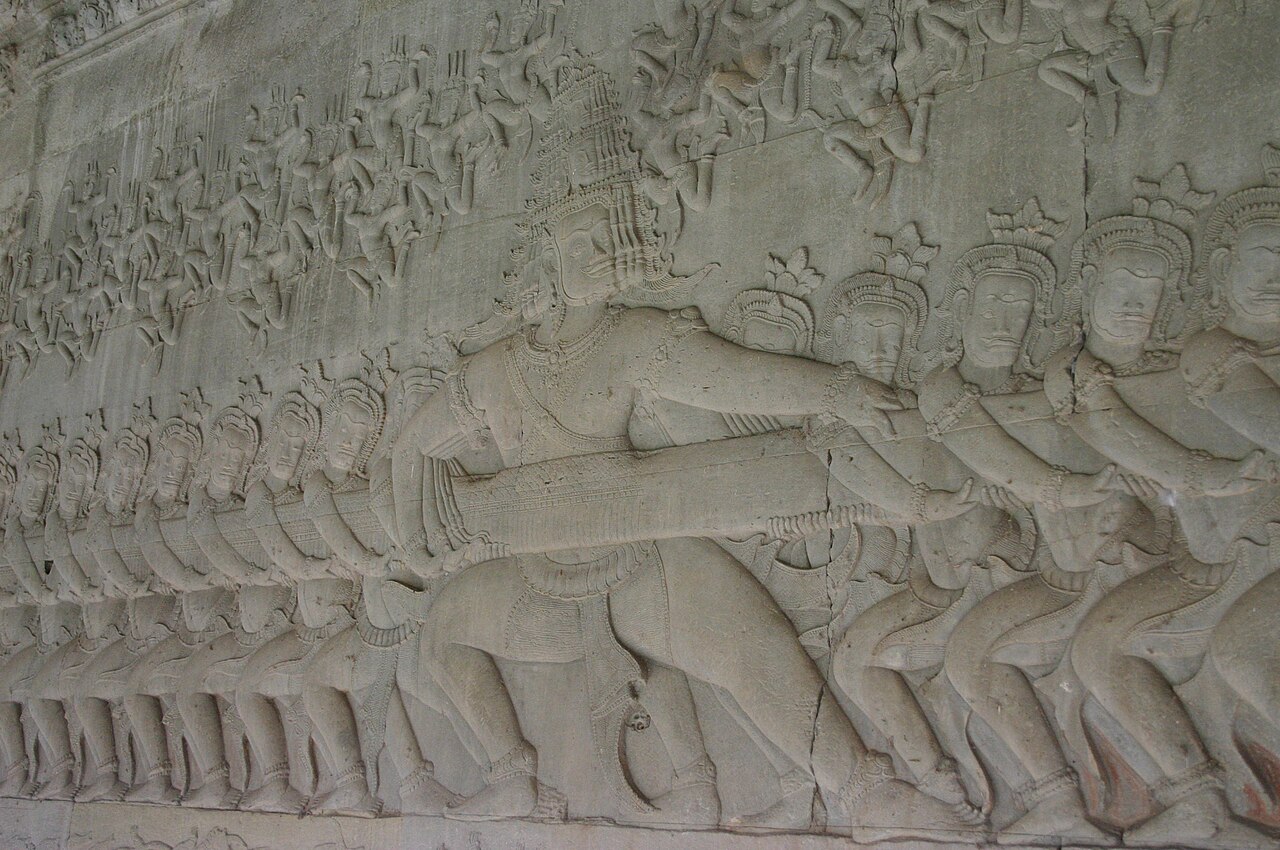
More than 1,000 square metres of bas-reliefs, in panels two metres high, wrap the lower galleries: the Churning of the Sea of Milk, the Battle of Kurukshetra, and nearly 1,800 carved devatas watching from the walls.
The palace of Vishnu that became a house of the Buddha
In the first half of the 12th century, King Suryavarman II raised his state Temple as the earthly residence of Lord Vishnu, the divine palace in which the king himself would dwell after death. His posthumous name, Paramavisnuloka, says it plainly: he who has entered the heaven of Vishnu. Some thirty years of labour went into the mountain of sandstone. Alone among the great sanctuaries of Angkor it faces west, and its reliefs are read counter-clockwise, in the reversed order of Brahmanic funerary rite.
Cambodia turned toward Theravada Buddhism, and the Temple turned with it, gradually, from the late 13th century, without ever being abandoned. In the Middle Period pilgrims came from across Buddhist Asia to what was then called Preah Pisnulok, leaving 41 inscriptions on the pillars of the Preah Poan gallery, in Khmer laced with Pali, and in Burmese and Japanese besides, recording their vows of truth and their pure faith. In the later 16th century a royal work sealed the four doorways of the central sanctuary with sandstone, and on each new wall a standing Buddha was carved: the old sanctum of Lord Vishnu reconceived as a stupa, the four Buddhas of the past enclosing the chamber that holds Maitreya, the Buddha to come.
The Temple kept its secrets a long time. In the 1930s, archaeologists sounding the well beneath the central tower found the original foundation deposit 23 metres down: two circular gold leaves set in a laterite block. Above ground, the silhouette had long since passed into the nation's keeping: Angkor Wat has always figured on the Cambodian flag. UNESCO inscribed Angkor on the World Heritage List on 14 December 1992, and the monks still tend the shrines.
What you'll actually see
1
The moat, the causeway, and Ta Reach
You enter from the west across a sandstone causeway 200 metres long and 12 metres wide, past lion guardians and naga balustrades, into a colonnaded gate nearly a quarter of a kilometre across. In its southern portico stands a colossal statue honoured as Ta Reach, the most powerful guardian spirit of the Angkor region, wrapped in cloth and still receiving offerings. Its original head, kept safe for years at the National Museum in Phnom Penh, was restored to the body in 2003.
2
The bas-relief galleries
The open galleries of the lower enclosure carry carved panels two metres high and more than 1,000 square metres in all, read counter-clockwise. The Battle of Kurukshetra rages on the west; Suryavarman II rides in procession on the south beside the 37 Heavens and 32 Hells, each hell named in stone; and on the east, gods and demons wind the serpent Vasuki around Mount Mandara and churn the Sea of Milk for the nectar of immortality. The northeast corner was carved four centuries later, in the 16th century, when a Buddhist kingdom still remembered its Brahmanic past.
3
Preah Poan and the Bakan
The cruciform cloister called Preah Poan, the Thousand Buddhas, filled over centuries with images in stone, wood and metal left by pilgrims; some remain in place and are venerated still. Beyond it a steep stair climbs to the Bakan, the uppermost terrace, where the sealed doorways carry their standing Buddhas and incense burns beneath the central tower.
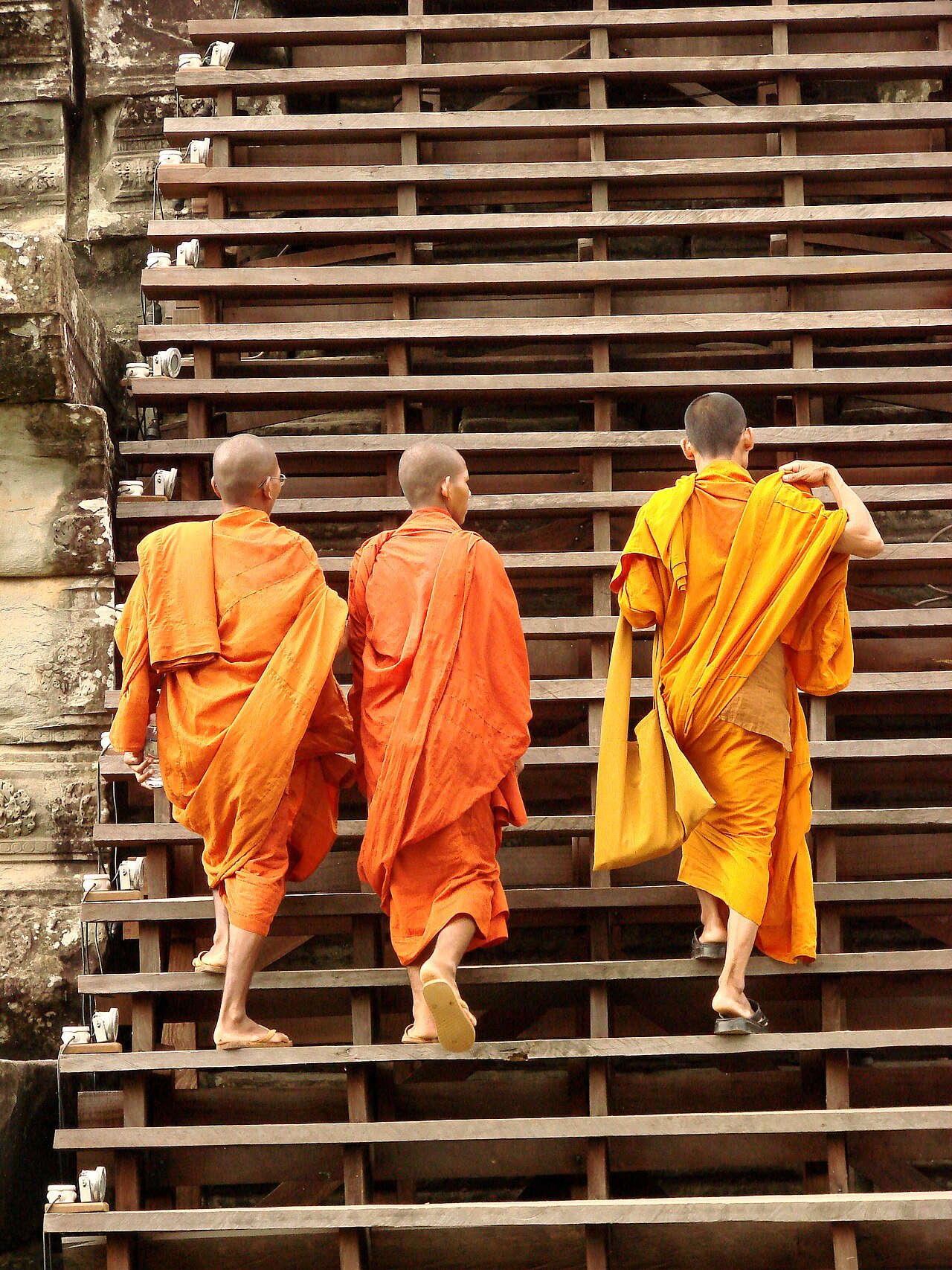
The Churning of the Sea of Milk bas-relief in the east gallery of Angkor WatBuddhist monks in saffron robes walking at Angkor Wat
The Churning of the Sea of Milk, and monks on the temple grounds · photos CC BY-SA 3.0 Jadamta and Adam Jones, Wikimedia Commons
The new year at the great Temple
Khmer New Year and Angkor Sankranta · 14 to 16 April 2027
For three days each April, Choul Chnam Thmey, the Khmer solar new year, turns the park into the nation's gathering place. The Angkor Sankranta festival fills the grounds beside Angkor Wat with traditional games, Bokator martial arts, Reamker dance-drama and apsara dance, and a lantern ceremony after dark, while the river and old town of Siem Reap celebrate alongside. On the first day of the 2026 holiday, APSARA counted more than 22,000 visitors in the Angkor area. The next holiday falls on 14 to 16 April 2027.
Rooms in Siem Reap fill fast for these three days; a pilgrim seeking quiet should choose another week, a pilgrim seeking Cambodia at its most joyful should come for exactly these.
Plan your visit
By air
Siem Reap Angkor International Airport (SAI), opened in October 2023, lies about 40 km east of town, roughly an hour by taxi to the Temples.
By road
The Temple stands 5.5 km north of Siem Reap town, a short tuk-tuk or taxi ride; passes are checked at the park entrances.
Timings
Angkor Wat is open 5:00 am to 5:30 pm daily. The Bakan upper level opens 7:40 am to 5:00 pm and is closed on Buddhist holy days.
The pass
Angkor Pass: 1 day US$37, 3 days US$62 (usable over 7 days), 7 days US$72 (usable over 30 days). Buy only through official channels: angkorenterprise.gov.kh, the official Angkor Pass app, or the official ticket office.
Sunrise
Gates open at 5:00 am and the sunrise crowd gathers at the reflecting ponds by the causeway; the northern pond is under APSARA restoration in 2026, so the southern pond takes the crowd.
Dress
Covered shoulders and knees are required at sacred places throughout Angkor. At the Bakan, hats are forbidden and decent dress is enforced.
The circuit
Allow two to three hours for the galleries and terraces. Children under 12 and pregnant women are not admitted to the Bakan for safety.
Angkor descends from the Sanskrit nagara, city, and wat is the Khmer word for Temple grounds: the city that is a Temple. In the Middle Period it was called Preah Pisnulok, after its founder's posthumous name.
Drones are banned over the park without written permission from the APSARA National Authority, and the whole site has been smoke free since 2012.
Monks are revered here: ask before photographing them, and women should not touch or stand too close to a monk.
Do not touch the carvings or lean on the structures; nine centuries of hands have already worn the stone smooth.
Questions pilgrims ask
Is Angkor Wat a Hindu Temple or a Buddhist Temple?
Both histories are true and the Temple hides neither. It was built in the 12th century as the state Temple of Lord Vishnu, and its greatest reliefs tell the Vaishnava epics. From the late 13th century it passed gradually into Theravada Buddhist use, and it is a living Buddhist Temple today, with shrines, offerings, and monks. Each tradition is honoured here in its own voice.
Is it still a place of worship, or only a monument?
It has remained in continuous religious use since it was built, a rare thing among the monuments of Angkor and one reason it survived so well. Buddha images at Preah Poan and beneath the towers are venerated with incense, flowers and candles, alongside the Temple's role as a conserved World Heritage monument.
Can I climb to the top level?
Yes, with limits. The Bakan, the uppermost terrace, opens at 7:40 am, closes at 5:00 pm, and is shut entirely on Buddhist holy days. Children under 12 and pregnant women are not admitted, hats must come off, and the queue for the stair grows through the morning.
Where do I buy the Angkor Pass?
Only from official channels: online at angkorenterprise.gov.kh, through the official Angkor Pass app, or at the official ticket office. A 1-day pass is US$37, 3 days US$62, 7 days US$72, and the pass covers the whole archaeological park, not Angkor Wat alone.
When is the best time to come?
At 5:00 am, when the gates open. The sunrise over the towers from the southern reflecting pond is the Temple's oldest daily ceremony, and the galleries are coolest and quietest before mid-morning. For festival crowds and lantern light, come for Khmer New Year in mid April.
The Sthan in photographs
Darshan from afar
From the temple's own channels. Nothing loads until you press play.
Dharamshalas and guest houses near this Sthan, shared by devotees. Adisthan takes no bookings and no money; contact each stay directly.
No stays are listed here yet. Know one that serves pilgrims well?
Are you with the APSARA National Authority, Angkor Enterprise, or the sangha that keeps the shrines of Angkor Wat alight? Claim this page to keep its hours, pass prices, and festival days true for every pilgrim.