When the war burned the hall to the ground, Guanshiyin was found seated, unharmed, beneath the open sky.
Be the first to check in
Coming up: Lunar New Year first incense · 6 FebEntry tended 25 May 2026
Open 6 am to 9:45 pm daily Free entry Poe blocks & fortune sticks Guanshiyin's birthday · 26 Mar 2027 Southern Fujian · national historic site
Come early and you will hear them before you see the gold: rows of worshippers, mostly women, chanting the sutra to Guanshiyin as the light climbs the swallowtail roofs. A stone waterfall murmurs at the forecourt, carp turn in the pond, and cut-porcelain dragons ride the ridgelines overhead. For nearly three centuries the people of old Bangka have carried their whole lives into this hall: their examinations, their marriages, their newborns, their dead. This is one Temple that holds a hundred gods, Buddhist, Taoist and folk, under a single sweeping roof.
In the Taihoku air raid of 1945 the main hall burned to the ground, yet the statue of Guanshiyin was found seated intact amid the ashes, needing only the lightest repair. Devotees have honoured Her the more ever since.
The front hall carries the only pair of bronze dragon columns in Taiwan, cast during the great rebuilding of 1919 to 1924 by master craftsmen brought across from Quanzhou in Fujian.
Front hall to Guanshiyin, rear hall to more than a hundred gods: Mazu of the seafarers, Wenchang Dijun of the examinations, Zhusheng Niangniang of childbirth, and Yue Lao the Old Man under the Moon, to whom Taipei's unmarried come for a red thread.
A Guanyin carried across the strait
In 1738 settlers from the counties of Jinjiang, Nan'an and Hui'an in Fujian, homesick and beset by disease in the malarial flats of early Bangka, sent home for a sacred presence to anchor them. Tradition holds they divided the incense of the ancestral Longshan Temple in Jinjiang and carried its Guanshiyin across the strait, raising this Dragon Mountain Temple to house Her. From the first it was more than a shrine. It was the meeting hall, the arbitration court and the militia ground of the Fujianese who were making Taipei.
The island did not spare it. A powerful earthquake in 1815 brought the halls down, and a fierce storm in 1867 battered them again, and each time the community rebuilt. Between 1919 and 1924, under the master carpenter Wang Yi-shun and the stone and porcelain masters of Quanzhou, the Temple was raised in the form seen today: its bronze dragon columns, its coffered caisson ceilings and its jiannian cut-porcelain roofs, the high-water mark of southern Fujian craft in Taiwan.
Then on 31 May 1945, in the last months of the war, American bombers struck the district. The main hall and its treasures burned. When the smoke cleared the people of Bangka came back to the ruins and found the statue of Guanshiyin still seated on Her lotus, whole. They took it as Her own answer, and rebuilt around Her once more.
What you'll actually see
1
The front hall and its dragon columns
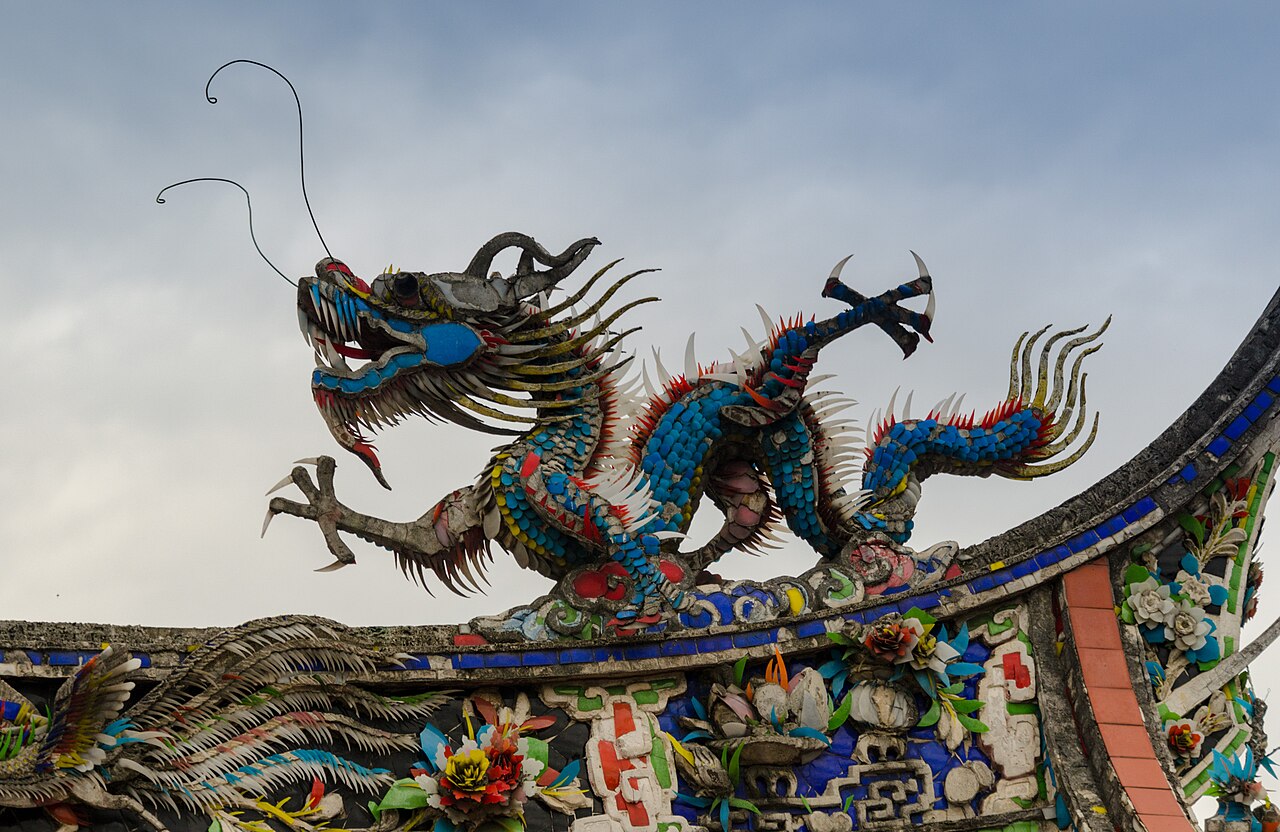
You meet the Temple at its most ornate first: the sweeping swallowtail ridges crowded with cut-porcelain dragons and phoenixes, gilded beam carvings above the doors, and, flanking the entrance, the pair of bronze dragon columns, the only ones of their kind in Taiwan. Overhead the front hall's caisson ceiling spirals inward without a single nail.
2
The forecourt: waterfall, pond and censer
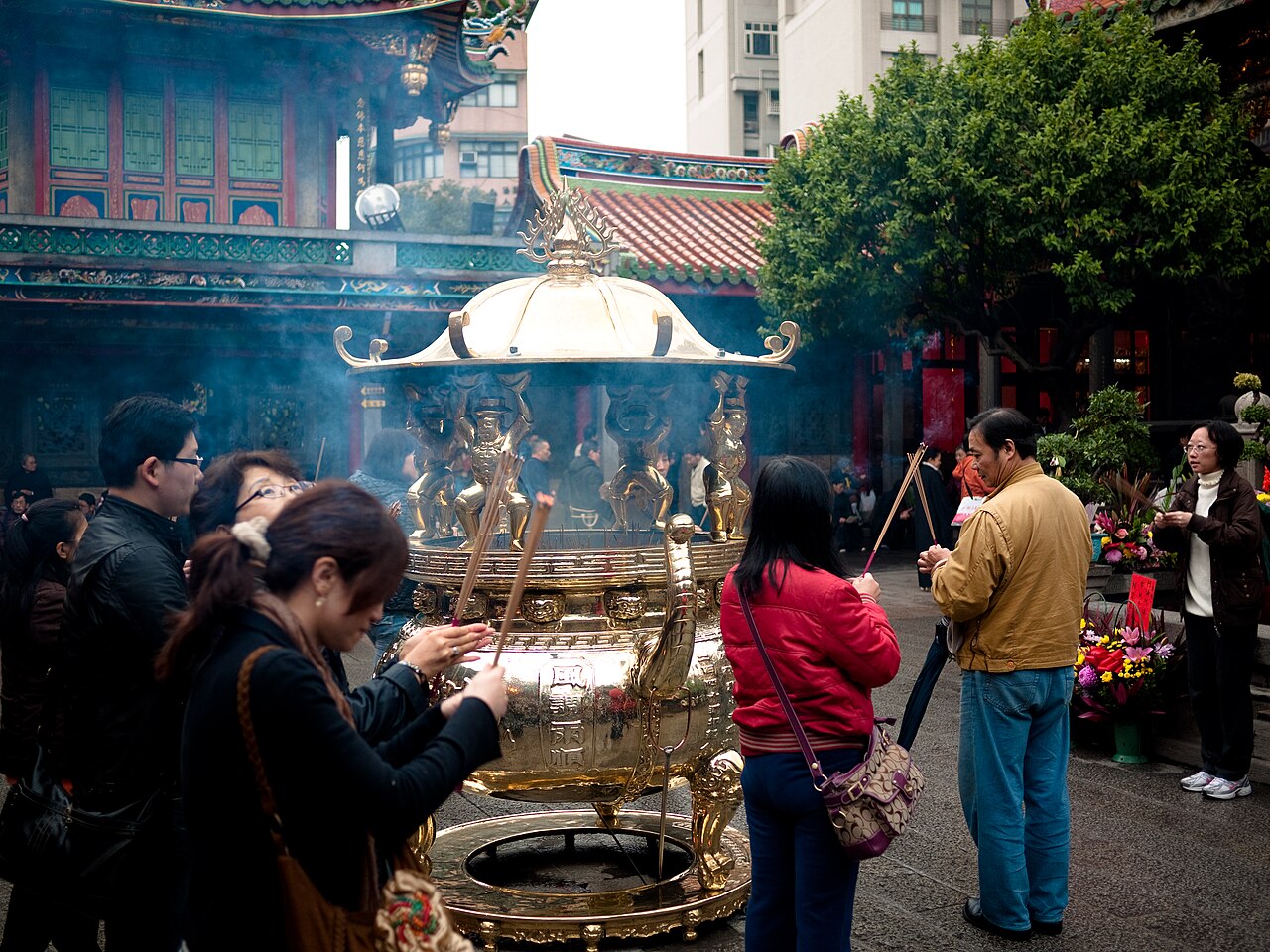
Between the outer gate and the front hall lies a small stone waterfall and a carp pond, and at the courtyard's heart the great golden censer on its lion feet. Since March 2020 the Temple has lit incense on the worshippers' behalf rather than in their hands, but the censer still stands as the courtyard's centre.
3
The rear hall of a hundred gods
Behind the main hall a row of small adjoining shrines holds the folk pantheon: Mazu the sea-mother flanked by her generals, Wenchang Dijun hung with students' pleas before examinations, Zhusheng Niangniang and her Twelve Midwives for safe childbirth, the warrior Guansheng Dijun, and, on the left, the quiet, much-visited shrine of Yue Lao.
Worshippers offering incense sticks around the great golden censer in the courtyard of Bangka Lungshan TempleA blue cut-porcelain dragon cresting a swallowtail roof ridge at Bangka Lungshan Temple
The temple's great golden censer amid worshippers' incense before 2020, and a cut-porcelain dragon riding a swallowtail ridge · photos CC BY 2.0 takuma mori and xiquinhosilva, Wikimedia Commons
The mother Temple's own day
Guanshiyin's Birthday · 26 March 2027
The nineteenth day of the second lunar month is the birthday of Guanshiyin, the bodhisattva for whom the Temple was raised, and the day belongs wholly to Her. The chanting halls fill from the six o'clock session onward. Worshippers press in with flowers, fruit and vegetarian offerings, and the sutra rises through the day almost without pause. Guanshiyin is honoured on three days across the year, and this, Her birthday, is the fullest of them. In 2027 it falls on 26 March.
Expect the densest crowds and the longest chanting of the year. Come for the first session at six for the quietest hour, and remember that personal incense is no longer lit here.
Plan your visit
By rail
MRT Longshan Temple Station on the Blue (Bannan) line, Exit 1, about a three minute walk. The station is named for the Temple.
By air
Taoyuan International Airport, about 40 km west. Take the Airport MRT to Taipei Main Station, then the Blue line two stops to Longshan Temple.
Timings
Open 6 am to 9:45 pm daily. Sutra chanting at 6:00 to 6:45 am, 8:00 to 8:45 am, and 3:45 to 5:00 pm.
Entry
Free. Fortune sticks and Yue Lao's red thread are given without charge; donations support the Temple's charitable work.
Best time
An early weekday morning, in time for the first chanting. The 1st and 15th of each lunar month, Lunar New Year and Guanshiyin's birthday bring the heaviest crowds.
Dress
Neat and modest. This is a living place of daily worship, not a museum, and the halls are busy from opening.
How to worship
Since March 2020 worshippers no longer burn their own incense; the Temple lights it on everyone's behalf. Pray with folded hands, cast the crescent poe blocks for a yes or no, and draw a numbered fortune stick for a fuller answer.
Bangka, also written Monga, is the old name of Wanhua, the oldest quarter of Taipei; the Temple has stood at its centre since 1738.
Longshan means Dragon Mountain: the name and the founding Guanshiyin both came from the ancestral Longshan Temple in Jinjiang, Fujian.
For a red thread from Yue Lao, worshippers leave sweets on a red plate, pray with their wish held in mind, cast the poe blocks, and carry the thread in a wallet rather than tying it, since a knot is read as an obstacle.
The Temple is a designated national historic site, protected since 1985; its 1920s carvings, bronze columns and cut-porcelain roofs are among the finest of the southern Fujian tradition in Taiwan.
Questions pilgrims ask
Is Bangka Lungshan a Buddhist or a Taoist Temple?
Both, and more. It began as a Buddhist Temple to Guanshiyin, who still presides in the front hall, but its rear hall gathers more than a hundred Taoist and folk deities. This weaving together of Buddhism, Taoism and folk religion is the ordinary shape of Taiwanese Temple worship.
Is the Guanyin statue really the one that survived the 1945 bombing?
The main hall was destroyed in the air raid of 31 May 1945, and tradition holds that the statue of Guanshiyin was found seated intact amid the ruins, needing only minor repair. Devotees took it as a sign of Her power, and She remains at the heart of the rebuilt hall.
Can I still burn incense here?
No. Since 13 March 2020 the Temple has asked worshippers not to burn their own incense, for the air and the health of the neighbourhood, and lights a small amount each day on everyone's behalf. You are welcome to pray, cast poe blocks and draw fortune sticks.
How do I ask Yue Lao for a partner?
Yue Lao's shrine sits in the rear hall. Offer sweets on the red plate, pray while picturing the love you hope for, cast the crescent poe blocks to ask his blessing, and if it is granted receive a red thread to keep with you.
Do I need a ticket?
No. Entry is free, and the Temple's fortune sticks and red threads are given without charge. Donations support its charitable and cultural work.
Dharamshalas and guest houses near this Sthan, shared by devotees. Adisthan takes no bookings and no money; contact each stay directly.
No stays are listed here yet. Know one that serves pilgrims well?
Are you with the trustees or clergy of Bangka Lungshan Temple? Claim this page to keep its chanting times, festival dates and rites true for every devotee who comes to Guanshiyin.