The teaching began on this ground, and the Wheel has not stopped turning.
Be the first to check in
Coming up: Buddha Purnima · 20 MayEntry tended 28 Jun 2026
Deer Park, Sarnath · 8 km from Varanasi Site open 6 am to 6 pm daily ₹25 Indian · ₹300 foreign nationals Dhamma Chakra Day · 29 Jul 2026 Gupta stonework · 5th-6th century CE 43.6 m tall, 28 m across
You come up a gravel path between clipped lawns and the excavated brick footprint of a vanished monastery, and the stupa rises ahead of you: a plain, windowless drum of stone and brick, wide at the base, rounding toward its crown. Egrets perch along the cornice. Monks sit cross-legged at its foot, chanting softly in Pali, Tibetan, Sinhala, facing the same wall of stone. There is no image here to look at, no idol, no inner sanctum to enter. There is only the ground itself, and the quiet people have crossed the world to sit in.
Tradition holds that Dhamek Stupa marks the ground of the Buddha's first teaching, the Dhammacakkappavattana Sutta, delivered to five ascetics some seven weeks after his enlightenment at Bodh Gaya. That sermon set the Wheel of Dharma turning and gave rise to the first Sangha.
At 43.6 metres tall and 28 metres across, it is the largest surviving structure at Sarnath: a solid cylinder built over a Mauryan-era core, faced in Gupta-period stone, enlarged across at least six building campaigns, and never finished.
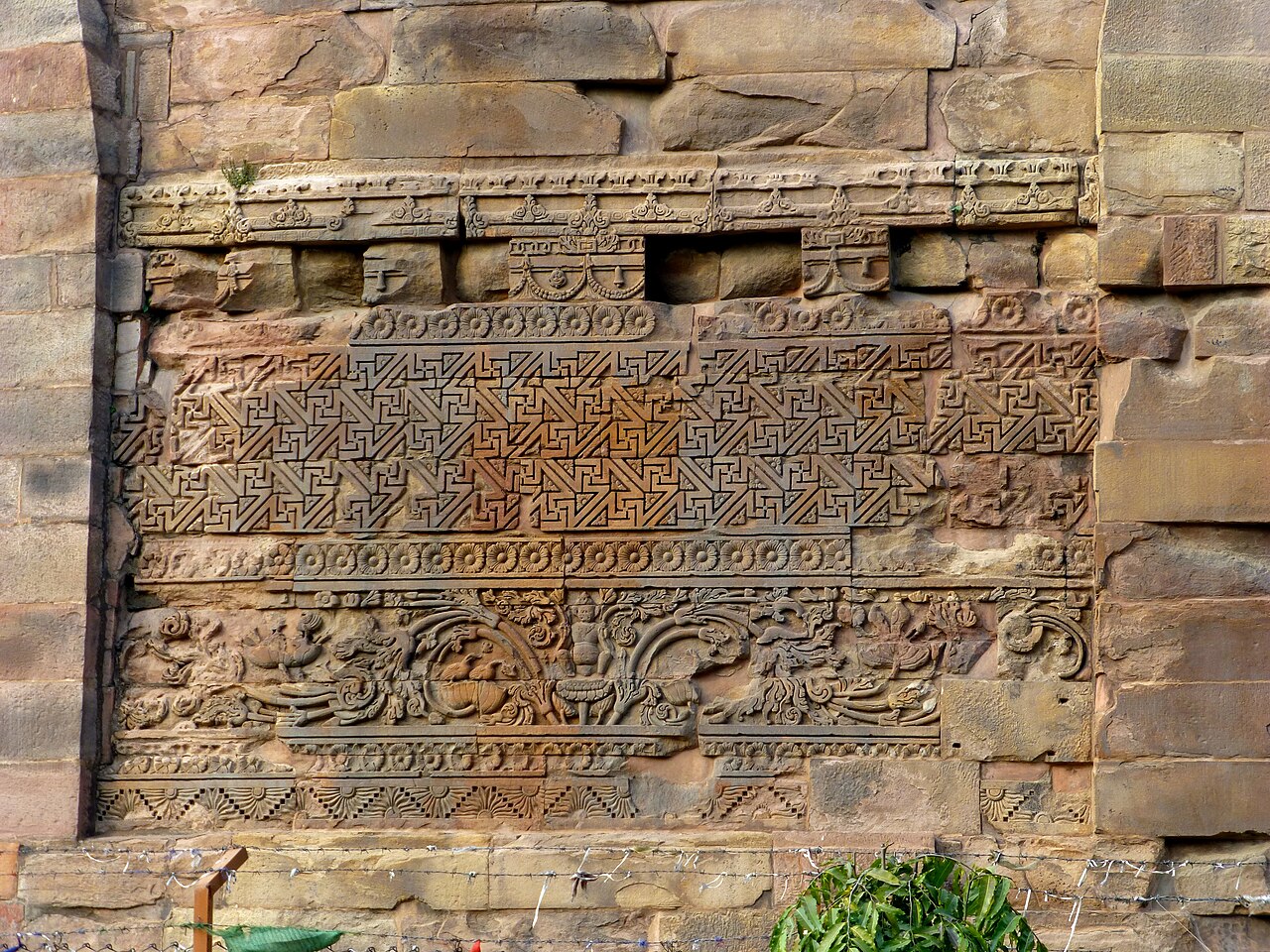
The lower drum carries some of the finest Gupta stone carving in India: bands of geometric scrollwork, lotus medallions, and human and bird figures cut directly into the sandstone facing, standing exposed for roughly fifteen hundred years.
The five who came to listen
Tradition holds that after his enlightenment at Bodh Gaya, the newly awakened Buddha walked some two hundred and fifty kilometres to this Deer Park outside Varanasi, seeking the five ascetics who had once practised austerity beside him and turned away when he abandoned that path. The Lalitavistara sutra records that he chose this ground deliberately: the Deer Park by the Hill of the Fallen Sages. Popular tradition holds that the five first recognised him near what is now the Chaukhandi Stupa, a short walk south, before walking on together to the spot Dhamek now marks.
Here, tradition holds, he preached the Dhammacakkappavattana Sutta, the turning of the Wheel of Dharma: the Middle Way, the Four Noble Truths, the Eightfold Path. Kaundinya understood first; all five took ordination, and the Sangha came into being. Emperor Ashoka is said to have visited in the third century BCE and raised a stupa and an inscribed pillar here. The structure seen today, enlarged across at least six later building campaigns, was given its carved stone facing under the Gupta emperors in the fifth to sixth century CE, and left permanently unfinished at its crown.
By 640 CE the Chinese pilgrim Xuanzang found a monastic town of more than fifteen hundred monks and a stupa he judged nearly ninety metres tall. Buddhism's decline in northern India after the twelfth century left Sarnath to ruin, and in 1794 labourers dismantling a nearby stupa for building stone found, then lost, a relic casket; parts of Dhamek's own facing were stripped around the same time. Nineteenth-century excavation recovered the site, and in 1931 the Maha Bodhi Society raised the Mulagandha Kuti Vihara beside it, returning daily worship to ground silent for centuries.
What you'll actually see
1
The excavated monastery ground
Before you reach the stupa you cross a wide field of red brick foundations: the low walls of viharas, votive stupas and shrine platforms uncovered here since the 1830s, the remains of a monastic town that once housed, by one Chinese pilgrim's count, over fifteen hundred monks.
2
The carved stone drum
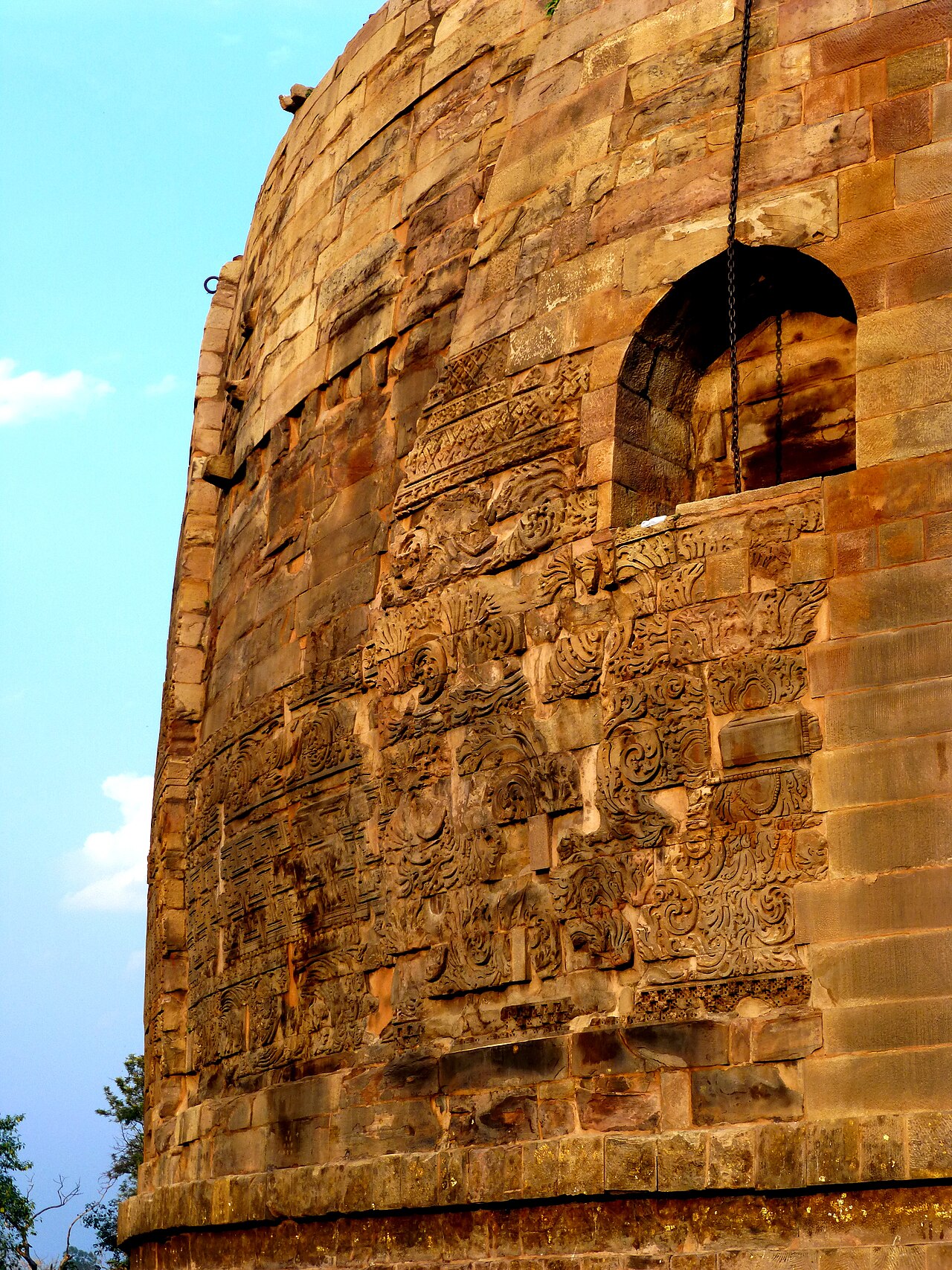
The lower third of the stupa is dressed in pale sandstone cut with running bands of geometric key pattern, lotus rosettes and scrolling vines, interrupted by recessed arched niches that once held images, and by lines of Brahmi-script inscription worked directly into the stone.
3
The unfinished brick tower above
Above the carved stone the structure turns to plain, undressed brick, rounding to a blunt crown with a small iron finial at its peak. The change in material marks where the work stopped: the upper stupa was never given its final stone facing.
Close-up of Gupta-period stone carving on the Dhamek Stupa's base, showing geometric key-pattern bands, lotus rosettes and carved figuresThe transition from carved stone base to plain brick tower on the Dhamek Stupa, with an arched relic niche in the stonework
The carved Gupta stonework and the stupa's stone-to-brick transition · photos by Photo Dharma (Anandajoti), CC BY 2.0, Wikimedia Commons
THE ANNIVERSARY OF THE FIRST SERMON
Dhamma Chakra Day at Sarnath
Each year on the full moon of Ashadha, Buddhists mark Dhammacakkappavattana Divas, also called Dhamma Chakra Pravartan Din or, across much of the wider Buddhist world, Asalha Puja: the day the Buddha turned the Wheel of Dharma at this Deer Park. The International Buddhist Confederation and the Maha Bodhi Society hold the day's main ceremony at the Mulagandha Kuti Vihara beside the stupa, with chanting, sutra readings and offerings drawing monks and lay pilgrims from across the Buddhist world; many also keep quiet vigil at the stupa itself. In India the same full moon is kept as Guru Purnima, a day of reverence for teachers in both Buddhist and Hindu practice. Dhamma Chakra Day falls on Wednesday, 29 July 2026.
The organised ceremony centres on the Vihara, not the stupa; arrive by mid-morning if you want to sit at the stupa itself before the day's crowds build.
Plan your visit
By air
Lal Bahadur Shastri International Airport (Varanasi) is about 30 km away, 45 minutes to an hour by taxi.
By rail
Varanasi Junction is the nearest major station, about 10 km away; autos and taxis cover the short run to Sarnath.
By road
Sarnath sits about 8 km northeast of central Varanasi; shared autos, cycle-rickshaws and taxis run the route all day.
Timings
The archaeological park and stupa are open 6 am to 6 pm daily. The Sarnath Museum keeps separate hours, 9 am to 5 pm, closed Fridays.
Fees
₹25 for Indian, SAARC and BIMSTEC nationals (₹20 booked online), ₹300 for foreign nationals (₹250 online). The museum is a separate ₹5 ticket for everyone.
Best time
Early morning, before the heat and the coach-tour groups, or the last hour before closing when the stone catches low light.
Dress
No dress code is enforced at the gate, but shoulders and knees covered is the custom at any Buddhist shrine in the complex.
The visit
There is no queue; circumambulation is unhurried and free. Allow 45 minutes to an hour for the stupa and monastery ruins, longer with the museum and the Vihara next door.
Dhamek takes its name from the Sanskrit dharmeksa, roughly the pondering of the law. About a kilometre south stands the Chaukhandi Stupa, which popular tradition holds marks where the Buddha first met the five ascetics, with Dhamek marking where he then taught them, though no inscription fixes either spot with certainty.
The lion capital now on India's national emblem once crowned an Ashoka pillar near this stupa. Excavated in 1904 to 1905, it was moved to the Sarnath Museum and adopted as the emblem of the Republic in 1950; only the broken pillar shaft remains near the stupa itself.
Dhamek Stupa is an Archaeological Survey of India monument, not a functioning shrine, so there is no fixed daily worship here. Living liturgy in Sarnath happens next door at the Mulagandha Kuti Vihara, built in 1931 by the Maha Bodhi Society, which holds Buddha Puja and chanting three times a day and is said to enshrine relics of the Buddha himself.
The Deer Park that gives the site its name still keeps deer today, in a sanctuary established in 1956 near the Vihara, a modern echo of the ancient mriga-dayā-vanam described in the old texts.
Questions pilgrims ask
Does the Dhamek Stupa mark the exact spot of the Buddha's first sermon?
It marks the ground within the ancient Deer Park that the old sources point to, and it is the largest and most venerated surviving monument there, but archaeology has not pinned the current structure to the precise footprint of the sermon itself. Popular tradition divides the story across the park: the nearby Chaukhandi Stupa is said to mark where the Buddha reunited with his five former companions, and Dhamek where he then taught them. Both readings are honoured here; neither is settled beyond dispute.
Is there a statue or idol inside?
No. A stupa is a solid reliquary, not a hall with an image. Ancient sources hold that Dhamek was among the eight stupas raised over the Buddha's relics after his death, though it has never been opened to confirm what, if anything, lies within its core. What you see and circle is the outer form itself.
Can I meditate or chant here?
Yes. Monks and lay pilgrims sit and chant at the base every day, in whichever tradition they carry, quietly and without any formal schedule to join. The stupa's own hours are set by the Archaeological Survey of India, 6 am to 6 pm, not by any liturgical clock.
Where is the lion capital shown on India's emblem?
In the Sarnath Museum, a short walk from the stupa, on a separate ₹5 ticket. It was excavated near the broken Ashoka pillar that still stands close to Dhamek, and in 1950 the Government of India adopted it as the national emblem. The museum is open 9 am to 5 pm and closed on Fridays.
Dharamshalas and guest houses near this Sthan, shared by devotees. Adisthan takes no bookings and no money; contact each stay directly.
No stays are listed here yet. Know one that serves pilgrims well?
Are you with the Archaeological Survey of India's Sarnath Circle, the Maha Bodhi Society, or a sangha that keeps vigil at this stupa? Claim this page to keep its hours, fees and the story of the first sermon accurate for every pilgrim who comes.