Five shrines built 1031 to 1582 CE Open to visitors noon to 5 or 6 pm Free · no photography inside 2.5 km from Mount Abu town Māru-Gurjara marble at its finest Samvatsari · 15 Sep 2026
Climb two and a half kilometres through pine and forest and the outer walls give away nothing: plain grey stone, low, unadorned, built the way Jain restraint asks a building to be built. Then you pass through the doorway and the ceiling opens overhead, white marble worked into lotus after lotus, dancing figures, tiny standing Tirthankaras, cut in places so fine that light comes through the stone itself. There Is no colour anywhere, no paint, only marble carved past the point where marble should still be able to hold a shape.
Two Temples built two centuries apart, the Vimal Vasahi of 1031 and the Luna Vasahi of 1230, hold what is widely regarded as the finest marble carving in Jain art. Tradition says the artisans were paid in gold by the weight of marble powder scraped from the stone, encouraging cuts of an almost impossible delicacy.
Dilwara ranks among the Śvētāmbara tradition's five Pancha Tirtha, the foremost pilgrimage shrines, alongside Shatrunjaya, Girnar, Sammed Shikharji and Ashtapad.
Five separate shrines stand inside one high-walled compound, each raised for a different Tirthankara across five centuries of patronage, from a Solanki-era minister's devotion in the 11th century to a small memorial Temple finished in 1582.
Five Temples, five centuries of devotion
The first stone at Dilwara was laid by Vimal Shah, a minister serving the Chaulukya king Bhima I of Gujarat, who by 1031 had raised the Vimal Vasahi in honour of Rishabhanatha, the first Tirthankara, on a forested rise above what is now Mount Abu. Two centuries later, in 1230, two brothers named Vastupal and Tejpal, ministers to the Vaghela ruler Virdhaval, built the Luna Vasahi for Neminatha, the twenty-second Tirthankara, in memory of their late brother Lunig. Tradition holds they modelled it deliberately on Vimal Shah's Temple, then surpassed it in the fineness of the stone-work.
Three smaller shrines followed across the next three centuries: the Pittalhar, raised between 1316 and 1432 by Bhima Shah, minister to the Sultan of Ahmedabad, and named for the brass image of Rishabhanatha at its heart; the Parshvanatha Temple, also called Khartar Vasahi, completed in 1458-59 by Sangvi Mandlik and family and standing three storeys tall, the tallest at Dilwara; and the small Mahavir Swami Temple, consecrated in 1582.
The Temples were not spared history's violence. Alauddin Khilji's forces damaged the complex in 1311, and repairs followed within a decade. The most extensive restoration came in the twentieth century, under the trust that still cares for Dilwara today, so that the marble the pilgrim touches now carries both the original eleventh-century cutting and centuries of careful renewal beneath it.
What you'll actually see
1
The Vimal Vasahi corridor and Hastishala
A corridor lined with dozens of small shrine-cells, each holding a carved Tirthankara image, rings the Vimal Vasahi's main sanctum. Beside it stands the Hastishala, an elephant court raised around 1147-49 by Vimal Shah's descendant Prithvipal, its marble elephants carrying carved likenesses of the family that endowed them.
2
The Rang Mandap of the Luna Vasahi
Beneath the Luna Vasahi's central dome hangs a great carved pendant, ringed by seventy-two seated Tirthankara figures in one circular band and three hundred and sixty tiny Jain monks in the band beneath. Nearby, two carved niches known as Derani and Jethani, named for the wives of Vastupal and Tejpal, hold images of the goddess Maa Lakshmi.
3
The brass giant of the Pittalhar
At the Pittalhar's heart stands a colossal image of Rishabhanatha cast in five metals and dominated by brass, or pital, which gives the Temple its name. Records at the site put the image, installed in 1468-69, at roughly four metric tons and eight feet tall, one of the largest metal Jain murtis in India.
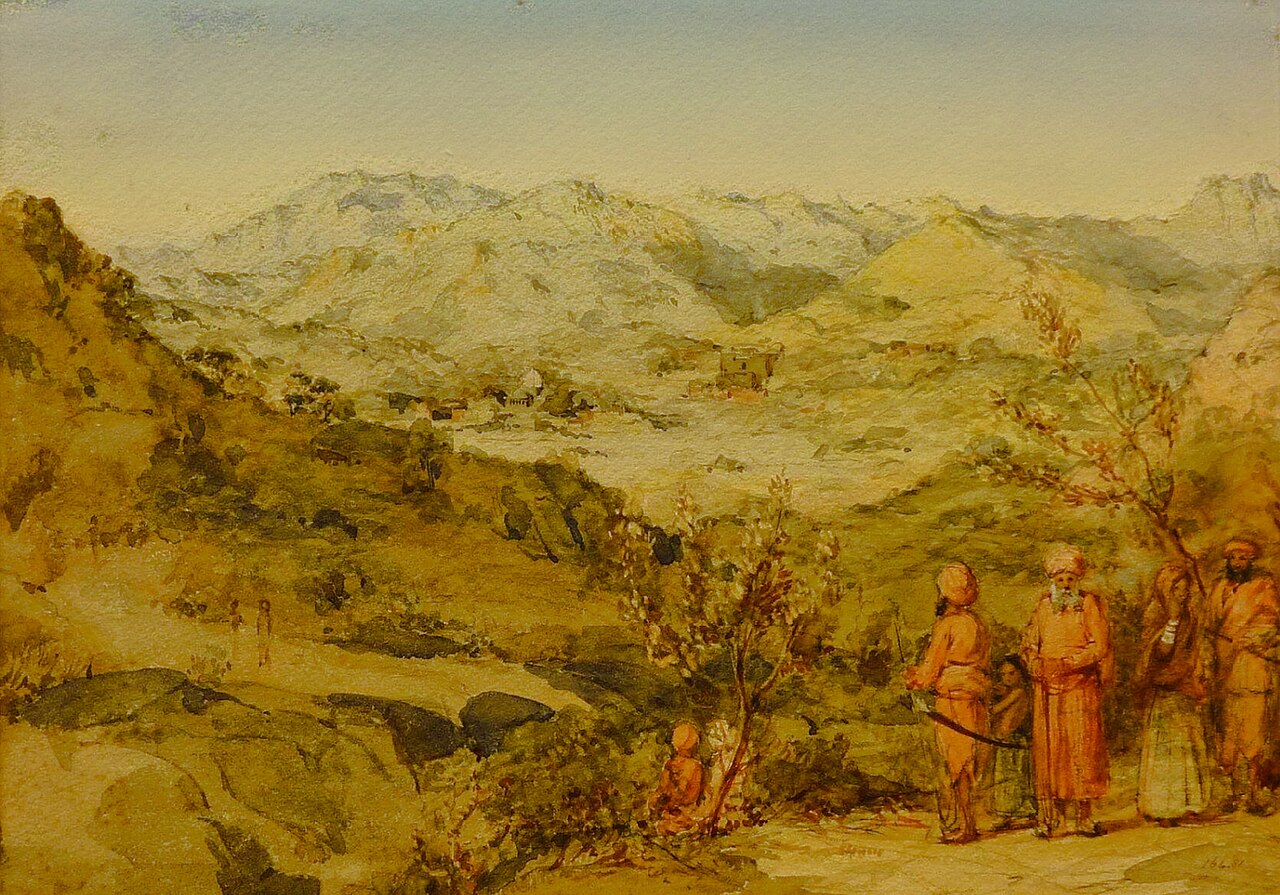
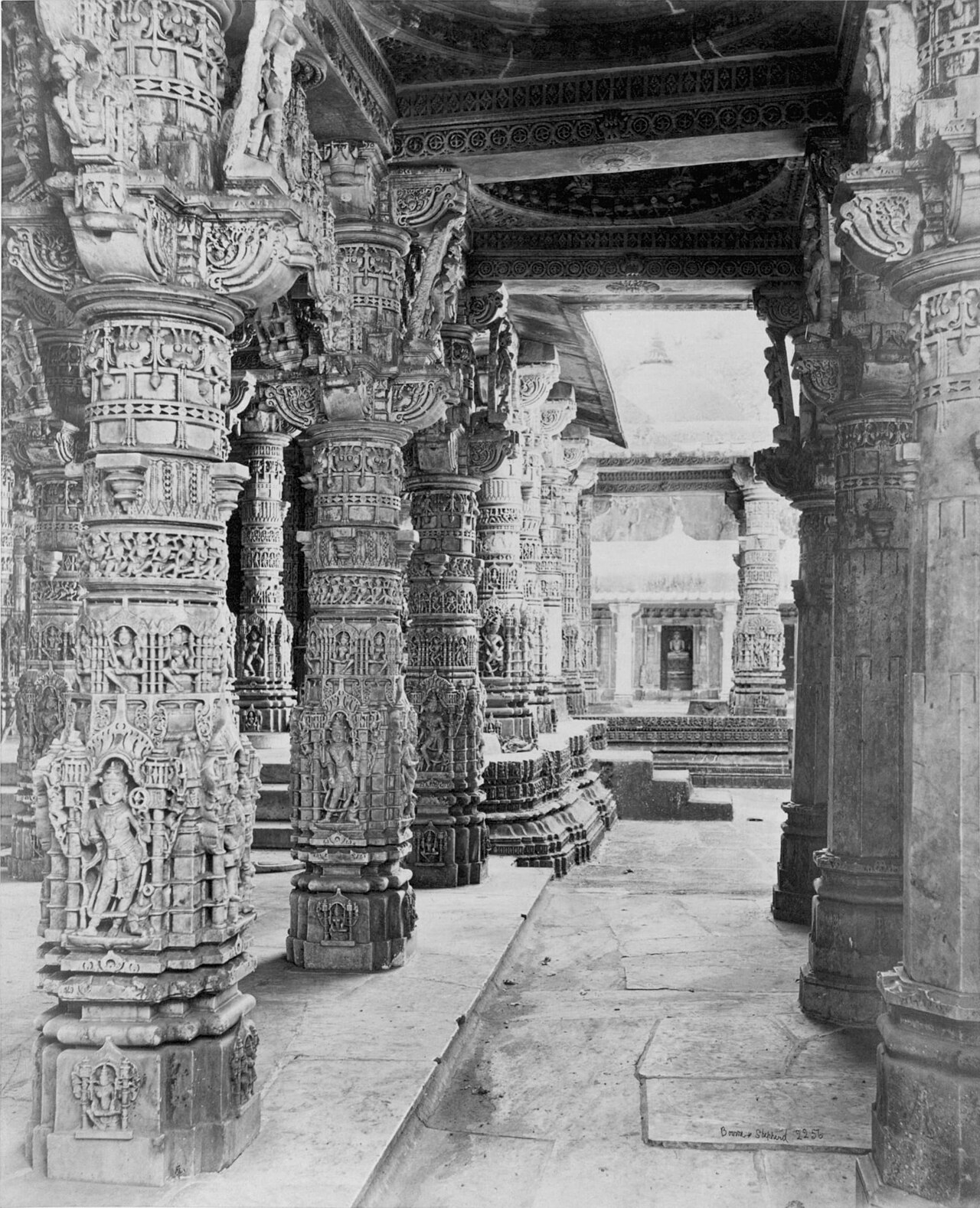
Marble ceiling at Dilwara carved in horizontal bands of Jain mythological figuresPilgrims on the forested path to the Dilwara Temples in an 1851 painting
Carved ceiling photographed by Lala Deen Dayal, 1882 (CC0, J. Paul Getty Museum), and pilgrims on the Dilwara path painted by William Carpenter, 1851 (public domain) · Wikimedia Commons
The ceiling found nowhere else
The Rang Mandap of the Luna Vasahi
Stand beneath the central dome of the Luna Vasahi and look up: a single marble pendant hangs at the centre, and around it run two unbroken bands of carving, seventy-two Tirthankaras seated above three hundred and sixty tiny monks, all cut from stone so thin in places that daylight shows through it. Masons are said to have been paid in gold by the weight of marble dust they scraped away, an incentive toward exactly this kind of impossible fineness.
Photography is not permitted inside any of the five Temples, so look slowly. Afternoon light through the marble screens shows the carving best.
Plan your visit
By rail
Abu Road railway station, about 28 km away on the Delhi-Mumbai line, with taxis and buses running up to Mount Abu.
By air
Maharana Pratap Airport, Udaipur, about 176 km away, roughly 3 to 4 hours by road.
By road
Mount Abu town is 2.5 km from the Temples; Udaipur is about 165 km by road.
Visiting hours
Open to the general public from noon to 5 or 6 pm daily; the morning, roughly 6 am to noon, is kept for Jain worship only.
Best time
October to March, when Mount Abu's hill climate is coolest; visit soon after noon opening for the best light on the ceilings.
Dress
Modest clothing covering shoulders and knees; leather items of any kind are not permitted inside.
Entry & rules
Free for everyone. Cameras, phones and leather goods must be left at the entrance; photography inside all five Temples is prohibited.
The Temples take their name from Delwara, the small village at their foot, which is also written Dilwara or Delvada.
Dilwara's custodial trust is the Seth Shri Kalyanji Parmanandji Pedhi of Sirohi, a distinct body from the similarly named Anandji Kalyanji Trust that manages Shatrunjaya at Palitana; the two names are often confused in casual writing.
Both Digambara and Svetambara Jains number Dilwara among their most revered sites, though the Temples themselves follow Svetambara worship.
Guided tours are available at the site for visitors who want the history and the carving explained Temple by Temple.
Questions pilgrims ask
Can I photograph the marble carving inside?
No. Cameras, phones and leather items are deposited at the entrance, and photography is prohibited inside all five Temples. The carving has to be seen in person and remembered, not captured.
Which is the oldest of the five Temples?
The Vimal Vasahi, dedicated to Rishabhanatha and completed by 1031 CE under the patronage of the minister Vimal Shah. The Luna Vasahi, built for Neminatha in 1230, is often held to surpass it in the fineness of its carving.
Can non-Jain visitors enter?
Yes. The Temples welcome all respectful visitors during the public hours of noon to 5 or 6 pm, subject to the same dress code and no-photography rule that apply to everyone.
Why are the outer walls so plain compared to the interior?
The restraint is deliberate. Jain tradition prizes honesty and non-excess, so the exteriors stay simple grey stone while the devotion is spent entirely on the interior, where the marble carving is at its most intricate.
Who looks after Dilwara today?
The Seth Shri Kalyanji Parmanandji Pedhi of Sirohi administers the Temples and their surrounding dharamshalas and bhojanshala, continuing a stewardship that carried out major restorations through the twentieth century.
Dharamshalas and guest houses near this Sthan, shared by devotees. Adisthan takes no bookings and no money; contact each stay directly.
No stays are listed here yet. Know one that serves pilgrims well?
Are you a trustee or representative of the Seth Shri Kalyanji Parmanandji Pedhi, Sirohi? Claim this page to confirm current timings, guided-tour arrangements and a way for pilgrims to reach the trust directly.