Completed 691 to 692 CE · 72 AH Shrine of the Foundation Stone Interior entry is for Muslims 240 m of golden Quranic mosaic Laylat al-Mi'raj · about 5 Jan 2027 Free entry
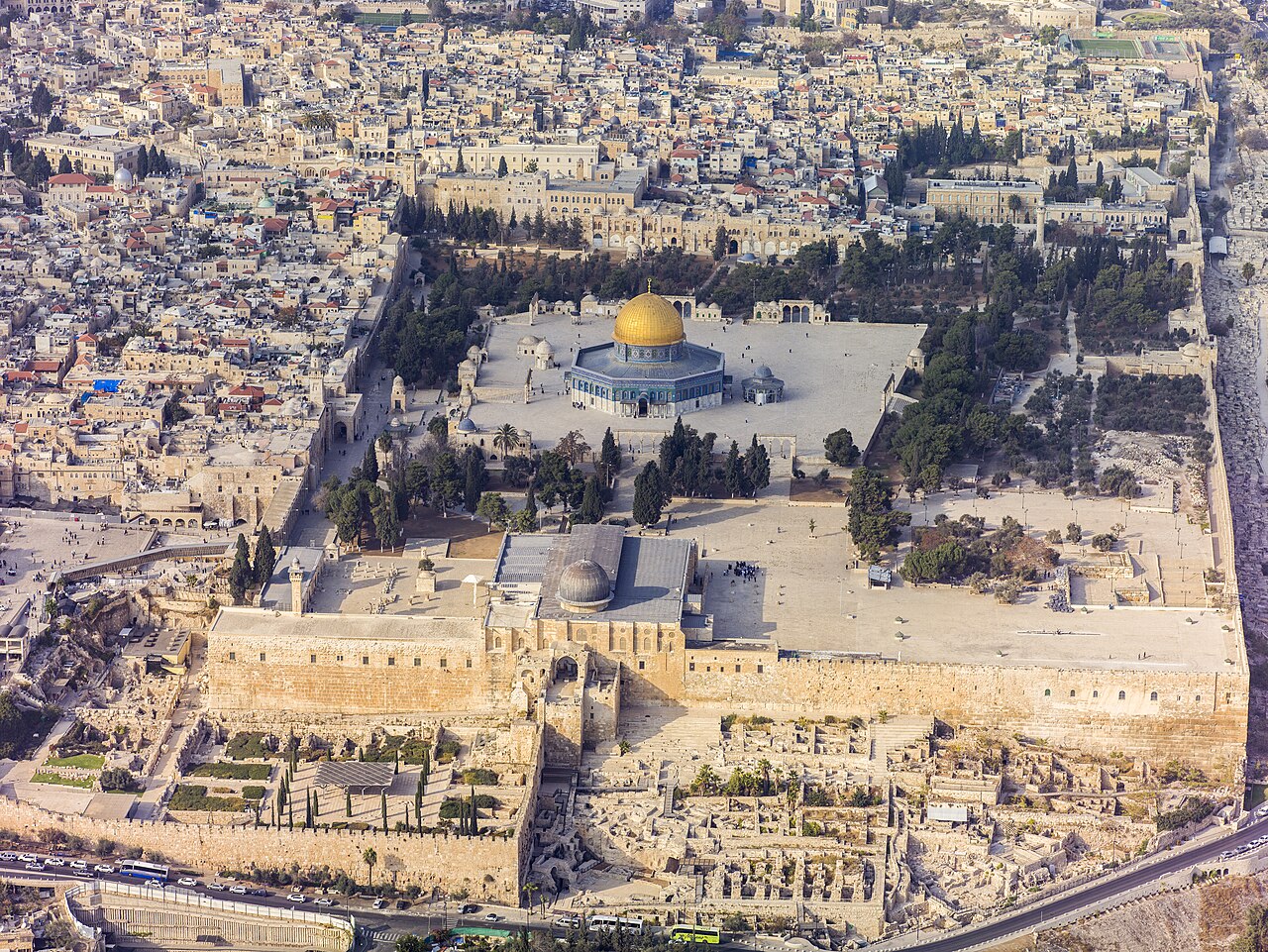
You climb one of the free-standing arched stairways onto the raised marble platform, and the building takes the whole sky: a perfect octagon sheathed in blue, white and turquoise tile, banded with Quranic script, crowned by a dome of gold twenty metres across. Pilgrims slow their step here without being told. Inside, beneath the painted dome, there is no minbar and no great congregation, only a bare grey rock rising from the floor. This is not a mosque. It is a shrine, and the rock is the reason for everything above it.
The world's oldest surviving work of Islamic architecture. Raised on the orders of the Umayyad caliph Abd al-Malik ibn Marwan and completed in 691 to 692 CE, the year 72 AH recorded in its own mosaic dedication, it carries the earliest surviving inscriptions proclaiming Islam and the Prophet Muhammad, peace be upon him.
It shelters the Foundation Stone. Islamic tradition holds that from this rock the Prophet, peace be upon him, ascended through the heavens in the Mi'raj on the night of the Journey (Quran 17:1). Jewish tradition names the same rock Even ha-Shetiyya, the stone from which the world was founded, and remembers upon it the Holy of Holies of the Temple. Both traditions hold this stone beloved; this page takes no side.
A 240 metre inscription in golden Kufic mosaic runs around its octagonal arcades, preserving some of the earliest surviving written verses of the Quran anywhere, in stone and glass rather than parchment, dated by the building itself to 72 AH.
The dome above the stone
Within living memory of the Prophet's companions, peace be upon him and upon them, the caliph Abd al-Malik resolved to crown the sacred esplanade of Jerusalem with a building unlike anything Islam had yet raised. His craftsmen worked from the models around them: the plan and mosaics follow the Byzantine churches of the city, and the dome was set out to almost exactly the measure of the rotunda of the Church of the Holy Sepulchre, 20.20 metres across against its 20.90. The shrine was complete by 691 to 692 CE. When the Abbasid caliph al-Ma'mun later renovated it, his workmen set his own name into the dedication, but left the date 72 AH untouched, and so the building still testifies to its true builder.
The Crusaders took the city in 1099 and made the shrine a church, Templum Domini, with a golden cross upon the dome. When Salah ad-Din restored Jerusalem in 1187 the cross was replaced by the crescent and the shrine reconsecrated. In the sixteenth century Suleiman the Magnificent clothed the exterior anew: the weathered Umayyad mosaics gave way to brilliant tilework in the Ottoman style of Iznik, blue and white and turquoise, some tiles carrying dates of 1545 to 1552, most of them made locally in the Qashani manner.
The gold the world knows is modern: in 1959 to 1961 the dome was sheeted in gilded aluminium bronze, and in 1993 it was regilded with 80 kilograms of gold through an 8.25 million dollar gift from King Hussein of Jordan, who sold a house in London to fund it. The shrine stands at the centre of al-Masjid al-Aqsa, the whole walled sanctuary, in the care of the Jerusalem Islamic Waqf under the Hashemite custodianship of Jordan, within the Old City that UNESCO inscribed as World Heritage in 1981.
What you'll actually see
1
The octagon and its tiles
Eight walls of marble below and tile above, each face patterned in arabesques of blue, white, green and turquoise, with the whole of Surah Ya-Sin running in a calligraphic band around the top. The tiles a pilgrim sees today are faithful copies of Suleiman's sixteenth-century tilework, remade in the 1960s when the originals had weathered beyond saving.
2
The golden script inside
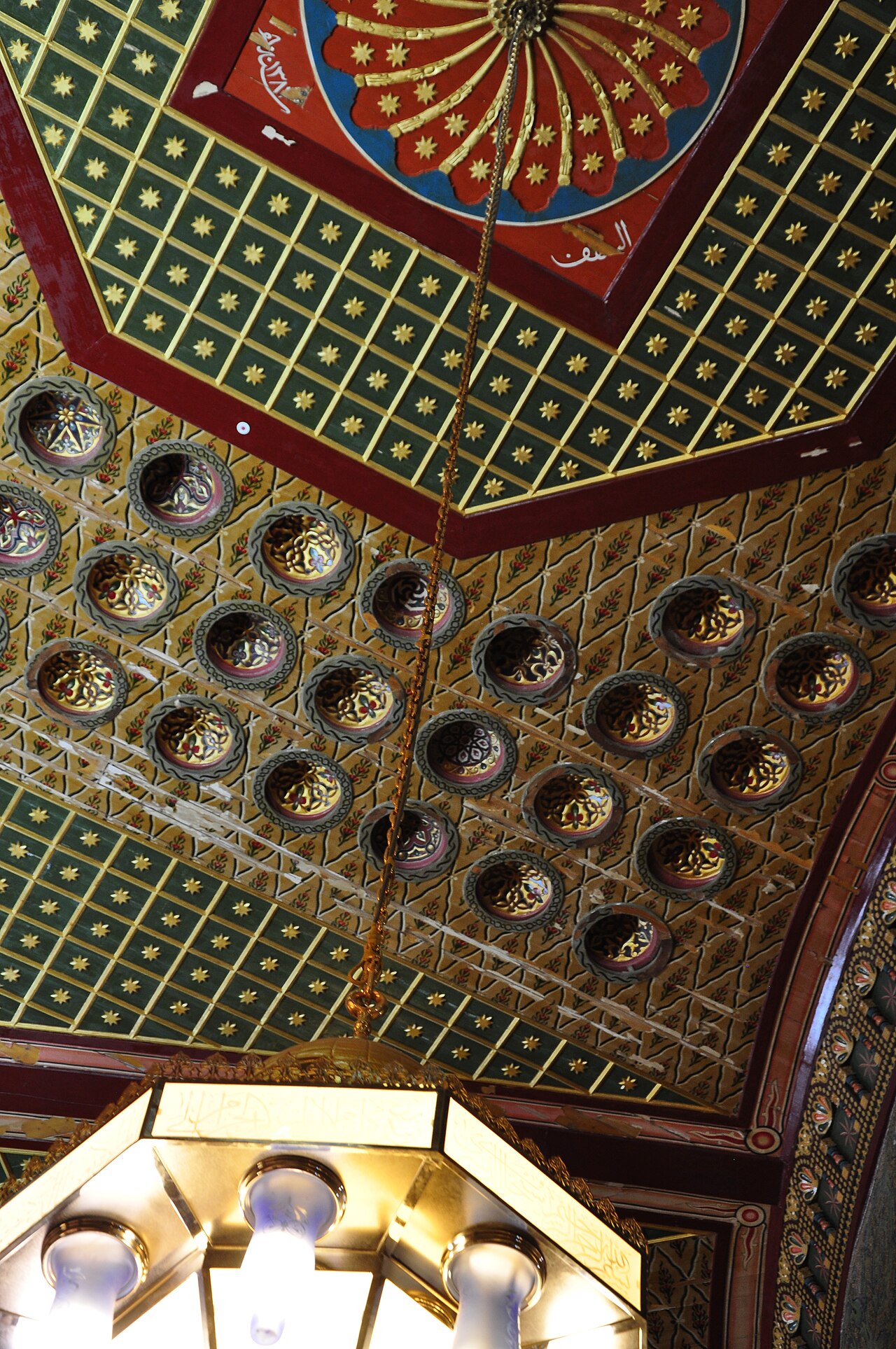
Two rings of ambulatory circle the rock, their arcades carrying the great mosaic inscription: 240 metres of gold Kufic lettering on green and blue, proclaiming the oneness of God and honouring the Prophet Muhammad, peace be upon him, and the Prophet Isa, Jesus son of Mary, as His messenger. Above it all the dome rises more than twenty metres, painted and gilded, directly over the stone.
3
The Stone and the cave beneath
At the centre lies al-Sakhra itself, the bare limestone summit of the hill, unpolished and uncarved. A stairway descends to a small cave beneath the rock, known as the Well of Souls, where tradition remembers the prayers of the prophets. Worshippers sit close along the rock's edge; the stone is the holiest thing in the building, and the building knows it.
The painted and gilded interior of the dome, rising directly above the Foundation StoneThe Dome of the Rock on its raised platform at the centre of the Al-Aqsa compound, seen from the air
Inside the dome, and the shrine on its platform · photos CC BY 2.0 (Lazhar Neftien) and CC BY-SA 4.0 (Godot13), Wikimedia Commons
THE NIGHT THIS SHRINE REMEMBERS
Laylat al-Isra wal-Mi'raj · expected about 5 January 2027
Every year on 27 Rajab, Muslims remember the Night Journey and the Ascension: the Prophet, peace be upon him, carried by night from Makkah to al-Masjid al-Aqsa, and raised from this rock through the heavens, where the five daily prayers were given to his people. The Dome of the Rock is the shrine of that ascent, and on this night the courts around it fill with prayer and remembrance. In 1448 AH the night of 27 Rajab is expected to fall around 5 January 2027, subject to the sighting of the moon; a month later, from about 8 February 2027, Ramadan turns the whole sanctuary into one vast mosque around the shrine.
The compound is at its fullest on 27 Rajab, Ramadan nights and Fridays; access arrangements change at short notice, so check locally before setting out.
Plan your visit
By air
Ben Gurion Airport is about 50 km away; direct trains run to Jerusalem Yitzhak Navon station, then light rail or taxi toward the Old City.
Getting in
Muslim worshippers enter the Al-Aqsa compound through its many open gates and climb any of the arched stairways to the platform. Non-Muslim visitors are admitted to the compound only through the Mughrabi Gate, from the Western Wall plaza, and view the shrine from the courtyards; the interior is open to Muslims.
Timings
The sanctuary lives around the five daily prayers. Non-Muslim visiting is typically Sunday to Thursday, a morning window of roughly 7:30 to 11:00 and a shorter early afternoon window, closed Friday, Saturday and Muslim holidays.
Entry fee
Free. There is no ticket for worship or for visiting the courtyards.
Best time
Early morning, when the sun comes up the Mount of Olives and takes the gold and the east-facing tiles first, and the platform is at its quietest.
Dress
Modest dress for all: legs and shoulders covered, and women cover the hair inside the prayer halls. Scarves and cover-ups are usually available near the gates.
Security
Screening at the gates; non-Muslim visitors show identification at the Mughrabi Gate and may not bring religious articles onto the esplanade. Arrangements change without notice, so check current conditions on the day.
The Dome of the Rock is a shrine, a mashhad, not a congregational mosque: jumu'ah is prayed at the Qibli Mosque at the southern wall. In the widest sense the whole walled sanctuary is al-Masjid al-Aqsa, so prayer within the Dome is prayer within al-Aqsa.
By long custom, at prayer times the interior of the Dome generally serves women worshippers, while the men's congregation fills the Qibli Mosque; practice can vary, and the building is open to all Muslim worshippers between prayers.
The platform is also the Temple Mount, the holiest place in Judaism, where the First and Second Temples stood; Jewish tradition places the Holy of Holies at the rock, and many observant Jews do not ascend the Mount out of reverence, praying instead at the Western Wall below. This page presents each tradition in its own voice and takes no side in questions the traditions themselves contest.
The dome is not solid gold: it is gilded aluminium bronze, sheeted in 1959 to 1961 and regilded in 1993 with 80 kilograms of gold given by King Hussein of Jordan.
Questions pilgrims ask
Is the Dome of the Rock a mosque?
No, and this is the most common misunderstanding. It is a shrine built over the Foundation Stone, with no congregational function of its own: Friday prayer gathers at the Qibli Mosque at the southern end of the compound. But since the whole walled sanctuary is al-Masjid al-Aqsa in the widest sense, prayer offered inside the Dome is prayer within al-Aqsa.
Can non-Muslims go inside?
The interior is open to Muslims. Non-Muslim visitors may enter the compound through the Mughrabi Gate during the set visiting windows, typically Sunday to Thursday mornings and a shorter early afternoon window, and see the shrine and its tilework from the surrounding courtyards; under the status quo they do not pray on the esplanade. Arrangements change, so check current conditions before you go.
What is the rock beneath the dome?
The bare limestone summit of the hill, called al-Sakhra in Arabic. Islamic tradition holds it is the place from which the Prophet, peace be upon him, ascended through the heavens in the Mi'raj. Jewish tradition names it Even ha-Shetiyya, the Foundation Stone from which the world was created, and remembers upon it the Holy of Holies of the Temple. Beneath it opens a small cave known as the Well of Souls.
Is the dome real gold?
The shine is real gold, but thin: the dome is aluminium bronze covered in gold leaf. The present gilding dates to 1993, when King Hussein of Jordan gave 8.25 million dollars, raised partly by selling his house in London, to cover the dome with 80 kilograms of gold.
How is the Dome of the Rock related to al-Masjid al-Aqsa?
It stands at the very centre of it. Al-Masjid al-Aqsa is the whole 14 hectare walled sanctuary, also called al-Haram al-Sharif; the Dome of the Rock is the shrine on its raised central platform, and the silver-domed Qibli Mosque is the congregational prayer hall at its southern wall. The Dome is the crown of the sanctuary, not a separate holy place.
Dharamshalas and guest houses near this Sthan, shared by devotees. Adisthan takes no bookings and no money; contact each stay directly.
No stays are listed here yet. Know one that serves pilgrims well?
Do you serve with the Jerusalem Islamic Waqf or an authorized body of the sanctuary? Claim this page to keep its guidance exact for every worshipper and visitor who comes to the Dome of the Rock.